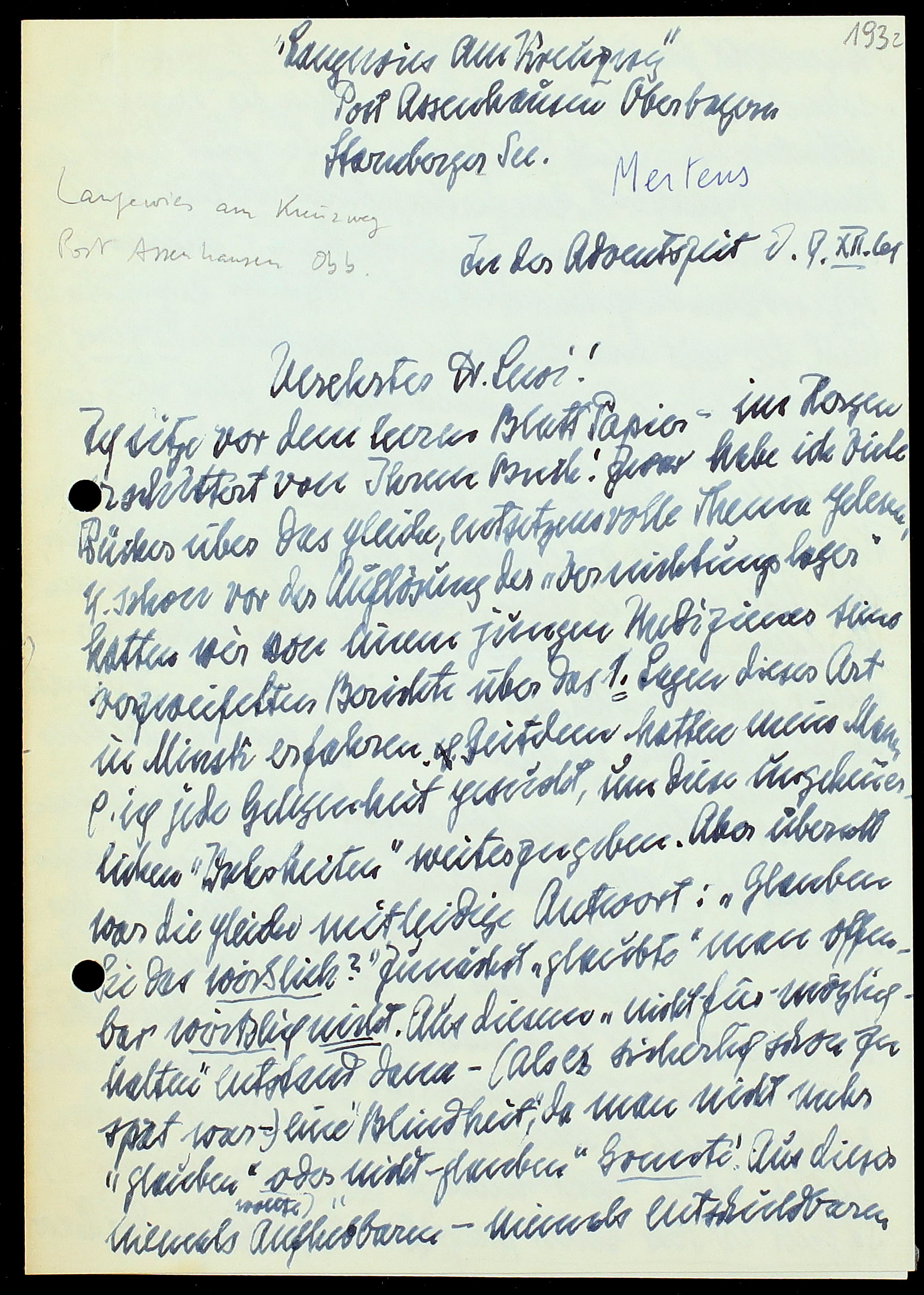
Gertrud Mertens, a correspondent from Bavaria, writes that she was very shocked when she read Ist das ein Mensch? and that, thanks to the testimony of a young officer, she and her husband were aware of the atrocities of the Lager even before the camps were freed.
In der Adventszeit d. 9.XII.61
Langewies am Kreuzweg Post Assenhausen Oberbayern Starnberger See
Verehrter Dr. Levi!
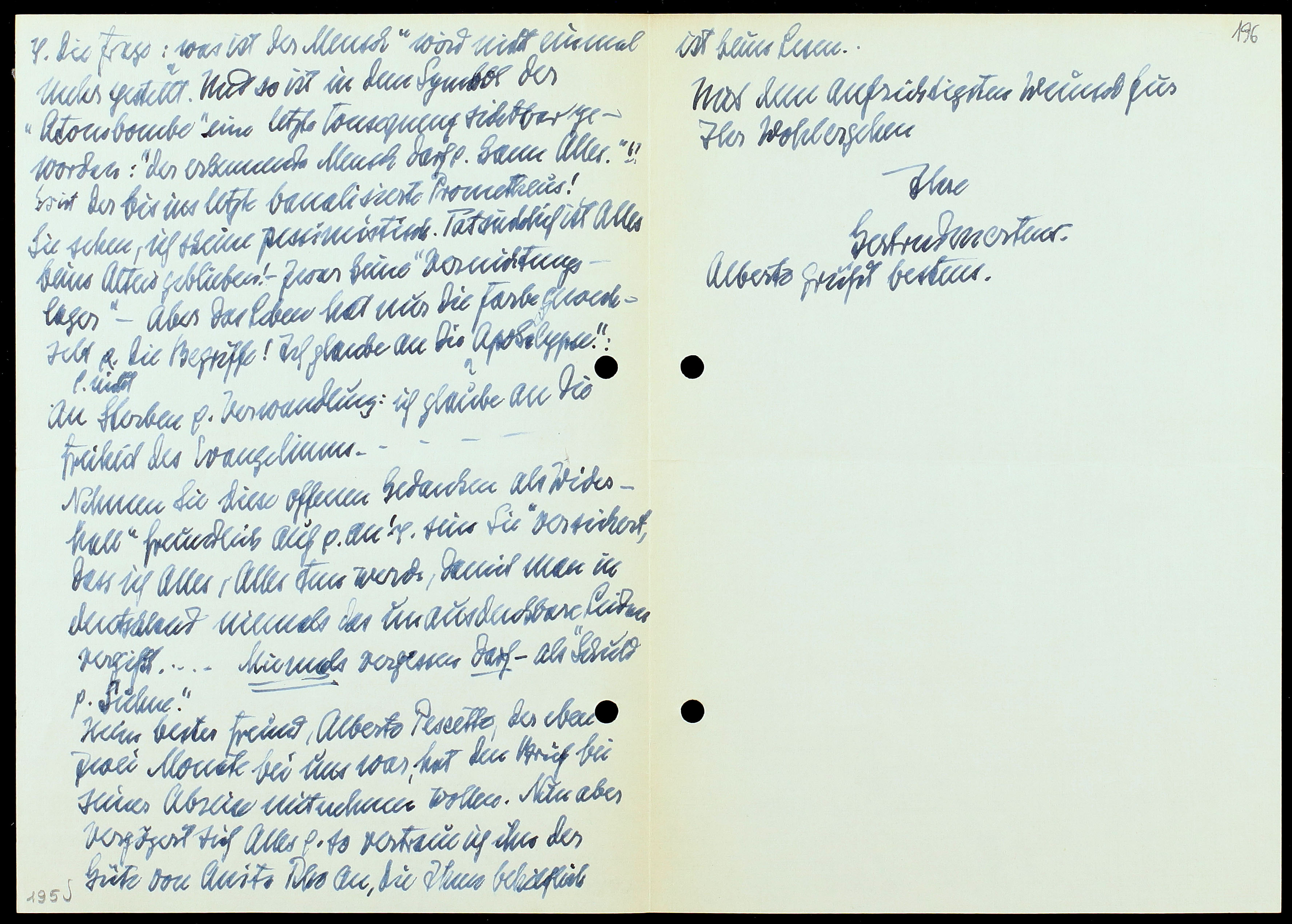
Ich sitze vor dem leeren Blatt Papier – im Herzen erschüttert von Ihrem Buch! Zwar habe ich viele Bücher über das gleiche, entsetzensvolle Thema gelesen, und schon vor der Auflösung der „Vernichtungslager“ hatten wir von einem jungen Mediziner seine verzweifelten Berichte über das 1. Lager dieser Art in Minsk erfahren.[1] Seitdem hatten mein Mann[2] und ich jede Gelegenheit gesucht, um diese ungeheuerlichen „Wahrheiten“ weiterzugeben. Aber überall war die gleiche mitleidige Antwort: „Glauben Sie das wirklich?“ Zunächst „glaubte“ man offenbar wirklich nicht. Aus diesem „nicht-für-möglich-halten“ entstand dann – (Als es sicherlich schon zu spät war –) eine „Blindheit“[3] da man nicht mehr „glauben“ wollte[4] oder „nicht-glauben“ konnte! Aus dieser niemals aufhebbaren – niemals entschuldbaren Ohnmacht zwischen „nichtglauben-können und „schon-müssen“ entstand dann eben der „psychologische“ Selbstbetrug. (?)[5] – Auch diese Zeilen an Sie sind heut wie damals gezeichnet von der Ungeheuerlichkeit des Ausmaßes dieser niemals zu bewältigen – niemals vergessbaren Ungeheuerlichkeit. Trotzdem versuche ich heut, Sie mit dem Maaß des menschlichen Herzens zu erreichen! Meine Ergriffenheit über die ganz spezielle Art Ihrer Aussage läßt mich diese Zeilen wagen. –
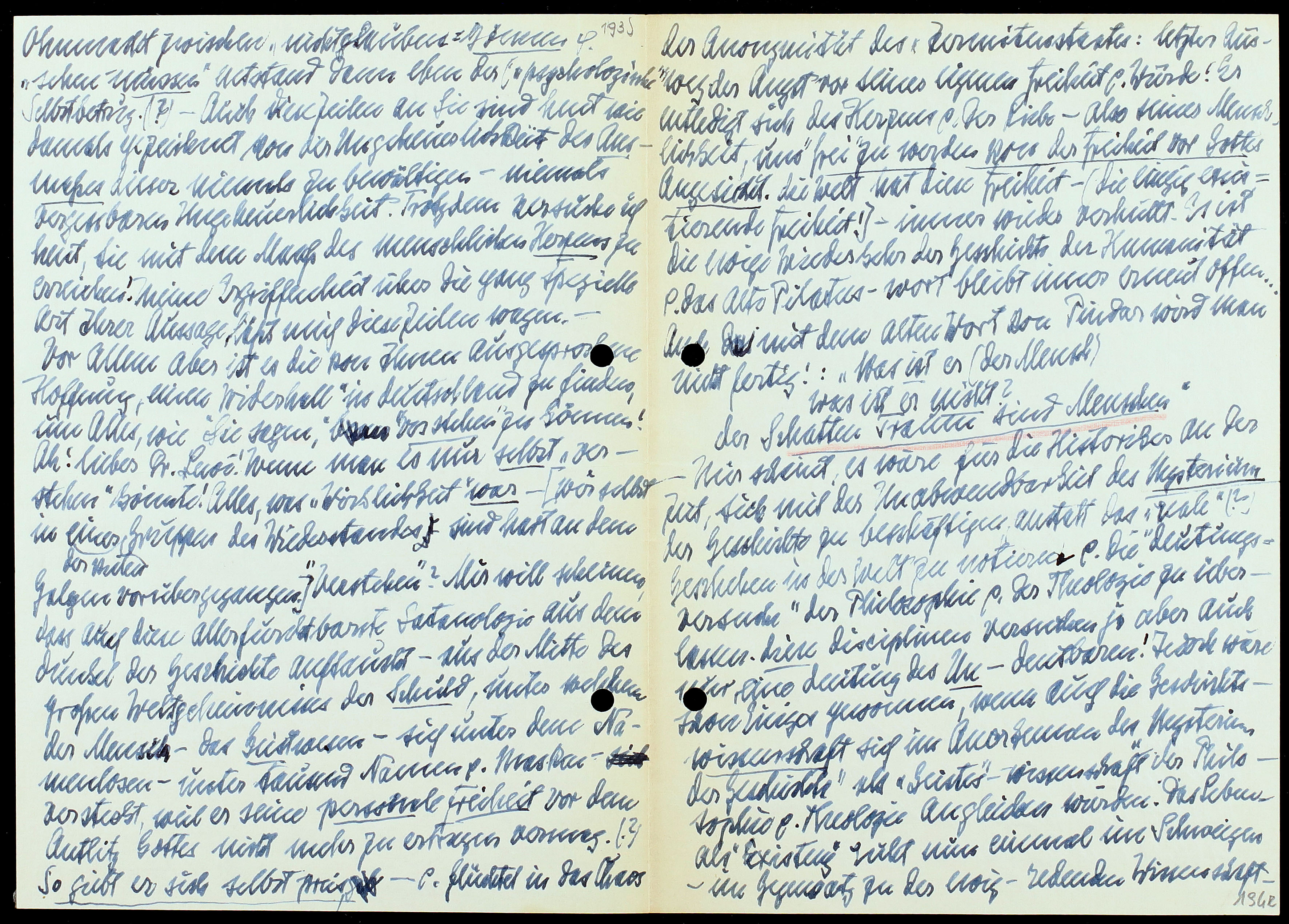
Vor allem aber ist es die von Ihnen ausgesprochene Hoffnung, einen „Widerhall“ in Deutschland zu finden, um Alles, wie Sie sagen, „verstehen“ zu können! Ah! lieber Dr. Levi! Wenn man es nur selbst „verstehen“ könnte! Alles, was „Wirklichkeit“ war – [wir selbst in einer der vielen[6] Gruppen des Widerstandes sind hart an dem Galgen vorübergegangen.][7] „Verstehen“? Mir will scheinen, dass auch diese allerfurchtbarste Satanologie[8] aus dem Dunkel der Geschichte auftaucht – aus der Mitte des Großen Weltgeheimnisses der Schuld, unter welchem der Mensch – das Geistwesen – sich unter dem Namenlosen[9] – unter tausend Namen und Masken – versteckt, weil es seine personaleFreiheit vor dem Antlitz Gottes nicht mehr zu ertragen vermag. (?) So gibt ersich selbst preis, – und flüchtet in das Chaos der Anonymität des Termitenstaates:[10] letzter Ausweg der Angst vor seiner eigenen Freiheit und Würde![11] Er entledigt sich des Herzens und der Liebe – also seiner Menschlichkeit, um „frei“ zu werden von der Freiheit vor Gottes Angesicht. Die Welt hat diese Freiheit – (die einzig existierende Freiheit!] – immer wieder verhüllt. Es ist die ewige Wiederkehr der Geschichte der Humanität und das alte Pilatus-Wort[12] bleibt immer erneut offen … Auch mit dem alten Wort von Pindar wird man nicht fertig!:
“Was ist er (der Mensch) was ist er nicht der Schatten Traum sind Menschen“[13]
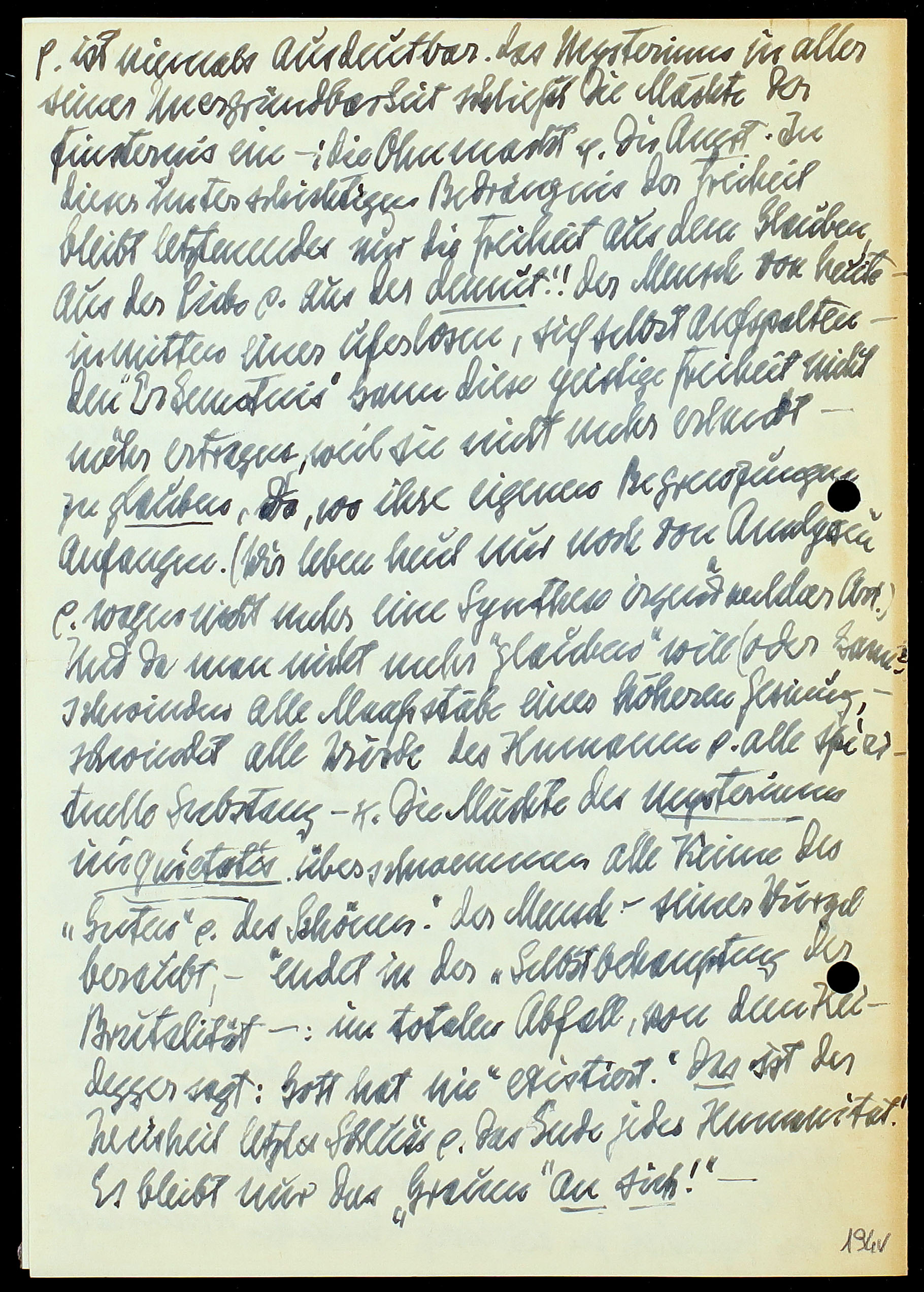
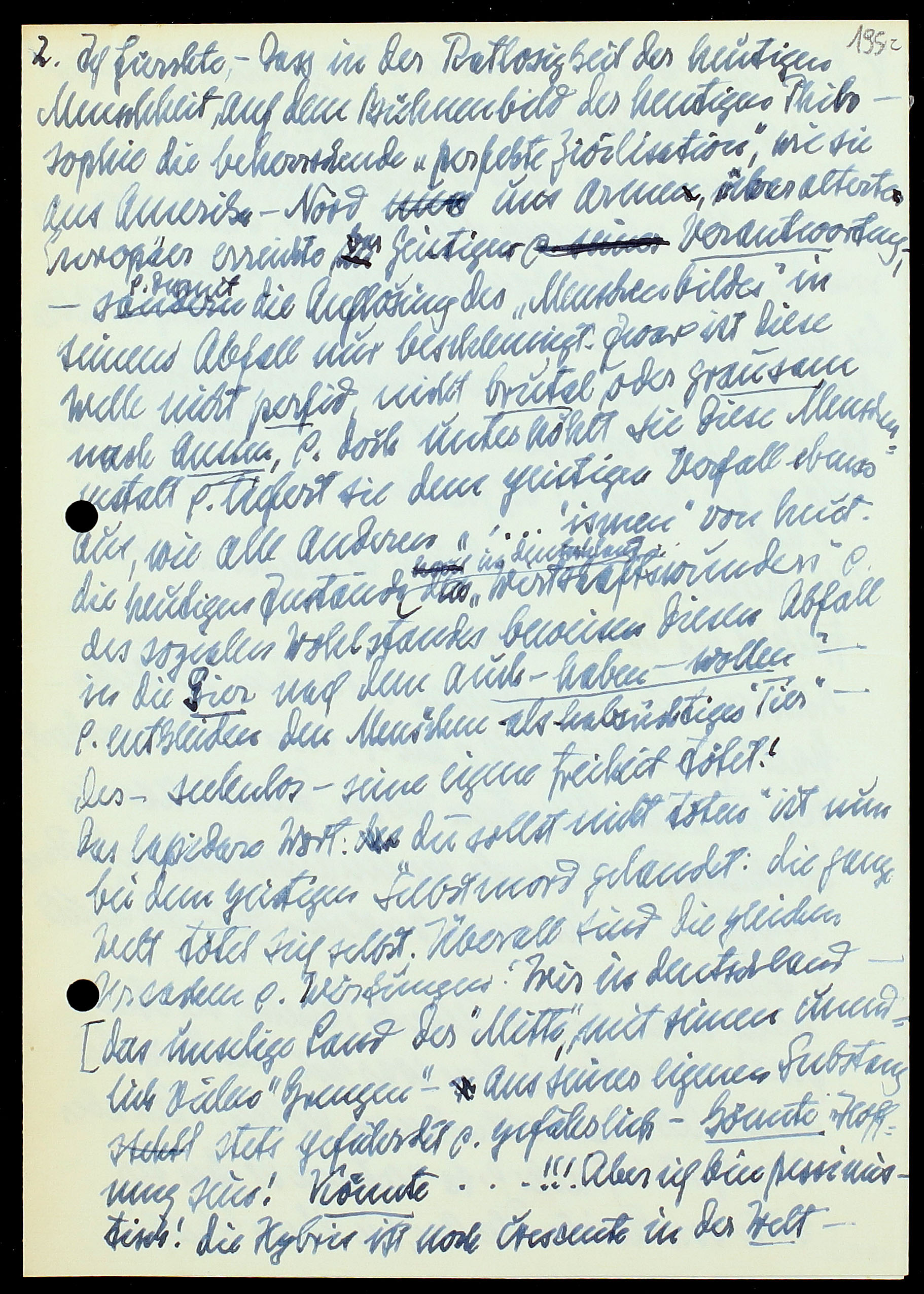
Mir scheint, es wäre für die Historiker an der Zeit, sich mit der Unabwendbarkeit des Mysteriums der Geschichte zu beschäftigen anstatt das „reale“ (?) Geschehen in der Welt zu notieren und die „Deutungsversuche“ der Philosophie und der Theologie zu überlassen. Diese Disciplinen versuchen ja aber auch unter eine Deutung des Un-deutbaren! Jedoch wäre schon Einiges gewonnen, wenn auch die Geschichtswissenschaft sich im Anerkennen des „Mysteriums der Geschichte“ als „Geistes“-wissenschaft der Philosophie und Theologie angleichen würden. Das Leben als „Existenz“ sucht nun einmal im Schweigen – im Gegensatz zu der ewig-redenden Wissenschaft – und ist niemals ausdeutbar. Das Mysterium in aller seiner Unergründbarkeit schließt die Mächte der Finsternis ein –: die Ohnmacht und die Angst. In dieser unterschichtigen Bedrängnis der Freiheit bleibt letztenendes nur die Freiheit aus dem Glauben, aus der Liebe und aus der demut!! der Mensch von heute – inmitten einer uferlosen, sich selbst aufspaltenden „Erkenntnis“ kann diese geistige Freiheit nicht mehr ertragen, weil sie nicht mehr erlaubt zu – glauben, da, wo ihre eigenen Begrenzungen anfangen. (Wir leben heut nur noch von Analysen und wagen nicht mehr eine Synthese irgendwelcher Art.) Und da man nicht mehr „glauben“ will (oder kann?), schwinden alle Maaßstäbe einer höheren Gesinnung, – schwindet alle Würde des Humanen und alle spirituelle Substanz – xxx. Die Mächte des Mysteriums iniquietatis[14] überschwemmen alle Keime des „Guten“ und des „Schönen“. Der Mensch – seiner Wurzel beraubt, -: endet in der „Selbstbehauptung der Brutalität – : im totalen Abfall, von dem Heidegger sagt: Gott hat nie „existiert.“[15]Das ist der Weisheit letzter Schluss und das Ende jeder Humanität! Es bleibt nur das „Grauen“ an sich!“ – 2. Ich fürchte, d – dass in der Ratlosigkeit der heutigen Menschheit, auf dem Bühnenbild der heutigen Philosophie die beherrschende „perfekte Zivilisation“, wie sie aus Amerika-Nord uns arme, überalterte Europäer erreichte, bar geistiger Verantwortung, – und damit die Auflösung des „Menschenbildes“ in seinem Abfall nur beschleunigt. Zwar ist diese Welle nicht perfid, nicht brutal, oder grausam nach Allem, und doch unterhöhlt sie diese Menschengestalt und liefert sie dem geistigen Verfall ebenso aus, wie alle anderen „…‘ismen“ von heut. Die heutigen Zustände in Deutschland,[16]des „Wirtschaftswunders“ und des sozialen Wohlstandes beweisen diesen Abfall in die Gier nach dem auch-haben-wollen – und entkleiden den Menschen als habsüchtiges „Tier“ – das – seelenlos – seine eigene Freiheit tötet!
Das lapidare Wort: „Du sollst nicht töten“ ist nun bei dem geistigen Selbstmord gelandet: die ganze Welt tötet sich selbst. Überall sind die gleichen Ursachen und Wirkungen!
Hier in Deutschland – [das unselige Land der „Mitte“, mit seinen unendliche vielen „Grenzen“ – aus seiner eigenen Substanz stets gefährdet und gefährlich – könnte Hoffnung sein! Könnte …!!! Aber ich bin pessimistisch! Die Hybris ist noch crescente in der Welt – und die Frage: was ist der Mensch“ wird nicht einmal mehr gestellt. Nur so ist in dem Symbol der „Atombombe“ eine letzte Consequenz sichtbar geworden: „Der erkennende Mensch darf und kann alles.“ Er ist der bis ins letzte banalisierte Prometheus![17]
Sie sehen, ich scheine pessimistisch. Tatsächlich ist alles beim Alten geblieben! – Zwar keine „Vernichtungslager“ – aber das Leben hat nur die Farbe gewechselt und nicht die Begriffe! Ich glaube an die Apokalypse!!: an Sterben und Verwandlung[18]: ich glaube an die Freiheit des Evangeliums. – –
Nehmen Sie diese offenen Gedanken als Widerhall „freundlich auf und an und seien Sie“ versichert, dass ich Alles, Alles tun werde, damit man in Deutschland niemals das unausdenkbare Leiden vergisst. – – Niemals vergessen darf – als „Schuld und Sühne“.[19]
Mein bester Freund, Alberto Pescetto, der eben zwei Monate bei uns war, hat den Brief bei seiner Abreise mitnehmen wollen. Nun aber verzögert sich Alles und so vertraue ich ihn der Güte von Anita Rho an, die Ihnen behilflich ist beim Lesen.
Mit dem aufrichtigsten Wunsch für
Ihr Wohlergehen
Ihre
Gertrud Mertens.
Alberto grüßt bestens.
Nel tempo dell’Avvento, il 9.XII.61
Gertrud Mertens Langewies am Kreuzung – Post Assenhausen Obb. Starnberger See
Egregio Dr. Levi!
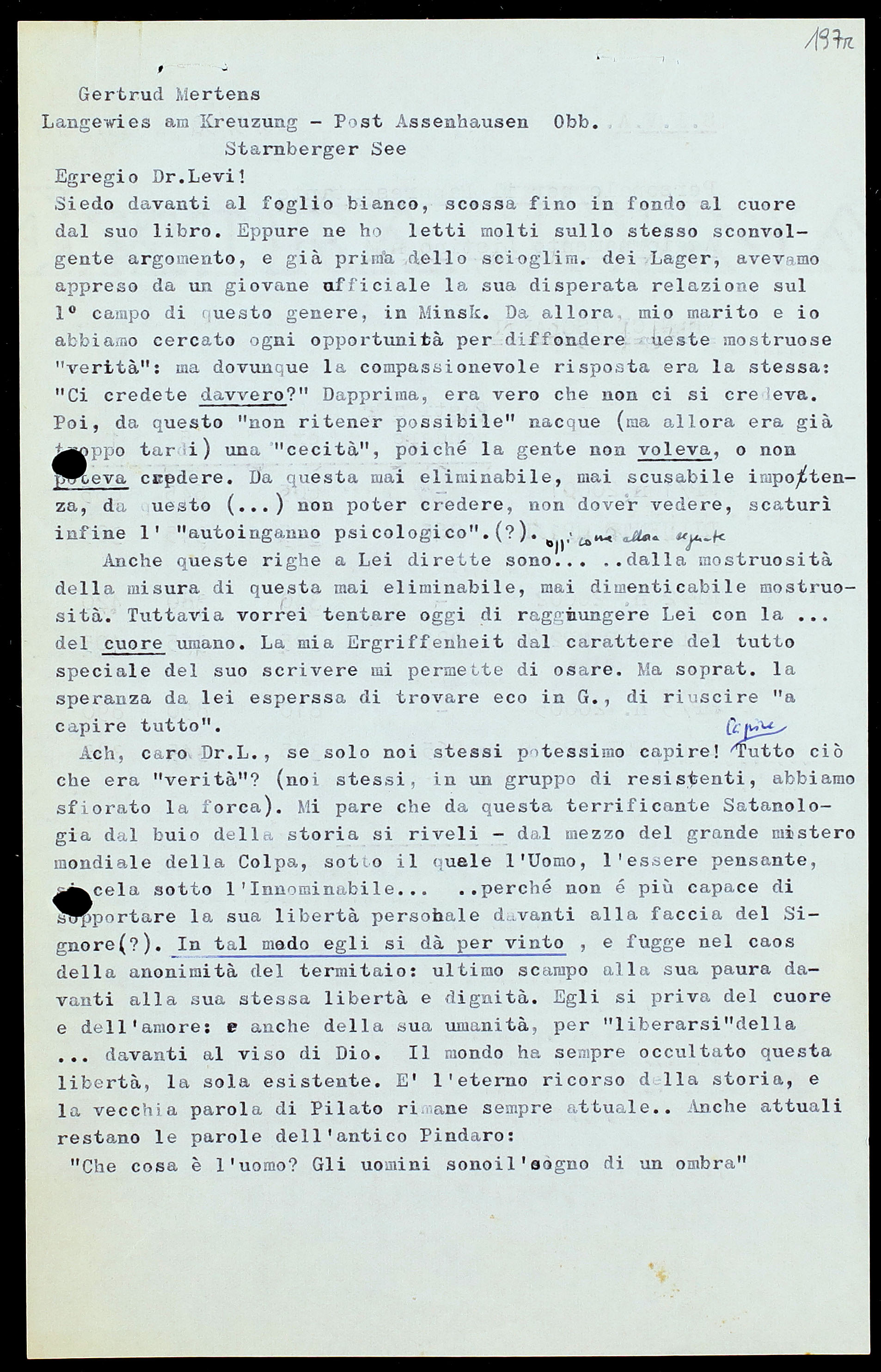
Siedo davanti al foglio bianco, scossa fino in fondo al cuore dal suo libro. Eppure ne ho letti molti sullo stesso sconvolgente argomento, e già prima dello scioglimento dei Lager, avevamo appreso da un giovane ufficiale la sua disperata relazione sul 1° campo di questo genere, in Minsk.[1] Da allora, mio marito[2] e io abbiamo cercato ogni opportunità per diffondere queste mostruose “verità”: ma dovunque la compassionevoleI risposta era la stessa: «Ci credete davvero?» Dapprima, era vero che non ci si credeva. Poi, da questo «non ritener possibile» nacque (ma allora era già troppo tardi) una «cecità»[3], poiché la gente non voleva, o non poteva credere.[4] Da questa mai eliminabile, mai scusabile impotenza, da questo (…) non poter credere, non dover vedere, scaturì infine l’«autoinganno psicologico». (?).[5]
Anche queste righe a Lei dirette sono oggi come alloraII segnate dalla mostruosità della misura di questa mai eliminabile, mai dimenticabile mostruosità. Tuttavia vorrei tentare oggi di raggiungere Lei con la … del cuore umano. La mia ErgriffenheitIII dal carattere del tutto speciale del suo scrivere mi permette di osare. Ma soprattutto la speranza da lei espressa di trovare eco in Germania, di riuscire «a capire tutto».
Ah, caro Dr. Levi, se solo noi stessi potessimo capire! CapireIV tutto ciò che era “verità”? (noi stessi, in un gruppo dei molti [6] di resistenti, abbiamo sfiorato la forca).[7] Mi pare che da questa terrificante Satanologia[8] dal buio della storia si riveli – dal mezzo del grande mistero mondiale della Colpa, sotto il quale l’Uomo, l’essere pensante, si cela sotto l’Innominabile[9]… .. perché non è più capace di sopportare la sua libertà personale davanti alla faccia del Signore(?). In tal modo egli si dà per vinto,V e fugge nel caos della anonimità del termitaio:[10] ultimo scampo alla sua paura davanti alla sua stessa libertà e dignità.[11] Egli si priva del cuore e dell’amore: e anche della sua umanità, per “liberarsi” della … davanti al viso di Dio. Il mondo ha sempre occultato questa libertà, la sola esistente. E’ l’eterno ricorso della storia, e la vecchia parola di Pilato[12] rimane sempre attuale.. Anche attuali restano le parole dell’antico Pindaro:
“Che cosa è l’uomo? Gli uomini sono il sogno di un ombra” [13]
Mi sembra che sia giunto il momento, per gli storici, di confrontarsi con l’ineluttabilità del mistero della storia, invece di continuare a registrare gli accadimenti “reali” (?) nel mondo e lasciare i “tentativi di interpretazione” alla filosofia e alla teologia. Anche queste discipline, del resto, tentano di sottomettere a un’interpretazione l’ininterpretabile! E tuttavia si sarebbe già compiuto un passo importante se anche la storiografia, riconoscendo il “mistero della storia”, si avvicinasse, come scienza dello “spirito”, alla filosofia e alla teologia. La vita, intesa come “esistenza”, cerca nel silenzio – al contrario del parlare incessante della scienza – e non è mai del tutto interpretabile. Il mistero in tutta la sua insondabilità racchiude in sé le forze delle tenebre: l’impotenza e la paura. In questo fondo oscuro in cui la libertà è sotto assedio, alla fine la sola libertà che resta è quella che nasce dalla fede, dall’amore e dall’umiltà!! L’uomo di oggi, immerso in una “conoscenza” sterminata che si auto-disgrega, trova questa libertà interiore intollerabile, poiché non gli consente più di credere là dove la conoscenza incontra il proprio limite. (Oggi viviamo solo di analisi, e non osiamo più nessuna forma di sintesi.) E poiché non si vuole (o non si può?) più “credere”, scompaiono tutti i criteri di una moralità superiore, scompare ogni dignità dell’umano, ogni sostanza spirituale… xxx. Le forze del Mysterium iniquitatis[14] sommergono ogni germoglio di “bene” e di “bellezza”. L’uomo, privato delle sue radici, precipita nella “affermazione brutale di sé”: nel decadimento totale, di cui Heidegger dice: Dio “non è mai esistito”.[15] Ecco il traguardo della sapienza: la fine di ogni umanità! Quel che rimane è solo l’“orrore” in sé stesso. – 2. Temo che, nel disorientamento attuale dell’umanità, sul palcoscenico della filosofia contemporanea, la “civiltà perfetta” dominante, quella che ci è arrivata dagli Stati Uniti, ci abbia colti, poveri europei invecchiati, senza alcun senso di responsabilità spirituale, accelerando così la dissoluzione dell’“immagine dell’uomo” nel suo decadimento. Va detto che, tutto sommato, quest’onda non è perfida, né brutale o crudele. Eppure mina dall’interno la figura dell’uomo, consegnandola al degrado spirituale al pari di tutti gli altri “ismi” contemporanei. Le condizioni attuali della Germania,[16]il cosiddetto “miracolo economico” e il benessere sociale, sono la dimostrazione evidente di quel decadimento nell’avidità dell’anche-io-voglio-avere, e spogliano l’essere umano riducendolo a un “animale” avido, senz’anima, che uccide la propria stessa libertà.
Il lapidario comandamento “non uccidere” è oggi degenerato in suicidio spirituale: il mondo intero uccide sé stesso. Le cause e le conseguenze sono sempre le stesse, ovunque!
Qui in Germania – questa terra infelice del “centro”, con le sue infinite “frontiere”, minacciata e pericolosa nella sua sostanza stessa – potrebbe esserci una speranza. Potrebbe…!!! Ma io sono pessimista! L’hybris è ancora crescente nel mondo – e la domanda “che cos’è l’uomo?” neanche si pone più. Solo così, nel simbolo della “bomba nucleare”, si rivela un’estrema conseguenza: “L’uomo che conosce può e deve fare tutto”. È un Prometeo ridotto alla più assoluta banalità![17]
Come vede, sembro pessimista. Il realtà tutto è rimasto com’era! Certo, non ci sono più “campi di sterminio”, ma la vita ha solo cambiato colore, non significato! Io credo nell’Apocalisse!! Credo nella morte e nella trasformazione.[18] Credo nella libertà del Vangelo.
La prego di accogliere e considerare questi pensieri aperti come un “Widerhall”, un’“eco” delle sue parole. E sia “certo che farò tutto, ma proprio tutto il possibile affinché in Germania non si dimentichi mai l’indicibile sofferenza. Mai si debba dimenticare – come colpa e come espiazione”.[19]
Il mio carissimo amico Alberto Pescetto, che è stato da noi per due mesi, voleva portare con sé questa lettera alla sua partenza. Ma tutto è slittato, e così affido questo scritto alla bontà di Anita Rho che L’aiuterà nella lettura.
Con i miei più sinceri auguri
di ogni bene
Sua
Gertrud Mertens
Alberto manda i suoi migliori saluti
During Advent, December 9, 1961
Langewies am Kreuzweg Post Assenhausen Oberbayern Starnberger See
Dear Mr. Levi!
I sit before this blank sheet of paper—my heart shaken to the core by your book! And yet I have read many books on the same horrific subject, and even before the “extermination camps” were dismantled we had heard desperate reports from a young doctor about the first camp of this kind in Minsk.[1] Ever since, my husband[2] and I had sought every opportunity to pass these monstrous “truths” on to others. But everywhere we went, we received the same compassionate response: “Do you really believe that?” At first, people obviously really did not “believe” it. This “inability to believe” then gave rise—(when it was certainly already too late—) to “blindness”[3] because people no longer wanted to “believe”[4]or were unable to “believe”! This irrevocable, inexcusable powerlessness between “not being able to believe” and “having to believe” then gave rise to “psychological” self-deception. (?)[5]—Even today, these lines to you are marked by the enormity of this never-to-be-overcome—never-to-be-forgotten atrocity. Nevertheless, today I seek to reach you with a measure of the human heart! The depth of my emotion in response to the special nature of what you have written allows me to venture writing these lines.—
Above all, however, it is your expressed hope to find a “resonance” in Germany in order to be able to “understand” everything, as you say! Ah! Dear Mr. Levi! If only one could “understand” it oneself! Everything that was “reality”—[we ourselves, in one of the many[6] resistance groups, passed hard by the gallows.][7] “Understand”? It seems to me that even this most terrible Satanology[8] emerges from the darkness of history—from the midst of the great world mystery of guilt, under which human beings—the mind and spiritual being—hides under the nameless[9]—under a thousand names and masks—because he can no longer bear his personal freedom before the face of God. (?) Thus he betrays himself—and flees into the chaos of anonymity in the ‘Termite state’:[10] the last resort of fear of his own freedom and dignity![11] He rids himself of his heart and love—that is, his humanity—in order to become “free” from the freedom before God. The world has veiled this freedom—(the only freedom that exists!]—over and over. It is the eternal return of the history of humanity, and Pilate’s old words[12] remain, again and again… Even Pindar’s old words cannot be resolved!
“What is he (man)
what is he not
man is but a dream of a shadow”[13]
It seems to me that it is time for historians to deal with the inevitability of the mystery of history instead of merely recording the “real” (?) events in the world and leaving all “attempts at interpretation” to philosophy and theology. But even these disciplines seek to interpret the uninterpretable! Nevertheless, much would be gained if the discipline of history were to align itself with philosophy and theology as a “humanities” discipline in recognizing the “mystery of history.” Life as “existence” seeks silence—in contrast to perpetually talkative science—and can never be interpreted. Mystery, in all its inscrutability, includes the powers of darkness: powerlessness and fear. In this underlying distress of freedom, ultimately only the freedom of faith, love, and humility remains! People today—in the thick of a boundless, self-dividing “knowledge”—can no longer bear this spiritual freedom, because it no longer allows them to believe where their own limitations begin. (Today, we live solely by analysis, and no longer dare to attempt any kind of synthesis.) And since people no longer want to (or can?) “believe,” all standards of higher sentiment disappear, all human dignity and spiritual substance vanish—xxx. The powers of the mystery of iniquity[14] overwhelm all seeds of “the good” and “the beautiful.” Human beings—robbed of their roots—end up in the “self-assertion of brutality”—in total apostasy, of which Heideggersays: God “never existed.”[15]That is the final word of wisdom and the end of all humanity! All that remains is “horror” itself!—2. I fear th—that in the helplessness of today’s humanity, on the stage of today’s philosophy, the dominant “perfect civilization,” as it reached us poor, old, obsolete Europeans from North America, devoid of spiritual responsibility, only accelerates the dissolution of the “image of humanity” in its apostasy. And this wave is not perfidious, brutal, or cruel, after all, yet it undermines the human form and exposes it to spiritual decay just like all the other “-isms” of the present day. The current conditions in Germany,[16] the “economic miracle” and social prosperity, prove this decline into greed for wanting to have it all—and expose human beings as grasping “animals” who—soullessly—kill their own freedom!
The succinct phrase, “Thou shalt not kill,” has ended up in spiritual suicide: the whole world is killing itself. The same causes and effects are everywhere!
Here in Germany—[the ill-fated land of the “middle,” with its countless “borders”—whose own substance renders it perennially endangered and dangerous—there could be hope! Could be…!!! But I am pessimistic! Hubris is still growing in the world—and the question “What is man?” is no longer even asked. Which is precisely how a final consequence has been rendered visible in the symbol of the “atomic bomb”: “The knowing man may and can do anything.” He is an utterly trivialized, banal Prometheus![17]
You see, I seem pessimistic. In fact, everything has remained the same!—There may be no “extermination camps” anymore—but life has merely changed color, not meaning! I believe in the apocalypse!!: in death and transformation:[18] I believe in the freedom of the Gospel.——
Please accept these candid thoughts as a friendly “resonance,” and rest “assured that I will do everything, everything in my power to ensure that people in Germany never forget the unthinkable suffering.——It must never be forgotten—as guilt and atonement.”[19]
My best friend, Alberto Pescetto, who has just spent two months with us, wanted to take the letter with him when he left. But now everything is delayed, so I entrust it to the kindness of Anita Rho, who will help you read it.
With my sincerest wishes for your well-being
Yours,
Gertrud Mertens.
Alberto sends his best regards.
In der Adventszeit d. 9.XII.61
Langewies am Kreuzweg Post Assenhausen Oberbayern Starnberger See
Verehrter Dr. Levi!
Ich sitze vor dem leeren Blatt Papier – im Herzen erschüttert von Ihrem Buch! Zwar habe ich viele Bücher über das gleiche, entsetzensvolle Thema gelesen, und schon vor der Auflösung der „Vernichtungslager“ hatten wir von einem jungen Mediziner seine verzweifelten Berichte über das 1. Lager dieser Art in Minsk erfahren.[1] Seitdem hatten mein Mann[2] und ich jede Gelegenheit gesucht, um diese ungeheuerlichen „Wahrheiten“ weiterzugeben. Aber überall war die gleiche mitleidige Antwort: „Glauben Sie das wirklich?“ Zunächst „glaubte“ man offenbar wirklich nicht. Aus diesem „nicht-für-möglich-halten“ entstand dann – (Als es sicherlich schon zu spät war –) eine „Blindheit“[3] da man nicht mehr „glauben“ wollte[4] oder „nicht-glauben“ konnte! Aus dieser niemals aufhebbaren – niemals entschuldbaren Ohnmacht zwischen „nichtglauben-können und „schon-müssen“ entstand dann eben der „psychologische“ Selbstbetrug. (?)[5] – Auch diese Zeilen an Sie sind heut wie damals gezeichnet von der Ungeheuerlichkeit des Ausmaßes dieser niemals zu bewältigen – niemals vergessbaren Ungeheuerlichkeit. Trotzdem versuche ich heut, Sie mit dem Maaß des menschlichen Herzens zu erreichen! Meine Ergriffenheit über die ganz spezielle Art Ihrer Aussage läßt mich diese Zeilen wagen. –
Vor allem aber ist es die von Ihnen ausgesprochene Hoffnung, einen „Widerhall“ in Deutschland zu finden, um Alles, wie Sie sagen, „verstehen“ zu können! Ah! lieber Dr. Levi! Wenn man es nur selbst „verstehen“ könnte! Alles, was „Wirklichkeit“ war – [wir selbst in einer der vielen[6] Gruppen des Widerstandes sind hart an dem Galgen vorübergegangen.][7] „Verstehen“? Mir will scheinen, dass auch diese allerfurchtbarste Satanologie[8] aus dem Dunkel der Geschichte auftaucht – aus der Mitte des Großen Weltgeheimnisses der Schuld, unter welchem der Mensch – das Geistwesen – sich unter dem Namenlosen[9] – unter tausend Namen und Masken – versteckt, weil es seine personaleFreiheit vor dem Antlitz Gottes nicht mehr zu ertragen vermag. (?) So gibt ersich selbst preis, – und flüchtet in das Chaos der Anonymität des Termitenstaates:[10] letzter Ausweg der Angst vor seiner eigenen Freiheit und Würde![11] Er entledigt sich des Herzens und der Liebe – also seiner Menschlichkeit, um „frei“ zu werden von der Freiheit vor Gottes Angesicht. Die Welt hat diese Freiheit – (die einzig existierende Freiheit!] – immer wieder verhüllt. Es ist die ewige Wiederkehr der Geschichte der Humanität und das alte Pilatus-Wort[12] bleibt immer erneut offen … Auch mit dem alten Wort von Pindar wird man nicht fertig!:
“Was ist er (der Mensch) was ist er nicht der Schatten Traum sind Menschen“[13]
Mir scheint, es wäre für die Historiker an der Zeit, sich mit der Unabwendbarkeit des Mysteriums der Geschichte zu beschäftigen anstatt das „reale“ (?) Geschehen in der Welt zu notieren und die „Deutungsversuche“ der Philosophie und der Theologie zu überlassen. Diese Disciplinen versuchen ja aber auch unter eine Deutung des Un-deutbaren! Jedoch wäre schon Einiges gewonnen, wenn auch die Geschichtswissenschaft sich im Anerkennen des „Mysteriums der Geschichte“ als „Geistes“-wissenschaft der Philosophie und Theologie angleichen würden. Das Leben als „Existenz“ sucht nun einmal im Schweigen – im Gegensatz zu der ewig-redenden Wissenschaft – und ist niemals ausdeutbar. Das Mysterium in aller seiner Unergründbarkeit schließt die Mächte der Finsternis ein –: die Ohnmacht und die Angst. In dieser unterschichtigen Bedrängnis der Freiheit bleibt letztenendes nur die Freiheit aus dem Glauben, aus der Liebe und aus der demut!! der Mensch von heute – inmitten einer uferlosen, sich selbst aufspaltenden „Erkenntnis“ kann diese geistige Freiheit nicht mehr ertragen, weil sie nicht mehr erlaubt zu – glauben, da, wo ihre eigenen Begrenzungen anfangen. (Wir leben heut nur noch von Analysen und wagen nicht mehr eine Synthese irgendwelcher Art.) Und da man nicht mehr „glauben“ will (oder kann?), schwinden alle Maaßstäbe einer höheren Gesinnung, – schwindet alle Würde des Humanen und alle spirituelle Substanz – xxx. Die Mächte des Mysteriums iniquietatis[14] überschwemmen alle Keime des „Guten“ und des „Schönen“. Der Mensch – seiner Wurzel beraubt, -: endet in der „Selbstbehauptung der Brutalität – : im totalen Abfall, von dem Heidegger sagt: Gott hat nie „existiert.“[15]Das ist der Weisheit letzter Schluss und das Ende jeder Humanität! Es bleibt nur das „Grauen“ an sich!“ – 2. Ich fürchte, d – dass in der Ratlosigkeit der heutigen Menschheit, auf dem Bühnenbild der heutigen Philosophie die beherrschende „perfekte Zivilisation“, wie sie aus Amerika-Nord uns arme, überalterte Europäer erreichte, bar geistiger Verantwortung, – und damit die Auflösung des „Menschenbildes“ in seinem Abfall nur beschleunigt. Zwar ist diese Welle nicht perfid, nicht brutal, oder grausam nach Allem, und doch unterhöhlt sie diese Menschengestalt und liefert sie dem geistigen Verfall ebenso aus, wie alle anderen „…‘ismen“ von heut. Die heutigen Zustände in Deutschland,[16]des „Wirtschaftswunders“ und des sozialen Wohlstandes beweisen diesen Abfall in die Gier nach dem auch-haben-wollen – und entkleiden den Menschen als habsüchtiges „Tier“ – das – seelenlos – seine eigene Freiheit tötet!
Das lapidare Wort: „Du sollst nicht töten“ ist nun bei dem geistigen Selbstmord gelandet: die ganze Welt tötet sich selbst. Überall sind die gleichen Ursachen und Wirkungen!
Hier in Deutschland – [das unselige Land der „Mitte“, mit seinen unendliche vielen „Grenzen“ – aus seiner eigenen Substanz stets gefährdet und gefährlich – könnte Hoffnung sein! Könnte …!!! Aber ich bin pessimistisch! Die Hybris ist noch crescente in der Welt – und die Frage: was ist der Mensch“ wird nicht einmal mehr gestellt. Nur so ist in dem Symbol der „Atombombe“ eine letzte Consequenz sichtbar geworden: „Der erkennende Mensch darf und kann alles.“ Er ist der bis ins letzte banalisierte Prometheus![17]
Sie sehen, ich scheine pessimistisch. Tatsächlich ist alles beim Alten geblieben! – Zwar keine „Vernichtungslager“ – aber das Leben hat nur die Farbe gewechselt und nicht die Begriffe! Ich glaube an die Apokalypse!!: an Sterben und Verwandlung[18]: ich glaube an die Freiheit des Evangeliums. – –
Nehmen Sie diese offenen Gedanken als Widerhall „freundlich auf und an und seien Sie“ versichert, dass ich Alles, Alles tun werde, damit man in Deutschland niemals das unausdenkbare Leiden vergisst. – – Niemals vergessen darf – als „Schuld und Sühne“.[19]
Mein bester Freund, Alberto Pescetto, der eben zwei Monate bei uns war, hat den Brief bei seiner Abreise mitnehmen wollen. Nun aber verzögert sich Alles und so vertraue ich ihn der Güte von Anita Rho an, die Ihnen behilflich ist beim Lesen.
Mit dem aufrichtigsten Wunsch für
Ihr Wohlergehen
Ihre
Gertrud Mertens.
Alberto grüßt bestens.
Nel tempo dell’Avvento, il 9.XII.61
Gertrud Mertens Langewies am Kreuzung – Post Assenhausen Obb. Starnberger See
Egregio Dr. Levi!
Siedo davanti al foglio bianco, scossa fino in fondo al cuore dal suo libro. Eppure ne ho letti molti sullo stesso sconvolgente argomento, e già prima dello scioglimento dei Lager, avevamo appreso da un giovane ufficiale la sua disperata relazione sul 1° campo di questo genere, in Minsk.[1] Da allora, mio marito[2] e io abbiamo cercato ogni opportunità per diffondere queste mostruose “verità”: ma dovunque la compassionevoleI risposta era la stessa: «Ci credete davvero?» Dapprima, era vero che non ci si credeva. Poi, da questo «non ritener possibile» nacque (ma allora era già troppo tardi) una «cecità»[3], poiché la gente non voleva, o non poteva credere.[4] Da questa mai eliminabile, mai scusabile impotenza, da questo (…) non poter credere, non dover vedere, scaturì infine l’«autoinganno psicologico». (?).[5]
Anche queste righe a Lei dirette sono oggi come alloraII segnate dalla mostruosità della misura di questa mai eliminabile, mai dimenticabile mostruosità. Tuttavia vorrei tentare oggi di raggiungere Lei con la … del cuore umano. La mia ErgriffenheitIII dal carattere del tutto speciale del suo scrivere mi permette di osare. Ma soprattutto la speranza da lei espressa di trovare eco in Germania, di riuscire «a capire tutto».
Ah, caro Dr. Levi, se solo noi stessi potessimo capire! CapireIV tutto ciò che era “verità”? (noi stessi, in un gruppo dei molti [6] di resistenti, abbiamo sfiorato la forca).[7] Mi pare che da questa terrificante Satanologia[8] dal buio della storia si riveli – dal mezzo del grande mistero mondiale della Colpa, sotto il quale l’Uomo, l’essere pensante, si cela sotto l’Innominabile[9]… .. perché non è più capace di sopportare la sua libertà personale davanti alla faccia del Signore(?). In tal modo egli si dà per vinto,V e fugge nel caos della anonimità del termitaio:[10] ultimo scampo alla sua paura davanti alla sua stessa libertà e dignità.[11] Egli si priva del cuore e dell’amore: e anche della sua umanità, per “liberarsi” della … davanti al viso di Dio. Il mondo ha sempre occultato questa libertà, la sola esistente. E’ l’eterno ricorso della storia, e la vecchia parola di Pilato[12] rimane sempre attuale.. Anche attuali restano le parole dell’antico Pindaro:
“Che cosa è l’uomo? Gli uomini sono il sogno di un ombra” [13]
Mi sembra che sia giunto il momento, per gli storici, di confrontarsi con l’ineluttabilità del mistero della storia, invece di continuare a registrare gli accadimenti “reali” (?) nel mondo e lasciare i “tentativi di interpretazione” alla filosofia e alla teologia. Anche queste discipline, del resto, tentano di sottomettere a un’interpretazione l’ininterpretabile! E tuttavia si sarebbe già compiuto un passo importante se anche la storiografia, riconoscendo il “mistero della storia”, si avvicinasse, come scienza dello “spirito”, alla filosofia e alla teologia. La vita, intesa come “esistenza”, cerca nel silenzio – al contrario del parlare incessante della scienza – e non è mai del tutto interpretabile. Il mistero in tutta la sua insondabilità racchiude in sé le forze delle tenebre: l’impotenza e la paura. In questo fondo oscuro in cui la libertà è sotto assedio, alla fine la sola libertà che resta è quella che nasce dalla fede, dall’amore e dall’umiltà!! L’uomo di oggi, immerso in una “conoscenza” sterminata che si auto-disgrega, trova questa libertà interiore intollerabile, poiché non gli consente più di credere là dove la conoscenza incontra il proprio limite. (Oggi viviamo solo di analisi, e non osiamo più nessuna forma di sintesi.) E poiché non si vuole (o non si può?) più “credere”, scompaiono tutti i criteri di una moralità superiore, scompare ogni dignità dell’umano, ogni sostanza spirituale… xxx. Le forze del Mysterium iniquitatis[14] sommergono ogni germoglio di “bene” e di “bellezza”. L’uomo, privato delle sue radici, precipita nella “affermazione brutale di sé”: nel decadimento totale, di cui Heidegger dice: Dio “non è mai esistito”.[15] Ecco il traguardo della sapienza: la fine di ogni umanità! Quel che rimane è solo l’“orrore” in sé stesso. – 2. Temo che, nel disorientamento attuale dell’umanità, sul palcoscenico della filosofia contemporanea, la “civiltà perfetta” dominante, quella che ci è arrivata dagli Stati Uniti, ci abbia colti, poveri europei invecchiati, senza alcun senso di responsabilità spirituale, accelerando così la dissoluzione dell’“immagine dell’uomo” nel suo decadimento. Va detto che, tutto sommato, quest’onda non è perfida, né brutale o crudele. Eppure mina dall’interno la figura dell’uomo, consegnandola al degrado spirituale al pari di tutti gli altri “ismi” contemporanei. Le condizioni attuali della Germania,[16]il cosiddetto “miracolo economico” e il benessere sociale, sono la dimostrazione evidente di quel decadimento nell’avidità dell’anche-io-voglio-avere, e spogliano l’essere umano riducendolo a un “animale” avido, senz’anima, che uccide la propria stessa libertà.
Il lapidario comandamento “non uccidere” è oggi degenerato in suicidio spirituale: il mondo intero uccide sé stesso. Le cause e le conseguenze sono sempre le stesse, ovunque!
Qui in Germania – questa terra infelice del “centro”, con le sue infinite “frontiere”, minacciata e pericolosa nella sua sostanza stessa – potrebbe esserci una speranza. Potrebbe…!!! Ma io sono pessimista! L’hybris è ancora crescente nel mondo – e la domanda “che cos’è l’uomo?” neanche si pone più. Solo così, nel simbolo della “bomba nucleare”, si rivela un’estrema conseguenza: “L’uomo che conosce può e deve fare tutto”. È un Prometeo ridotto alla più assoluta banalità![17]
Come vede, sembro pessimista. Il realtà tutto è rimasto com’era! Certo, non ci sono più “campi di sterminio”, ma la vita ha solo cambiato colore, non significato! Io credo nell’Apocalisse!! Credo nella morte e nella trasformazione.[18] Credo nella libertà del Vangelo.
La prego di accogliere e considerare questi pensieri aperti come un “Widerhall”, un’“eco” delle sue parole. E sia “certo che farò tutto, ma proprio tutto il possibile affinché in Germania non si dimentichi mai l’indicibile sofferenza. Mai si debba dimenticare – come colpa e come espiazione”.[19]
Il mio carissimo amico Alberto Pescetto, che è stato da noi per due mesi, voleva portare con sé questa lettera alla sua partenza. Ma tutto è slittato, e così affido questo scritto alla bontà di Anita Rho che L’aiuterà nella lettura.
Con i miei più sinceri auguri
di ogni bene
Sua
Gertrud Mertens
Alberto manda i suoi migliori saluti
During Advent, December 9, 1961
Langewies am Kreuzweg Post Assenhausen Oberbayern Starnberger See
Dear Mr. Levi!
I sit before this blank sheet of paper—my heart shaken to the core by your book! And yet I have read many books on the same horrific subject, and even before the “extermination camps” were dismantled we had heard desperate reports from a young doctor about the first camp of this kind in Minsk.[1] Ever since, my husband[2] and I had sought every opportunity to pass these monstrous “truths” on to others. But everywhere we went, we received the same compassionate response: “Do you really believe that?” At first, people obviously really did not “believe” it. This “inability to believe” then gave rise—(when it was certainly already too late—) to “blindness”[3] because people no longer wanted to “believe”[4]or were unable to “believe”! This irrevocable, inexcusable powerlessness between “not being able to believe” and “having to believe” then gave rise to “psychological” self-deception. (?)[5]—Even today, these lines to you are marked by the enormity of this never-to-be-overcome—never-to-be-forgotten atrocity. Nevertheless, today I seek to reach you with a measure of the human heart! The depth of my emotion in response to the special nature of what you have written allows me to venture writing these lines.—
Above all, however, it is your expressed hope to find a “resonance” in Germany in order to be able to “understand” everything, as you say! Ah! Dear Mr. Levi! If only one could “understand” it oneself! Everything that was “reality”—[we ourselves, in one of the many[6] resistance groups, passed hard by the gallows.][7] “Understand”? It seems to me that even this most terrible Satanology[8] emerges from the darkness of history—from the midst of the great world mystery of guilt, under which human beings—the mind and spiritual being—hides under the nameless[9]—under a thousand names and masks—because he can no longer bear his personal freedom before the face of God. (?) Thus he betrays himself—and flees into the chaos of anonymity in the ‘Termite state’:[10] the last resort of fear of his own freedom and dignity![11] He rids himself of his heart and love—that is, his humanity—in order to become “free” from the freedom before God. The world has veiled this freedom—(the only freedom that exists!]—over and over. It is the eternal return of the history of humanity, and Pilate’s old words[12] remain, again and again… Even Pindar’s old words cannot be resolved!
“What is he (man)
what is he not
man is but a dream of a shadow”[13]
It seems to me that it is time for historians to deal with the inevitability of the mystery of history instead of merely recording the “real” (?) events in the world and leaving all “attempts at interpretation” to philosophy and theology. But even these disciplines seek to interpret the uninterpretable! Nevertheless, much would be gained if the discipline of history were to align itself with philosophy and theology as a “humanities” discipline in recognizing the “mystery of history.” Life as “existence” seeks silence—in contrast to perpetually talkative science—and can never be interpreted. Mystery, in all its inscrutability, includes the powers of darkness: powerlessness and fear. In this underlying distress of freedom, ultimately only the freedom of faith, love, and humility remains! People today—in the thick of a boundless, self-dividing “knowledge”—can no longer bear this spiritual freedom, because it no longer allows them to believe where their own limitations begin. (Today, we live solely by analysis, and no longer dare to attempt any kind of synthesis.) And since people no longer want to (or can?) “believe,” all standards of higher sentiment disappear, all human dignity and spiritual substance vanish—xxx. The powers of the mystery of iniquity[14] overwhelm all seeds of “the good” and “the beautiful.” Human beings—robbed of their roots—end up in the “self-assertion of brutality”—in total apostasy, of which Heideggersays: God “never existed.”[15]That is the final word of wisdom and the end of all humanity! All that remains is “horror” itself!—2. I fear th—that in the helplessness of today’s humanity, on the stage of today’s philosophy, the dominant “perfect civilization,” as it reached us poor, old, obsolete Europeans from North America, devoid of spiritual responsibility, only accelerates the dissolution of the “image of humanity” in its apostasy. And this wave is not perfidious, brutal, or cruel, after all, yet it undermines the human form and exposes it to spiritual decay just like all the other “-isms” of the present day. The current conditions in Germany,[16] the “economic miracle” and social prosperity, prove this decline into greed for wanting to have it all—and expose human beings as grasping “animals” who—soullessly—kill their own freedom!
The succinct phrase, “Thou shalt not kill,” has ended up in spiritual suicide: the whole world is killing itself. The same causes and effects are everywhere!
Here in Germany—[the ill-fated land of the “middle,” with its countless “borders”—whose own substance renders it perennially endangered and dangerous—there could be hope! Could be…!!! But I am pessimistic! Hubris is still growing in the world—and the question “What is man?” is no longer even asked. Which is precisely how a final consequence has been rendered visible in the symbol of the “atomic bomb”: “The knowing man may and can do anything.” He is an utterly trivialized, banal Prometheus![17]
You see, I seem pessimistic. In fact, everything has remained the same!—There may be no “extermination camps” anymore—but life has merely changed color, not meaning! I believe in the apocalypse!!: in death and transformation:[18] I believe in the freedom of the Gospel.——
Please accept these candid thoughts as a friendly “resonance,” and rest “assured that I will do everything, everything in my power to ensure that people in Germany never forget the unthinkable suffering.——It must never be forgotten—as guilt and atonement.”[19]
My best friend, Alberto Pescetto, who has just spent two months with us, wanted to take the letter with him when he left. But now everything is delayed, so I entrust it to the kindness of Anita Rho, who will help you read it.
With my sincerest wishes for your well-being
Yours,
Gertrud Mertens.
Alberto sends his best regards.
Info
Notes
Tag
Sender: Gertrud Körber-Mertens
Addressee: Primo Levi
Date of Drafting: 1961-12-09
Place of Writing: Lake Starnberg
Description:handwritten letter in blue fountain pen on white A4 paper (mm295x210 folded). Under the letterhead, Levi has added two handwritten insertions: to the right, “Langewies am Kreuzweg | Post Assenhausen Obb.” is written by hand in pencil and to the left, “Mertens” is written by hand in blue ballpoint pen. Levi’s translation (f. 197) is typed on recovered paper with handwritten insertions in blue ballpoint pen and black fountain pen; the back of sheet 197 is an updated price list of SIVA insulating paints dated 28/05/58 (mm156x246).
Archive: Archivio privato di Primo Levi, Turin
Series: Complesso di fondi Primo Levi, Fondo Primo Levi, Corrispondenza, Corrispondenti particolari, Fasc.020, sottofasc. 001, doc. doc. 67, ff. 193r/v, 194r/v, 195r/v, 196, 197r/v (trad.)
Folio: 3, recto e verso, 2 solo recto
DOI:
1The reference is to the concentration camp at Maly Trostenets (Minsk).
3Matthew 13:14-15: “In them is fulfilled the prophecy of Isaiah: You will be ever hearing but never understanding; you will be ever seeing but never perceiving. For this people’s heart has become calloused; they hardly hear with their ears, and they have closed their eyes. Otherwise they might see with their eyes, hear with their ears, understand with their hearts and turn, and I would heal them.” In the chapter “The Drowned and the Saved” in If This Is a Man, Primo Levi quotes the verse that directly precedes it (Matthew 13:12). “In history and in life one sometimes seems to glimpse a fierce law that states: ‘To he who has, it will be given; from he who has not, it will be taken away’” (CW I, p. 84).
4
“wollte” was inserted by means of a wavy line below the text.
5HereMertens paraphrases a passage from the chapter “Moral Guilt” [“Die moralische Schuld”] from the 1946 book The Question of German Guilt [Die Schuldfrage]by Karl Jaspers.Writes Jaspers: “Impotent submission always left a margin of activity which, though not without risk, could still be cautiously effective. Its anxious omission weighs upon the individual as moral guilt. Blindness [Blindheit] for the misfortune of others, lack of the imagination of the heart, inner indifference toward the witnessed evil – that is moral guilt,” cf. K. Jaspers, The Question of German Guilt, New York: Dial Press, 1947, pp. 63-64. A few lines above, Jaspers also deals with the topic of psychological self-deception: “Many engaged in convenient self-deception [Selbsttäuschung]. In due time they were going to change this evil government. The Party would disappear again, with the Fuehrer’s death at the latest. For the present one had to belong, to right things from within” (p. 61).
6
“der vielen” was inserted by means of a wavy line beneath the text.
7Mertens is alluding to the death sentence by guillotine for members of the White Rose, a resistance group in Munich whose actions were delineated in June 1942 during two literary soirées Gertrud Mertens organized at her apartment in Munich. Cf. the relative biography. Levi referred to the “group of religious believers” of the White Rose in a 1978 interview with Marco Viglino (OC III, p. 920). He alluded to this episode of German resistance again in his conversation with Ferdinando Camon, which took place between 1982 and 1986 (OC III, p. 833). By the time Mertens’ letter was received in 1961, the Italian translation of Inge Scholl’s The White Rose, published by La Nuova Italia in 1959, was already available. The book appeared in the “Biblioteca Leone Ginzburg” series, the same in which De Silva (acquired by La Nuova Italia in 1948) had published If This Is a Man in 1947.
8In The Question of German Guilt, Jaspers defines Nazism as Teufelei (“devilry”) or as a teuflische Organisation “diabolical organization,” cf. K. Jaspers The Question of German Guilt, New York: Dial Press, 1947, p. 97. In these pages, Jaspers borrows the adjective “satanic” from the book published in 1945 by the economist Wilhelm Röpke, Die Deutsche Frage (The German Question). Levi refers to these passages in Jaspers’ The Question of German Guilt in his article “Testimonianza per Eichmann,” published in the magazine Il Ponte in April 1961 (OC II, pp. 1314-15).
9The reference here is to Exodus 3:13-14. “Then Moses said to God, ‘If I come to the people of Israel and say to them, ‘The God of your fathers has sent me to you,’ and they ask me, ‘What is his name?’ what shall I say to them?’God said to Moses, ‘I Am who I Am.’ And he said, ‘Say this to the people of Israel: ‘I Am has sent me to you.’” The Unnamable God of Exodus 3:14 is the foundation of negative theology. In the Germanic area, the most influential elaboration was by Meister Eckhart, a 14th-century theologian and mystic whose opus would become the source of inspiration for late 19th-century and 20th-century reflections on the total otherness of God and the limits of affirmative power of human reasoning. This tradition found expression in thinkers such as Schelling, Schopenhauer, Kierkegaard, Karl Barth, Erich Przywara, and Martin Heidegger, all authors who formed the semantic and conceptual horizon of Gertrud Mertens’ letter.
10“Termite state” [Termitenstaat] is a phrase that reveals the commingling of biology and sociology that was typical of political thought during the late 1800s and early 1900s. Used in a polemical key to denounce the oppression and depersonalization of hyper-organized societies, the term was widely used in dystopic literature, such as Empire of the Ants (1905) by H.G. Wells and Brave New World (1932)by Aldous Huxley. The image of the termite state can also be found in criticism of modern society formulated by the movement Renouveau catholique, a cultural horizon of reference for the intellectual education of Gertrud Mertens. Cf. the topic of “religious renewal” [religiöse Erneuerung] in the relative biography.
11Mertens is alluding to the “The Grand Inquisitor” in The Brothers Karamazov by Dostoevski. Standing before the silent and imprisoned Christ, the Inquisitor says, “Hadst Thou accepted [the sword of Caesar], Thou wouldst have accomplished all that man seeks on earth—that is, someone to worship, someone to keep his conscience, and some means of uniting all in one unanimous and harmonious ant-heap, for the craving for universal unity is the third and last anguish of men,” cf. F. Dostoevski, The Brothers Karamazov, Chicago London Toronto Geneva Sydney Tokyo Manila: William Benton, 1952, p. 133.
12John 18:37-38. “Then Pilate said to him, ‘So you are a king?’ Jesus answered, ‘You say that I am a king. For this purpose I was born and for this purpose I have come into the world—to bear witness to the truth. Everyone who is of the truth listens to my voice.’ Pilate said to him, ‘What is truth?’”.
13“Schatten Traum sind Menschen” is underlined by Mertens, and also by Levi in red pencil.
14Paul in his second letter to the Thessalonians regarding the coming of the Antichrist: “For the secret power of lawlessness is already at work; but the one who now holds it back will continue to do so till he is taken out of the way. And then the lawless one will be revealed, whom the Lord Jesus will overthrow with the breath of his mouth and destroy by the splendor of his coming. The coming of the lawless one will be in accordance with how Satan works. He will use all sorts of displays of power through signs and wonders that serve the lie, and all the ways that wickedness deceives those who are perishing. They perish because they refused to love the truth and so be saved” (2 Thessalonians 2:7-10).
15To quote Heidegger in his famous inaugural address as rector in 1933 (Selbstbehauptung der deutschen Universität): “And if our most authentic existence itself stands before a great transformation, and if it is true what that passionate seeker of God and last German philosopher, Friedrich Nietzsche, said: ‘God is dead’ – and if we must be serious about this forsakenness of modern human beings in the midst of what is, then what is the situation of science?” Cf. M. Heidegger, “The Self-Affirmation of the German University,” Gunther Neske & Emil Kettering (eds), Martin Heidegger and National Socialism, New York: Paragon House, 1990, pp. 5-13. This quote from Heidegger, along with a conversational tone that combines biblical themes and notions of idealist philosophy (Schelling’s “dark ground of freedom”), suggest a theological-Catholic interpretation of Heideggerian existentialism.
16
“in Deutschland” was inserted above the line by means of a wavy line.
17Die Atombombe und die Zukunft des Menschen [The atom bomb and the future of mankind] by Karl Jaspers, published in 1958. The book is based on a conference Jasper held in October 1956 and that was broadcast on Radio Basilea. The third part quotes various letters from readers that the author received following the broadcast. Mertens seems to refer to one of these: “The meaning of technology has always harbored destruction. Its meaning is therefore fulfilled in the super bomb. It is an impulse that comes from the very nature of the thing: the Promethean hubris of man who produces what he is unable to keep within measure, that is, to dominate, or who does not measure up to the possibilities of his own creations,” cf. K. Jasper, Die Atombombe und die Zukunft des Menschen, Munich: R. Piper & Co Verlag, 1958, p. 459.
18“And while thou spurnest at the best | Whose word is ‘Die and be new-born!’ | Thou bidest but a cloudy guest | Upon an earth that knows not morn” [Und so lang du das nicht hast, | Dieses: Stirb und werde! | Bist du nur ein trüber Gast| Auf der dunklen Erde] cf. J.W. Goethe, West-Eastern Divan (1819), London and Toronto: J.M. Dent and Sons, Ltd., 1914, p. 19.
19The reference is once again to Dostoevski, this time to Crime and Punishment (1866), translated into German as Schuld und Sühne (Guilt and Atonement)
IIn italics, Primo Levi’s partial translation of the letter. Here, Levi translates “mitleidig” as “compassionate” but most probably it should be sarcastically interpreted as “pitying.”
II
“oggi come allora segnate” was added by hand in black fountain-pen ink.
III«Commozione» (profound emotion)
IV
“Capire” was added by hand in blue ballpoint pen.
V
The passage “Thus he betrays himself” is underlined by hand in blue ballpoint pen.