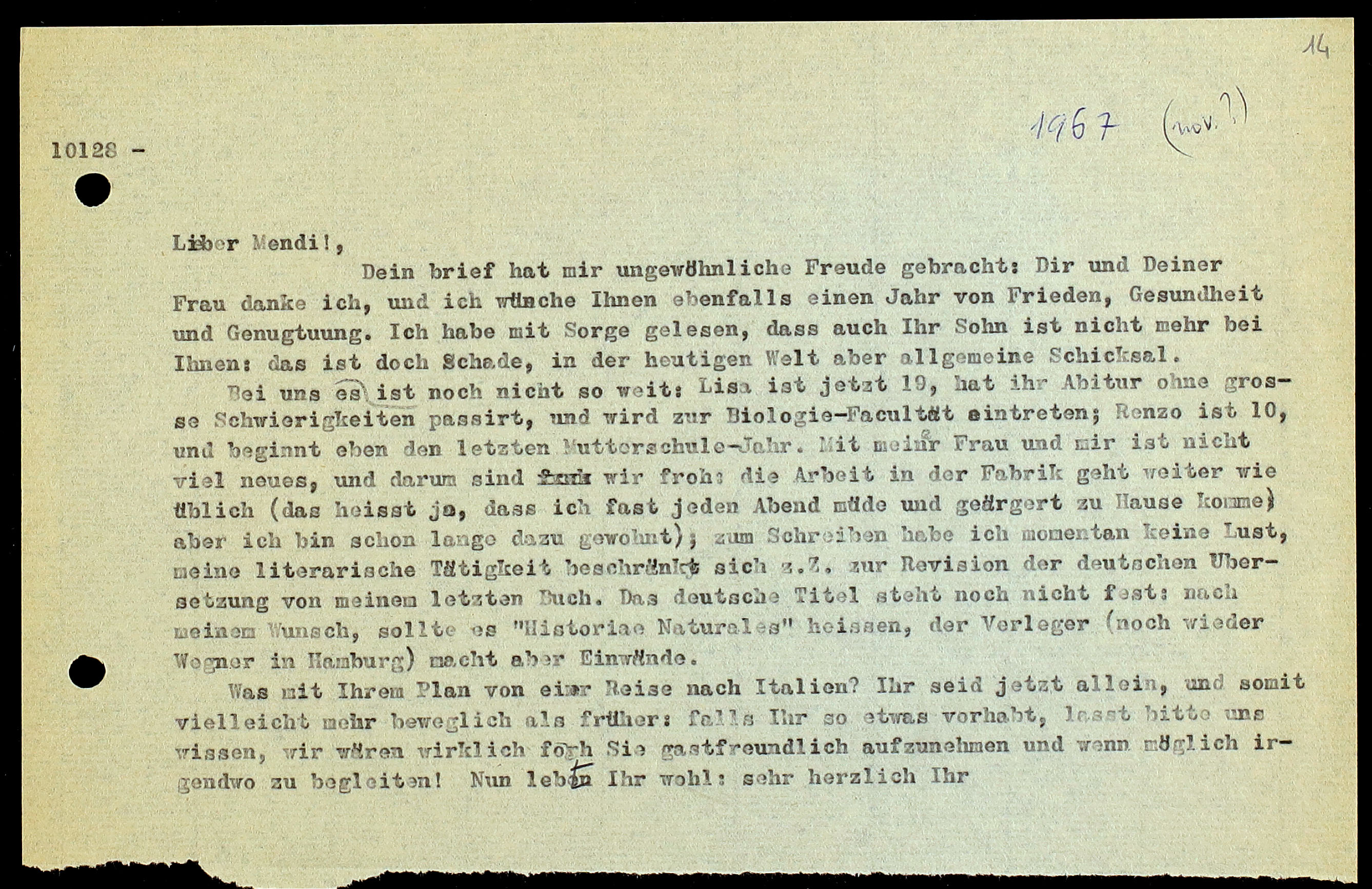
Levi reciprocates the holiday wishes and provides news about his own family and his work as an author. He asks Davidovic if he is planning a trip to Italy.
Lieber Mendi,[1]
Dein brief hat mir ungewöhnliche Freude gebracht: Dir und Deiner Frau danke ich, und ich wünsche Ihnen ebenfalls einen Jahr von Frieden, Gesundheit und Genugtuung. Ich habe mit Sorge gelesen, dass auch Ihr Sohn ist nicht mehr bei Ihnen: das ist doch Schade, in der heutigen Welt aber allgemeine Schicksal.
Bei uns ist es[2]noch nicht so weit: Lisa ist jetzt 19, hat ihr Abitur ohne grosse Schwierigkeiten passirt, und wird zur Biologie-Facultät eintreten; Renzo ist 10, und beginnt eben den letzten Mutterschule-Jahr. Mit meiner[3]Frau und mir ist nicht viel neues, und darum sind wir froh: die Arbeit in der Fabrik geht weiter wie üblich (das heisst ja, dass ich fast jeden Abend müde und geärgert zu Hause komme) aber ich bin schon lange dazu gewohnt; zum Schreiben habe ich momentan keine Lust, meine literarische Tätigkeit beschränkt sich zur Zeit zur Revision der deutschen Ubersetzung von meinem letzten Buch. Das deutsche Titel steht noch nicht fest: nach meinem Wunsch, sollte es Historiae Naturales heissen, der Verleger (noch wieder Wegner in Hamburg) macht aber Einwände.[4]
Was mit Ihrem Plan von einer Reise nach Italien? Ihr seid jetzt allein, und somit vielleicht mehr beweglich als früher: falls Ihr so etwas vorhabt, lasst bitte uns wissen, wir wären wirklich froh[5] Sie gastfreundlich aufzunehmen und wenn möglich irgendwo zu begleiten! Nun lebt[6] Ihr wohl: sehr herzlich Ihr
Caro Mendi,[1]
la tua lettera mi ha portato grandissima gioia. Ringrazio te e tua moglie e auguro anche a voi un anno di pace, salute e soddisfazioni. Ho letto con dispiacere che anche vostro figlio non è più con voi. È davvero un peccato, ma nel mondo di oggi è ormai un destino comune.
Da noi le cose non sono[2] ancora a quel punto. Lisa ha diciannove anni, ha superato senza grandi difficoltà l’esame di maturità e si iscriverà alla facoltà di Biologia; Renzo ha dieci anni e sta per iniziare l’ultimo anno di scuola elementare.
Per quanto riguarda me e mia moglie[3], non ci sono grandi novità, e di questo siamo contenti. Il lavoro in fabbrica prosegue come al solito (il che significa che quasi ogni sera torno a casa stanco e di cattivo umore), ma ormai mi ci sono abituato da un bel po’. Per il momento non ho voglia di scrivere; la mia attività letteraria si limita attualmente alla revisione della traduzione tedesca del mio ultimo libro. Il titolo tedesco non è stato ancora deciso: io desidererei che si intitolasseHistoriae Naturales, ma l’editore (ancora una volta Wegner di Amburgo) non è d’accordo.[4]
E che ne è del vostro progetto di viaggio in Italia? Ora siete soli e quindi forse più liberi di muovervi rispetto a prima. Se avete davvero quest’intenzione, fatecelo sapere: saremmo davvero felici[5] di ospitarvi e, se possibile, di accompagnarvi in giro. State bene,[6] intanto. Con grandissimo affetto, vostro
Dear Mendi,[1]
Your letter brought me great joy: I thank you and your wife, and I wish you both a year of peace, health, and fulfillment. I was concerned to read that your son is no longer with you: that is a shame, but in today’s world it is an all-too-common fate.
We are[2] not as far along as you all: Lisa is now 19, passed her high school graduation exams without much difficulty, and will be studying in the biology department; Renzois 10 and is just starting his last year of elementary school. Not much is new with my wife[3] and me, and we are glad about that: work at the factory continues as usual (which means, of course, that I come home tired and annoyed almost every evening), but I have long since gotten used to it; I do not feel like writing at the moment—my literary activities are currently limited to revising the German translation of my latest book. The German title has not been decided yet: I would like it to be Historiae Naturales, but the publisher (once again, Wegnerin Hamburg) has objections.[4]
What about your plans for a trip to Italy? You are on your own now, and so perhaps more flexible than before: if you are planning something like that, please let us know—we would be truly happy[5]to welcome you and, if possible, accompany you somewhere! So now, be well:[6] sending warm regards,
Lieber Mendi,[1]
Dein brief hat mir ungewöhnliche Freude gebracht: Dir und Deiner Frau danke ich, und ich wünsche Ihnen ebenfalls einen Jahr von Frieden, Gesundheit und Genugtuung. Ich habe mit Sorge gelesen, dass auch Ihr Sohn ist nicht mehr bei Ihnen: das ist doch Schade, in der heutigen Welt aber allgemeine Schicksal.
Bei uns ist es[2]noch nicht so weit: Lisa ist jetzt 19, hat ihr Abitur ohne grosse Schwierigkeiten passirt, und wird zur Biologie-Facultät eintreten; Renzo ist 10, und beginnt eben den letzten Mutterschule-Jahr. Mit meiner[3]Frau und mir ist nicht viel neues, und darum sind wir froh: die Arbeit in der Fabrik geht weiter wie üblich (das heisst ja, dass ich fast jeden Abend müde und geärgert zu Hause komme) aber ich bin schon lange dazu gewohnt; zum Schreiben habe ich momentan keine Lust, meine literarische Tätigkeit beschränkt sich zur Zeit zur Revision der deutschen Ubersetzung von meinem letzten Buch. Das deutsche Titel steht noch nicht fest: nach meinem Wunsch, sollte es Historiae Naturales heissen, der Verleger (noch wieder Wegner in Hamburg) macht aber Einwände.[4]
Was mit Ihrem Plan von einer Reise nach Italien? Ihr seid jetzt allein, und somit vielleicht mehr beweglich als früher: falls Ihr so etwas vorhabt, lasst bitte uns wissen, wir wären wirklich froh[5] Sie gastfreundlich aufzunehmen und wenn möglich irgendwo zu begleiten! Nun lebt[6] Ihr wohl: sehr herzlich Ihr
Caro Mendi,[1]
la tua lettera mi ha portato grandissima gioia. Ringrazio te e tua moglie e auguro anche a voi un anno di pace, salute e soddisfazioni. Ho letto con dispiacere che anche vostro figlio non è più con voi. È davvero un peccato, ma nel mondo di oggi è ormai un destino comune.
Da noi le cose non sono[2] ancora a quel punto. Lisa ha diciannove anni, ha superato senza grandi difficoltà l’esame di maturità e si iscriverà alla facoltà di Biologia; Renzo ha dieci anni e sta per iniziare l’ultimo anno di scuola elementare.
Per quanto riguarda me e mia moglie[3], non ci sono grandi novità, e di questo siamo contenti. Il lavoro in fabbrica prosegue come al solito (il che significa che quasi ogni sera torno a casa stanco e di cattivo umore), ma ormai mi ci sono abituato da un bel po’. Per il momento non ho voglia di scrivere; la mia attività letteraria si limita attualmente alla revisione della traduzione tedesca del mio ultimo libro. Il titolo tedesco non è stato ancora deciso: io desidererei che si intitolasseHistoriae Naturales, ma l’editore (ancora una volta Wegner di Amburgo) non è d’accordo.[4]
E che ne è del vostro progetto di viaggio in Italia? Ora siete soli e quindi forse più liberi di muovervi rispetto a prima. Se avete davvero quest’intenzione, fatecelo sapere: saremmo davvero felici[5] di ospitarvi e, se possibile, di accompagnarvi in giro. State bene,[6] intanto. Con grandissimo affetto, vostro
Dear Mendi,[1]
Your letter brought me great joy: I thank you and your wife, and I wish you both a year of peace, health, and fulfillment. I was concerned to read that your son is no longer with you: that is a shame, but in today’s world it is an all-too-common fate.
We are[2] not as far along as you all: Lisa is now 19, passed her high school graduation exams without much difficulty, and will be studying in the biology department; Renzois 10 and is just starting his last year of elementary school. Not much is new with my wife[3] and me, and we are glad about that: work at the factory continues as usual (which means, of course, that I come home tired and annoyed almost every evening), but I have long since gotten used to it; I do not feel like writing at the moment—my literary activities are currently limited to revising the German translation of my latest book. The German title has not been decided yet: I would like it to be Historiae Naturales, but the publisher (once again, Wegnerin Hamburg) has objections.[4]
What about your plans for a trip to Italy? You are on your own now, and so perhaps more flexible than before: if you are planning something like that, please let us know—we would be truly happy[5]to welcome you and, if possible, accompany you somewhere! So now, be well:[6] sending warm regards,
Info
Notes
Tag
Sender: Primo Levi
Addressee: Emil Davidovič
Date of Drafting: 1967-11-01
Place of Writing: Turin
Description:carbon copy on onionskin paper of a typewritten letter in A5 format (mm140x220) with handwritten corrections and insertions. In the upper left-hand corner is written “10128 –”: this is Levi’s zip code, introduced in Italy on July 1, 1967. Most likely, Levi typed it onto the letterhead on the original sheet and a trace of it remains on the carbon copy.
Archive: Archivio privato di Primo Levi, Turin
Series: Corrispondenza, Corrispondenti particolari, fascicolo 22, sottofascicolo 1, f. 14.
Folio: 1, front only
DOI:
1On the upper right margin, Levi notes “1967” by hand in blue ballpoint pen and “(nov?)” in black ballpoint pen.
2Most likely, “es ist” is emended to “ist es” with a transposition mark on the original; a trace of the correction remains on the carbon copy.
3Most likely, the second “e” in “meiner” was added by hand on the original; a trace of it remains on the carbon copy.
4On July 1, 1967, Heinz Riedt, who had been tasked with translating Natural Histories by the publisher Wagner, had proposed to Primo Levi: “As for the title […], why not go with Pliny, no less? Put his famous work in the plural and say Naturales Historiae? There would also be the irony about the German obsession with humanism (at least use it as a subtitle).” Levi agreed: “it is without a doubt fine for the cultured public, and for the others it has the allure of the unknown.” Their correspondence shows that in November 1967, the title of choice was still Naturales Historiae, even though formal confirmation on the part of the editor had yet to arrive. But in January 1968, Wagner was already inclined to use Die Verdoppelung einer schönen Dame for commercial reasons (cf. P. Levi, Il carteggio con Heinz Riedt, cit., pp. 264-66., p. 326, p. 340).
5Most likely, “forh” was emended to “froh” on the original, a trace of it remains on the carbon copy.