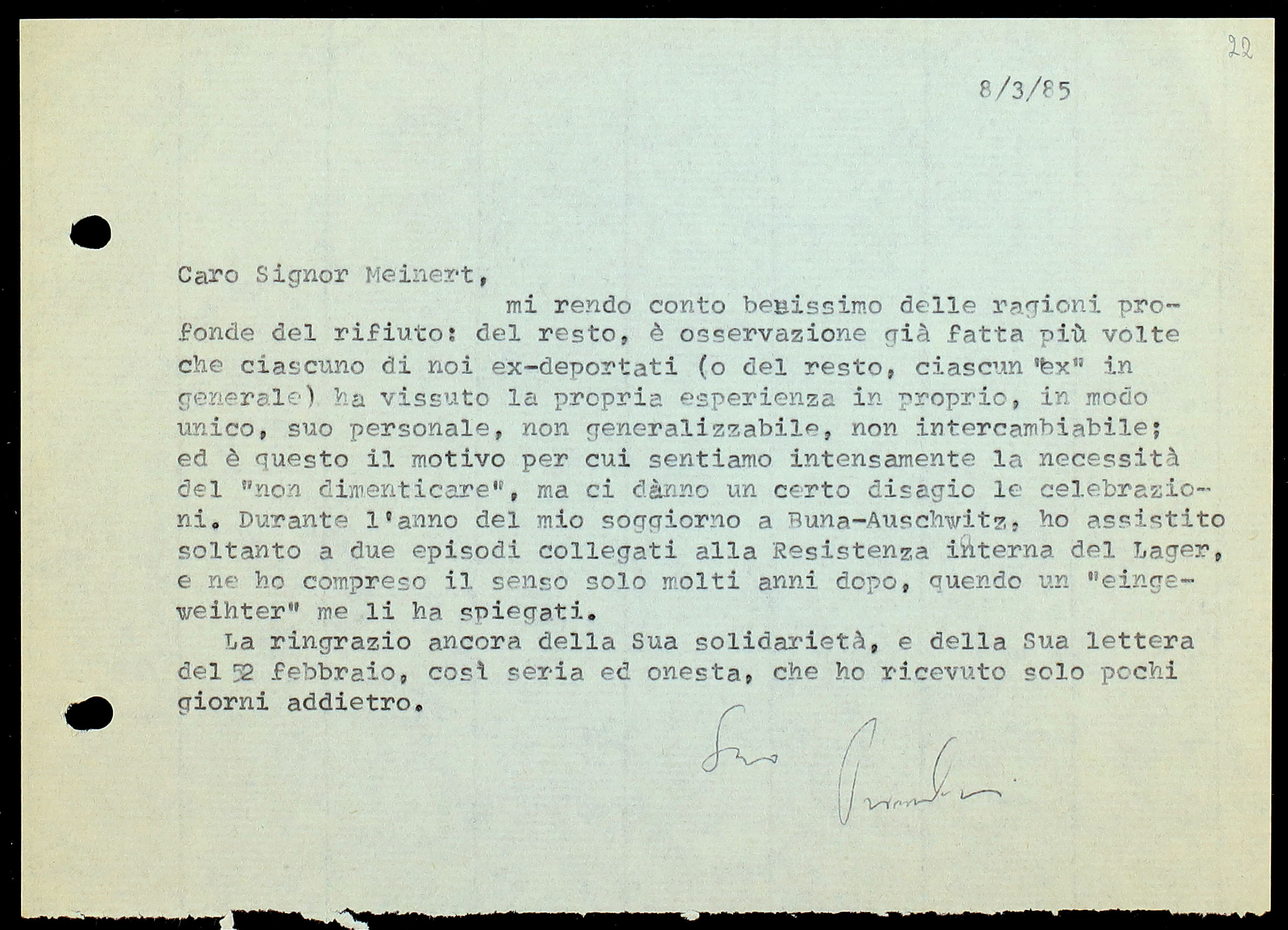
Levi replies to Meinert, saying that he understands the reasons for the rejection of If This Is a Man. He says he feels ill at ease, as an ex-deportee, over the celebrations, even though he believes it is necessary to keep alive the memory of what happened.
mi rendo conto benissimo delle ragioni profonde del rifiuto: del resto, è osservazione già fatta più volte che ciascuno di noi ex-deportati (o del resto, ciascun «ex» in generale) ha vissuto la propria esperienza in proprio, in modo unico, suo personale, non generalizzabile, non intercambiabile; ed è questo il motivo per cui sentiamo intensamente la necessità del «non dimenticare», ma ci danno un certo disagio le celebrazioni.[2] Durante l’anno del mio soggiorno a Buna-Auschwitz, ho assistito soltanto a due episodi collegati alla Resistenza interna del Lager, e ne ho compreso il senso solo molti anni dopo, quando un «eingeweihter»[3] me li ha spiegati.
La ringrazio ancora della Sua solidarietà, e della Sua lettera del 5 febbraio, così seria ed onesta, che ho ricevuto solo pochi giorni addietro.
Suo
Primo Levi
8/3/85
Caro Signor Meinert,[1]
mi rendo conto benissimo delle ragioni profonde del rifiuto: del resto, è osservazione già fatta più volte che ciascuno di noi ex-deportati (o del resto, ciascun «ex» in generale) ha vissuto la propria esperienza in proprio, in modo unico, suo personale, non generalizzabile, non intercambiabile; ed è questo il motivo per cui sentiamo intensamente la necessità del «non dimenticare», ma ci danno un certo disagio le celebrazioni.[2] Durante l’anno del mio soggiorno a Buna-Auschwitz, ho assistito soltanto a due episodi collegati alla Resistenza interna del Lager, e ne ho compreso il senso solo molti anni dopo, quando un «eingeweihter»[3] me li ha spiegati.
La ringrazio ancora della Sua solidarietà, e della Sua lettera del 5 febbraio, così seria ed onesta, che ho ricevuto solo pochi giorni addietro.
Suo
Primo Levi
8/3/85
Dear Mr. Meinert,[1]
I fully understand the deep underlying reasons for the rejection: after all, the observation has already been made many times that each one of us ex-deportees (or, for that matter, each “ex” in general) has lived his own experience on his own, in a way that is unique, personal, not generalizable and not interchangeable. And this is the reason we feel so intensely the need to “not forget,” but the celebrations cause a certain discomfort in us.[2] During the year I spent at Buna-Auschwitz, I witnessed only two episodes related to internal Resistance at the Lager, and I only understood the meaning many years later, when an “eingeweihter”[3]explained them to me.
I thank you once again for your solidarity, and for your letter dated February 5, so serious and honest, which I only received a few days ago.
Yours
Primo Levi
8/3/85
Caro Signor Meinert,[1]
mi rendo conto benissimo delle ragioni profonde del rifiuto: del resto, è osservazione già fatta più volte che ciascuno di noi ex-deportati (o del resto, ciascun «ex» in generale) ha vissuto la propria esperienza in proprio, in modo unico, suo personale, non generalizzabile, non intercambiabile; ed è questo il motivo per cui sentiamo intensamente la necessità del «non dimenticare», ma ci danno un certo disagio le celebrazioni.[2] Durante l’anno del mio soggiorno a Buna-Auschwitz, ho assistito soltanto a due episodi collegati alla Resistenza interna del Lager, e ne ho compreso il senso solo molti anni dopo, quando un «eingeweihter»[3] me li ha spiegati.
La ringrazio ancora della Sua solidarietà, e della Sua lettera del 5 febbraio, così seria ed onesta, che ho ricevuto solo pochi giorni addietro.
Suo
Primo Levi
8/3/85
Caro Signor Meinert,[1]
mi rendo conto benissimo delle ragioni profonde del rifiuto: del resto, è osservazione già fatta più volte che ciascuno di noi ex-deportati (o del resto, ciascun «ex» in generale) ha vissuto la propria esperienza in proprio, in modo unico, suo personale, non generalizzabile, non intercambiabile; ed è questo il motivo per cui sentiamo intensamente la necessità del «non dimenticare», ma ci danno un certo disagio le celebrazioni.[2] Durante l’anno del mio soggiorno a Buna-Auschwitz, ho assistito soltanto a due episodi collegati alla Resistenza interna del Lager, e ne ho compreso il senso solo molti anni dopo, quando un «eingeweihter»[3] me li ha spiegati.
La ringrazio ancora della Sua solidarietà, e della Sua lettera del 5 febbraio, così seria ed onesta, che ho ricevuto solo pochi giorni addietro.
Suo
Primo Levi
8/3/85
Dear Mr. Meinert,[1]
I fully understand the deep underlying reasons for the rejection: after all, the observation has already been made many times that each one of us ex-deportees (or, for that matter, each “ex” in general) has lived his own experience on his own, in a way that is unique, personal, not generalizable and not interchangeable. And this is the reason we feel so intensely the need to “not forget,” but the celebrations cause a certain discomfort in us.[2] During the year I spent at Buna-Auschwitz, I witnessed only two episodes related to internal Resistance at the Lager, and I only understood the meaning many years later, when an “eingeweihter”[3]explained them to me.
I thank you once again for your solidarity, and for your letter dated February 5, so serious and honest, which I only received a few days ago.
Yours
Primo Levi
Info
Notes
Tag
Sender: Primo Levi
Addressee: Joachim Meinert
Date of Drafting: 1985-03-08
Place of Writing: Turin
Description: carbon copy on onionskin paper of a typewritten letter with signature written by hand in black ballpoint pen.
1
This letter was published for the first time, and in German translation, in J. Meinert, Geschichte eines Verbots. Warum Primo Levis Hauptwerk in der DDR nicht erscheinen durfte (“The story of a ban. Why Primo Levi’s major book could not be published in the GDR”), in Sinn und Form, 2/2000, pp. 162-163. Cf. the biography of Joachim Meinert.
2
This consideration was written at the same time as the preface of The Drowned and the Saved, which states: “It is not that the ceremonies and celebrations, the monuments and flags, should be deplored always and everywhere. A certain dose of rhetoric can be indispensable in assuring that a memory lasts […]; but we must beware of oversimplification” (CW III, p. 2418).
3
“eingeweihter” means an “initiate.” In this passage Levi most probably alludes to Alfred Besserman, the former French deportee and member of the camp resistance recalled in the article “A Secret Defense Committee in Auschwitz” that was published in Ha Keillah / The Community in April 1979 (CW II, pp. 1276-77). Besserman, whom Levi had met in Rome in March 1960 during the International Conference against Antisemitism, explained the dynamics that had led to a substitution of names on the list for the gas chamber to the detriment of a brutal Kapo. Cf. the insight The “New Swastikas” in 1959-’60 and the Besserman Effect, and S. Luzzatto, Primo Levi e i suoi compagni. Tra storia e letteratura, Rome: Donzelli, 2024, pp. 100-3. The episode is also recounted in letter 183 to Emil Davidovič dated February 2, 1965.