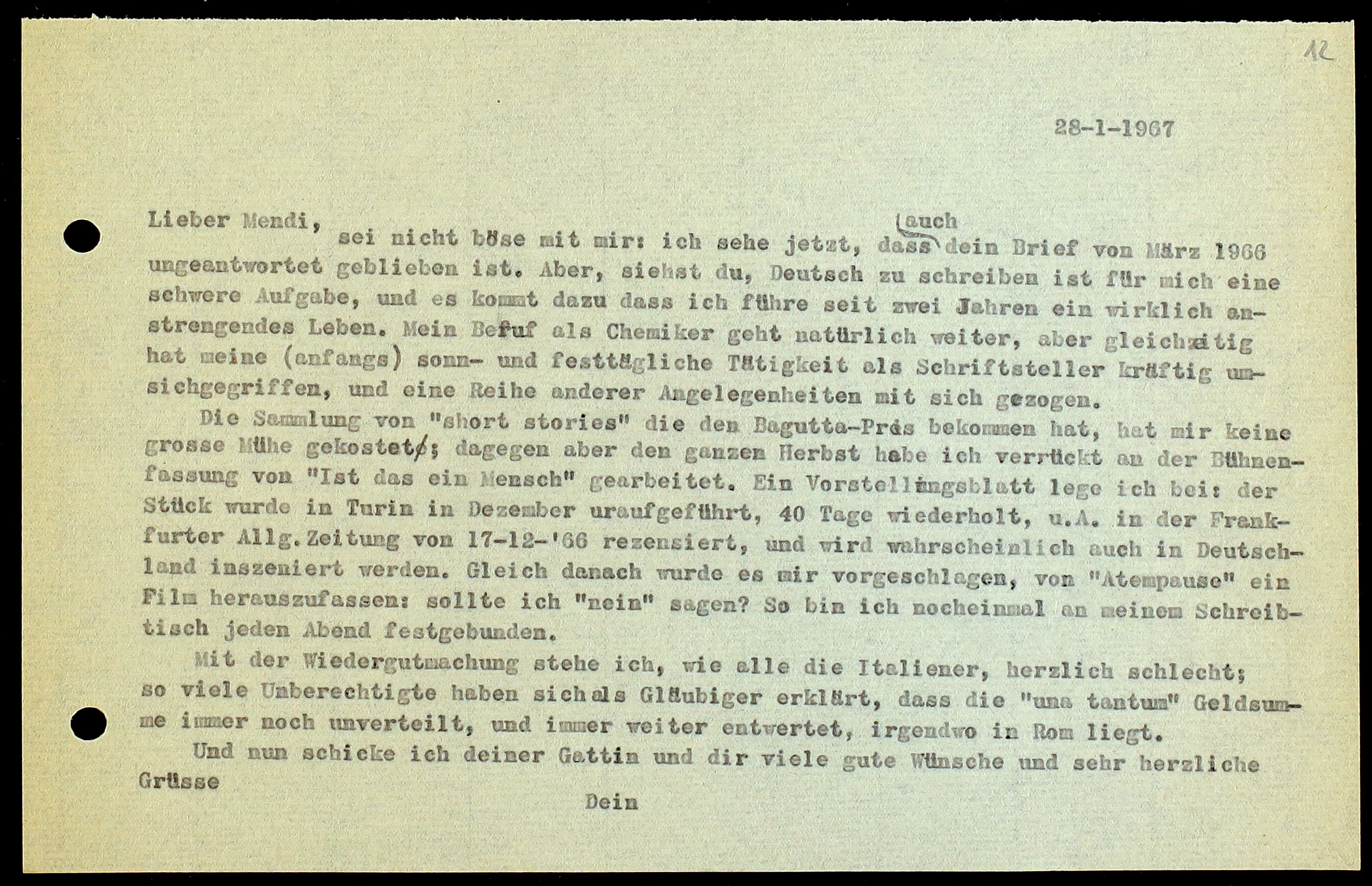
Levi aggiorna Davidovic sulla realizzazione della versione teatrale di Se questo è un uomo e sul progetto di una trasposizione cinematografica de La tregua.
28-1-1967
Lieber Mendi,
sei nicht böse mit mir: ich sehe jetzt, dass auch[1] dein Brief von März 1966 ungeantwortet geblieben ist. Aber, siehst du, Deutsch zu schreiben ist für mich eine schwere Aufgabe, und es kommt dazu dass ich führe seit zwei Jahren ein wirklich anstrengendes Leben. Mein Beruf als Chemiker geht natürlich weiter, aber gleichzeitig hat meine (anfangs) sonn- und festtägliche Tätigkeit als Schriftsteller kräftig umsichgegriffen, und eine Reihe anderer Angelegenheiten mit sich gezogen.
Die Sammlung von «short stories» die den Bagutta-Preis bekommen hat, hat mir keine grosse Mühe gekostet; dagegen aber den ganzen Herbst habe ich verrückt an der Bühnenfassung von Ist das ein Mensch gearbeitet.[2] Ein Vorstellungsblatt lege ich bei[3]: der Stück wurde in Turin in Dezember uraufgeführt, 40 Tage wiederholt, unter Anderem in der Frankfurter Allgemeine Zeitung von 17-12-’66 rezensiert, und wird wahrscheinlich auch in Deutschland inszeniert werden.[4] Gleich danach wurde es mir vorgeschlagen, von Atempause ein Film herauszufassen: sollte ich «nein» sagen? So bin ich nocheinmal an meinem Schreibtisch jeden Abend festgebunden.[5]
Mit der Wiedergutmachung stehe ich, wie alle die Italiener, herzlich schlecht; so viele Unberechtigte haben sich als Gläubiger erklärt, dass die una tantum Geldsumme immer noch unverteilt, und immer weiter entwertet, irgendwo in Rom liegt.[6]
Und nun schicke ich deiner Gattin und dir viele gute Wünsche und sehr herzliche Grüsse
Dein
28 gennaio 1967
Caro Mendi,
non essere arrabbiato con me: mi accorgo solo adesso che anche[1] la tua lettera del marzo 1966 non ha avuto risposta. Ma, vedi, scrivere in tedesco è per me un compito faticoso; e a questo si aggiunge il fatto che da due anni conduco una vita davvero estenuante. Il mio lavoro di chimico, ovviamente, va avanti, ma allo stesso tempo la mia attività di scrittore, che all’inizio si limitava alle domeniche e ai giorni festivi, ha preso decisamente il sopravvento, trascinando con sé tutta una serie di altri impegni.
La raccolta di racconti che ha ricevuto il Premio Bagutta non mi è costata troppa fatica; in compenso, per tutto l’autunno ho lavorato come un matto all’adattamento teatrale di Se questo è un uomo. Ti accludo il foglio di sala[2]: il dramma ha debuttato a Torino nel dicembre scorso, è rimasto in scena per quaranta giorni,[3] è stato recensito, tra gli altri, sulla «Frankfurter Allgemeine Zeitung» del 17 dicembre 1966 e probabilmente sarà rappresentato anche in Germania.[4] Subito dopo mi è stato proposto di trarre un film dallaTregua: come fare a dire di no? Ed eccomi di nuovo inchiodato ogni sera alla scrivania.[5]
Quanto al risarcimento, sono messo, come tutti gli italiani, decisamente male: tante persone che non ne avevano diritto si sono dichiarate creditrici, cosicché la somma una tantum è ancora da qualche parte a Roma, non distribuita, e continua a svalutarsi.[6]
E ora mando a te e a tua moglie molti cari auguri e i miei saluti più affettuosi,
tuo
January 28, 1967
Dear Mendi,
Please do not be angry with me: I now realize that your letter from March 1966 also[1]went unanswered. But, you see, writing in German is a tough task for me, and on top of that, I have been leading a truly exhausting life for the past two years. My career as a chemist continues, of course, but at the same time, my work as a writer—which I initially did only on Sundays and holidays—has really taken off and brought with it a whole host of other responsibilities.
The collection of short stories that won the Bagutta Prize did not take much effort on my part; on the other hand, I spent the entire fall working like crazy on the stage adaptation of If This is a Man. I am enclosing a program[2]: the play premiered in Turin in December, ran for 40 days,[3] was reviewed in the Frankfurter Allgemeine Zeitung on December 17, 1966, among other publications, and will likely be staged in Germany as well.[4] Immediately afterward, I was offered the chance to adapt The Truce into a film: how could I say no? So here I am, chained to my desk once again every evening.[5]
Like all Italians, I am in a terrible situation when it comes to reparations; so many undeserving people have declared themselves creditors that the “lump-sum” payment is still languishing, undistributed—and steadily losing value—somewhere in Rome.[6]
Sending you and your wife many best wishes and very warm regards,
Yours,
28-1-1967
Lieber Mendi,
sei nicht böse mit mir: ich sehe jetzt, dass auch[1] dein Brief von März 1966 ungeantwortet geblieben ist. Aber, siehst du, Deutsch zu schreiben ist für mich eine schwere Aufgabe, und es kommt dazu dass ich führe seit zwei Jahren ein wirklich anstrengendes Leben. Mein Beruf als Chemiker geht natürlich weiter, aber gleichzeitig hat meine (anfangs) sonn- und festtägliche Tätigkeit als Schriftsteller kräftig umsichgegriffen, und eine Reihe anderer Angelegenheiten mit sich gezogen.
Die Sammlung von «short stories» die den Bagutta-Preis bekommen hat, hat mir keine grosse Mühe gekostet; dagegen aber den ganzen Herbst habe ich verrückt an der Bühnenfassung von Ist das ein Mensch gearbeitet.[2] Ein Vorstellungsblatt lege ich bei[3]: der Stück wurde in Turin in Dezember uraufgeführt, 40 Tage wiederholt, unter Anderem in der Frankfurter Allgemeine Zeitung von 17-12-’66 rezensiert, und wird wahrscheinlich auch in Deutschland inszeniert werden.[4] Gleich danach wurde es mir vorgeschlagen, von Atempause ein Film herauszufassen: sollte ich «nein» sagen? So bin ich nocheinmal an meinem Schreibtisch jeden Abend festgebunden.[5]
Mit der Wiedergutmachung stehe ich, wie alle die Italiener, herzlich schlecht; so viele Unberechtigte haben sich als Gläubiger erklärt, dass die una tantum Geldsumme immer noch unverteilt, und immer weiter entwertet, irgendwo in Rom liegt.[6]
Und nun schicke ich deiner Gattin und dir viele gute Wünsche und sehr herzliche Grüsse
Dein
28 gennaio 1967
Caro Mendi,
non essere arrabbiato con me: mi accorgo solo adesso che anche[1] la tua lettera del marzo 1966 non ha avuto risposta. Ma, vedi, scrivere in tedesco è per me un compito faticoso; e a questo si aggiunge il fatto che da due anni conduco una vita davvero estenuante. Il mio lavoro di chimico, ovviamente, va avanti, ma allo stesso tempo la mia attività di scrittore, che all’inizio si limitava alle domeniche e ai giorni festivi, ha preso decisamente il sopravvento, trascinando con sé tutta una serie di altri impegni.
La raccolta di racconti che ha ricevuto il Premio Bagutta non mi è costata troppa fatica; in compenso, per tutto l’autunno ho lavorato come un matto all’adattamento teatrale di Se questo è un uomo. Ti accludo il foglio di sala[2]: il dramma ha debuttato a Torino nel dicembre scorso, è rimasto in scena per quaranta giorni,[3] è stato recensito, tra gli altri, sulla «Frankfurter Allgemeine Zeitung» del 17 dicembre 1966 e probabilmente sarà rappresentato anche in Germania.[4] Subito dopo mi è stato proposto di trarre un film dallaTregua: come fare a dire di no? Ed eccomi di nuovo inchiodato ogni sera alla scrivania.[5]
Quanto al risarcimento, sono messo, come tutti gli italiani, decisamente male: tante persone che non ne avevano diritto si sono dichiarate creditrici, cosicché la somma una tantum è ancora da qualche parte a Roma, non distribuita, e continua a svalutarsi.[6]
E ora mando a te e a tua moglie molti cari auguri e i miei saluti più affettuosi,
tuo
January 28, 1967
Dear Mendi,
Please do not be angry with me: I now realize that your letter from March 1966 also[1]went unanswered. But, you see, writing in German is a tough task for me, and on top of that, I have been leading a truly exhausting life for the past two years. My career as a chemist continues, of course, but at the same time, my work as a writer—which I initially did only on Sundays and holidays—has really taken off and brought with it a whole host of other responsibilities.
The collection of short stories that won the Bagutta Prize did not take much effort on my part; on the other hand, I spent the entire fall working like crazy on the stage adaptation of If This is a Man. I am enclosing a program[2]: the play premiered in Turin in December, ran for 40 days,[3] was reviewed in the Frankfurter Allgemeine Zeitung on December 17, 1966, among other publications, and will likely be staged in Germany as well.[4] Immediately afterward, I was offered the chance to adapt The Truce into a film: how could I say no? So here I am, chained to my desk once again every evening.[5]
Like all Italians, I am in a terrible situation when it comes to reparations; so many undeserving people have declared themselves creditors that the “lump-sum” payment is still languishing, undistributed—and steadily losing value—somewhere in Rome.[6]
Sending you and your wife many best wishes and very warm regards,
Yours,
Info
Note
Tag
Mittente: Primo Levi
Destinatario: Emil Davidovič
Data di stesura: 1967-01-28
Luogo di stesura: Torino
Descrizione del documento:copia carbone su carta velina di lettera ds. (mm140x220).
Archivio: Archivio privato di Primo Levi, Torino
Segnatura: Corrispondenza, Corrispondenti particolari, fascicolo 22, sottofascicolo 1, f. 12.
Fogli: 1, solo recto
DOI:
1Verosimilmente«auch» è aggiunto con una serpentina ds. sopra il rigo, sull’originale, qui ne resta la traccia in copia carbone.
2Primo Levi iniziò a lavorare alla versione teatrale di Se questo è un uomo nel 1964 insieme con l’attore piemontese Pieralberto Marché. La stesura del copione si concluse sul finire del 1965 e la produzione iniziò nell’estate dell’anno successivo. Con la regia di Gianfranco De Bosio, la prima messa in scena avvenne il 18 novembre 1966 al Teatro Carignano di Torino. Nello stesso anno Einaudi ne pubblicò la versione a stampa (cfr. OC I, pp. 1481-82 e I. Thomson, Primo Levi. A life, cit., p. 380-87).
3Una copia del programma di sala è disponibile nell’archivio digitale del Teatro Stabile di Torino. All’interno è presente un testo di presentazione di Primo Levi, poi incluso come introduzione nella versione a stampa di Einaudi (ora in OC I, pp. 1195-1997).
4Con il titolo Ein Stück an alle. Primo Levis „Ist da ein Mensch“, uraufgeführt (“Uno spettacolo per tutti. La prima di Se questo è un uomo di Primo Levi”), la recensione è apparsa a pagina 13 della «Frankfurter Allgemeine Zeitung» del 17 dicembre 1966 firmata da Sinah Kessler. Dal carteggio con Heinz Riedt emerge che già nell’ottobre 1966 la Fischer si era mostrata interessata alla versione drammatica di Se questo è un uomo, e l’interesse proseguì anche nel 1968(P. Levi, Il carteggio con Heinz Riedt, cit., p. 199, p. 229, p. 344 e p. 358). Nonostante queste premesse, il progetto sembra non avere avuto un seguito.
5Il film avrebbe dovuto essere diretto da Mario Monicelli, ma non fu mai realizzato. In questo periodo, Levi stava comunicando la notizia anche ad altri corrispondenti tedeschi: cfr. le lettere 87, 159 e Id. Il carteggio con Heinz Riedt, cit, p. 238.
6Il 10 marzo 1955 fu promulgata la legge n. 96 sulle Provvidenze a favore dei perseguitati politici antifascisti o razziali e dei loro familiari superstiti (nota anche come legge Terracini). Il provvedimento fu però ritenuto insufficiente dall’Unione delle Comunità Israelitiche, tanto che, al 1972, solo 471 ex perseguitati razziali poterono beneficiare degli indennizzi. La svolta avvenne nel 1961 quando, a fronte della decisione del governo della Repubblica Federale di estendere la Wiedergutmachung ("riparazioni") agli ebrei non tedeschi (come stabilito dallalegge federale sui risarcimenti del 1957), allo Stato italiano vennero corrisposti 40 milioni di marchi. I pagamenti furono però erogati solo nel 1968. A riceverli furono3.321 ex perseguitati razziali, tra i quali anche Primo Levi (l’elenco dei nominativi pubblicato il 22 maggio 1968 sulla Gazzetta Ufficiale è disponibile qui). Cfr. I. Pavan, Le conseguenze economiche delle leggi razziali, il Mulino, Bologna 2022, pp. 179-87.