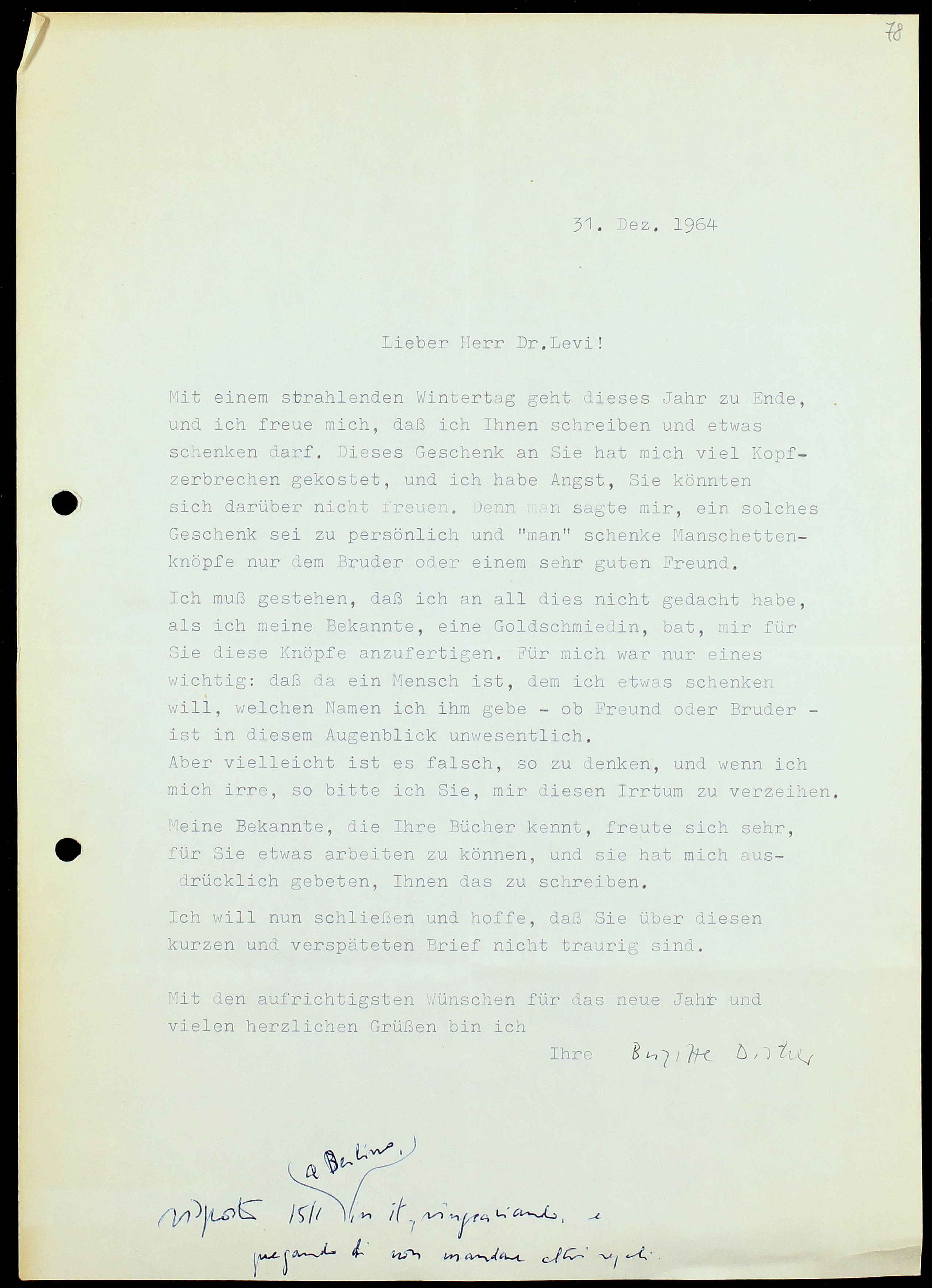
This letter accompanies a valuable present Distler has given Levi: a set of custom-made, golden cuff links.
31 Dez. 1964
Lieber Herr Dr.Levi!
Mit einem strahlenden Wintertag geht dieses Jahr zu Ende, und ich freue mich, daß ich Ihnen schreiben und etwas schenken darf. Dieses Geschenk an Sie hat mich viel Kopfzerbrechen gekostet, und ich habe Angst, Sie könnten sich darüber nicht freuen. Denn man sagte mir, ein solches Geschenk sei zu persönlich und „man” schenke Manschettenknöpfe nur dem Bruder oder einem sehr guten Freund.[1]
Ich muß gestehen, daß ich an all dies nicht gedacht habe, als ich meine Bekannte, eine Goldschmiedin, bat, mir für Sie diese Knöpfe anzufertigen. Für mich war nur eines wichtig: daß da ein Mensch ist, dem ich etwas schenken will, welchen Namen ich ihm gebe – ob Freund oder Bruder – ist in diesem Augenblick unwesentlich.
Aber vielleicht ist es falsch, so zu denken, und wenn ich mich irre, so bitte ich Sie, mir diesen Irrtum zu verzeihen. Meine Bekannte, die IhreBücher kennt, freute sich sehr, für Sie etwas arbeiten zu können, und sie hat mich ausdrücklich gebeten, Ihnen das zu schreiben.
Ich will nun schließen und hoffe, daß Sie über diesen kurzen und verspäteten Brief nicht traurig sind.
Mit den aufrichtigsten Wünschen für das neue Jahr und vielen herzlichen Grüßen bin ich
Ihre Brigitte Distler
31 dicembre 1964
Caro Dottor Levi!
quest’anno si chiude con una luminosa giornata d’inverno, e sono felice di poterLe scrivere e di farLe un regalo. Un regalo che mi è costato un bel po’ di rimuginio, perché temo che possa non farLe piacere. Mi è stato detto, infatti, che simili doni sono troppo personali, che i gemelli da polso “si” regalano solo a un fratello o a un caro amico.[1]
Devo confessare che a tutto questo non avevo pensato quando ho chiesto a una mia conoscente, un’orafa, di realizzare per Lei questi gemelli. Per me contava una cosa soltanto: che c’era una persona alla quale volevo fare un regalo. Qualunque nome le attribuissi – amico o fratello – in quel momento era irrilevante.
Forse sbaglio a pensare così; se è un errore, La prego di perdonarmi. La mia conoscente, che ha letto i Suoilibri, è stata molto contenta di poter lavorare per Lei e mi ha chiesto espressamente di scriverGlielo.
E adesso concludo, sperando per questa breve e tardiva lettera non La rattristi.
Con i più sinceri auguri per il nuovo anno e con tanti cordiali saluti, Sua
Brigitte Distler
Dec. 31, 1964
Dear Mr. Levi!
A glorious winter’s day now brings this year to an end, and I am delighted to be able to write to you and give you a gift. This gift has caused me a lot of headaches, and I am afraid you may not be happy with it. I have been told that such a gift is too personal and that “one” only gives cufflinks to one’s brother or a very good friend.[1]
I must admit that I did not think about any of that when I asked my friend, a goldsmith, to make these cufflinks for you. For me, only one thing was important: that there is a person to whom I want to give a gift, and what name I give him—whether friend or brother—is at this moment entirely irrelevant.
But perhaps it is wrong to think this way, and if I am mistaken, I ask you to forgive me for this error. My friend, who knows yourbooks, was very happy to be able to do something for you, and she expressly asked me to write this to you.
I will now sign off and hope that you are not upset about this short and belated letter.
With my sincerest wishes for the new year and warm regards, I remain,
Yours,
Brigitte Distler
31 Dez. 1964
Lieber Herr Dr.Levi!
Mit einem strahlenden Wintertag geht dieses Jahr zu Ende, und ich freue mich, daß ich Ihnen schreiben und etwas schenken darf. Dieses Geschenk an Sie hat mich viel Kopfzerbrechen gekostet, und ich habe Angst, Sie könnten sich darüber nicht freuen. Denn man sagte mir, ein solches Geschenk sei zu persönlich und „man” schenke Manschettenknöpfe nur dem Bruder oder einem sehr guten Freund.[1]
Ich muß gestehen, daß ich an all dies nicht gedacht habe, als ich meine Bekannte, eine Goldschmiedin, bat, mir für Sie diese Knöpfe anzufertigen. Für mich war nur eines wichtig: daß da ein Mensch ist, dem ich etwas schenken will, welchen Namen ich ihm gebe – ob Freund oder Bruder – ist in diesem Augenblick unwesentlich.
Aber vielleicht ist es falsch, so zu denken, und wenn ich mich irre, so bitte ich Sie, mir diesen Irrtum zu verzeihen. Meine Bekannte, die IhreBücher kennt, freute sich sehr, für Sie etwas arbeiten zu können, und sie hat mich ausdrücklich gebeten, Ihnen das zu schreiben.
Ich will nun schließen und hoffe, daß Sie über diesen kurzen und verspäteten Brief nicht traurig sind.
Mit den aufrichtigsten Wünschen für das neue Jahr und vielen herzlichen Grüßen bin ich
Ihre Brigitte Distler
31 dicembre 1964
Caro Dottor Levi!
quest’anno si chiude con una luminosa giornata d’inverno, e sono felice di poterLe scrivere e di farLe un regalo. Un regalo che mi è costato un bel po’ di rimuginio, perché temo che possa non farLe piacere. Mi è stato detto, infatti, che simili doni sono troppo personali, che i gemelli da polso “si” regalano solo a un fratello o a un caro amico.[1]
Devo confessare che a tutto questo non avevo pensato quando ho chiesto a una mia conoscente, un’orafa, di realizzare per Lei questi gemelli. Per me contava una cosa soltanto: che c’era una persona alla quale volevo fare un regalo. Qualunque nome le attribuissi – amico o fratello – in quel momento era irrilevante.
Forse sbaglio a pensare così; se è un errore, La prego di perdonarmi. La mia conoscente, che ha letto i Suoilibri, è stata molto contenta di poter lavorare per Lei e mi ha chiesto espressamente di scriverGlielo.
E adesso concludo, sperando per questa breve e tardiva lettera non La rattristi.
Con i più sinceri auguri per il nuovo anno e con tanti cordiali saluti, Sua
Brigitte Distler
Dec. 31, 1964
Dear Mr. Levi!
A glorious winter’s day now brings this year to an end, and I am delighted to be able to write to you and give you a gift. This gift has caused me a lot of headaches, and I am afraid you may not be happy with it. I have been told that such a gift is too personal and that “one” only gives cufflinks to one’s brother or a very good friend.[1]
I must admit that I did not think about any of that when I asked my friend, a goldsmith, to make these cufflinks for you. For me, only one thing was important: that there is a person to whom I want to give a gift, and what name I give him—whether friend or brother—is at this moment entirely irrelevant.
But perhaps it is wrong to think this way, and if I am mistaken, I ask you to forgive me for this error. My friend, who knows yourbooks, was very happy to be able to do something for you, and she expressly asked me to write this to you.
I will now sign off and hope that you are not upset about this short and belated letter.
With my sincerest wishes for the new year and warm regards, I remain,
Yours,
Brigitte Distler
Info
Notes
Tag
Sender: Brigitte Distler
Addressee: Primo Levi
Date of Drafting: 1964-12-31
Place of Writing: Berlin
Description:typewritten letter with handwritten signature in black ballpoint pen. In the lower margin of the sheet, in the center, Levi notes in blue ballpoint pen: “risposto 15/1 a Berlino in it., ringraziando, e pregando di non mandare altri regali” (“answered 15/1 to Berlin in Italian, thanking her and asking that she not send any other gifts”).
Archive: Archivio privato di Primo Levi, Turin
Series: Complesso di Fondi primo Levi, Fondo Primo Levi, Corrispondenza, Corrispondenti particolari, fasc. 20, sottofasc. 001, doc. 028, f. 78.
Folio: 1, front only
DOI: https://doi.org/10.15160/w5mp-xg98
1
Over twenty years later, Levi recounted his reaction to this gift in The Drowned and the Saved: “In December 1964, from Berlin, where she had moved, she sent me a pair of gold cuff links, which she had commissioned from a girlfriend who was a goldsmith. I didn’t have the heart to send them back to her. I thanked her but asked her not to send me anything else. I sincerely hope I did not offend this innately kind person. I hope she understood the reason for my defense. Since then I have heard nothing from her” (CW III, p. 2555).