Waltraut Falter, a poet who lives in Deggendorf, writes to Levi that she was struck by his book which, she believes, should be circulated among the new generations of Germans, as well as in the schools.
Deggendorf, den 27. VII. 1969
Sehr geehrter Signor Primo Levi!
Tieferschüttert und angesprochen las ich Ihr Buch: Ist das ein Mensch?
Es ist nicht nur die menschliche Anteilnahme, die durch Ihr und Ihrer Leidensgenossen Schicksal zu tiefst bewegt wird.
Es ist nicht nur die Mitverantwortlichkeit, die, wie durch Posaunenstoß des Jüngsten Gerichtes, durch die, von diesem grauenvollen Schicksal erhobene Anklage, getroffen und aufgerufen wird.
Es ist nicht nur das Entsetzen vor dem, alles Fassungsvermögen übersteigenden und nie mehr zu rechtfertigenden Ausmaß an Unrecht und Grausamkeit, das geschehen ist und geschehen konnte; der Schauder vor den unbegrenzten Fähigkeiten und Möglichkeiten des Menschen in seiner Abgründigkeit nach der Tiefe des unmenschlichen zu, aber auch die Ehrfurcht vor der Entfaltungskraft und Wirkung seiner übermenschlichen, inneren Größe, durch die er es vermag, selbst aus der tiefsten Hölle der Erniedrigung, des Hasses und der Bosheit, sein wahres und edles Menschsein zu retten, wie Sie es bewiesen haben, das so stark anspricht und erschüttert.
Es ist nicht nur ein Zurückgreifen und Aufzeigen der Vergangenheit, was Sie in Ihrem Buch verkünden, sondern eine gewaltig eindringliche Mahnung an die Gegenwart, zur Wachsamkeit und zu Bestreben, alles zu tun und alles zu vermeiden, was den Aufbruch des teuflisch Bestialischen im Menschen zur Folge haben könnte. Es ist ein dringender Aufruf, dieser Gefahr der Entmenschlichung, das menschlich Möglichste und Wirkungsvollste entgegen zu setzen: die Hochschätzung und Förderung der wahren und hohen inneren Werte, die Kraft und die Macht edler und hoher Gesinnung und reiner, echter Güte, wie sie Ihnen in Ihrem Lorenzo begegnet ist.
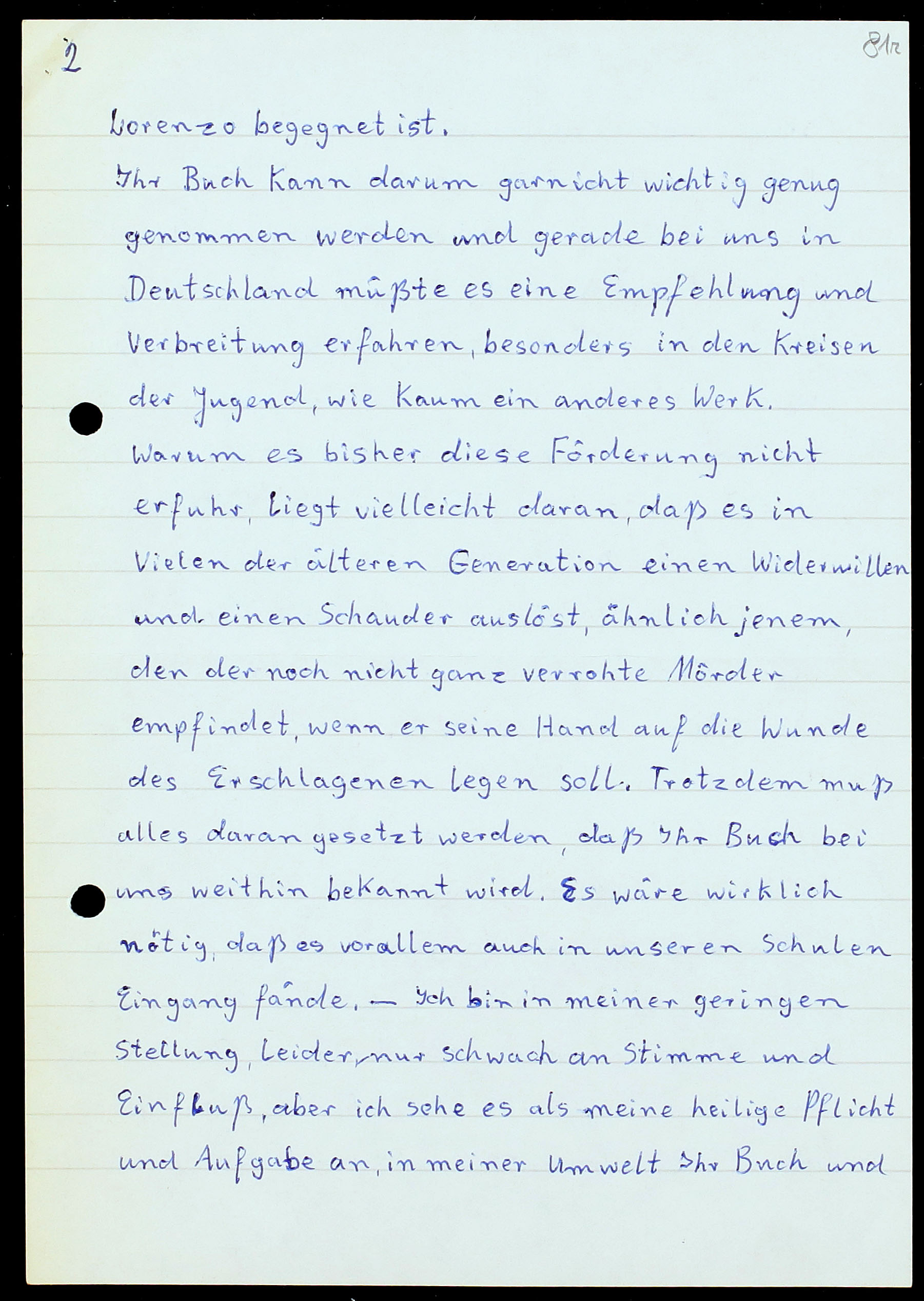
Ihr Buch kann darum garnicht wichtig genug genommen werden und gerade bei uns in Deutschland müßte es eine Empfehlung und Verbreitung erfahren, besonders in den Kreisen der Jugend, wie kaum ein anderes Werk.
Warum es bisher diese Förderung nicht erfuhr, liegt vielleicht daran, daß es in vielen der älteren Generation einen Widerwillen und einen Schauder auslöst, ähnlich jenem, den der noch nicht ganz verrohte Mörder empfindet, wenn er seine Hand auf die Wunde des Erschlagenen legen soll. Trotzdem muß alles daran gesetzt werden, daß Ihr Buch bei uns weiterhin bekannt wird. Es wäre wirklich nötig, daß es vor allem auch in unseren Schulen Eingang fände. – Ich bin in meiner geringen Stellung, leider, nur schwach an Stimme und Einfluß, aber ich sehe es als meine heilige Pflicht und Aufgabe an, in meiner Umwelt Ihr Buch und seine mahnende Botschaft zu verbreiten. Doch das allein ist nicht genug!
Romano Guardini[1] schrieb in seinem Werk, (Das Ende der Neuzeit): „Die Liebe wird aus der allgemeinen Welthaltung verschwinden. Sie wird nicht mehr verstanden noch gekannt sein“.[2] –
– Immer wieder sehe ich die bittere Wahrheit dieser Worte in meinen eigenen Erfahrungen bestätigt. Ich fühle mich oft sehr einsam und allein in einer gewaltigen Gegenströmung, und war schon nahe daran, zu verzagen und an den Menschen zu verzweifeln. Jetzt aber kam mir Ihr Buch zu Hilfe! Sie sind mir begegnet als ein Rufender, ein „Mensch“, der den „Menschen“ sucht und ansprechen und retten will, in dieser entmenschten, grausamen, geist- und seelenlosen Welt der breiten Massen und Vermassung, die den Menschen mehr und mehr zum Golem zu erniedrigen und abzustumpfen droht und das wahre, edle Menschsein anfeindet. Ich bin nicht mehr allein! Ich kam Trost-und-Kraft-und Hilfe-suchend und findend nach Ihren blicken. Ihr Ruf ist mir Trost und Auftrieb zugleich, immer wieder Mut zu fassen, an die Macht und Kraft und den Sinn der Güte zu glauben und frei und unbeirrt meinem eigenen Streben auf diesem Wege treu zu bleiben. Ich will nicht aufhören, überall und in allen, die mir begegnen, den „Menschen“ zu suchen und seine Würde zu achten. Ich bin sehr glücklich über jeden Funken wahrer Menschlichkeit, den ich unter Schlacke und Asche oder im Schlamm der Gosse noch zu finden und anzusprechen vermag.
Ich möchte die Menschen heimholen in ihn wahres Sein! Ich bin mir aber auch bewußt, daß dazu ein nur illusorischer Idealismus nicht genügt, sondern daß der eigene Einsatz und Wandel ins Gutsein, bis zur letztmöglichen Erfassung und Hingabe nötig ist, dies zu verwirklichen. Es genügt nicht, nur das Gute zu tun, man muß „gut werden und sein“. Nur so wird man auch an den unausbleiblichen Misserfolgen und Enttäuschungen nicht zerbrechen, sondern frei das Edle und Gute um des Guten willen wirken und erfüllen können. Das Wissen um Sie und Ihr heldenmütiges Durchhalten und edles Streben, sehr verehrter Signor Primo Levi, gibt mir Mur und Kraft und neue Hoffnung, auch meinen Idealen treu zu bleiben und trotz allen schlimmen Erfahrungen immer wieder an den „Menschen“ zu glauben
Ich danke Ihnen von Herzen!
Leider kann ich nicht italienisch, um diesen Brief an Sie in Ihrer schönen Muttersprache abzufassen. – O Primo Levi! Der Gesang des Ulyss, die Sprache und Botschaft der schmerzvollen Flamme – Ihrer Flamme! – Sie kann nicht mehr verstummen! Es ist das Kapitel in Ihrem Buch, das nie zu Ende gehen kann, Sie werden sich immer darum quälen und mühen, diesen Gesang zu übersetzen und mitzuteilen!
Ich habe Sie verstanden und Ihre Botschaft aufgenommen und will sie weiter tragen, wohin ich gehe!
Mit freundlichen Grüßen und allen guten Wünschen denkt an Sie, Hochachtungsvoll
Ihre
Ergebene
Waltraut Falter
836 Deggendorf / Nbay,
Nördl. Graben 35,
Deutschland – Germany
Deggendorf, 27 luglio 1969
Stimatissimo Signor Primo Levi,
leggendo il il Suo libro Se questo è un uomo mi sono sentita profondamente scossa e chiamata in causa.
Non è soltanto la partecipazione umana davanti al destino Suo e dei Suoi compagni di sofferenza che fa vibrare con tanta forza.
Non è soltanto il senso di corresponsabilità risvegliato, come al suono delle trombe del Giudizio, dall’accusa sollevata da questo destino tremendo.
Non è soltanto l’orrore per l’ingiustizia e la crudeltà di ciò che è accaduto e poteva accadere, le cui proporzioni superano ogni possibilità di comprendere e giustificare; né soltanto il brivido davanti al potere illimitato che l’essere umano ha nelle viscere di raggiungere abissi di disumanità; è anche il più profondo rispetto per quella sovrumana grandezza interiore capace di dispiegarsi e agire, grazie alla quale – come Lei ha dimostrato – l’uomo riesce a trarre in salvo la propria autentica e nobile umanità persino dalla voragine infernale dell’umiliazione, dell’odio e della malvagità: ecco cosa scuote con forza e chiama in causa.
Il Suo libro non è soltanto un richiamo al passato per fare luce; è un monito vigoroso e pressante a tenere gli occhi aperti sul presente, ad adoperarsi con ogni mezzo e impedire qualunque cosa possa innescare una nuova irruzione della brutalità demoniaca nell’uomo. È un appello incalzante a opporre a questa minaccia di disumanizzazione tutto quanto è umanamente possibile ed efficace: il rispetto e la difesa dei veri e più alti valori morali, la forza e il potere di nobili e alti principi, di quella bontà autentica e pura che Lei ha incontrato nel Suo Lorenzo.
Per questo motivo, non sarà mai abbastanza l’attenzione che susciterà il Suo libro: in Germania andrebbe raccomandato e diffuso come poche altre opere, soprattutto tra i giovani.
Che ciò non sia avvenuto finora dipende forse dal fatto che in molti della vecchia generazione suscita un sentimento di orrore e repulsione, simile a quello che prova l’assassino non ancora del tutto abbrutito quando posa la mano sulla ferita della sua vittima. Comunque bisogna fare di tutto perché il Suo libro sia sempre più conosciuto; sarebbe davvero necessario che entrasse prima di tutto nelle nostre scuole. Dalla modesta posizione in cui mi trovo, ioho purtroppo voce e influenza limitate, ma considero una missione e un dovere sacro diffondere, nel mio ambiente, il Suo libro e il messaggio di ammonimento che contiene. Ma questo da solo non basta!
Romano Guardini[1] ha scritto nella sua opera, (La fine dell’epoca moderna): «L’amore scomparirà dalla condotta generale. Non sarà più compreso».[2]
Continuamente vedo riconfermata nella mia esperienza personale la verità amara di queste parole. Mi sento spesso molto sola, travolta controcorrente, ed è mancato poco che non precipitassi nello sconforto, nella sfiducia verso gli esseri umani. Adesso però mi è venuto in soccorso il Suo libro! Ho sentito il suo richiamo, quello di un «essere umano» che cerca l’«essere umano» e vuole parlarci e salvarci, in questo mondo disumanizzato, crudele, senza spirito né anima, che sempre più minaccia di ridurre l’uomo a un golem, e di ottundere e perseguitare la vera, nobile umanità. Non sono più sola! Ho cercato conforto, forza e aiuto, e li ho trovati nel Suo sguardo. Il Suo richiamo è per me conforto e slancio insieme, mi dà ogni volta nuovo coraggio di credere nella forza, nel potere e nella bontà, e di rimanere liberamente e saldamente fedele al mio proprio desiderio di percorrere questo cammino. Non voglio smettere di cercare, in chiunque incontro, l’«uomo», e di rispettarne la dignità. Sono felice per ogni scintilla di vera umanità che riesco ancora a trovare e risvegliare sotto le scorie e le ceneri e il fango ai margini delle strade.
Vorrei ricondurre gli uomini al loro vero essere! Sono però consapevole del fatto che non basta un idealismo illusorio; per realizzare ciò occorrono un impegno in prima persona e una trasformazione interiore in esseri di bontà fino a raggiungere il massimo grado di comprensione e dedizione. Non basta fare il bene, bisogna “diventare ed essere buoni”: solo così si può resistere agli insuccessi e alle delusioni inevitabili e agire liberamente con nobiltà d’animo e bontà per il fine ultimo del bene stesso.
Sapere di Lei e della Sua resistenza eroica, del suo nobile sforzo, stimatissimo Signor Levi, mi dà coraggio e forza e una nuova speranza nella possibilità di restare fedele ai miei ideali e, malgrado tutte le brutte esperienze vissute, di credere sempre ancora nell’“uomo”.
La ringrazio di cuore!
Purtroppo non conosco l’italiano per scrivere questa lettera nella Sua bella lingua madre. – O Primo Levi! Il canto di Ulisse, la lingua e il messaggio della fiamma – della Sua fiamma! – Un canto che non potrà più tacere! È il capitolo del Suo libro che non potrà mai finire. Lei continuerà sempre a tormentarsi e a lottare per tradurre e trasmettere quel canto!
Io L’ho compresa e ho accolto il Suo messaggio: voglio portarlo avanti, ovunque io vada!
InviandoLe i più cari saluti e auguri di ogni bene, La pensa con profonda stima la Sua devota
Waltraut Falter
836 Deggendorf / Nbay, Nördl. Graben 35, Deutschland – Germany
Deggendorf, July 27, 1969
Dear Mr. Primo Levi,
I was deeply moved and touched by your book If This is a Man.
It is not only human compassion that is deeply elicited by your fate and that of your fellow sufferers.
It is not only our shared responsibility that is found and called upon, as by the trumpet blast of the Last Judgment, by the accusation raised by this horrific fate.
It is not only the horror at the incomprehensible and unjustifiable extent of injustice and cruelty that has happened and could happen; the shudder at the unlimited capabilities and possibilities of man in his abysmal descent into inhumanity, but also the awe at the powerful deployment and effect of his superhuman inner greatness, through which he is able to rescue his true and noble humanity even from the deepest hell of humiliation, hatred, and malice, as you have proven, which is so shocking and moving.
What you proclaim in your book is not merely a recourse to and illustration of the past, but a powerfully urgent warning to the present to be vigilant and to strive to do everything and avoid everything that could result in the emergence of the diabolically bestial in human beings. It is an urgent call to counter this danger of dehumanization with the most human and effective means possible: the appreciation and promotion of true and high inner values, the strength and power of noble high-mindedness, and pure, genuine kindness, as you encountered in your Lorenzo.
Your book cannot be taken seriously enough and, here in Germany in particular, it should be recommended and disseminated, especially among young people, more than almost any other work.
The reason it has not received such broad support so far is perhaps because it triggers a revulsion and a shudder in many people of the older generation, similar to that felt by a murderer who is not yet completely brutalized when he has to lay his hand on the wound of the slain. Nevertheless, every effort must be made to ensure that your book continues to be known here. It would be especially necessary that it find its way into our schools, in particular. Unfortunately, in my humble position, I have only a weak voice and limited influence, but I consider it my sacred duty and task to spread your book and its warning message everywhere I go. But that alone is not enough!
Romano Guardini[1] wrote in his work, The End of the Modern World, “Love will disappear from the general worldview. It will no longer be understood or known.”—[2]
— Time and again, I see the bitter truth of these words confirmed in my own experiences. I often feel very lonely, all by myself in a powerful countercurrent, and I have been close to despairing and losing faith in humanity. But now your book has come to my aid! I encountered you as a summoner, a “human being” who seeks “human beings” and wants to address and save them from this dehumanized, cruel, spiritless, soulless world of the vast masses and massification, which threatens to increasingly degrade and dull human beings into golems and is hostile to true, noble humanity. I am no longer alone! I came seeking comfort, strength, and help, and found it in your outlook. Your call is both comfort and encouragement to me: to take courage again and again, to believe in the power and strength and meaning of goodness, and to remain free and unwavering in my own pursuit of this path. I will not cease to seek out the “human being” in everyone I encounter and to respect their dignity. I am very happy about every spark of true humanity that I am still able to find and speak to beneath the slag and ashes or in the mud in the gutter.
I want to bring people home to their true being! But I am also aware that illusory idealism alone is not enough to achieve this, and rather that my own commitment and transformation into goodness, to the utmost possible understanding and devotion, is necessary to realize this. It is not enough just to do good; one must “become and remain good.” Only in this way will one not be broken by the inevitable failures and disappointments, but will be able to freely work and fulfill the noble and good for the sake of the good. Knowing about you and your heroic perseverance and noble aspirations, dear Signor Primo Levi, gives me courage and strength and new hope to remain true to my ideals and, despite all the terrible experiences, to continue to believe in “humanity.”
Thank you from the bottom of my heart!
Unfortunately, I do not know Italian well enough to write this letter to you in your beautiful mother tongue. O Primo Levi! The Canto of Ulysses, the language and message of the painful flame—your flame!—can no longer be silenced! It is the chapter in your book that can never end; you will always struggle and strive to translate and communicate this Canto!
I have understood you and taken in your message, and I will carry it with me wherever I go!
With kind regards and best wishes, thinking of you, sincerely,
Tieferschüttert und angesprochen las ich Ihr Buch: Ist das ein Mensch?
Es ist nicht nur die menschliche Anteilnahme, die durch Ihr und Ihrer Leidensgenossen Schicksal zu tiefst bewegt wird.
Es ist nicht nur die Mitverantwortlichkeit, die, wie durch Posaunenstoß des Jüngsten Gerichtes, durch die, von diesem grauenvollen Schicksal erhobene Anklage, getroffen und aufgerufen wird.
Es ist nicht nur das Entsetzen vor dem, alles Fassungsvermögen übersteigenden und nie mehr zu rechtfertigenden Ausmaß an Unrecht und Grausamkeit, das geschehen ist und geschehen konnte; der Schauder vor den unbegrenzten Fähigkeiten und Möglichkeiten des Menschen in seiner Abgründigkeit nach der Tiefe des unmenschlichen zu, aber auch die Ehrfurcht vor der Entfaltungskraft und Wirkung seiner übermenschlichen, inneren Größe, durch die er es vermag, selbst aus der tiefsten Hölle der Erniedrigung, des Hasses und der Bosheit, sein wahres und edles Menschsein zu retten, wie Sie es bewiesen haben, das so stark anspricht und erschüttert.
Es ist nicht nur ein Zurückgreifen und Aufzeigen der Vergangenheit, was Sie in Ihrem Buch verkünden, sondern eine gewaltig eindringliche Mahnung an die Gegenwart, zur Wachsamkeit und zu Bestreben, alles zu tun und alles zu vermeiden, was den Aufbruch des teuflisch Bestialischen im Menschen zur Folge haben könnte. Es ist ein dringender Aufruf, dieser Gefahr der Entmenschlichung, das menschlich Möglichste und Wirkungsvollste entgegen zu setzen: die Hochschätzung und Förderung der wahren und hohen inneren Werte, die Kraft und die Macht edler und hoher Gesinnung und reiner, echter Güte, wie sie Ihnen in Ihrem Lorenzo begegnet ist.
Ihr Buch kann darum garnicht wichtig genug genommen werden und gerade bei uns in Deutschland müßte es eine Empfehlung und Verbreitung erfahren, besonders in den Kreisen der Jugend, wie kaum ein anderes Werk.
Warum es bisher diese Förderung nicht erfuhr, liegt vielleicht daran, daß es in vielen der älteren Generation einen Widerwillen und einen Schauder auslöst, ähnlich jenem, den der noch nicht ganz verrohte Mörder empfindet, wenn er seine Hand auf die Wunde des Erschlagenen legen soll. Trotzdem muß alles daran gesetzt werden, daß Ihr Buch bei uns weiterhin bekannt wird. Es wäre wirklich nötig, daß es vor allem auch in unseren Schulen Eingang fände. – Ich bin in meiner geringen Stellung, leider, nur schwach an Stimme und Einfluß, aber ich sehe es als meine heilige Pflicht und Aufgabe an, in meiner Umwelt Ihr Buch und seine mahnende Botschaft zu verbreiten. Doch das allein ist nicht genug!
Romano Guardini[1] schrieb in seinem Werk, (Das Ende der Neuzeit): „Die Liebe wird aus der allgemeinen Welthaltung verschwinden. Sie wird nicht mehr verstanden noch gekannt sein“.[2] –
– Immer wieder sehe ich die bittere Wahrheit dieser Worte in meinen eigenen Erfahrungen bestätigt. Ich fühle mich oft sehr einsam und allein in einer gewaltigen Gegenströmung, und war schon nahe daran, zu verzagen und an den Menschen zu verzweifeln. Jetzt aber kam mir Ihr Buch zu Hilfe! Sie sind mir begegnet als ein Rufender, ein „Mensch“, der den „Menschen“ sucht und ansprechen und retten will, in dieser entmenschten, grausamen, geist- und seelenlosen Welt der breiten Massen und Vermassung, die den Menschen mehr und mehr zum Golem zu erniedrigen und abzustumpfen droht und das wahre, edle Menschsein anfeindet. Ich bin nicht mehr allein! Ich kam Trost-und-Kraft-und Hilfe-suchend und findend nach Ihren blicken. Ihr Ruf ist mir Trost und Auftrieb zugleich, immer wieder Mut zu fassen, an die Macht und Kraft und den Sinn der Güte zu glauben und frei und unbeirrt meinem eigenen Streben auf diesem Wege treu zu bleiben. Ich will nicht aufhören, überall und in allen, die mir begegnen, den „Menschen“ zu suchen und seine Würde zu achten. Ich bin sehr glücklich über jeden Funken wahrer Menschlichkeit, den ich unter Schlacke und Asche oder im Schlamm der Gosse noch zu finden und anzusprechen vermag.
Ich möchte die Menschen heimholen in ihn wahres Sein! Ich bin mir aber auch bewußt, daß dazu ein nur illusorischer Idealismus nicht genügt, sondern daß der eigene Einsatz und Wandel ins Gutsein, bis zur letztmöglichen Erfassung und Hingabe nötig ist, dies zu verwirklichen. Es genügt nicht, nur das Gute zu tun, man muß „gut werden und sein“. Nur so wird man auch an den unausbleiblichen Misserfolgen und Enttäuschungen nicht zerbrechen, sondern frei das Edle und Gute um des Guten willen wirken und erfüllen können. Das Wissen um Sie und Ihr heldenmütiges Durchhalten und edles Streben, sehr verehrter Signor Primo Levi, gibt mir Mur und Kraft und neue Hoffnung, auch meinen Idealen treu zu bleiben und trotz allen schlimmen Erfahrungen immer wieder an den „Menschen“ zu glauben
Ich danke Ihnen von Herzen!
Leider kann ich nicht italienisch, um diesen Brief an Sie in Ihrer schönen Muttersprache abzufassen. – O Primo Levi! Der Gesang des Ulyss, die Sprache und Botschaft der schmerzvollen Flamme – Ihrer Flamme! – Sie kann nicht mehr verstummen! Es ist das Kapitel in Ihrem Buch, das nie zu Ende gehen kann, Sie werden sich immer darum quälen und mühen, diesen Gesang zu übersetzen und mitzuteilen!
Ich habe Sie verstanden und Ihre Botschaft aufgenommen und will sie weiter tragen, wohin ich gehe!
Mit freundlichen Grüßen und allen guten Wünschen denkt an Sie, Hochachtungsvoll
Ihre
Ergebene
Waltraut Falter
836 Deggendorf / Nbay,
Nördl. Graben 35,
Deutschland – Germany
Deggendorf, 27 luglio 1969
Stimatissimo Signor Primo Levi,
leggendo il il Suo libro Se questo è un uomo mi sono sentita profondamente scossa e chiamata in causa.
Non è soltanto la partecipazione umana davanti al destino Suo e dei Suoi compagni di sofferenza che fa vibrare con tanta forza.
Non è soltanto il senso di corresponsabilità risvegliato, come al suono delle trombe del Giudizio, dall’accusa sollevata da questo destino tremendo.
Non è soltanto l’orrore per l’ingiustizia e la crudeltà di ciò che è accaduto e poteva accadere, le cui proporzioni superano ogni possibilità di comprendere e giustificare; né soltanto il brivido davanti al potere illimitato che l’essere umano ha nelle viscere di raggiungere abissi di disumanità; è anche il più profondo rispetto per quella sovrumana grandezza interiore capace di dispiegarsi e agire, grazie alla quale – come Lei ha dimostrato – l’uomo riesce a trarre in salvo la propria autentica e nobile umanità persino dalla voragine infernale dell’umiliazione, dell’odio e della malvagità: ecco cosa scuote con forza e chiama in causa.
Il Suo libro non è soltanto un richiamo al passato per fare luce; è un monito vigoroso e pressante a tenere gli occhi aperti sul presente, ad adoperarsi con ogni mezzo e impedire qualunque cosa possa innescare una nuova irruzione della brutalità demoniaca nell’uomo. È un appello incalzante a opporre a questa minaccia di disumanizzazione tutto quanto è umanamente possibile ed efficace: il rispetto e la difesa dei veri e più alti valori morali, la forza e il potere di nobili e alti principi, di quella bontà autentica e pura che Lei ha incontrato nel Suo Lorenzo.
Per questo motivo, non sarà mai abbastanza l’attenzione che susciterà il Suo libro: in Germania andrebbe raccomandato e diffuso come poche altre opere, soprattutto tra i giovani.
Che ciò non sia avvenuto finora dipende forse dal fatto che in molti della vecchia generazione suscita un sentimento di orrore e repulsione, simile a quello che prova l’assassino non ancora del tutto abbrutito quando posa la mano sulla ferita della sua vittima. Comunque bisogna fare di tutto perché il Suo libro sia sempre più conosciuto; sarebbe davvero necessario che entrasse prima di tutto nelle nostre scuole. Dalla modesta posizione in cui mi trovo, ioho purtroppo voce e influenza limitate, ma considero una missione e un dovere sacro diffondere, nel mio ambiente, il Suo libro e il messaggio di ammonimento che contiene. Ma questo da solo non basta!
Romano Guardini[1] ha scritto nella sua opera, (La fine dell’epoca moderna): «L’amore scomparirà dalla condotta generale. Non sarà più compreso».[2]
Continuamente vedo riconfermata nella mia esperienza personale la verità amara di queste parole. Mi sento spesso molto sola, travolta controcorrente, ed è mancato poco che non precipitassi nello sconforto, nella sfiducia verso gli esseri umani. Adesso però mi è venuto in soccorso il Suo libro! Ho sentito il suo richiamo, quello di un «essere umano» che cerca l’«essere umano» e vuole parlarci e salvarci, in questo mondo disumanizzato, crudele, senza spirito né anima, che sempre più minaccia di ridurre l’uomo a un golem, e di ottundere e perseguitare la vera, nobile umanità. Non sono più sola! Ho cercato conforto, forza e aiuto, e li ho trovati nel Suo sguardo. Il Suo richiamo è per me conforto e slancio insieme, mi dà ogni volta nuovo coraggio di credere nella forza, nel potere e nella bontà, e di rimanere liberamente e saldamente fedele al mio proprio desiderio di percorrere questo cammino. Non voglio smettere di cercare, in chiunque incontro, l’«uomo», e di rispettarne la dignità. Sono felice per ogni scintilla di vera umanità che riesco ancora a trovare e risvegliare sotto le scorie e le ceneri e il fango ai margini delle strade.
Vorrei ricondurre gli uomini al loro vero essere! Sono però consapevole del fatto che non basta un idealismo illusorio; per realizzare ciò occorrono un impegno in prima persona e una trasformazione interiore in esseri di bontà fino a raggiungere il massimo grado di comprensione e dedizione. Non basta fare il bene, bisogna “diventare ed essere buoni”: solo così si può resistere agli insuccessi e alle delusioni inevitabili e agire liberamente con nobiltà d’animo e bontà per il fine ultimo del bene stesso.
Sapere di Lei e della Sua resistenza eroica, del suo nobile sforzo, stimatissimo Signor Levi, mi dà coraggio e forza e una nuova speranza nella possibilità di restare fedele ai miei ideali e, malgrado tutte le brutte esperienze vissute, di credere sempre ancora nell’“uomo”.
La ringrazio di cuore!
Purtroppo non conosco l’italiano per scrivere questa lettera nella Sua bella lingua madre. – O Primo Levi! Il canto di Ulisse, la lingua e il messaggio della fiamma – della Sua fiamma! – Un canto che non potrà più tacere! È il capitolo del Suo libro che non potrà mai finire. Lei continuerà sempre a tormentarsi e a lottare per tradurre e trasmettere quel canto!
Io L’ho compresa e ho accolto il Suo messaggio: voglio portarlo avanti, ovunque io vada!
InviandoLe i più cari saluti e auguri di ogni bene, La pensa con profonda stima la Sua devota
Waltraut Falter
836 Deggendorf / Nbay, Nördl. Graben 35, Deutschland – Germany
Deggendorf, July 27, 1969
Dear Mr. Primo Levi,
I was deeply moved and touched by your book If This is a Man.
It is not only human compassion that is deeply elicited by your fate and that of your fellow sufferers.
It is not only our shared responsibility that is found and called upon, as by the trumpet blast of the Last Judgment, by the accusation raised by this horrific fate.
It is not only the horror at the incomprehensible and unjustifiable extent of injustice and cruelty that has happened and could happen; the shudder at the unlimited capabilities and possibilities of man in his abysmal descent into inhumanity, but also the awe at the powerful deployment and effect of his superhuman inner greatness, through which he is able to rescue his true and noble humanity even from the deepest hell of humiliation, hatred, and malice, as you have proven, which is so shocking and moving.
What you proclaim in your book is not merely a recourse to and illustration of the past, but a powerfully urgent warning to the present to be vigilant and to strive to do everything and avoid everything that could result in the emergence of the diabolically bestial in human beings. It is an urgent call to counter this danger of dehumanization with the most human and effective means possible: the appreciation and promotion of true and high inner values, the strength and power of noble high-mindedness, and pure, genuine kindness, as you encountered in your Lorenzo.
Your book cannot be taken seriously enough and, here in Germany in particular, it should be recommended and disseminated, especially among young people, more than almost any other work.
The reason it has not received such broad support so far is perhaps because it triggers a revulsion and a shudder in many people of the older generation, similar to that felt by a murderer who is not yet completely brutalized when he has to lay his hand on the wound of the slain. Nevertheless, every effort must be made to ensure that your book continues to be known here. It would be especially necessary that it find its way into our schools, in particular. Unfortunately, in my humble position, I have only a weak voice and limited influence, but I consider it my sacred duty and task to spread your book and its warning message everywhere I go. But that alone is not enough!
Romano Guardini[1] wrote in his work, The End of the Modern World, “Love will disappear from the general worldview. It will no longer be understood or known.”—[2]
— Time and again, I see the bitter truth of these words confirmed in my own experiences. I often feel very lonely, all by myself in a powerful countercurrent, and I have been close to despairing and losing faith in humanity. But now your book has come to my aid! I encountered you as a summoner, a “human being” who seeks “human beings” and wants to address and save them from this dehumanized, cruel, spiritless, soulless world of the vast masses and massification, which threatens to increasingly degrade and dull human beings into golems and is hostile to true, noble humanity. I am no longer alone! I came seeking comfort, strength, and help, and found it in your outlook. Your call is both comfort and encouragement to me: to take courage again and again, to believe in the power and strength and meaning of goodness, and to remain free and unwavering in my own pursuit of this path. I will not cease to seek out the “human being” in everyone I encounter and to respect their dignity. I am very happy about every spark of true humanity that I am still able to find and speak to beneath the slag and ashes or in the mud in the gutter.
I want to bring people home to their true being! But I am also aware that illusory idealism alone is not enough to achieve this, and rather that my own commitment and transformation into goodness, to the utmost possible understanding and devotion, is necessary to realize this. It is not enough just to do good; one must “become and remain good.” Only in this way will one not be broken by the inevitable failures and disappointments, but will be able to freely work and fulfill the noble and good for the sake of the good. Knowing about you and your heroic perseverance and noble aspirations, dear Signor Primo Levi, gives me courage and strength and new hope to remain true to my ideals and, despite all the terrible experiences, to continue to believe in “humanity.”
Thank you from the bottom of my heart!
Unfortunately, I do not know Italian well enough to write this letter to you in your beautiful mother tongue. O Primo Levi! The Canto of Ulysses, the language and message of the painful flame—your flame!—can no longer be silenced! It is the chapter in your book that can never end; you will always struggle and strive to translate and communicate this Canto!
I have understood you and taken in your message, and I will carry it with me wherever I go!
With kind regards and best wishes, thinking of you, sincerely,
Description:handwritten letter in blue ballpoint pen on A5 lined notebook paper (mm210x147).
Archive: Archivio privato di Primo Levi, Turin
Series: Complesso di Fondi primo Levi, Fondo Primo Levi, Corrispondenza, Corrispondenti particolari, fasc. 20, sottofasc. 001, doc. 029, f. 80r/v, 81r/v, 82r/v, 83r.
Folio: 3 front and back, 1 front only
DOI: https://doi.org/10.15160/wfjs-g620
1Romano Guardini was a Catholic theologian of Italian origin and a naturalized German. In 1923, he became the chair of the faculty of Religion, Philosophy, and Catholic Worldview [Religion Philosophie und katholische Weltanschauung] at the Humboldt University of Berlin. In 1939, the Nazi regime abolished the chair. Guardini was also a figure of reference for Catholic youth associationism, in particular the cultural universe of the Quickborn movement, becoming a symbol of moral resistance to Nazism. His pedagogy and his teachings were highly inspirational to the members of the White Rose, a resistance group in Munich to which Guardini dedicated two very important and early writings: La bilancia dell’esistenza (“The balance of existence,” 1945) and “Viva la libertà!” (“Hooray for liberty!,” 1958). Cf. R. Guardini, La rosa bianca, Brescia: Morcelliana, 1994.
2The quote, which in turn refers to Matthew 24:12 (“Because of the increase of wickedness, the love of most will grow cold”), is taken from the conclusion of the book published in 1950 Das Ende der Neuzeit. Ein Versuch zur Orientierung? (The End of the Modern World. A Search for Orientation). Cf. R. Guardini, La fine dell’epoca moderna/Il potere, Brescia: Morcelliana, 1987, pp. 107-8.