Distler sends Levi a record by her father Hugo, a composer who committed suicide in 1942, and gives a brief summary of her family history.
30 Dezember 1963
Lieber Herr Dr. Levi!
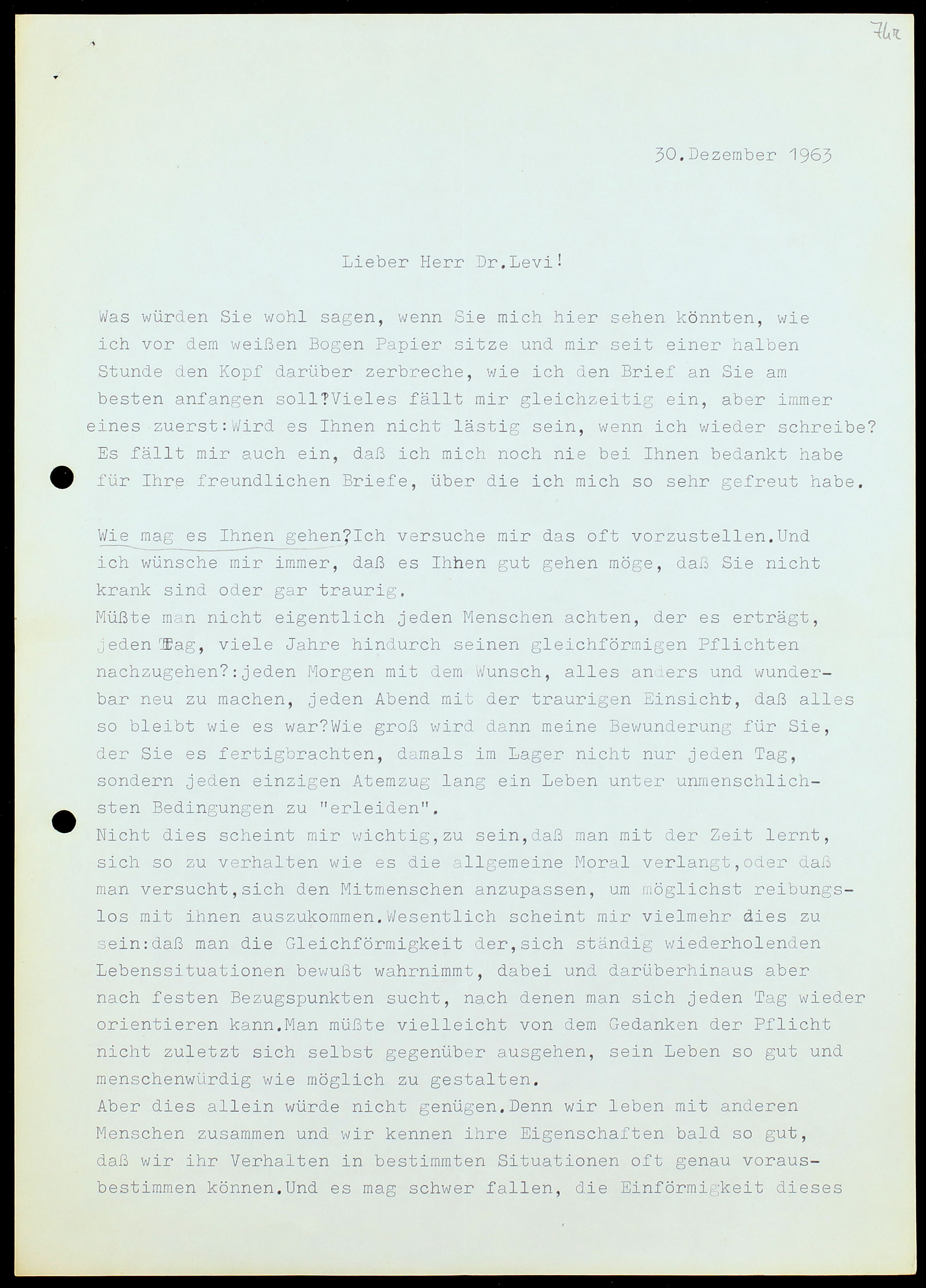
Was würden Sie wohl sagen, wenn Sie mich hier sehen könnten, wie ich vor dem weißen Bogen Papier sitze und mir seit einer halben Stunde den Kopf darüber zerbreche, wie ich den Brief an Sie am besten anfangen soll? Vieles fällt mir gleichzeitig ein, aber immer eines zuerst: Wird es Ihnen nicht lästig sein, wenn ich wieder schreibe? Es fällt mir auch ein, daß ich mich noch nie bei Ihnen bedankt habe für Ihre freundlichen Briefe, über die ich mich so sehr gefreut habe.
Wie mag es Ihnen gehen?[1] Ich versuche mir das oft vorzustellen. Und ich wünsche mir immer, daß es Ihnen gut gehen möge, daß Sie nicht krank sind oder gar traurig.
Müßte man nicht eigentlich jeden Menschen achten, der es erträgt, jeden Tag, viele Jahre hindurch seinen gleichförmigen Pflichten nachzugehen? : jeden Morgen mit dem Wunsch, alles anders und wunderbar neu zu machen, jeden Abend mit der traurigen Einsicht, daß alles so bleibt wie es war? Wie groß wird dann meine Bewunderung für Sie, der Sie es fertigbrachten, damals im Lager nicht nur jeden Tag, sondern jeden einzigen Atemzug lang ein Leben unter unmenschlichsten Bedingungen zu „erleiden”.
Nicht dies scheint mir wichtig, zu sein, daß man mit der Zeit lernt, sich so zu verhalten wie es die allgemeine Moral verlangt, oder daß man versucht, sich den Mitmenschen anzupassen, um möglichst reibungslos mit ihnen auszukommen.Wesentlich scheint mir vielmehr dies zu sein: daß man die Gleichförmigkeit der, sich ständig wiederholenden Lebenssituationen bewußt wahrnimmt, dabei und darüberhinaus aber nach festen Bezugspunkten sucht, nach denen man sich jeden Tag wieder orientieren kann. Man müßte vielleicht von dem Gedanken der Pflicht nicht zuletzt sich selbst gegenüber ausgehen, sein Leben so gut und menschenwürdig wie möglich zu gestalten.
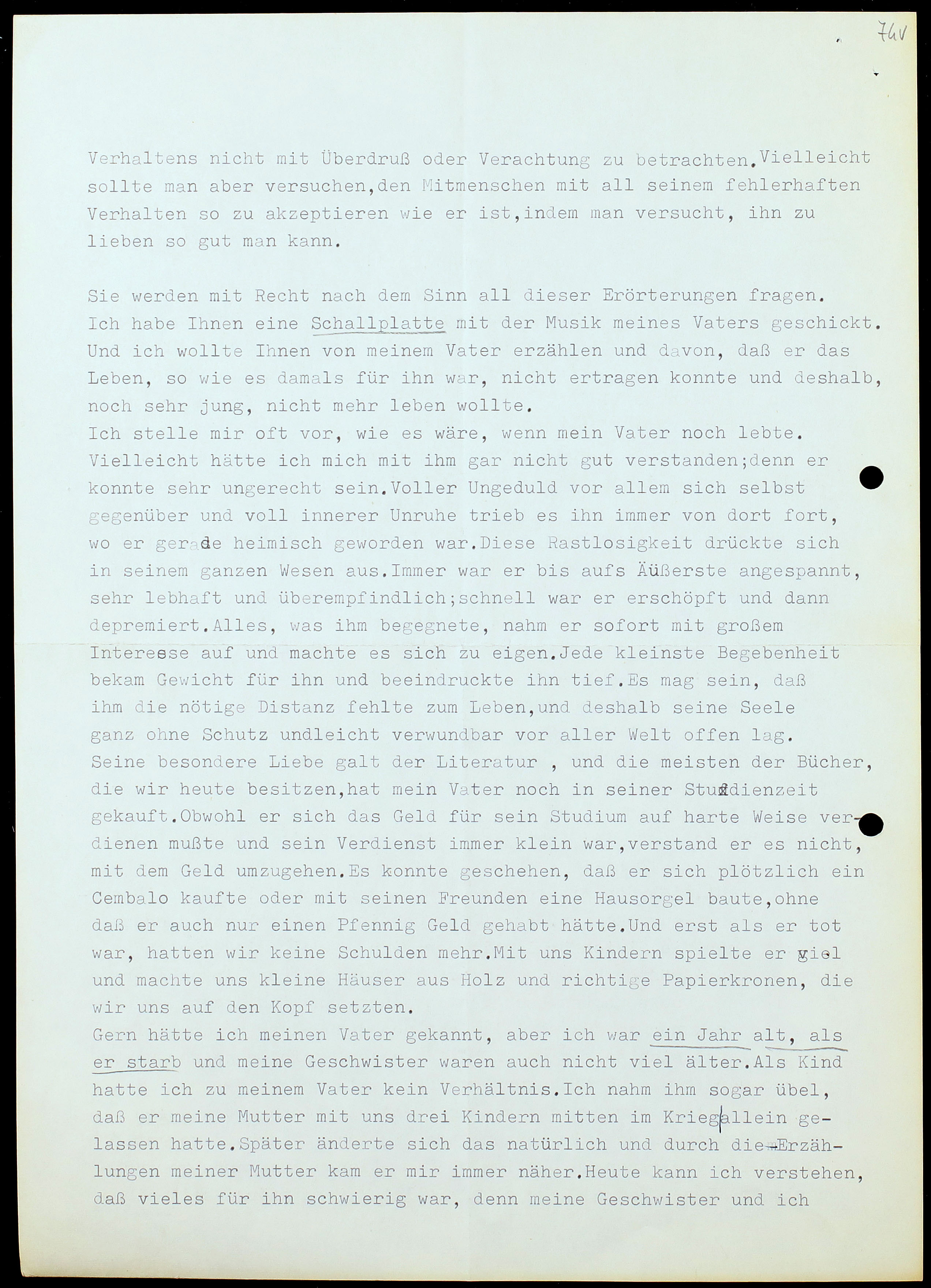
Aber dies allein würde nicht genügen. Denn wir leben mit anderen Menschen zusammen und wir kennen ihre Eigenschaften bald so gut, daß wir ihr Verhalten in bestimmten Situationen oft genau vorausbestimmen können. Und es mag schwer fallen, die Einförmigkeit dieses Verhaltens nicht mit Überdruß oder Verachtung zu betrachten. Vielleicht sollte man aber versuchen, den Mitmenschen mit all seinem fehlerhaften Verhalten so zu akzeptieren wie er ist, indem man versucht, ihn zu lieben so gut man kann.
Sie werden mit Recht nach dem Sinn all dieser Erörterungen fragen. Ich habe Ihnen eine Schallplatte[2] mit der Musik meines Vaters[3] geschickt. Und ich wollte Ihnen von meinem Vater erzählen und davon, daß er das Leben, so wie es damals für ihn war, nicht ertragen konnte und deshalb, noch sehr jung, nicht mehr leben wollte.
Ich stelle mir oft vor, wie es wäre, wenn mein Vater noch lebte. Vielleicht hätte ich mich mit ihm gar nicht gut verstanden; denn er konnte sehr ungerecht sein. Voller Ungeduld vor allem sich selbst gegenüber und voll innerer Unruhe trieb es ihn immer von dort fort, wo er gerade heimisch geworden war. Diese Rastlosigkeit drückte sich in seinem ganzen Wesen aus. Immer war er bis aufs Äüßerste angespannt, sehr lebhaft und überempfindlich; schnell war er erschöpft und dann depremiert. Alles, was ihm begegnete, nahm er sofort mit großem Interesse auf und machte es sich zu eigen. Jede kleinste Begebenheit bekam Gewicht für ihn und beeindruckte ihn tief. Es mag sein, daß ihm die nötige Distanz fehlte zum Leben, und deshalb seine Seele ganz ohne Schutz undleicht verwundbar vor aller Welt offen lag.
Seine besondere Liebe galt der Literatur, und die meisten der Bücher, die wir heute besitzen, hat mein Vater noch in seiner Studienzeit gekauft. Obwohl er sich das Geld für sein Studium auf harte Weise verdienen mußte und sein Verdienst immer klein war, verstand er es nicht, mit dem Geld umzugehen. Es konnte geschehen, daß er sich plötzlich ein Cembalo kaufte oder mit seinen Freunden eine Hausorgel baute, ohne daß er auch nur einen Pfennig Geld gehabt hätte. Und erst als er tot war, hatten wir keine Schulden mehr. Mit uns Kindern spielte er viel und machte uns kleine Häuser aus Holz und richtige Papierkronen, die wir uns auf den Kopf setzten.
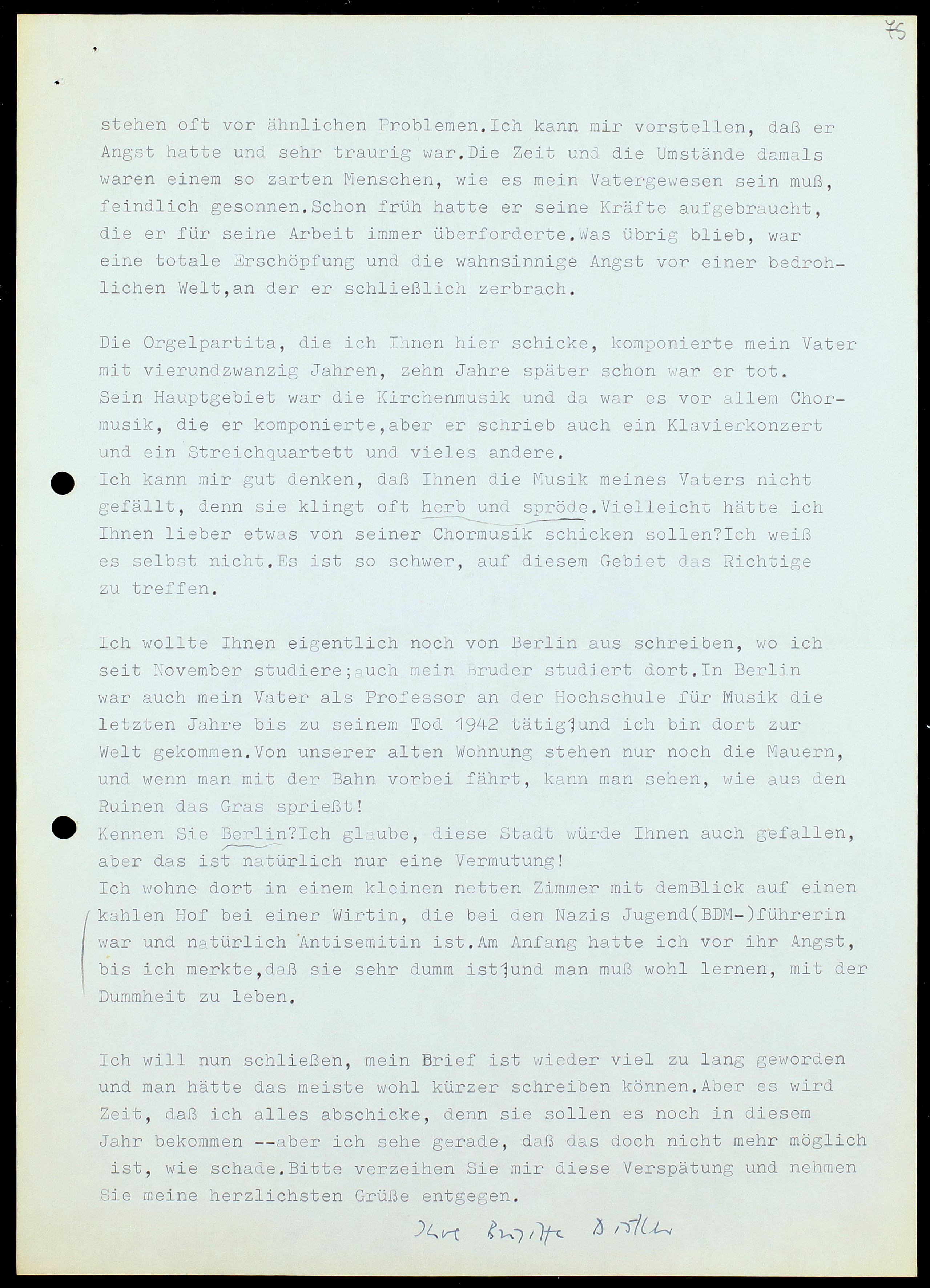
Gern hätte ich meinen Vater gekannt, aber ich war ein Jahr alt, als er starb[4] und meine Geschwister waren auch nicht viel älter. Als Kind hatte ich zu meinem Vater kein Verhältnis. Ich nahm ihm sogar übel, daß er meine Mutter mit uns drei Kindern mitten im Krieg allein gelassen hatte. Später änderte sich das natürlich und durch die Erzählungen meiner Mutterkam er mir immer näher. Heute kann ich verstehen, daß vieles für ihn schwierig war, denn meine Geschwister und ich stehen oft vor ähnlichen Problemen. Ich kann mir vorstellen, daß er Angst hatte und sehr traurig war. Die Zeit und die Umstände damals waren einem so zarten Menschen, wie es mein Vatergewesen sein muß, feindlich gesonnen. Schon früh hatte er seine Kräfte aufgebraucht, die er für seine Arbeit immer überforderte. Was übrig blieb, war eine totale Erschöpfung und die wahnsinnige Angst vor einer bedrohlichen Welt, an der er schließlich zerbrach.
Die Orgelpartita, die ich Ihnen hier schicke, komponierte mein Vatermit vierundzwanzig Jahren, zehn Jahre später schon war er tot.
Sein Hauptgebiet war die Kirchenmusik und da war es vor allem Chormusik, die er komponierte, aber er schrieb auch ein Klavierkonzert und ein Streichquartett und vieles andere.
Ich kann mir gut denken, daß Ihnen die Musik meines Vaters nicht gefällt, denn sie klingt oft herb und spröde.[5] Vielleicht hätte ich Ihnen lieber etwas von seiner Chormusik schicken sollen? Ich weiß es selbst nicht. Es ist so schwer, auf diesem Gebiet das Richtige zu treffen.
Ich wollte Ihnen eigentlich noch von Berlin aus schreiben, wo ich seit November studiere; auch mein Bruder studiert dort.[6] In Berlin war auch mein Vaterals Professor an der Hochschule für Musik die letzten Jahre bis zu seinem Tod 1942 tätig und ich bin dort zur Welt gekommen. Von unserer alten Wohnung stehen nur noch die Mauern, und wenn man mit der Bahn vorbei fährt, kann man sehen, wie aus den Ruinen das Gras sprießt![7]
Kennen Sie Berlin?[8] Ich glaube, diese Stadt würde Ihnen auch gefallen, aber das ist natürlich nur eine Vermutung!
Ich wohne dort in einem kleinen netten Zimmer mit dem Blick auf einen kahlen Hof bei einer Wirtin, die bei den Nazis Jugend (BDM–) führerin war und natürlich Antisemitin ist. Am Anfang hatte ich vor ihr Angst, bis ich merkte, daß sie sehr dumm ist und man muß wohl lernen, mit der Dummheit zu leben.[9]
Ich will nun schließen, mein Brief ist wieder viel zu lang geworden und man hätte das meiste wohl kürzer schreiben können. Aber es wird Zeit, daß ich alles abschicke, denn sie sollen es noch in diesem Jahr bekommen – aber ich sehe gerade, daß das doch nicht mehr möglich ist, wie schade. Bitte verzeihen Sie mir diese Verspätung und nehmen Sie meine herzlichsten Grüße entgegen.
Ihre Brigitte Distler
30 dicembre 1963
Caro Dottor Levi,
Cosa direbbe se potesse vedermi qui, seduta davanti al foglio bianco, intenta da mezz’ora a lambiccarmi il cervello chiedendomi come iniziare a meglio questa lettera? Sono tante le cose che mi frullano in testa, ma sempre una per primo: non La disturberò se Le scrivo ancora? Mi viene anche in mente che non L’ho mai ringraziata per le Sue lettere gentili, che mi hanno dato tanta gioia.
Come sta?[1] Cerco spesso di immaginarlo. E mi auguro sempre che stia bene, che non sia malato o, peggio, triste.
Non si dovrebbe forse rispettare chi sopporta, ogni giorno e per tanti anni, le proprie monotone incombenze quotidiane? Ogni mattina con il desiderio di fare qualcosa di completamente e meravigliosamente nuovo, ogni sera con l’amara consapevolezza che tutto è rimasto com’era? Quanto cresce allora la mia ammirazione per Lei, che nel Lager è riuscito a “sopportare” non solo ogni giorno, ma ogni singolo respiro, una vita nelle condizioni più disumane.
Quello che mi sembra importante non è imparare col tempo a comportarsi come vuole la morale comune, o cercare di adeguarsi agli altri per vivere senza attriti. Più essenziale mi sembra piuttosto vivere con consapevolezza la monotonia di situazioni che si ripetono, e nondimeno cercare punti fermi ai quali orientarsi di nuovo ogni giorno. Forse bisognerebbe partire dall’idea di dovere – anche verso se stessi – di rendere la vita il più possibile degna e umana.
Ma nemmeno questo basterebbe. Perché viviamo insieme ad altre persone, e conosciamo così bene la loro indole da poter prevedere spesso il loro comportamento. È difficile non guardare con noia o con disprezzo questa monotonia. O forse si dovrebbe provare ad accettare l’altro con tutte le sue mancanze, cercando ad amarlo come si può.
Si chiederà, a ragione, il senso di tutte queste considerazioni. Le ho mandato un disco[2] con la musica di mio padre.[3] E vorrei parlarLe di lui, lui che non è riuscito a sopportare la vita com’era allora, e ancora giovane non ha voluto più viverla.
Spesso mi chiedo come sarebbe, se mio padre fosse ancora vivo. Forse non saremmo andati molto d’accordo: sapeva essere molto ingiusto. Impaziente soprattutto con se stesso, sempre in preda a un’inquietudine che lo spingeva via dai luoghi dov’era appena diventato di casa. Questa irrequietezza si rifletteva in tutta la sua persona: teso fino allo stremo, vivace, ipersensibile; bastava poco per sfinirlo e poi farlo cadere in depressione. In qualunque cosa s’imbattesse, ne restava colpito e la faceva sua. Ogni minima circostanza per lui aveva peso e gli lasciava un’impressione profonda. Forse gli mancava la giusta distanza dalla vita, e perciò la sua anima era del tutto priva di difese, esposta e vulnerabile davanti al mondo.
Amava soprattutto la letteratura, e molti libri che ancora possediamo, mio padre li aveva comprati quando ancora studiava all’università. Anche se si è sempre mantenuto agli studi lavorando duramente e guadagnando poco, non ha mai imparato ad amministrare il denaro: capitava che all’improvviso comprasse un clavicembalo o costruisse un organo con gli amici, senza avere un soldo. Solo dopo la sua morte non abbiamo più avuto debiti. Con noi bambini giocava molto, costruiva casette di legno e vere corone di carta da metterci in testa.
Avrei tanto voluto conoscere mio padre, ma avevo un anno quando è morto[4]e i miei fratelli non erano molto più grandi. Da piccola gli rimproveravo di aver lasciato mia madre sola con tre figli piccoli nel bel mezzo della guerra. Con gli anni, naturalmente, il mio giudizio è cambiato, e grazie ai racconti di mia madre l’ho sentito sempre più vicino. Oggi capisco che per lui molte cose non erano facili, e spesso io e i mieifratelli ci troviamo di fronte agli stessi problemi. Posso immaginare la sua paura, la sua tristezza. I tempi e le circostanze di allora erano senz’altro avversi per un uomo sensibile quale doveva esser stato mio padre. Si sovraccaricava di lavoro, e ben presto aveva consumato le sue forze. Quel che gli restava era soltanto una stanchezza totale e un’angoscia folle di fronte a un mondo minaccioso che alla fine lo ha spezzato.
La partitura per organo che Le invio è stata composta da mio padre quando aveva ventiquattro anni; dieci anni dopo era già morto. Il suo campo era soprattutto la musica sacra, in particolare quella corale; ma ha composto anche un concerto per pianoforte, un quartetto d’archi e molto altro.
Immagino che la musica di mio padre possa non piacerLe: spesso è aspra e severa.[5] Forse avrei dovuto mandarLe un brano corale. Non so, è così difficile in questo ambito fare la scelta giusta.
Avrei voluto scriverLe anche di Berlino, dove studio da novembre, come anche mio fratello.[6] Lì, negli ultimi anni fino a quando è morto, nel 1942, mio padreha occupato una cattedra al Conservatorio; ed è sempre lì che sono nata io. Della nostra vecchia casa restano solo i muri: passando in treno si vede l’erba che spunta fra le macerie![7]
Conosce Berlino?[8]Credo che questa città Le piacerebbe, ma naturalmente è solo una mia supposizione!
Io abito in una piccola stanza con vista su un cortile spoglio, presso una padrona di casa che è stata una capogruppo della gioventù nazista (BDM) e naturalmente è antisemita. All’inizio mi faceva paura, ma poi ho capito che è molto stupida e bisognerà pur imparare a convivere con la stupidità.[9]
Ora chiudo, anche questa lettera è troppo lunga e molto avrei potuto dirlo più brevemente. È tempo di spedirla, se voglio che le arrivi entro quest’anno… ma vedo già che non sarà possibile, peccato. Mi scusi per il ritardo e accolga i miei più cordiali saluti,
Sua Brigitte Distler
December 30, 1963
Dear Mr. Levi,
What would you say if you could see me here, sitting before this blank sheet of paper, racking my brains for half an hour trying to figure out how best to begin this letter to you? Many things come to mind at once, but one thing always comes first: Will it not bother you if I write again? It also occurs to me that I have never thanked you for your kind letters, which I have enjoyed so much.
How are you?[1] I often try to imagine. And I always hope that you are well, neither ill nor sad.
Should one not respect everyone who can stand performing the same monotonous duties every day, year after year? Every morning with the desire to make everything different and wonderfully new, every evening with the sad realization that everything remains as it was? How great, then, is my admiration for you, who managed to “endure” life in the camp under the most inhuman conditions, not only every day, but every single breath.
What seems important to me is not that, over time, one learns to behave as general norms and morality demand, nor that one tries to adapt to one’s fellow human beings in order to get along with them as smoothly as possible.What strikes me as much more important is that one consciously perceives the uniformity of constantly repeating life situations, yet at the same time, above and beyond that, one searches for fixed points of reference that one can use to orient oneself every day. Perhaps one should start from the idea that it is one’s duty, not least to oneself, to make one’s life as good and as humane as possible.
But this alone would not be enough. For we live together with other people and we soon know their characteristics so well that we can often predict their behavior in certain situations. And it may be difficult not to view the monotony of this behavior with weariness or contempt. But perhaps one should try to accept one’s fellow human beings with all their flawed behavior as they are, by trying to love them as best one can.
You will rightly ask about the meaning of all this. I have sent you a record[2] of my father’s music.[3] And I wanted to tell you about my father and how he could not bear life as it was for him at the time and therefore, while still very young, no longer wanted to live.
I often imagine what it would be like if my father were still alive. Perhaps I would not have seen eye to eye with him very well, because he could be very unfair. Full of impatience, especially with himself, and full of inner turmoil, he was always driven away from wherever he had just settled down. This restlessness expressed itself in his entire being. He was always extremely tense, very lively, and hypersensitive; he quickly became exhausted and then depressed. He immediately took an interest in everything he encountered and made it his own. Every little event took on significance for him and made a deep impression on him. It may be that he lacked the necessary distance from life, and therefore his soul lay open to the world, completely unprotected and easily wounded.
He had a particular love of literature, and most of the books we own today are ones my father bought back when he was a student. Although he had to work hard to earn the money for his studies, and his earnings were always modest, he did not know how to manage his money. He would suddenly buy a harpsichord or build a chamber organ with his friends despite not having a penny to his name. It was only after he died that we were finally debt-free. He played with us children a lot and made us little wooden houses and real paper crowns that we wore on our heads.
I would have liked to have known my father, but I was one year old when he died[4] and my siblings were not much older. As a child, I had no relationship with my father. I even resented him for leaving my mother alone with us three children in the middle of the war. Later, of course, that changed, and through my mother’s stories, I grew closer to him. Today, I can understand that many things were difficult for him, because my siblings and I often face similar problems. I can imagine that he was afraid and very sad. The times and circumstances back then were hostile to someone as sensitive as my father must have been. He had exhausted his strength early on, always overworking himself. What remained was total exhaustion and an insane fear of a threatening world, which ultimately broke him.
The organ partita I am sending you here was composed by my father at the age of twenty-four; only ten years later, he was dead.
His primary domain was church music, and he mainly composed choral music, but he also wrote a piano concerto and a string quartet and many other works.
I can well imagine you might not like my father’s music, because it often sounds harsh and grating.[5] Perhaps I should have sent you something from his choral music instead? I myself do not really know. It is so difficult to get this kind of thing right.
I actually wanted to write to you from Berlin, where I have been studying since November; my brother[6] is also studying there. My father was a professor at the Hochschule für Musik in Berlin until his death in 1942, and I was born there. Only the outside walls of our old apartment building remain, and when you pass by on the train, you can see grass sprouting from the ruins![7]
Are you familiar with Berlin?[8]I think you would like this city too, but that is just a guess, of course!
I live there in a small, comfortable room overlooking a bare courtyard; my landlady was a Nazi youth leader (BDM) and is, of course, Antisemitic. At first I was afraid of her, but then I realized that she is very stupid, and that sooner or later one has to learn to live alongside stupidity.[9]
I will sign off now, as my letter has once again become much too long and most of it could probably have been written more concisely. But it is time for me to send all this, as I wanted you to receive it before the end of the year—but I can see that is no longer possible, which is a pity. Please forgive me for the delay and accept my warmest regards.
Yours, Brigitte Distler
30 Dezember 1963
Lieber Herr Dr. Levi!
Was würden Sie wohl sagen, wenn Sie mich hier sehen könnten, wie ich vor dem weißen Bogen Papier sitze und mir seit einer halben Stunde den Kopf darüber zerbreche, wie ich den Brief an Sie am besten anfangen soll? Vieles fällt mir gleichzeitig ein, aber immer eines zuerst: Wird es Ihnen nicht lästig sein, wenn ich wieder schreibe? Es fällt mir auch ein, daß ich mich noch nie bei Ihnen bedankt habe für Ihre freundlichen Briefe, über die ich mich so sehr gefreut habe.
Wie mag es Ihnen gehen?[1] Ich versuche mir das oft vorzustellen. Und ich wünsche mir immer, daß es Ihnen gut gehen möge, daß Sie nicht krank sind oder gar traurig.
Müßte man nicht eigentlich jeden Menschen achten, der es erträgt, jeden Tag, viele Jahre hindurch seinen gleichförmigen Pflichten nachzugehen? : jeden Morgen mit dem Wunsch, alles anders und wunderbar neu zu machen, jeden Abend mit der traurigen Einsicht, daß alles so bleibt wie es war? Wie groß wird dann meine Bewunderung für Sie, der Sie es fertigbrachten, damals im Lager nicht nur jeden Tag, sondern jeden einzigen Atemzug lang ein Leben unter unmenschlichsten Bedingungen zu „erleiden”.
Nicht dies scheint mir wichtig, zu sein, daß man mit der Zeit lernt, sich so zu verhalten wie es die allgemeine Moral verlangt, oder daß man versucht, sich den Mitmenschen anzupassen, um möglichst reibungslos mit ihnen auszukommen.Wesentlich scheint mir vielmehr dies zu sein: daß man die Gleichförmigkeit der, sich ständig wiederholenden Lebenssituationen bewußt wahrnimmt, dabei und darüberhinaus aber nach festen Bezugspunkten sucht, nach denen man sich jeden Tag wieder orientieren kann. Man müßte vielleicht von dem Gedanken der Pflicht nicht zuletzt sich selbst gegenüber ausgehen, sein Leben so gut und menschenwürdig wie möglich zu gestalten.
Aber dies allein würde nicht genügen. Denn wir leben mit anderen Menschen zusammen und wir kennen ihre Eigenschaften bald so gut, daß wir ihr Verhalten in bestimmten Situationen oft genau vorausbestimmen können. Und es mag schwer fallen, die Einförmigkeit dieses Verhaltens nicht mit Überdruß oder Verachtung zu betrachten. Vielleicht sollte man aber versuchen, den Mitmenschen mit all seinem fehlerhaften Verhalten so zu akzeptieren wie er ist, indem man versucht, ihn zu lieben so gut man kann.
Sie werden mit Recht nach dem Sinn all dieser Erörterungen fragen. Ich habe Ihnen eine Schallplatte[2] mit der Musik meines Vaters[3] geschickt. Und ich wollte Ihnen von meinem Vater erzählen und davon, daß er das Leben, so wie es damals für ihn war, nicht ertragen konnte und deshalb, noch sehr jung, nicht mehr leben wollte.
Ich stelle mir oft vor, wie es wäre, wenn mein Vater noch lebte. Vielleicht hätte ich mich mit ihm gar nicht gut verstanden; denn er konnte sehr ungerecht sein. Voller Ungeduld vor allem sich selbst gegenüber und voll innerer Unruhe trieb es ihn immer von dort fort, wo er gerade heimisch geworden war. Diese Rastlosigkeit drückte sich in seinem ganzen Wesen aus. Immer war er bis aufs Äüßerste angespannt, sehr lebhaft und überempfindlich; schnell war er erschöpft und dann depremiert. Alles, was ihm begegnete, nahm er sofort mit großem Interesse auf und machte es sich zu eigen. Jede kleinste Begebenheit bekam Gewicht für ihn und beeindruckte ihn tief. Es mag sein, daß ihm die nötige Distanz fehlte zum Leben, und deshalb seine Seele ganz ohne Schutz undleicht verwundbar vor aller Welt offen lag.
Seine besondere Liebe galt der Literatur, und die meisten der Bücher, die wir heute besitzen, hat mein Vater noch in seiner Studienzeit gekauft. Obwohl er sich das Geld für sein Studium auf harte Weise verdienen mußte und sein Verdienst immer klein war, verstand er es nicht, mit dem Geld umzugehen. Es konnte geschehen, daß er sich plötzlich ein Cembalo kaufte oder mit seinen Freunden eine Hausorgel baute, ohne daß er auch nur einen Pfennig Geld gehabt hätte. Und erst als er tot war, hatten wir keine Schulden mehr. Mit uns Kindern spielte er viel und machte uns kleine Häuser aus Holz und richtige Papierkronen, die wir uns auf den Kopf setzten.
Gern hätte ich meinen Vater gekannt, aber ich war ein Jahr alt, als er starb[4] und meine Geschwister waren auch nicht viel älter. Als Kind hatte ich zu meinem Vater kein Verhältnis. Ich nahm ihm sogar übel, daß er meine Mutter mit uns drei Kindern mitten im Krieg allein gelassen hatte. Später änderte sich das natürlich und durch die Erzählungen meiner Mutterkam er mir immer näher. Heute kann ich verstehen, daß vieles für ihn schwierig war, denn meine Geschwister und ich stehen oft vor ähnlichen Problemen. Ich kann mir vorstellen, daß er Angst hatte und sehr traurig war. Die Zeit und die Umstände damals waren einem so zarten Menschen, wie es mein Vatergewesen sein muß, feindlich gesonnen. Schon früh hatte er seine Kräfte aufgebraucht, die er für seine Arbeit immer überforderte. Was übrig blieb, war eine totale Erschöpfung und die wahnsinnige Angst vor einer bedrohlichen Welt, an der er schließlich zerbrach.
Die Orgelpartita, die ich Ihnen hier schicke, komponierte mein Vatermit vierundzwanzig Jahren, zehn Jahre später schon war er tot.
Sein Hauptgebiet war die Kirchenmusik und da war es vor allem Chormusik, die er komponierte, aber er schrieb auch ein Klavierkonzert und ein Streichquartett und vieles andere.
Ich kann mir gut denken, daß Ihnen die Musik meines Vaters nicht gefällt, denn sie klingt oft herb und spröde.[5] Vielleicht hätte ich Ihnen lieber etwas von seiner Chormusik schicken sollen? Ich weiß es selbst nicht. Es ist so schwer, auf diesem Gebiet das Richtige zu treffen.
Ich wollte Ihnen eigentlich noch von Berlin aus schreiben, wo ich seit November studiere; auch mein Bruder studiert dort.[6] In Berlin war auch mein Vaterals Professor an der Hochschule für Musik die letzten Jahre bis zu seinem Tod 1942 tätig und ich bin dort zur Welt gekommen. Von unserer alten Wohnung stehen nur noch die Mauern, und wenn man mit der Bahn vorbei fährt, kann man sehen, wie aus den Ruinen das Gras sprießt![7]
Kennen Sie Berlin?[8] Ich glaube, diese Stadt würde Ihnen auch gefallen, aber das ist natürlich nur eine Vermutung!
Ich wohne dort in einem kleinen netten Zimmer mit dem Blick auf einen kahlen Hof bei einer Wirtin, die bei den Nazis Jugend (BDM–) führerin war und natürlich Antisemitin ist. Am Anfang hatte ich vor ihr Angst, bis ich merkte, daß sie sehr dumm ist und man muß wohl lernen, mit der Dummheit zu leben.[9]
Ich will nun schließen, mein Brief ist wieder viel zu lang geworden und man hätte das meiste wohl kürzer schreiben können. Aber es wird Zeit, daß ich alles abschicke, denn sie sollen es noch in diesem Jahr bekommen – aber ich sehe gerade, daß das doch nicht mehr möglich ist, wie schade. Bitte verzeihen Sie mir diese Verspätung und nehmen Sie meine herzlichsten Grüße entgegen.
Ihre Brigitte Distler
30 dicembre 1963
Caro Dottor Levi,
Cosa direbbe se potesse vedermi qui, seduta davanti al foglio bianco, intenta da mezz’ora a lambiccarmi il cervello chiedendomi come iniziare a meglio questa lettera? Sono tante le cose che mi frullano in testa, ma sempre una per primo: non La disturberò se Le scrivo ancora? Mi viene anche in mente che non L’ho mai ringraziata per le Sue lettere gentili, che mi hanno dato tanta gioia.
Come sta?[1] Cerco spesso di immaginarlo. E mi auguro sempre che stia bene, che non sia malato o, peggio, triste.
Non si dovrebbe forse rispettare chi sopporta, ogni giorno e per tanti anni, le proprie monotone incombenze quotidiane? Ogni mattina con il desiderio di fare qualcosa di completamente e meravigliosamente nuovo, ogni sera con l’amara consapevolezza che tutto è rimasto com’era? Quanto cresce allora la mia ammirazione per Lei, che nel Lager è riuscito a “sopportare” non solo ogni giorno, ma ogni singolo respiro, una vita nelle condizioni più disumane.
Quello che mi sembra importante non è imparare col tempo a comportarsi come vuole la morale comune, o cercare di adeguarsi agli altri per vivere senza attriti. Più essenziale mi sembra piuttosto vivere con consapevolezza la monotonia di situazioni che si ripetono, e nondimeno cercare punti fermi ai quali orientarsi di nuovo ogni giorno. Forse bisognerebbe partire dall’idea di dovere – anche verso se stessi – di rendere la vita il più possibile degna e umana.
Ma nemmeno questo basterebbe. Perché viviamo insieme ad altre persone, e conosciamo così bene la loro indole da poter prevedere spesso il loro comportamento. È difficile non guardare con noia o con disprezzo questa monotonia. O forse si dovrebbe provare ad accettare l’altro con tutte le sue mancanze, cercando ad amarlo come si può.
Si chiederà, a ragione, il senso di tutte queste considerazioni. Le ho mandato un disco[2] con la musica di mio padre.[3] E vorrei parlarLe di lui, lui che non è riuscito a sopportare la vita com’era allora, e ancora giovane non ha voluto più viverla.
Spesso mi chiedo come sarebbe, se mio padre fosse ancora vivo. Forse non saremmo andati molto d’accordo: sapeva essere molto ingiusto. Impaziente soprattutto con se stesso, sempre in preda a un’inquietudine che lo spingeva via dai luoghi dov’era appena diventato di casa. Questa irrequietezza si rifletteva in tutta la sua persona: teso fino allo stremo, vivace, ipersensibile; bastava poco per sfinirlo e poi farlo cadere in depressione. In qualunque cosa s’imbattesse, ne restava colpito e la faceva sua. Ogni minima circostanza per lui aveva peso e gli lasciava un’impressione profonda. Forse gli mancava la giusta distanza dalla vita, e perciò la sua anima era del tutto priva di difese, esposta e vulnerabile davanti al mondo.
Amava soprattutto la letteratura, e molti libri che ancora possediamo, mio padre li aveva comprati quando ancora studiava all’università. Anche se si è sempre mantenuto agli studi lavorando duramente e guadagnando poco, non ha mai imparato ad amministrare il denaro: capitava che all’improvviso comprasse un clavicembalo o costruisse un organo con gli amici, senza avere un soldo. Solo dopo la sua morte non abbiamo più avuto debiti. Con noi bambini giocava molto, costruiva casette di legno e vere corone di carta da metterci in testa.
Avrei tanto voluto conoscere mio padre, ma avevo un anno quando è morto[4]e i miei fratelli non erano molto più grandi. Da piccola gli rimproveravo di aver lasciato mia madre sola con tre figli piccoli nel bel mezzo della guerra. Con gli anni, naturalmente, il mio giudizio è cambiato, e grazie ai racconti di mia madre l’ho sentito sempre più vicino. Oggi capisco che per lui molte cose non erano facili, e spesso io e i mieifratelli ci troviamo di fronte agli stessi problemi. Posso immaginare la sua paura, la sua tristezza. I tempi e le circostanze di allora erano senz’altro avversi per un uomo sensibile quale doveva esser stato mio padre. Si sovraccaricava di lavoro, e ben presto aveva consumato le sue forze. Quel che gli restava era soltanto una stanchezza totale e un’angoscia folle di fronte a un mondo minaccioso che alla fine lo ha spezzato.
La partitura per organo che Le invio è stata composta da mio padre quando aveva ventiquattro anni; dieci anni dopo era già morto. Il suo campo era soprattutto la musica sacra, in particolare quella corale; ma ha composto anche un concerto per pianoforte, un quartetto d’archi e molto altro.
Immagino che la musica di mio padre possa non piacerLe: spesso è aspra e severa.[5] Forse avrei dovuto mandarLe un brano corale. Non so, è così difficile in questo ambito fare la scelta giusta.
Avrei voluto scriverLe anche di Berlino, dove studio da novembre, come anche mio fratello.[6] Lì, negli ultimi anni fino a quando è morto, nel 1942, mio padreha occupato una cattedra al Conservatorio; ed è sempre lì che sono nata io. Della nostra vecchia casa restano solo i muri: passando in treno si vede l’erba che spunta fra le macerie![7]
Conosce Berlino?[8]Credo che questa città Le piacerebbe, ma naturalmente è solo una mia supposizione!
Io abito in una piccola stanza con vista su un cortile spoglio, presso una padrona di casa che è stata una capogruppo della gioventù nazista (BDM) e naturalmente è antisemita. All’inizio mi faceva paura, ma poi ho capito che è molto stupida e bisognerà pur imparare a convivere con la stupidità.[9]
Ora chiudo, anche questa lettera è troppo lunga e molto avrei potuto dirlo più brevemente. È tempo di spedirla, se voglio che le arrivi entro quest’anno… ma vedo già che non sarà possibile, peccato. Mi scusi per il ritardo e accolga i miei più cordiali saluti,
Sua Brigitte Distler
December 30, 1963
Dear Mr. Levi,
What would you say if you could see me here, sitting before this blank sheet of paper, racking my brains for half an hour trying to figure out how best to begin this letter to you? Many things come to mind at once, but one thing always comes first: Will it not bother you if I write again? It also occurs to me that I have never thanked you for your kind letters, which I have enjoyed so much.
How are you?[1] I often try to imagine. And I always hope that you are well, neither ill nor sad.
Should one not respect everyone who can stand performing the same monotonous duties every day, year after year? Every morning with the desire to make everything different and wonderfully new, every evening with the sad realization that everything remains as it was? How great, then, is my admiration for you, who managed to “endure” life in the camp under the most inhuman conditions, not only every day, but every single breath.
What seems important to me is not that, over time, one learns to behave as general norms and morality demand, nor that one tries to adapt to one’s fellow human beings in order to get along with them as smoothly as possible.What strikes me as much more important is that one consciously perceives the uniformity of constantly repeating life situations, yet at the same time, above and beyond that, one searches for fixed points of reference that one can use to orient oneself every day. Perhaps one should start from the idea that it is one’s duty, not least to oneself, to make one’s life as good and as humane as possible.
But this alone would not be enough. For we live together with other people and we soon know their characteristics so well that we can often predict their behavior in certain situations. And it may be difficult not to view the monotony of this behavior with weariness or contempt. But perhaps one should try to accept one’s fellow human beings with all their flawed behavior as they are, by trying to love them as best one can.
You will rightly ask about the meaning of all this. I have sent you a record[2] of my father’s music.[3] And I wanted to tell you about my father and how he could not bear life as it was for him at the time and therefore, while still very young, no longer wanted to live.
I often imagine what it would be like if my father were still alive. Perhaps I would not have seen eye to eye with him very well, because he could be very unfair. Full of impatience, especially with himself, and full of inner turmoil, he was always driven away from wherever he had just settled down. This restlessness expressed itself in his entire being. He was always extremely tense, very lively, and hypersensitive; he quickly became exhausted and then depressed. He immediately took an interest in everything he encountered and made it his own. Every little event took on significance for him and made a deep impression on him. It may be that he lacked the necessary distance from life, and therefore his soul lay open to the world, completely unprotected and easily wounded.
He had a particular love of literature, and most of the books we own today are ones my father bought back when he was a student. Although he had to work hard to earn the money for his studies, and his earnings were always modest, he did not know how to manage his money. He would suddenly buy a harpsichord or build a chamber organ with his friends despite not having a penny to his name. It was only after he died that we were finally debt-free. He played with us children a lot and made us little wooden houses and real paper crowns that we wore on our heads.
I would have liked to have known my father, but I was one year old when he died[4] and my siblings were not much older. As a child, I had no relationship with my father. I even resented him for leaving my mother alone with us three children in the middle of the war. Later, of course, that changed, and through my mother’s stories, I grew closer to him. Today, I can understand that many things were difficult for him, because my siblings and I often face similar problems. I can imagine that he was afraid and very sad. The times and circumstances back then were hostile to someone as sensitive as my father must have been. He had exhausted his strength early on, always overworking himself. What remained was total exhaustion and an insane fear of a threatening world, which ultimately broke him.
The organ partita I am sending you here was composed by my father at the age of twenty-four; only ten years later, he was dead.
His primary domain was church music, and he mainly composed choral music, but he also wrote a piano concerto and a string quartet and many other works.
I can well imagine you might not like my father’s music, because it often sounds harsh and grating.[5] Perhaps I should have sent you something from his choral music instead? I myself do not really know. It is so difficult to get this kind of thing right.
I actually wanted to write to you from Berlin, where I have been studying since November; my brother[6] is also studying there. My father was a professor at the Hochschule für Musik in Berlin until his death in 1942, and I was born there. Only the outside walls of our old apartment building remain, and when you pass by on the train, you can see grass sprouting from the ruins![7]
Are you familiar with Berlin?[8]I think you would like this city too, but that is just a guess, of course!
I live there in a small, comfortable room overlooking a bare courtyard; my landlady was a Nazi youth leader (BDM) and is, of course, Antisemitic. At first I was afraid of her, but then I realized that she is very stupid, and that sooner or later one has to learn to live alongside stupidity.[9]
I will sign off now, as my letter has once again become much too long and most of it could probably have been written more concisely. But it is time for me to send all this, as I wanted you to receive it before the end of the year—but I can see that is no longer possible, which is a pity. Please forgive me for the delay and accept my warmest regards.
Yours, Brigitte Distler
Info
Notes
Tag
Sender: Brigitte Distler
Addressee: Primo Levi
Date of Drafting: 1963-12-30
Place of Writing: Berlin
Description:typewritten letter with handwritten signature in blue ballpoint pen. The pages have marks and underlining in pencil by Levi.
Archive: Archivio privato di Primo Levi, Turin
Series: Complesso di Fondi primo Levi, Fondo Primo Levi, Corrispondenza, Corrispondenti particolari, fasc. 20, sottofasc. 001, doc. 025, f. 74r/v, 75.
Folio: 1 front and back, 1 front only
DOI: https://doi.org/10.15160/9fyt-8f66
1“Wie mag es Ihnen gehen?” is underlined by hand in pencil.
2
“Schallplatte” is underlined by hand in pencil. The composition that Brigitte Distler sent Levi might be Nun komm, der HeidenHeiland, composed in 1932 and whose score can be consulted in the Digital Library of the Bayerische Staatsbibliothek, where it is conserved in the Hugo Distler fonds.
3
Hugo Distler was a German composer of sacred music; he committed suicide in 1942, when Brigitte was only one year old. For information about his life and his musical production, see the
The Distler family lived in Oberbarnim, in the municipality of Straussberg, on the outskirts of Berlin, cf. the biography of Brigitte Distler.
8
“Berlin” is underlined by hand in pencil. Levi was in Berlin in the summer of 1962, as he writes in a letter to Heinz Riedt on August 25 of that year: “It was a highly educational and memorable experience. Berlin truly struck me as a sinister city, and not only East Berlin. The wall itself is something horrible and barbaric, and full of discouraging foreboding; moreover, it is exploited (or better, it was: today everything is once again topsy-turvy) to the repugnant self-satisfaction of the Westerners, who organize short exemplary trips along the wall and beyond for foreign tourists, and sell photographs, mementos, and refreshments near the check points. You know that I have mixed and ambivalent feelings about Germany and the Germans: I returned home even more confused, with the impression that wrong is everywhere and right is nowhere, full of anxiety and fear, and the sensation that a monstrous egg is being incubated in Berlin” (P. Levi, Il carteggio con Heinz Riedt, cit., pp. 123-24).
9
The paragraph is marked with a handwritten sign in pencil in the inner margin of the sheet. Distler alludes to the League of German Girls [Bund Deutscher Mädel]; cf. n. 2 Letter 153.