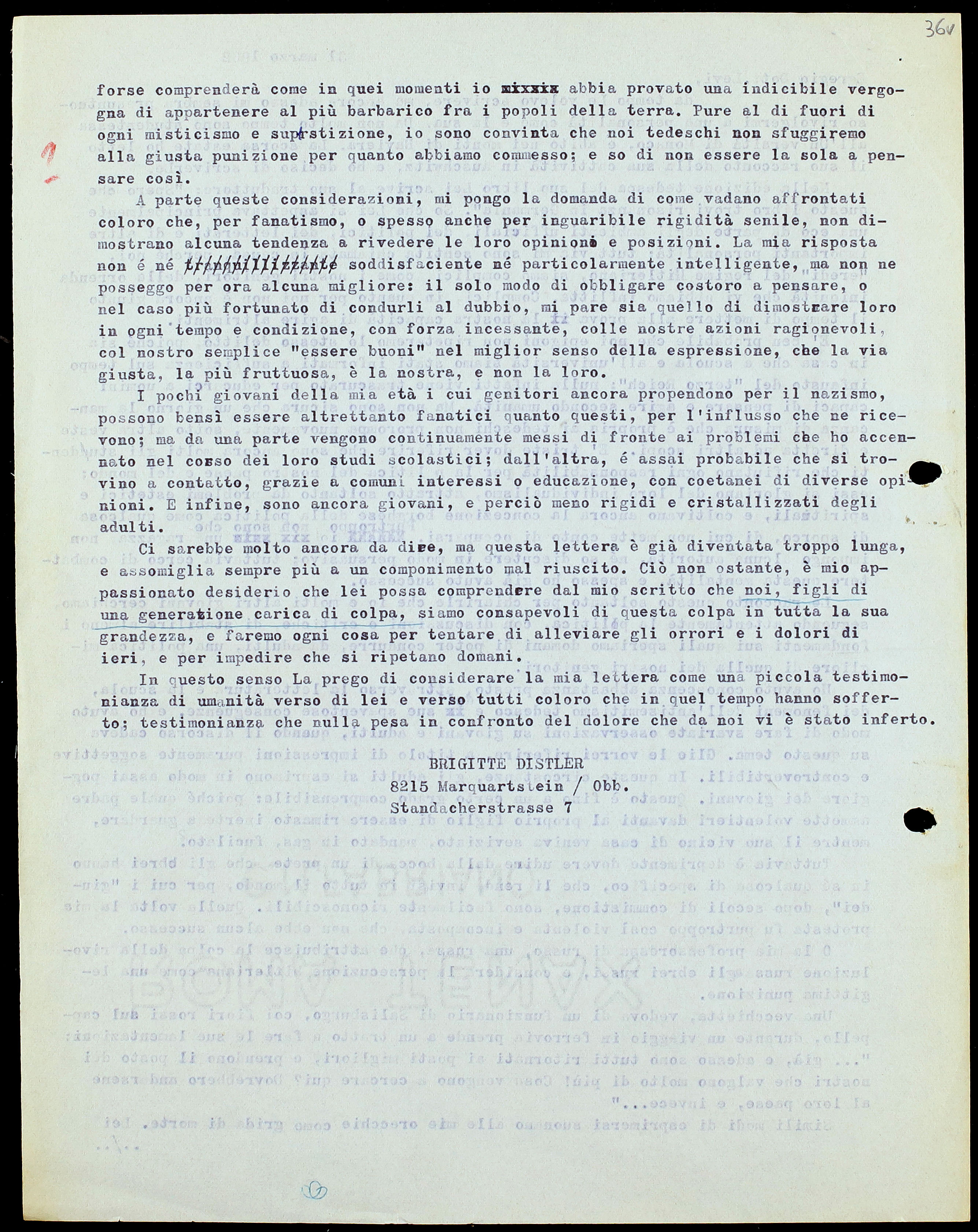
Brigitte Distler, a young university student from Munich, the daughter of the musician Hugo Distler, writes to Levi that she feels as though a line in the Preface of Ist das ein Mensch? is addressed to her, too, and shares her own impressions of contemporary Germany.
31.März 1962
Sehr geehrter Herr Dr. Levi!
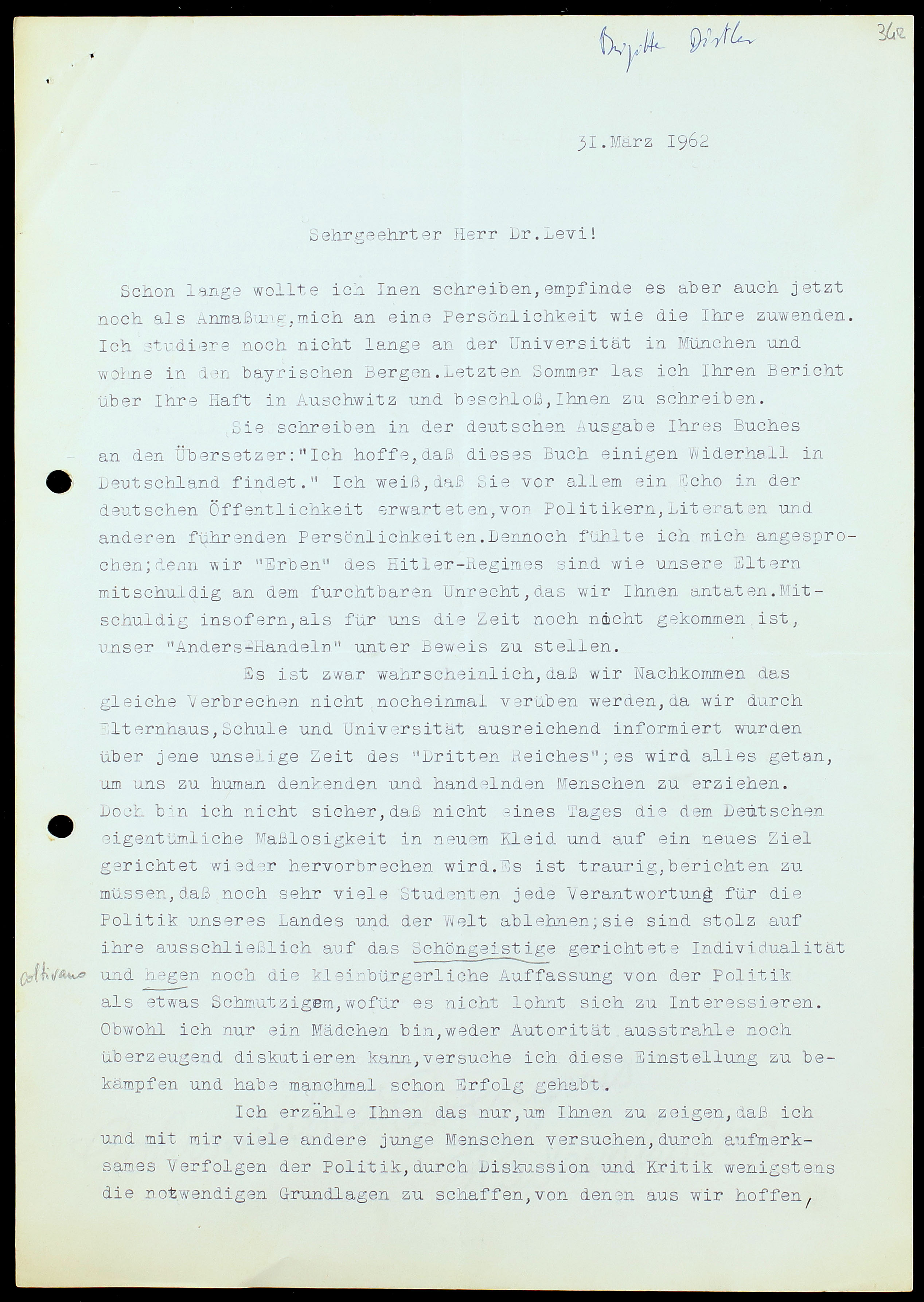
Schon lange wollte ich Inen schreiben, empfinde es aber auch jetzt noch als Anmaßung, mich an eine Persönlichkeit wie die Ihre zuwenden. Ich studiere noch nicht lange an der Universität in München und wohne in den bayrischen Bergen.[1] Letzten Sommer las ich Ihren Bericht über Ihre Haft in Auschwitz und beschloß, Ihnen zu schreiben.[2]
Sie schreiben in der deutschen Ausgabe Ihres Buches an den Übersetzer: „Ich hoffe, daß dieses Buch einigen Widerhall in Deutschland findet”.[3] Ich weiß, daß Sie vor allem ein Echo in der deutschen Öffentlichkeit erwarteten, von Politikern, Literaten und anderen führenden Persönlichkeiten. Dennoch fühlte ich mich angesprochen; denn wir „Erben“ des Hitler-Regimes sind wie unsere Eltern mitschuldig an dem furchtbaren Unrecht, das wir Ihnen antaten. Mitschuldig insofern, als für uns die Zeit noch nicht gekommen ist, unser „Anders-Handeln” unter Beweis zu stellen.
Es ist zwar wahrscheinlich, daß wir Nachkommen das gleiche Verbrechen nicht nocheinmal verüben werden, da wir durch Elternhaus, Schule und Universität ausreichend informiert wurden über jene unselige Zeit des „Dritten Reiches”; es wird alles getan, um uns zu human denkenden und handelnden Menschen zu erziehen.
Doch bin ich nicht sicher, daß nicht eines Tages die dem Deutschen eigentümliche Maßlosigkeit in neuem Kleid und auf ein neues Ziel gerichtet wieder hervorbrechen wird. Es ist traurig, berichten zu müssen, daß noch sehr viele Studenten jede Verantwortung für die Politik unseres Landes und der Welt ablehnen; sie sind stolz auf ihre ausschließlich auf das Schöngeistige[4] gerichtete Individualität und hegen[5] noch die kleinbürgerliche Auffassung von der Politik als etwas Schmutzigem, wofür es nicht lohnt sich zu Interessieren.
Obwohl ich nur ein Mädchen bin, weder Autorität ausstrahle noch überzeugend diskutieren kann, versuche ich diese Einstellung zu bekämpfen und habe manchmal schon Erfolg gehabt.
Ich erzähle Ihnen das nur, um Ihnen zu zeigen, daß ich und mit mir viele andere junge Menschen versuchen, durch aufmerksames Verfolgen der Politik, durch Diskussion und Kritik wenigstens die notwendigen Grundlagen zu schaffen, von denen aus wir hoffen, als Erwachsene eine bessere Politik führen zu können als unsere Eltern es taten.
Schon ziemlich früh durch Literatur und Schule mit den Erscheinungen des deutschen Antisemitismus und seinen entsetzlichen Folgen in Berührung gekommen, machte ich bei Erwachsenen wie Jugendlichen die verschiedensten Beobachtungen, wenn das Gespräch auf dieses Thema kam. Ich möchte sie Ihnen mitteilen als rein subjektive und anfechtbare[6] Eindrücke. Es schneiden mit ihren Äußerungen dabei die Erwachsenen sehr viel schlechter ab als die Jugendlichen. Das ist bis zu einem gewissen Grade verständlich, denn welcher Vater gibt vor seinem Kind gerne zu, er hätte tatenlos zugesehen, als sien Nachbar im gleichen Haus mißhandelt, vergast und erschossen wurde.
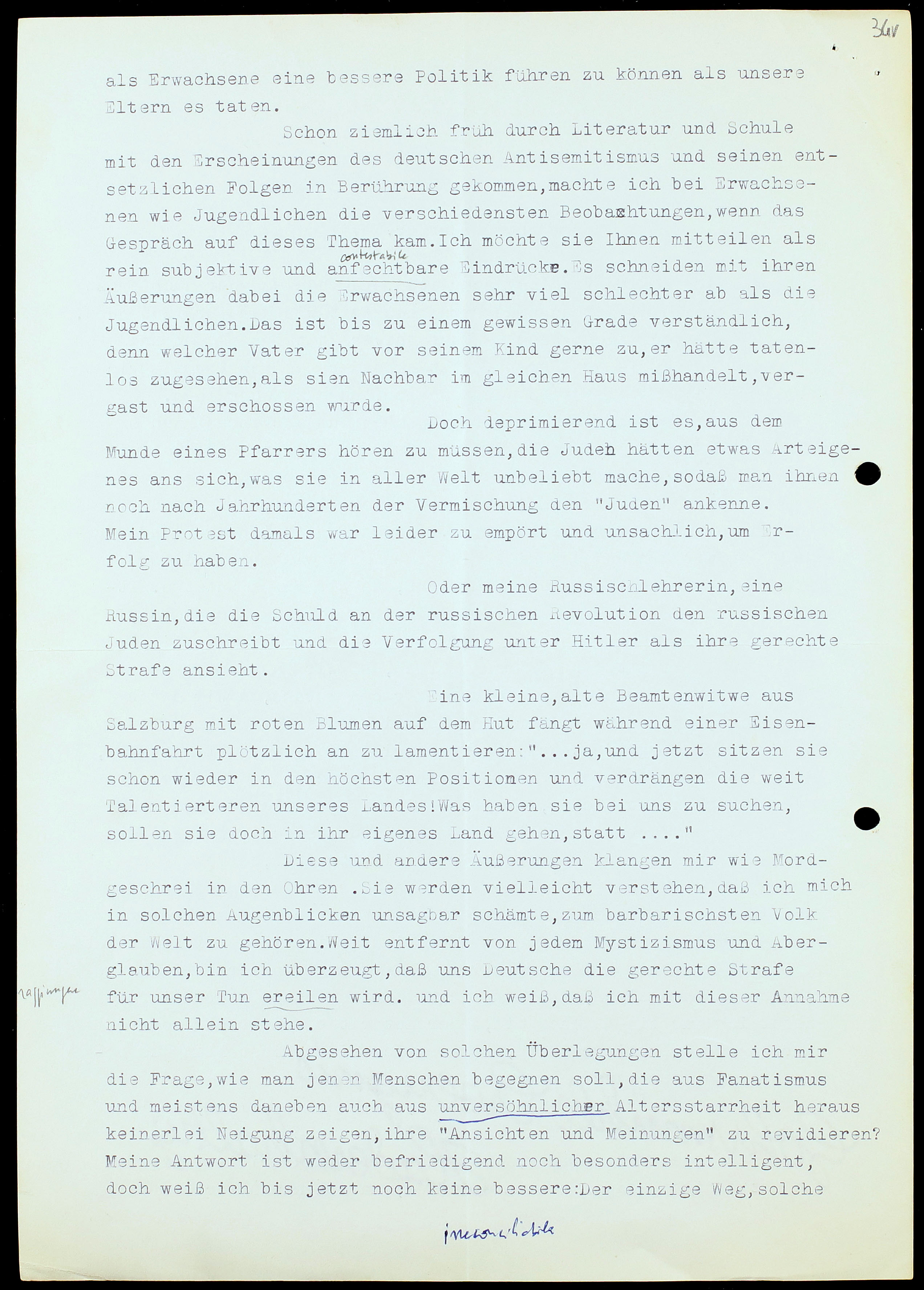
Doch deprimierend ist es, aus dem Munde eines Pfarrers hören zu müssen, die Juden hätten etwas Arteigenes ans sich, was sie in aller Welt unbeliebt mache, sodaß man ihnen noch nach Jahrhunderten der Vermischung den „Juden“ ankenne. Mein Protest damals war leider zu empört und unsachlich, um Erfolg zu haben.
Oder meine Russischlehrerin, eine Russin, die die Schuld an der russischen Revolution den russischen Juden zuschreibt und die Verfolgung unter Hitler als ihre gerechte Strafe ansieht.
Eine kleine, alte Beamtenwitwe aus Salzburg mit roten Blumen auf dem Hut fängt während einer Eisenbahnfahrt plötzlich an zu lamentieren: „… ja, und jetzt sitzen sie schon wieder in den höchsten Positionen und verdrängen die weit Talentierteren unseres Landes! Was haben sie bei uns zu suchen, sollen sie doch in ihr eigenes Land gehen, statt …”
Diese und andere Äußerungen klangen mir wie Mordgeschrei in den Ohren. Sie werden vielleicht verstehen, daß ich mich in solchen Augenblicken unsagbar schämte, zum barbarischsten Volk der Welt zu gehören. Weit entfernt von jedem Mystizismus und Aberglauben, bin ich überzeugt, daß uns Deutsche die gerechte Strafe für unser Tun ereilen[7]wird und ich weiß, daß ich mit dieser Annahme nicht allein stehe.
Abgesehen von solchen Überlegungen stelle ich mir die Frage, wie man jenen Menschen begegnen soll, die aus Fanatismus und meistens daneben auch aus unversöhnlicher[8]Altersstarrheit heraus keinerlei Neigung zeigen, ihre „Ansichten und Meinungen” zu revidieren?
Meine Antwort ist weder befriedigend noch besonders intelligent, doch weiß ich bis jetzt noch keine bessere: Der einzige Weg, solche Menschen zumindest nachdenklich, im Glücksfalle schwankend zu machen, scheint mir der zu sein, ihnen durch unser vernünftiges Handeln, durch unser bloßes „Gut-Sein“ imbesten Sinne und zwar in allen Lagen und Zeiten unvermindert stark zu zeigen, daß unser Weg der richtige, der fruchtbringende ist und nicht der ihre.
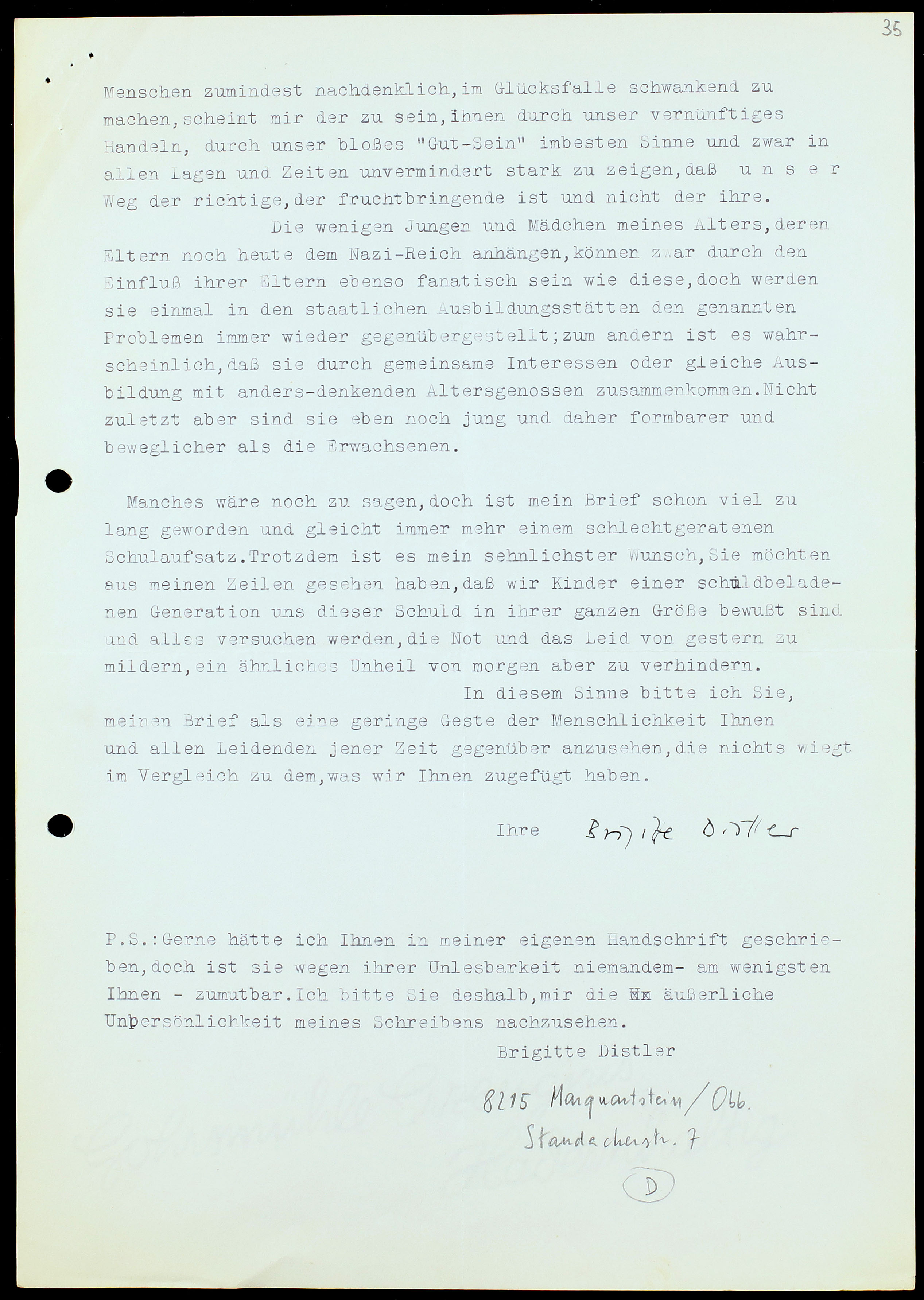
Die wenigen Jungen und Mädchen meines Alters, deren Eltern noch heute dem Nazi-Reich anhängen, können zwar durch den Einfluß ihrer Eltern ebenso fanatisch sein wie diese, doch werden sie einmal in den staatlichen Ausbildungsstätten den genannten Problemen immer wieder gegenübergestellt; zum andern ist es wahrscheinlich, daß sie durch gemeinsame Interessen oder gleiche Ausbildung mit anders-denkenden Altersgenossen zusammenkommen. Nicht zuletzt aber sind sie eben noch jung und daher formbarer und beweglicher als die Erwachsenen.
Manches wäre noch zu sagen, doch ist mein Brief schon viel zu lang geworden und gleicht immer mehr einem schlechtgeratenen Schulaufsatz. Trotzdem ist es mein sehnlichster Wunsch, Sie möchten aus meinen Zeilen gesehen haben, daß wir Kinder einer schuldbeladenen Generation uns dieser Schuld in ihrer ganzen Größe bewußt sind und alles versuchen werden, die Not und das Leid von gestern zu mildern, ein ähnliches Unheil von morgen aber zu verhindern.
In diesem Sinne bitte ich Sie, meinen Brief als eine geringe Geste der Menschlichkeit Ihnen und allen Leidenden jener Zeit gegenüber anzusehen, die nichts wiegt im Vergleich zu dem, was wir Ihnen zugefügt haben.
Ihre
Brigitte Distler
P.S.: Gerne hätte ich Ihnen in meiner eigenen Handschrift geschrieben, doch ist sie wegen ihrer Unlesbarkeit niemandem – am wenigsten Ihnen – zumutbar. Ich bitte Sie deshalb, mir die äußerliche Unpersönlichkeit meines Schreibens nachzusehen.
Brigitte Distler
31 marzo 1962
Egregio Dott. Levi
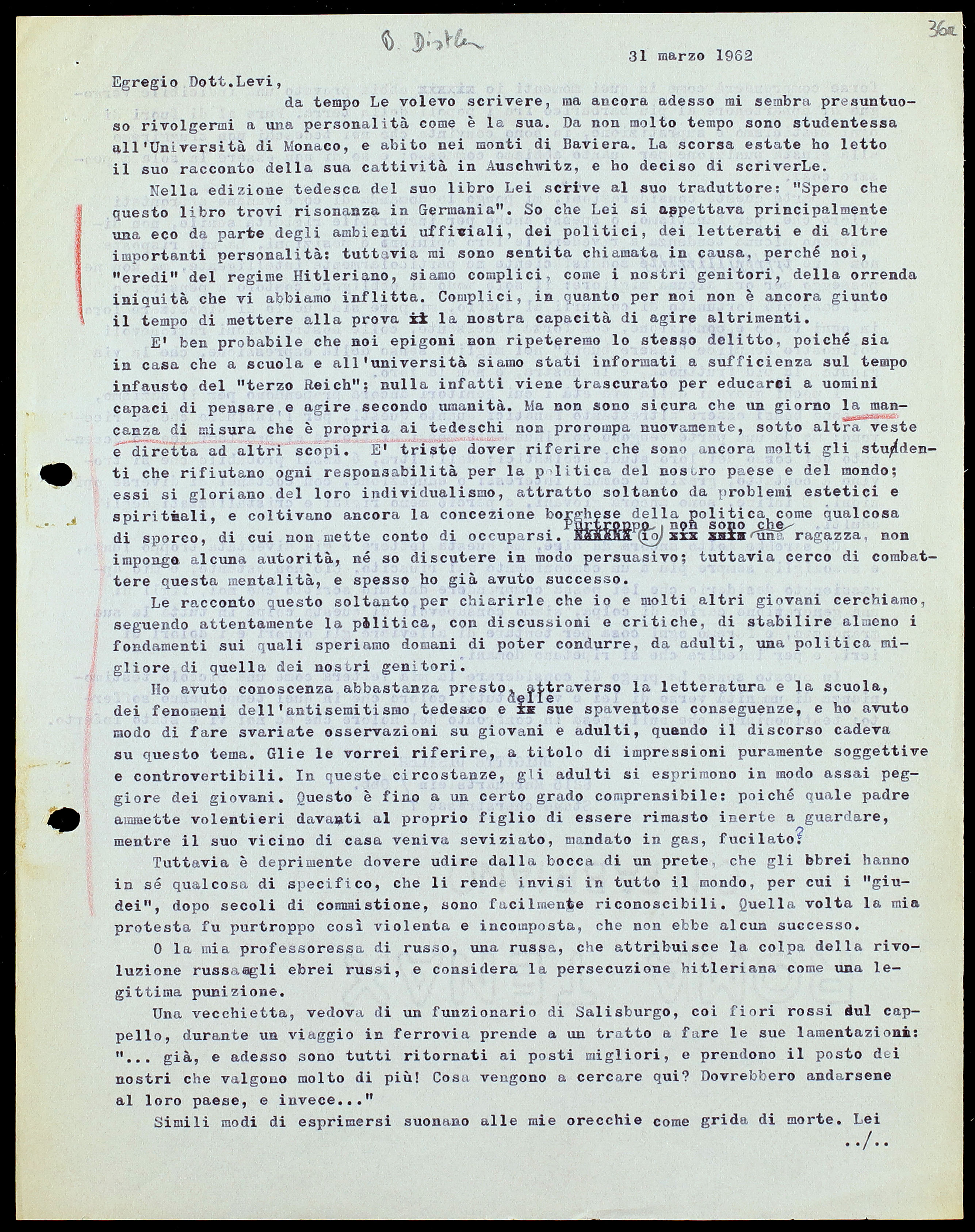
da tempo Le volevo scrivere, ma ancora adesso mi sembra presuntuoso rivolgermi a una personalità come è la sua. Da non molto tempo sono studentessa all’Università di Monaco, e abito nei monti di Baviera.[1] La scorsa estate ho letto il suo racconto della sua cattività in Auschwitz, e ho deciso di scriverLe.[2]
Nella edizione tedesca del suo libro Lei scrive al suo traduttore: «Spero che questo libro trovi risonanza in Germania».[3] So che Lei si aspettava principalmente una eco da parte degli ambienti ufficiali, dei politici, dei letterati e di altre importanti personalità: tuttavia mi sono sentita chiamata in causa, perché noi, “eredi” del regime Hitleriano, siamo complici, come i nostri genitori, della orrenda iniquità che vi abbiamo inflitta. Complici, in quanto per noi non è ancora giunto il tempo di mettere alla prova la nostra capacità di agire altrimenti.I
È ben probabile che noi epigoni non ripeteremo lo stesso delitto, poiché sia in casa che a scuola e all’università siamo stati informati a sufficienza sul tempo infausto del “terzo Reich”: nulla infatti viene trascurato per educarci a uomini capaci di pensare e agire secondo umanità. Ma non sono sicura che un giorno la mancanza di misura che è propria ai tedeschiIInon prorompa nuovamente, sotto altra veste e diretta ad altri scopi. È triste dover riferire che sono ancora molti gli studenti che rifiutano ogni responsabilità per la politica del nostro paese e del mondo; essi si gloriano del loro individualismo, attratto soltanto da problemi estetici e spirituali,[4] e coltivano[5]ancora la concezione borghese della politica, come qualcosa di sporco, di cui non mette conto di occuparsi. Purtroppo io non sono cheIII una ragazza, non impongo alcuna autorità, né so discutere in modo persuasivo; tuttavia cerco di combattere questa mentalità, e spesso ho già avuto successo.
Le racconto questo soltanto per chiarirle che io e molti altri giovani cerchiamo, seguendo attentamente la politica, con discussioni e critiche, di stabilire almeno i fondamenti sui quali speriamo domani di poter condurre, da adulti, una politica migliore di quella dei nostri genitori.
Ho avuto conoscenza abbastanza presto attraverso la letteratura e la scuola, dei fenomeni dell’antisemitismo tedesco e delleIV sue spaventose conseguenze, e ho avuto modo di fare svariate osservazioni su giovani e adulti, quando il discorso cadeva su questo tema. Gliele vorrei riferire, a titolo di impressioni puramente soggettive e controvertibili.[6] In queste circostanze, gli adulti si esprimono in modo assai peggiore dei giovani. Questo è fino a un certo grado comprensibile: poiché quale padre ammette volentieri davanti al proprio figlio di essere rimasto inerte a guardare, mentre il suo vicino di casa veniva seviziato, mandato in gas, fucilato?
Tuttavia è deprimente dovere udire dalla bocca di un prete, che gli ebrei hanno in sé qualcosa di specifico, che li rende invisi in tutto il mondo, per cui i “giudei”, dopo secoli di commistione, sono facilmente riconoscibili.VQuella volta la mia protesta fu purtroppo così violenta e incomposta, che non ebbe alcun successo.
O la mia professoressa di russo, una russa, che attribuisce la colpa della rivoluzione russa agli ebrei russi, e considera la persecuzione hitleriana come una legittima punizione.
Una vecchietta, vedova di un funzionario di Salisburgo, coi fiori rossi sul cappello, durante un viaggio in ferrovia prende a un tratto a fare le sue lamentazioni: «… già, e adesso sono tutti ritornati ai posti migliori, e prendono il posto dei nostri che valgono molto di più! Cosa vengono a cercare qui? Dovrebbero andarsene al loro paese, e invece…»
Simili modi di esprimersi suonano alle mie orecchie come grida di morte. Lei forse comprenderà come in quei momenti ioVIabbia provato una indicibile vergogna di appartenere al più barbarico fra i popoli della terra. Pure al di fuori di ogni misticismo e superstizione, io sono convinta che noi tedeschi non sfuggiremo alla giusta punizione per quanto abbiamo commesso;[7] e so di non essere la sola a pensare così.VII
A parte queste considerazioni, mi pongo la domanda di come vadano affrontati coloro che, per fanatismo, o spesso anche per inguaribile rigidità senile,[8] non dimostrano alcuna tendenza a rivedere le loro opinioni e posizioni. La mia risposta non è néVIIIsoddisfacente né particolarmente intelligente, ma non ne posseggo per ora alcuna migliore: il solo modo di obbligare costoro a pensare, o nel caso più fortunato di condurli al dubbio, mi pare sia quello di dimostrare loro in ogni tempo e condizione, con forza incessante, colle nostre azioni ragionevoli, col nostro semplice “essere buoni” nel miglior senso della espressione, che la via giusta, la più fruttuosa, è la nostra, e non la loro.
I pochi giovani della mia età i cui genitori ancora propendono per il nazismo, possono bensì essere altrettanto fanatici quanto questi, per l’influsso che ne ricevono; ma da una parte vengono continuamente messi di fronte ai problemi che ho accennato nel corso dei loro studi scolastici; dall’altra, è assai probabile che si trovino a contatto, grazie a comuni interessi o educazione, con coetanei di diverse opinioni. E infine, sono ancora giovani, e perciò meno rigidi e cristallizzati degli adulti.
Ci sarebbe molto ancora da dire, ma questa lettera è già diventata troppo lunga, e assomiglia sempre più a un componimento mal riuscito. Ciò non ostante, è mio appassionato desiderio che lei possa comprendere dal mio scritto che noi, figli di una generazione carica di colpa,IX siamo consapevoli di questa colpa in tutta la sua grandezza, e faremo ogni cosa per tentare di alleviare gli orrori e i dolori di ieri, e per impedire che si ripetano domani.
In questo senso La prego di considerare la mia lettera come una piccola testimonianza di umanità verso di lei e verso tutti coloro che in quel tempo hanno sofferto; testimonianza che nulla pesa in confronto del dolore che da noi vi è stato inferto.
BRIGITTE DISTLER 8215 Marquartstein / Obb.
Standacherstrasse 7X
March 31, 1962
Dear Mr. Levi,
I have wanted to write to you for a long time, but even now I still feel it may be presumptuous of me to address a personage such as yourself. I fairly recently began studying at the University of Munich, and live in the Bavarian mountains.[1] Last summer I read your account of your imprisonment in Auschwitz and decided to write to you.[2]
In the German edition of your book, you write to the translator: “I hope that this book will find some resonance in Germany.”[3]I know that you expected an echo above all from the German public, from politicians, writers, and other leading figures. Nevertheless, I felt this line addressed me, too; for we, the “heirs” of Hitler’s regime, are, like our parents, complicit in the terrible injustice we did to you. Complicit insofar as the time has not yet come for us to prove that we would act differently.
It is likely that we, their descendants, will not commit the same crime again, as we have been sufficiently informed about the disastrous period of the “Third Reich” by our parents, schools, and universities; everything is being done to educate us and raise us to think and act humanely.
However, I am not sure that one day the lack of measure peculiar to the Germans will not reemerge in a new guise, directed toward a new goal. It is sad to report that many students still reject any responsibility for the politics of our country and the world; they are proud of their individuality, which focuses exclusively on aesthetics,[4] and still harbor[5] the petty bourgeois view of politics as something dirty that is not worth getting involved in.
Although I am only a young woman, and possess neither inherent authority nor the ability to argue convincingly, I try to combat this attitude and have sometimes been successful.
I tell you this solely to show that I, and many other young people with me, are trying, by paying attention to politics, open debate, and criticism, to at least lay the necessary foundations from which we hope, as adults, to be able to politically conduct things better than our parents did.
Having come into contact with the manifestations of German Antisemitism and its horrific consequences at a fairly early age through literature and school, I have made a wide variety of observations among both adults and young people whenever conversations turned to this topic. I would like to share my observations with you as purely subjective and disputable[6] impressions. The adults here fare much worse than the young people in their statements. This is understandable to a certain extent, because what kind of father would willingly admit to his child that he stood by and watched as his neighbor just down the hall was abused, gassed, and shot?
And yet it is depressing to hear a pastor say that Jews have something inherent in them that makes them unpopular all over the world, so that even after centuries of intermingling, they can still be recognized as “Jews.” Unfortunately, my protest at the time was too indignant and unobjective to be successful.
Or my Russian teacher, a Russian woman who blames Russian Jews for the Russian Revolution and considers their persecution under Hitler to be their just punishment.
A small, elderly civil-servant’s widow from Salzburg with red flowers on her hat suddenly began complaining during a train ride, “Indeed, and now they are right back in the highest positions, displacing the far more talented people of our country! What are they doing here? They should go to their own country instead of….”
These and other remarks sounded to my ears like murderous cries. You will perhaps understand that in such moments I felt unspeakably ashamed to belong to the most barbaric people in the world. Far removed from any mysticism or superstition, I am convinced that just punishment for our actions will catch up with[7] us Germans, and I know that I am not alone in this assumption.
Apart from such considerations, I ask myself how one should deal with those people who, out of fanaticism and, in most cases, an irreconcilable[8] senile stubbornness, show no inclination whatsoever to revise their “views and opinions”?
My answer is neither satisfactory nor particularly intelligent, but I do not know of a better one yet: the only way to make such people at least think and, in the best case scenario, waver, seems to me to be to show them, through our reasonable actions, through our plain old “goodness” in the best sense of the word, in absolutely all situations and at all times, that our way is the right one, the fruitful one, not theirs.
The few young men and women of my age whose parents still adhere to the Nazi regime might well be just as fanatical as their parents due to their parents’ influence, but once they enter state educational institutions, they will be confronted with the aforementioned problems again and again; on the other hand, it is also likely that they will come together with like-minded peers through shared interests or the same education. Last but not least, they are still young, and therefore more malleable and flexible than adults.
There is still much to be said, but my letter is already far too long and increasingly resembles a poorly written school essay. Nevertheless, it is my fervent wish that you will see from my words that we, the children of a guilt-ridden generation, are aware of the full extent of this guilt and will do everything in our power to alleviate the hardship and suffering of yesterday and prevent similar calamities tomorrow.
In this spirit, I ask you to regard my letter as a small gesture of humanity toward you and all those who suffered during that time, which is nothing compared to what we have done to you.
Yours,
Brigitte Distler
P.S.: I would have liked to have written to you in my own handwriting, but because it is illegible, it would be unreasonable to expect anyone—least of all you—to read it. I therefore ask you to forgive the apparent impersonality of my letter.
Brigitte Distler
31.März 1962
Sehr geehrter Herr Dr. Levi!
Schon lange wollte ich Inen schreiben, empfinde es aber auch jetzt noch als Anmaßung, mich an eine Persönlichkeit wie die Ihre zuwenden. Ich studiere noch nicht lange an der Universität in München und wohne in den bayrischen Bergen.[1] Letzten Sommer las ich Ihren Bericht über Ihre Haft in Auschwitz und beschloß, Ihnen zu schreiben.[2]
Sie schreiben in der deutschen Ausgabe Ihres Buches an den Übersetzer: „Ich hoffe, daß dieses Buch einigen Widerhall in Deutschland findet”.[3] Ich weiß, daß Sie vor allem ein Echo in der deutschen Öffentlichkeit erwarteten, von Politikern, Literaten und anderen führenden Persönlichkeiten. Dennoch fühlte ich mich angesprochen; denn wir „Erben“ des Hitler-Regimes sind wie unsere Eltern mitschuldig an dem furchtbaren Unrecht, das wir Ihnen antaten. Mitschuldig insofern, als für uns die Zeit noch nicht gekommen ist, unser „Anders-Handeln” unter Beweis zu stellen.
Es ist zwar wahrscheinlich, daß wir Nachkommen das gleiche Verbrechen nicht nocheinmal verüben werden, da wir durch Elternhaus, Schule und Universität ausreichend informiert wurden über jene unselige Zeit des „Dritten Reiches”; es wird alles getan, um uns zu human denkenden und handelnden Menschen zu erziehen.
Doch bin ich nicht sicher, daß nicht eines Tages die dem Deutschen eigentümliche Maßlosigkeit in neuem Kleid und auf ein neues Ziel gerichtet wieder hervorbrechen wird. Es ist traurig, berichten zu müssen, daß noch sehr viele Studenten jede Verantwortung für die Politik unseres Landes und der Welt ablehnen; sie sind stolz auf ihre ausschließlich auf das Schöngeistige[4] gerichtete Individualität und hegen[5] noch die kleinbürgerliche Auffassung von der Politik als etwas Schmutzigem, wofür es nicht lohnt sich zu Interessieren.
Obwohl ich nur ein Mädchen bin, weder Autorität ausstrahle noch überzeugend diskutieren kann, versuche ich diese Einstellung zu bekämpfen und habe manchmal schon Erfolg gehabt.
Ich erzähle Ihnen das nur, um Ihnen zu zeigen, daß ich und mit mir viele andere junge Menschen versuchen, durch aufmerksames Verfolgen der Politik, durch Diskussion und Kritik wenigstens die notwendigen Grundlagen zu schaffen, von denen aus wir hoffen, als Erwachsene eine bessere Politik führen zu können als unsere Eltern es taten.
Schon ziemlich früh durch Literatur und Schule mit den Erscheinungen des deutschen Antisemitismus und seinen entsetzlichen Folgen in Berührung gekommen, machte ich bei Erwachsenen wie Jugendlichen die verschiedensten Beobachtungen, wenn das Gespräch auf dieses Thema kam. Ich möchte sie Ihnen mitteilen als rein subjektive und anfechtbare[6] Eindrücke. Es schneiden mit ihren Äußerungen dabei die Erwachsenen sehr viel schlechter ab als die Jugendlichen. Das ist bis zu einem gewissen Grade verständlich, denn welcher Vater gibt vor seinem Kind gerne zu, er hätte tatenlos zugesehen, als sien Nachbar im gleichen Haus mißhandelt, vergast und erschossen wurde.
Doch deprimierend ist es, aus dem Munde eines Pfarrers hören zu müssen, die Juden hätten etwas Arteigenes ans sich, was sie in aller Welt unbeliebt mache, sodaß man ihnen noch nach Jahrhunderten der Vermischung den „Juden“ ankenne. Mein Protest damals war leider zu empört und unsachlich, um Erfolg zu haben.
Oder meine Russischlehrerin, eine Russin, die die Schuld an der russischen Revolution den russischen Juden zuschreibt und die Verfolgung unter Hitler als ihre gerechte Strafe ansieht.
Eine kleine, alte Beamtenwitwe aus Salzburg mit roten Blumen auf dem Hut fängt während einer Eisenbahnfahrt plötzlich an zu lamentieren: „… ja, und jetzt sitzen sie schon wieder in den höchsten Positionen und verdrängen die weit Talentierteren unseres Landes! Was haben sie bei uns zu suchen, sollen sie doch in ihr eigenes Land gehen, statt …”
Diese und andere Äußerungen klangen mir wie Mordgeschrei in den Ohren. Sie werden vielleicht verstehen, daß ich mich in solchen Augenblicken unsagbar schämte, zum barbarischsten Volk der Welt zu gehören. Weit entfernt von jedem Mystizismus und Aberglauben, bin ich überzeugt, daß uns Deutsche die gerechte Strafe für unser Tun ereilen[7]wird und ich weiß, daß ich mit dieser Annahme nicht allein stehe.
Abgesehen von solchen Überlegungen stelle ich mir die Frage, wie man jenen Menschen begegnen soll, die aus Fanatismus und meistens daneben auch aus unversöhnlicher[8]Altersstarrheit heraus keinerlei Neigung zeigen, ihre „Ansichten und Meinungen” zu revidieren?
Meine Antwort ist weder befriedigend noch besonders intelligent, doch weiß ich bis jetzt noch keine bessere: Der einzige Weg, solche Menschen zumindest nachdenklich, im Glücksfalle schwankend zu machen, scheint mir der zu sein, ihnen durch unser vernünftiges Handeln, durch unser bloßes „Gut-Sein“ imbesten Sinne und zwar in allen Lagen und Zeiten unvermindert stark zu zeigen, daß unser Weg der richtige, der fruchtbringende ist und nicht der ihre.
Die wenigen Jungen und Mädchen meines Alters, deren Eltern noch heute dem Nazi-Reich anhängen, können zwar durch den Einfluß ihrer Eltern ebenso fanatisch sein wie diese, doch werden sie einmal in den staatlichen Ausbildungsstätten den genannten Problemen immer wieder gegenübergestellt; zum andern ist es wahrscheinlich, daß sie durch gemeinsame Interessen oder gleiche Ausbildung mit anders-denkenden Altersgenossen zusammenkommen. Nicht zuletzt aber sind sie eben noch jung und daher formbarer und beweglicher als die Erwachsenen.
Manches wäre noch zu sagen, doch ist mein Brief schon viel zu lang geworden und gleicht immer mehr einem schlechtgeratenen Schulaufsatz. Trotzdem ist es mein sehnlichster Wunsch, Sie möchten aus meinen Zeilen gesehen haben, daß wir Kinder einer schuldbeladenen Generation uns dieser Schuld in ihrer ganzen Größe bewußt sind und alles versuchen werden, die Not und das Leid von gestern zu mildern, ein ähnliches Unheil von morgen aber zu verhindern.
In diesem Sinne bitte ich Sie, meinen Brief als eine geringe Geste der Menschlichkeit Ihnen und allen Leidenden jener Zeit gegenüber anzusehen, die nichts wiegt im Vergleich zu dem, was wir Ihnen zugefügt haben.
Ihre
Brigitte Distler
P.S.: Gerne hätte ich Ihnen in meiner eigenen Handschrift geschrieben, doch ist sie wegen ihrer Unlesbarkeit niemandem – am wenigsten Ihnen – zumutbar. Ich bitte Sie deshalb, mir die äußerliche Unpersönlichkeit meines Schreibens nachzusehen.
Brigitte Distler
31 marzo 1962
Egregio Dott. Levi
da tempo Le volevo scrivere, ma ancora adesso mi sembra presuntuoso rivolgermi a una personalità come è la sua. Da non molto tempo sono studentessa all’Università di Monaco, e abito nei monti di Baviera.[1] La scorsa estate ho letto il suo racconto della sua cattività in Auschwitz, e ho deciso di scriverLe.[2]
Nella edizione tedesca del suo libro Lei scrive al suo traduttore: «Spero che questo libro trovi risonanza in Germania».[3] So che Lei si aspettava principalmente una eco da parte degli ambienti ufficiali, dei politici, dei letterati e di altre importanti personalità: tuttavia mi sono sentita chiamata in causa, perché noi, “eredi” del regime Hitleriano, siamo complici, come i nostri genitori, della orrenda iniquità che vi abbiamo inflitta. Complici, in quanto per noi non è ancora giunto il tempo di mettere alla prova la nostra capacità di agire altrimenti.I
È ben probabile che noi epigoni non ripeteremo lo stesso delitto, poiché sia in casa che a scuola e all’università siamo stati informati a sufficienza sul tempo infausto del “terzo Reich”: nulla infatti viene trascurato per educarci a uomini capaci di pensare e agire secondo umanità. Ma non sono sicura che un giorno la mancanza di misura che è propria ai tedeschiIInon prorompa nuovamente, sotto altra veste e diretta ad altri scopi. È triste dover riferire che sono ancora molti gli studenti che rifiutano ogni responsabilità per la politica del nostro paese e del mondo; essi si gloriano del loro individualismo, attratto soltanto da problemi estetici e spirituali,[4] e coltivano[5]ancora la concezione borghese della politica, come qualcosa di sporco, di cui non mette conto di occuparsi. Purtroppo io non sono cheIII una ragazza, non impongo alcuna autorità, né so discutere in modo persuasivo; tuttavia cerco di combattere questa mentalità, e spesso ho già avuto successo.
Le racconto questo soltanto per chiarirle che io e molti altri giovani cerchiamo, seguendo attentamente la politica, con discussioni e critiche, di stabilire almeno i fondamenti sui quali speriamo domani di poter condurre, da adulti, una politica migliore di quella dei nostri genitori.
Ho avuto conoscenza abbastanza presto attraverso la letteratura e la scuola, dei fenomeni dell’antisemitismo tedesco e delleIV sue spaventose conseguenze, e ho avuto modo di fare svariate osservazioni su giovani e adulti, quando il discorso cadeva su questo tema. Gliele vorrei riferire, a titolo di impressioni puramente soggettive e controvertibili.[6] In queste circostanze, gli adulti si esprimono in modo assai peggiore dei giovani. Questo è fino a un certo grado comprensibile: poiché quale padre ammette volentieri davanti al proprio figlio di essere rimasto inerte a guardare, mentre il suo vicino di casa veniva seviziato, mandato in gas, fucilato?
Tuttavia è deprimente dovere udire dalla bocca di un prete, che gli ebrei hanno in sé qualcosa di specifico, che li rende invisi in tutto il mondo, per cui i “giudei”, dopo secoli di commistione, sono facilmente riconoscibili.VQuella volta la mia protesta fu purtroppo così violenta e incomposta, che non ebbe alcun successo.
O la mia professoressa di russo, una russa, che attribuisce la colpa della rivoluzione russa agli ebrei russi, e considera la persecuzione hitleriana come una legittima punizione.
Una vecchietta, vedova di un funzionario di Salisburgo, coi fiori rossi sul cappello, durante un viaggio in ferrovia prende a un tratto a fare le sue lamentazioni: «… già, e adesso sono tutti ritornati ai posti migliori, e prendono il posto dei nostri che valgono molto di più! Cosa vengono a cercare qui? Dovrebbero andarsene al loro paese, e invece…»
Simili modi di esprimersi suonano alle mie orecchie come grida di morte. Lei forse comprenderà come in quei momenti ioVIabbia provato una indicibile vergogna di appartenere al più barbarico fra i popoli della terra. Pure al di fuori di ogni misticismo e superstizione, io sono convinta che noi tedeschi non sfuggiremo alla giusta punizione per quanto abbiamo commesso;[7] e so di non essere la sola a pensare così.VII
A parte queste considerazioni, mi pongo la domanda di come vadano affrontati coloro che, per fanatismo, o spesso anche per inguaribile rigidità senile,[8] non dimostrano alcuna tendenza a rivedere le loro opinioni e posizioni. La mia risposta non è néVIIIsoddisfacente né particolarmente intelligente, ma non ne posseggo per ora alcuna migliore: il solo modo di obbligare costoro a pensare, o nel caso più fortunato di condurli al dubbio, mi pare sia quello di dimostrare loro in ogni tempo e condizione, con forza incessante, colle nostre azioni ragionevoli, col nostro semplice “essere buoni” nel miglior senso della espressione, che la via giusta, la più fruttuosa, è la nostra, e non la loro.
I pochi giovani della mia età i cui genitori ancora propendono per il nazismo, possono bensì essere altrettanto fanatici quanto questi, per l’influsso che ne ricevono; ma da una parte vengono continuamente messi di fronte ai problemi che ho accennato nel corso dei loro studi scolastici; dall’altra, è assai probabile che si trovino a contatto, grazie a comuni interessi o educazione, con coetanei di diverse opinioni. E infine, sono ancora giovani, e perciò meno rigidi e cristallizzati degli adulti.
Ci sarebbe molto ancora da dire, ma questa lettera è già diventata troppo lunga, e assomiglia sempre più a un componimento mal riuscito. Ciò non ostante, è mio appassionato desiderio che lei possa comprendere dal mio scritto che noi, figli di una generazione carica di colpa,IX siamo consapevoli di questa colpa in tutta la sua grandezza, e faremo ogni cosa per tentare di alleviare gli orrori e i dolori di ieri, e per impedire che si ripetano domani.
In questo senso La prego di considerare la mia lettera come una piccola testimonianza di umanità verso di lei e verso tutti coloro che in quel tempo hanno sofferto; testimonianza che nulla pesa in confronto del dolore che da noi vi è stato inferto.
BRIGITTE DISTLER 8215 Marquartstein / Obb.
Standacherstrasse 7X
March 31, 1962
Dear Mr. Levi,
I have wanted to write to you for a long time, but even now I still feel it may be presumptuous of me to address a personage such as yourself. I fairly recently began studying at the University of Munich, and live in the Bavarian mountains.[1] Last summer I read your account of your imprisonment in Auschwitz and decided to write to you.[2]
In the German edition of your book, you write to the translator: “I hope that this book will find some resonance in Germany.”[3]I know that you expected an echo above all from the German public, from politicians, writers, and other leading figures. Nevertheless, I felt this line addressed me, too; for we, the “heirs” of Hitler’s regime, are, like our parents, complicit in the terrible injustice we did to you. Complicit insofar as the time has not yet come for us to prove that we would act differently.
It is likely that we, their descendants, will not commit the same crime again, as we have been sufficiently informed about the disastrous period of the “Third Reich” by our parents, schools, and universities; everything is being done to educate us and raise us to think and act humanely.
However, I am not sure that one day the lack of measure peculiar to the Germans will not reemerge in a new guise, directed toward a new goal. It is sad to report that many students still reject any responsibility for the politics of our country and the world; they are proud of their individuality, which focuses exclusively on aesthetics,[4] and still harbor[5] the petty bourgeois view of politics as something dirty that is not worth getting involved in.
Although I am only a young woman, and possess neither inherent authority nor the ability to argue convincingly, I try to combat this attitude and have sometimes been successful.
I tell you this solely to show that I, and many other young people with me, are trying, by paying attention to politics, open debate, and criticism, to at least lay the necessary foundations from which we hope, as adults, to be able to politically conduct things better than our parents did.
Having come into contact with the manifestations of German Antisemitism and its horrific consequences at a fairly early age through literature and school, I have made a wide variety of observations among both adults and young people whenever conversations turned to this topic. I would like to share my observations with you as purely subjective and disputable[6] impressions. The adults here fare much worse than the young people in their statements. This is understandable to a certain extent, because what kind of father would willingly admit to his child that he stood by and watched as his neighbor just down the hall was abused, gassed, and shot?
And yet it is depressing to hear a pastor say that Jews have something inherent in them that makes them unpopular all over the world, so that even after centuries of intermingling, they can still be recognized as “Jews.” Unfortunately, my protest at the time was too indignant and unobjective to be successful.
Or my Russian teacher, a Russian woman who blames Russian Jews for the Russian Revolution and considers their persecution under Hitler to be their just punishment.
A small, elderly civil-servant’s widow from Salzburg with red flowers on her hat suddenly began complaining during a train ride, “Indeed, and now they are right back in the highest positions, displacing the far more talented people of our country! What are they doing here? They should go to their own country instead of….”
These and other remarks sounded to my ears like murderous cries. You will perhaps understand that in such moments I felt unspeakably ashamed to belong to the most barbaric people in the world. Far removed from any mysticism or superstition, I am convinced that just punishment for our actions will catch up with[7] us Germans, and I know that I am not alone in this assumption.
Apart from such considerations, I ask myself how one should deal with those people who, out of fanaticism and, in most cases, an irreconcilable[8] senile stubbornness, show no inclination whatsoever to revise their “views and opinions”?
My answer is neither satisfactory nor particularly intelligent, but I do not know of a better one yet: the only way to make such people at least think and, in the best case scenario, waver, seems to me to be to show them, through our reasonable actions, through our plain old “goodness” in the best sense of the word, in absolutely all situations and at all times, that our way is the right one, the fruitful one, not theirs.
The few young men and women of my age whose parents still adhere to the Nazi regime might well be just as fanatical as their parents due to their parents’ influence, but once they enter state educational institutions, they will be confronted with the aforementioned problems again and again; on the other hand, it is also likely that they will come together with like-minded peers through shared interests or the same education. Last but not least, they are still young, and therefore more malleable and flexible than adults.
There is still much to be said, but my letter is already far too long and increasingly resembles a poorly written school essay. Nevertheless, it is my fervent wish that you will see from my words that we, the children of a guilt-ridden generation, are aware of the full extent of this guilt and will do everything in our power to alleviate the hardship and suffering of yesterday and prevent similar calamities tomorrow.
In this spirit, I ask you to regard my letter as a small gesture of humanity toward you and all those who suffered during that time, which is nothing compared to what we have done to you.
Yours,
Brigitte Distler
P.S.: I would have liked to have written to you in my own handwriting, but because it is illegible, it would be unreasonable to expect anyone—least of all you—to read it. I therefore ask you to forgive the apparent impersonality of my letter.
Brigitte Distler
Info
Notes
Tag
Sender: Brigitte Distler
Addressee: Primo Levi
Date of Drafting: 1962-03-31
Place of Writing: Munich
Description:typewritten letter on white paper with handwritten signature in black ballpoint pen. The sheets have notes and underlining by Levi in pencil and blue ballpoint pen. In the upper margin of f. 34r, Levi has written by hand in blue ballpoint pen: “Brigitte Distler;” in the lower margin of f. 35, Levi has written by hand in pencil: “8215 Marquartstein / Obb. | Standacherstr. 7 | D.” Translation by Levi (f. 36r/v) handwritten on onionskin paper with typed insertions and corrections and underlining in red and blue pencil. In the upper margin of f. 36r, “B. Distler” is handwritten in pencil.
Archive: Archivio privato di Primo Levi, Turin
Series: Complesso di Fondi primo Levi, Fondo Primo Levi, Corrispondenza, Corrispondenti particolari, fasc. 20, sottofasc. 001, doc. 017, f. 34r/v, 35, 36 r/v (trad. Levi).
Folio: 2 front and back, 1 front only
DOI: https://doi.org/10.15160/hd10-v532
1
In June 1961, Brigitte Distler passed the admission exam to the University of Munich, where she concentrated on Slavic and German studies, and History.
2
Ist da ein Mensch? by Primo Levi had actually been published in November.
3
Levi wrote in his Preface to the German edition of If this Is a Man, “I hope that this book will have some kind of echo in Germany,” cf. CW II, p. 1151.
4“Schöngeistige” is underlined in pencil.
5“hegen” is underlined and accompanied by an insertion handwritten in pencil by Levi in the inner margin of the sheet: “coltivano” (“harbor”).
6“anfechtbare” is underlined and accompanied by an insertion handwritten by Levi in pencil above the line: “contestabile” (“disputable”).
7“ereilen” is underlined and accompanied by an insertion handwritten in pencil by Levi in the inner margin of the sheet: “raggiungere.” (“catch up”).
8“unversöhnlicher” is underlined and accompanied by an insertion handwritten in blue ballpoint pen by Levi in the lower margin of the sheet: “inconciliabile” (“irreconcilable”).
I
Italicized in the text is Primo Levi's translation of the letter. The paragraph is marked with a handwritten sign in red pencil in the inner margin of the sheet.
II“la mancanza di misura che è propria ai tedeschi” is underlined in red pencil.
III“purtroppo io non sono che” is typed in and corrects a previous, illegible translation that was crossed out by typewriter.
IV“delle” is typed in and corrects the previous typed word: “le.”
VA long passage of the letter, from “È triste dover riferire che sono ancora molti gli studenti…” to “i ‘giudei,’ dopo secoli di commistione, sono facilmente riconoscibili,” is marked with a handwritten sign in red pencil in the inner margin of the sheet.
VI“mi sia” follows, crossed out by typewriter.
VIIThe sentence is marked with a handwritten question mark in red pencil in the inner margin of the sheet.
VIII“tranquillizzante” follows, crossed out by typewriter.
IX“noi, figli di una generazione carica di colpa” is underlined by hand in blue pencil.
X
Levi does not translate the postscript: “P.S.: I would have liked to write to you in my own handwriting, but it is illegible to everyone and that is not acceptable—especially not for you. Therefore, I apologize for the impersonal appearance of my letter.”