Karl Wagner, a chemist, writes from Tübingen thanking Levi for Ist das ein Mensch? and expressing his feelings of shame as a German.
Tübingen, 20.1.1962 im Rotbad 27
Sehr geehrter Herr Dr. Levi.
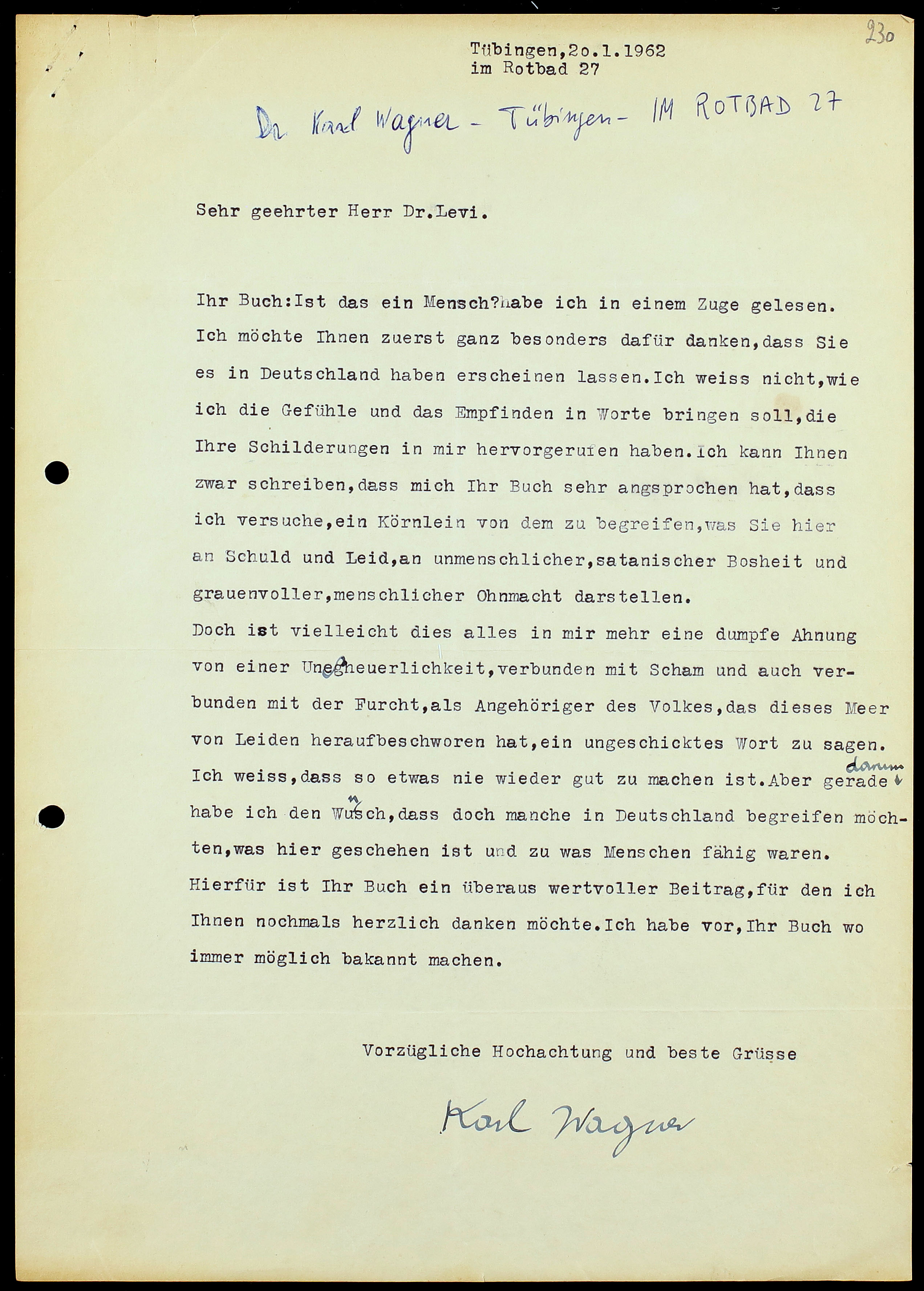
Ihr Buch: Ist das ein Mensch? habe ich in einem Zuge gelesen. Ich möchte Ihnen zuerst ganz besonders dafür danken, dass Sie es in Deutschland haben erscheinen lassen. Ich weiss nicht, wie ich die Gefühle und das Empfinden in Worte bringen soll, die Ihre Schilderungen in mir hervorgerufen haben. Ich kann Ihnen zwar schreiben, dass mich Ihr Buch sehr angesprochen hat, dass ich versuche, ein Körnlein von dem zu begreifen, was Sie hier an Schuld und Leid, an unmenschlicher, satanischer Bosheit und grauenvoller, menschlicher Ohnmacht darstellen.
Doch ist vielleicht dies alles in mir mehr eine dumpfe Ahnung von einer Ungeheuerlichkeit,[1] verbunden mit Scham und auch verbunden mit der Furcht, als Angehöriger des Volkes, das dieses Meer von Leiden heraufbeschworen hat, ein ungeschicktes Wort zu sagen.
Ich weiss, dass so etwas nie wieder gut zu machen ist. Aber gerade darum[2]habe ich den Wunsch,[3] dass doch manche in Deutschland begreifen möchten, was hier geschehen ist und zu was Menschen fähig waren. Hierfür ist Ihr Buch ein überaus wertvoller Beitrag, für den ich Ihnen nochmals herzlich danken möchte. Ich habe vor, Ihr Buch wo immer möglich bekannt machen.
Vorzügliche Hochachtung und beste Grüsse
Karl Wagner
Tubinga 20 gennaio 1962
Egregio Dott. Levi,
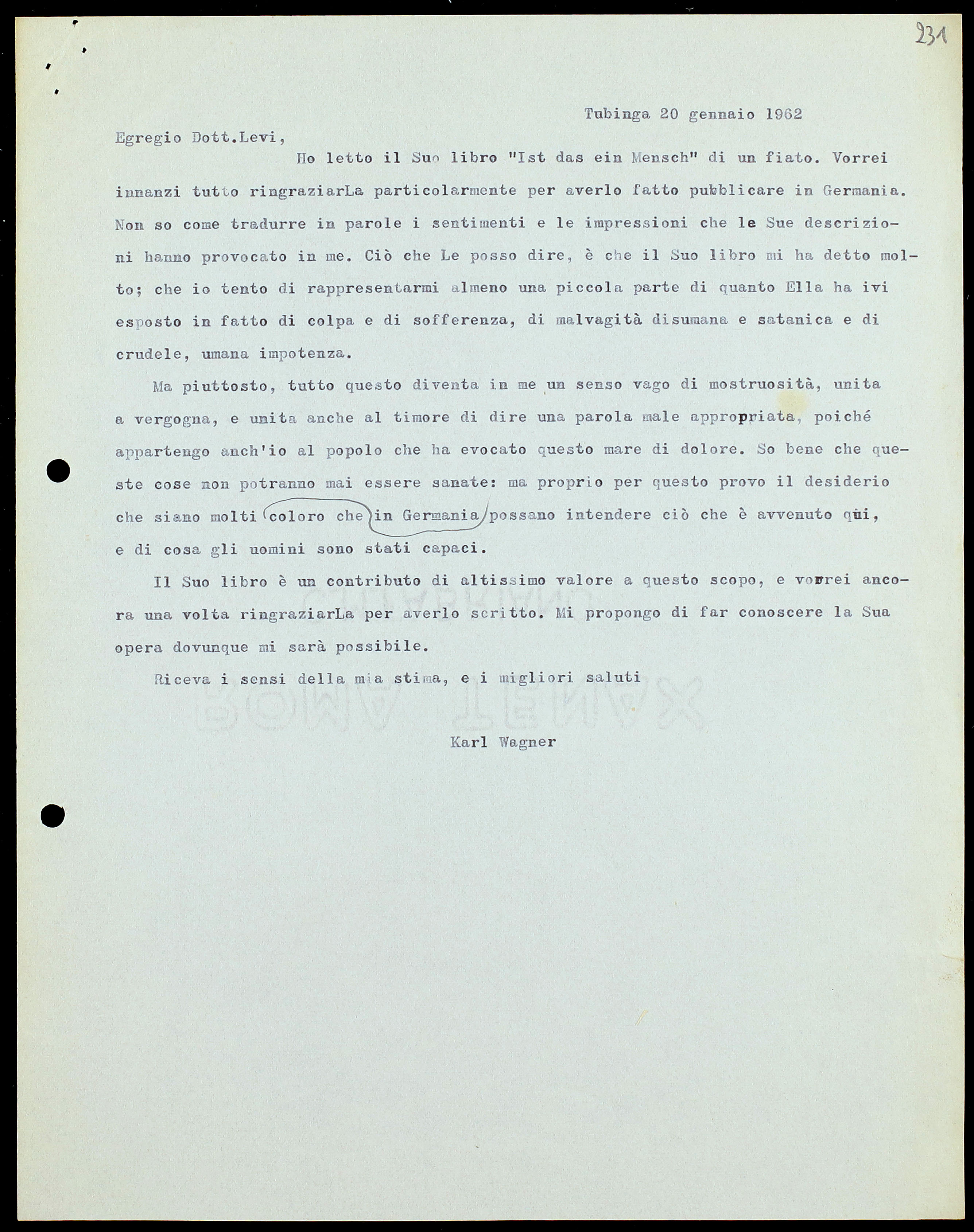
Ho letto il Suo libro Ist das ein Mensch di un fiato. Vorrei innanzi tutto ringraziarLa particolarmente per averlo fatto pubblicare in Germania. Non so come tradurre in parole i sentimenti e le impressioni che le Sue descrizioni hanno provocato in me. Ciò che Le posso dire, è che il Suo libro mi ha detto molto; che io tento di rappresentarmi almeno una piccola parte di quanto Ella ha ivi esposto in fatto di colpa e di sofferenza, di malvagità disumana e satanica e di crudele, umana impotenza.
Ma piuttosto, tutto questo diventa in me un senso vago di mostruosità,[1]unita a vergogna, e unita anche al timore di dire una parola male appropriata, poiché appartengo anch’io al popolo che ha evocato questo mare di dolore. So bene che queste cose non potranno mai essere sanate: ma proprio per questo[2]provo il desiderio[3] che siano molti in Germania coloro cheI possano intendere ciò che è avvenuto qui, e di cosa gli uomini sono stati capaci.
Il Suo libro è un contributo di altissimo valore a questo scopo, e vorrei ancora una volta ringraziarLa per averlo scritto. Mi propongo di far conoscere la Sua opera dovunque mi sarà possibile.
Riceva i sensi della mia stima, e i migliori saluti
Karl Wagner
Tübingen, January 20, 1962
im Rotbad 27
Dear Mr. Levi,
I read your book If This is a Man in one sitting. First of all, I would like to thank you very much for publishing it in Germany. I do not know how to put into words the feelings and emotions your descriptions have evoked in me. But I can certainly say that your book has spoken to me deeply, and that I am trying to comprehend a tiny fraction of what you describe therein, in terms of guilt and suffering, inhuman, satanic malice, and horrific human powerlessness.
But perhaps all this is more of a vague sense of monstrosity I feel within,[1] combined with shame and also the fear of saying something inappropriate as a member of the people who brought about this vast sea of suffering.
I know that something like this can never be made right again. But that is precisely why[2] I hope[3] that some people in Germany will try to understand what happened here, and what people were capable of. Your book is an extremely valuable contribution to this, for which I would like to warmly thank you again. I intend to make your bookknown wherever possible.
With the utmost respect and best regards,
Karl Wagner
Tübingen, 20.1.1962 im Rotbad 27
Sehr geehrter Herr Dr. Levi.
Ihr Buch: Ist das ein Mensch? habe ich in einem Zuge gelesen. Ich möchte Ihnen zuerst ganz besonders dafür danken, dass Sie es in Deutschland haben erscheinen lassen. Ich weiss nicht, wie ich die Gefühle und das Empfinden in Worte bringen soll, die Ihre Schilderungen in mir hervorgerufen haben. Ich kann Ihnen zwar schreiben, dass mich Ihr Buch sehr angesprochen hat, dass ich versuche, ein Körnlein von dem zu begreifen, was Sie hier an Schuld und Leid, an unmenschlicher, satanischer Bosheit und grauenvoller, menschlicher Ohnmacht darstellen.
Doch ist vielleicht dies alles in mir mehr eine dumpfe Ahnung von einer Ungeheuerlichkeit,[1] verbunden mit Scham und auch verbunden mit der Furcht, als Angehöriger des Volkes, das dieses Meer von Leiden heraufbeschworen hat, ein ungeschicktes Wort zu sagen.
Ich weiss, dass so etwas nie wieder gut zu machen ist. Aber gerade darum[2]habe ich den Wunsch,[3] dass doch manche in Deutschland begreifen möchten, was hier geschehen ist und zu was Menschen fähig waren. Hierfür ist Ihr Buch ein überaus wertvoller Beitrag, für den ich Ihnen nochmals herzlich danken möchte. Ich habe vor, Ihr Buch wo immer möglich bekannt machen.
Vorzügliche Hochachtung und beste Grüsse
Karl Wagner
Tubinga 20 gennaio 1962
Egregio Dott. Levi,
Ho letto il Suo libro Ist das ein Mensch di un fiato. Vorrei innanzi tutto ringraziarLa particolarmente per averlo fatto pubblicare in Germania. Non so come tradurre in parole i sentimenti e le impressioni che le Sue descrizioni hanno provocato in me. Ciò che Le posso dire, è che il Suo libro mi ha detto molto; che io tento di rappresentarmi almeno una piccola parte di quanto Ella ha ivi esposto in fatto di colpa e di sofferenza, di malvagità disumana e satanica e di crudele, umana impotenza.
Ma piuttosto, tutto questo diventa in me un senso vago di mostruosità,[1]unita a vergogna, e unita anche al timore di dire una parola male appropriata, poiché appartengo anch’io al popolo che ha evocato questo mare di dolore. So bene che queste cose non potranno mai essere sanate: ma proprio per questo[2]provo il desiderio[3] che siano molti in Germania coloro cheI possano intendere ciò che è avvenuto qui, e di cosa gli uomini sono stati capaci.
Il Suo libro è un contributo di altissimo valore a questo scopo, e vorrei ancora una volta ringraziarLa per averlo scritto. Mi propongo di far conoscere la Sua opera dovunque mi sarà possibile.
Riceva i sensi della mia stima, e i migliori saluti
Karl Wagner
Tübingen, January 20, 1962
im Rotbad 27
Dear Mr. Levi,
I read your book If This is a Man in one sitting. First of all, I would like to thank you very much for publishing it in Germany. I do not know how to put into words the feelings and emotions your descriptions have evoked in me. But I can certainly say that your book has spoken to me deeply, and that I am trying to comprehend a tiny fraction of what you describe therein, in terms of guilt and suffering, inhuman, satanic malice, and horrific human powerlessness.
But perhaps all this is more of a vague sense of monstrosity I feel within,[1] combined with shame and also the fear of saying something inappropriate as a member of the people who brought about this vast sea of suffering.
I know that something like this can never be made right again. But that is precisely why[2] I hope[3] that some people in Germany will try to understand what happened here, and what people were capable of. Your book is an extremely valuable contribution to this, for which I would like to warmly thank you again. I intend to make your bookknown wherever possible.
With the utmost respect and best regards,
Karl Wagner
Info
Notes
Tag
Sender: Karl Wagner
Addressee: Primo Levi
Date of Drafting: 1962-01-20
Place of Writing: Tübingen
Description:typewritten letter with handwritten insertions and signature in blue fountain pen by Wagner. In the upper margin of f. 230, below the indication of the place and date, Levi notes in blue ballpoint pen: “Dr. Karl Wagner – Tübingen – IM ROTBAD 27.” Typewritten translation by Levi (f. 231) on white paper with handwritten interventions in pencil.
Archive: Archivio privato di Primo Levi, Turin
Series: Complesso di fondi Primo Levi, Fondo Primo Levi, Corrispondenza, Corrispondenti particolari, Fasc. 020, sottofasc. 001, doc. 087, f. 230 e 231 (trad.).
Folio: 2, front only
DOI: https://doi.org/10.15160/9adw-v724
1“Unegheuerlichkeit,” typewritten and emended by Wagner with a handwritten transpose symbol in blue fountain pen.
2“darum” is inserted by Wagner by hand in blue fountain pen.
3“Wusch,” typewritten, is emended by Wagner by hand in blue fountain pen.
IItalicized in the text is Primo Levi's translation of the letter. “Molti coloro che in Germania,” typewritten and emended with a transpose symbol in pencil.