Helga Redmann, a young correspondent from Crailsheim (between Stuttgart and Nuremberg), writes that she was deeply shocked by reading Ist das ein Mensch?, even though she was aware of the atrocities committed in the camps.
8 Okt. 1962
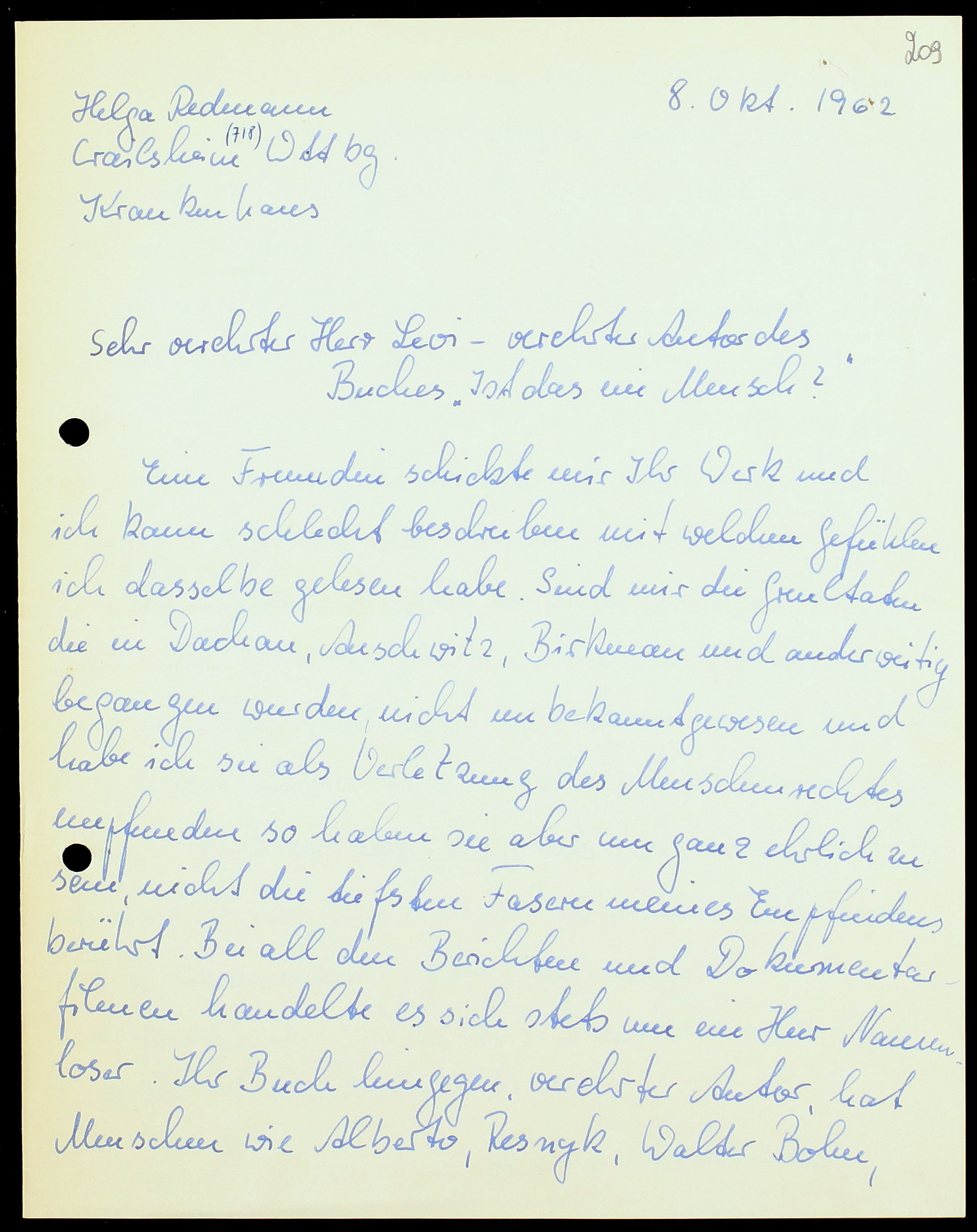
Helga Redmann Crailsheim[1] Wdd bg. Krankenhaus
Sehr verehrter Herr Levi – verehrter Autor des Buches Ist das ein Mensch?
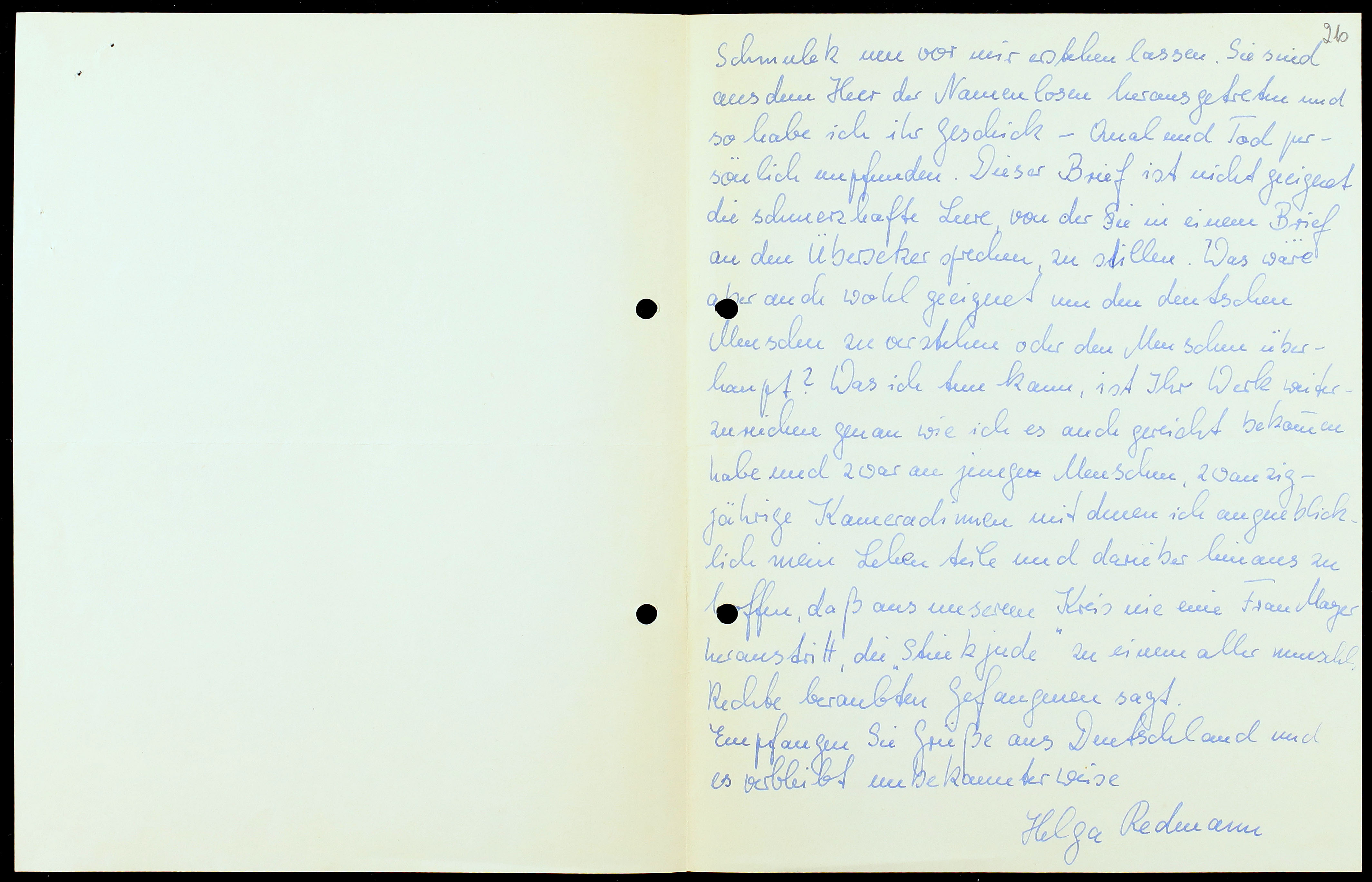
Eine Freundin schickte mir Ihr Werk und ich kann schlecht beschreiben mit welchen Gefühlen ich dasselbe gelesen habe. Sind mir die Gräueltaten die in Dachau, Auschwitz, Birkenau und anderweitig begangen wurden, nicht im bekannt gewesen und habe ich sei als Verletzung des Menschenrechts empfunden so haben sie als im ganz ehrlich zu sein, nicht die die felsen Fasere meines Empfindens berütot. Bei all den Berichten und Dokumentarfilmen handelte es sich stets um ein Heer Namenlosen. Ihr Buch hingegen, verehrter Autor, hat Menschen wie Alberto,[2] Resnyk,[3]Walter Bonn, Schmulek[4] um vor mir erstehen lassen. Sie sind aus dem Heer der Namenlosen[5] herausgetreten und so habe ich ihr Geschick – Qual und Tod persönlich empfunden. Dieser Brief ist nicht geeignet die schmerzhafte Leere, von der Sie in einem Brief an den Übersetzer sprechen, zu stillen. Was wäre aber an die wohl geeignet uns den deutschen Menschen zu verstehen oder den Menschen überhaupt? Was ich tun kann, ist Ihr Werk weiterzureichen genau wie ich es auch gereicht bekannt habe mich zwar an jungen Menschen, zwanzigjährige Kameradinnen mit denen ich augenblicklich mein Leben Teile und dareibes hinaus zu hoffen, daß aus unseren Kreis nie eine Frau Mayers herausdritt, dei “Stinkjude” zu einem alles Menschenrechte beraubten Gefangenen sagt.[6]
Empfangen Sie Grüße aus Deutschland und es verbleibt unbekannterweise
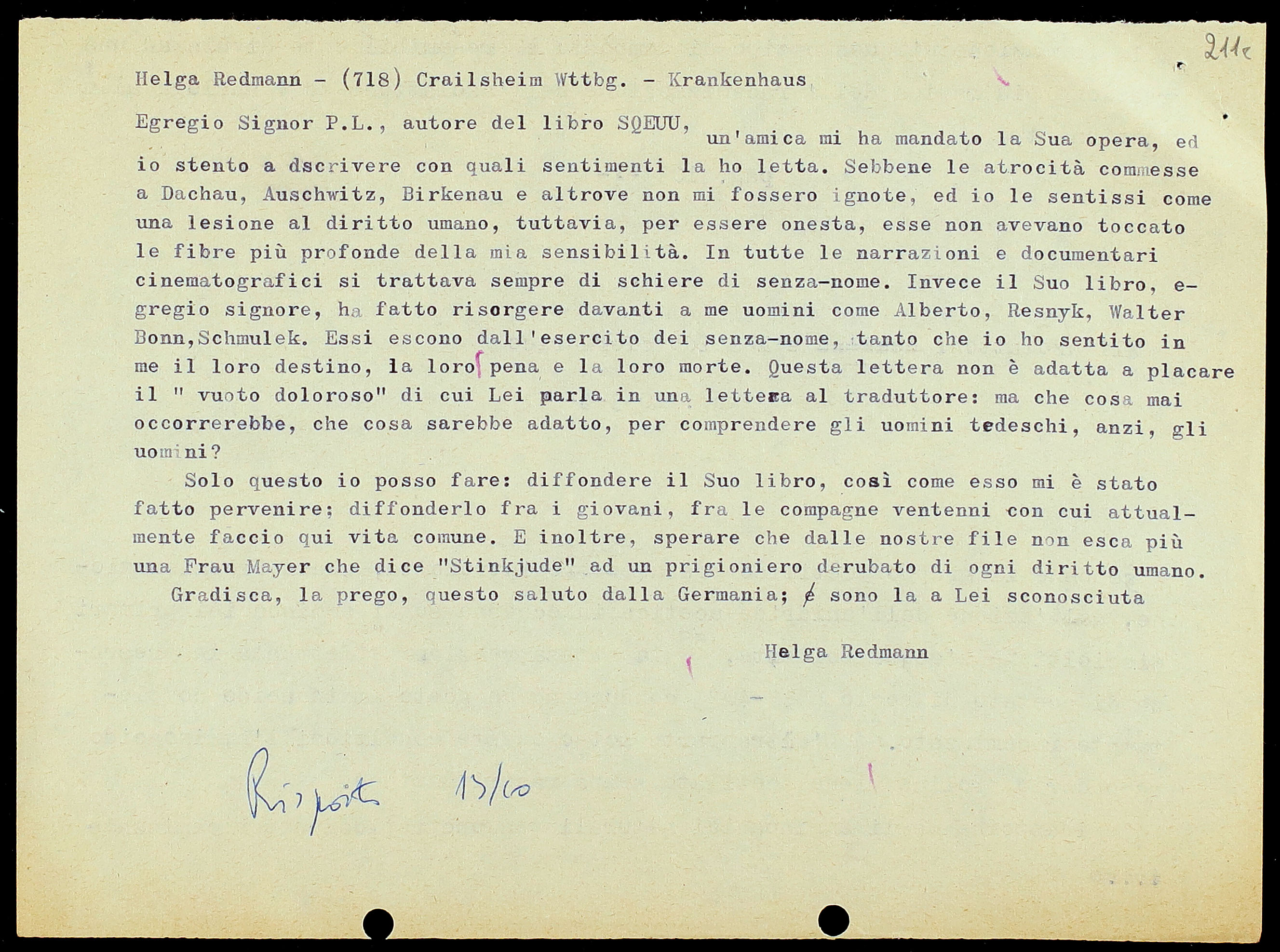
un’amica mi ha mandato la Sua opera, ed io stento a descrivere con quali sentimenti la ho letta. Sebbene le atrocità commesse a Dachau, Auschwitz, Birkenau e altrove non mi fossero ignote, ed io le sentissi come una lesione al diritto umano, tuttavia, per essere onesta, esse non avevano toccato le fibre più profonde della mia sensibilità. In tutte le narrazioni e documentari cinematografici si trattava sempre di schiere di senza-nome. Invece il Suo libro, egregio signore, ha fatto risorgere davanti a me uomini come Alberto[2], Resnyk,[3]Walter Bonn, Schmulek.[4] Essi escono dall’esercito dei senza-nome,[5] tanto che io ho sentito in me il loro destino, la loro pena e la loro morte. Questa lettera non è adatta a placare il «vuoto doloroso» di cui Lei parla in una lettera al traduttore: ma che cosa mai occorrerebbe, che cosa sarebbe adatto, per comprendere gli uomini tedeschi, anzi, gli uomini?
Solo questo io posso fare: diffondere il Suo libro, così come esso mi è stato fatto pervenire: diffonderlo fra i giovani, fra le compagne ventenni con cui attualmente faccio vita comune. E inoltre, sperare che dalle nostre file non esca più una Frau Mayer che dice «Stinkjude» ad un prigioniero derubato di ogni diritto umano.[6]
Gradisca, la prego, questo saluto dalla Germania; sono la a Lei sconosciuta
Helga Redmann
Oct. 8, 1962
Helga Redmann Crailsheim[1] Wttbg. Hospital
Dear Mr. Levi—esteemed author of the book If This is a Man
A friend sent me your work, and I find it difficult to describe the feelings I had while reading it. Although I was aware of the atrocities committed in Dachau, Auschwitz, Birkenau, and elsewhere, and although I considered them violations of human rights, to be completely honest, they did not deeply move me. All the reports and documentaries always featured an army of nameless people. But your book, esteemed author, brought people like Alberto,[2] Resnyk,[3]Walter Bonn, and Schmulek[4] to life before my eyes. They have stepped out of the army of the nameless,[5] and so I felt their fate—torment and death—personally. This letter cannot suffice to fill the painful void you speak of in your letter to the translator. But what would suffice to understand German people, or people in general? What I can do is pass your work along, just as I have passed it on to young people, twenty-year-old comrades with whom I currently share my life, and hope that no woman like Mrs. Mayer—a woman who calls a prisoner deprived of all human rights a “stinking Jew”—ever emerges from our midst.[6]
Greetings from Germany, and I remain, even though we have not met, yours,
Helga Redmann
8 Okt. 1962
Helga Redmann Crailsheim[1] Wdd bg. Krankenhaus
Sehr verehrter Herr Levi – verehrter Autor des Buches Ist das ein Mensch?
Eine Freundin schickte mir Ihr Werk und ich kann schlecht beschreiben mit welchen Gefühlen ich dasselbe gelesen habe. Sind mir die Gräueltaten die in Dachau, Auschwitz, Birkenau und anderweitig begangen wurden, nicht im bekannt gewesen und habe ich sei als Verletzung des Menschenrechts empfunden so haben sie als im ganz ehrlich zu sein, nicht die die felsen Fasere meines Empfindens berütot. Bei all den Berichten und Dokumentarfilmen handelte es sich stets um ein Heer Namenlosen. Ihr Buch hingegen, verehrter Autor, hat Menschen wie Alberto,[2] Resnyk,[3]Walter Bonn, Schmulek[4] um vor mir erstehen lassen. Sie sind aus dem Heer der Namenlosen[5] herausgetreten und so habe ich ihr Geschick – Qual und Tod persönlich empfunden. Dieser Brief ist nicht geeignet die schmerzhafte Leere, von der Sie in einem Brief an den Übersetzer sprechen, zu stillen. Was wäre aber an die wohl geeignet uns den deutschen Menschen zu verstehen oder den Menschen überhaupt? Was ich tun kann, ist Ihr Werk weiterzureichen genau wie ich es auch gereicht bekannt habe mich zwar an jungen Menschen, zwanzigjährige Kameradinnen mit denen ich augenblicklich mein Leben Teile und dareibes hinaus zu hoffen, daß aus unseren Kreis nie eine Frau Mayers herausdritt, dei “Stinkjude” zu einem alles Menschenrechte beraubten Gefangenen sagt.[6]
Empfangen Sie Grüße aus Deutschland und es verbleibt unbekannterweise
un’amica mi ha mandato la Sua opera, ed io stento a descrivere con quali sentimenti la ho letta. Sebbene le atrocità commesse a Dachau, Auschwitz, Birkenau e altrove non mi fossero ignote, ed io le sentissi come una lesione al diritto umano, tuttavia, per essere onesta, esse non avevano toccato le fibre più profonde della mia sensibilità. In tutte le narrazioni e documentari cinematografici si trattava sempre di schiere di senza-nome. Invece il Suo libro, egregio signore, ha fatto risorgere davanti a me uomini come Alberto[2], Resnyk,[3]Walter Bonn, Schmulek.[4] Essi escono dall’esercito dei senza-nome,[5] tanto che io ho sentito in me il loro destino, la loro pena e la loro morte. Questa lettera non è adatta a placare il «vuoto doloroso» di cui Lei parla in una lettera al traduttore: ma che cosa mai occorrerebbe, che cosa sarebbe adatto, per comprendere gli uomini tedeschi, anzi, gli uomini?
Solo questo io posso fare: diffondere il Suo libro, così come esso mi è stato fatto pervenire: diffonderlo fra i giovani, fra le compagne ventenni con cui attualmente faccio vita comune. E inoltre, sperare che dalle nostre file non esca più una Frau Mayer che dice «Stinkjude» ad un prigioniero derubato di ogni diritto umano.[6]
Gradisca, la prego, questo saluto dalla Germania; sono la a Lei sconosciuta
Helga Redmann
Oct. 8, 1962
Helga Redmann Crailsheim[1] Wttbg. Hospital
Dear Mr. Levi—esteemed author of the book If This is a Man
A friend sent me your work, and I find it difficult to describe the feelings I had while reading it. Although I was aware of the atrocities committed in Dachau, Auschwitz, Birkenau, and elsewhere, and although I considered them violations of human rights, to be completely honest, they did not deeply move me. All the reports and documentaries always featured an army of nameless people. But your book, esteemed author, brought people like Alberto,[2] Resnyk,[3]Walter Bonn, and Schmulek[4] to life before my eyes. They have stepped out of the army of the nameless,[5] and so I felt their fate—torment and death—personally. This letter cannot suffice to fill the painful void you speak of in your letter to the translator. But what would suffice to understand German people, or people in general? What I can do is pass your work along, just as I have passed it on to young people, twenty-year-old comrades with whom I currently share my life, and hope that no woman like Mrs. Mayer—a woman who calls a prisoner deprived of all human rights a “stinking Jew”—ever emerges from our midst.[6]
Greetings from Germany, and I remain, even though we have not met, yours,
Helga Redmann
Info
Notes
Tag
Sender: Helga Kabat Job-Redmann
Addressee: Primo Levi
Date of Drafting: 1962-10-08
Place of Writing: Crailsheim
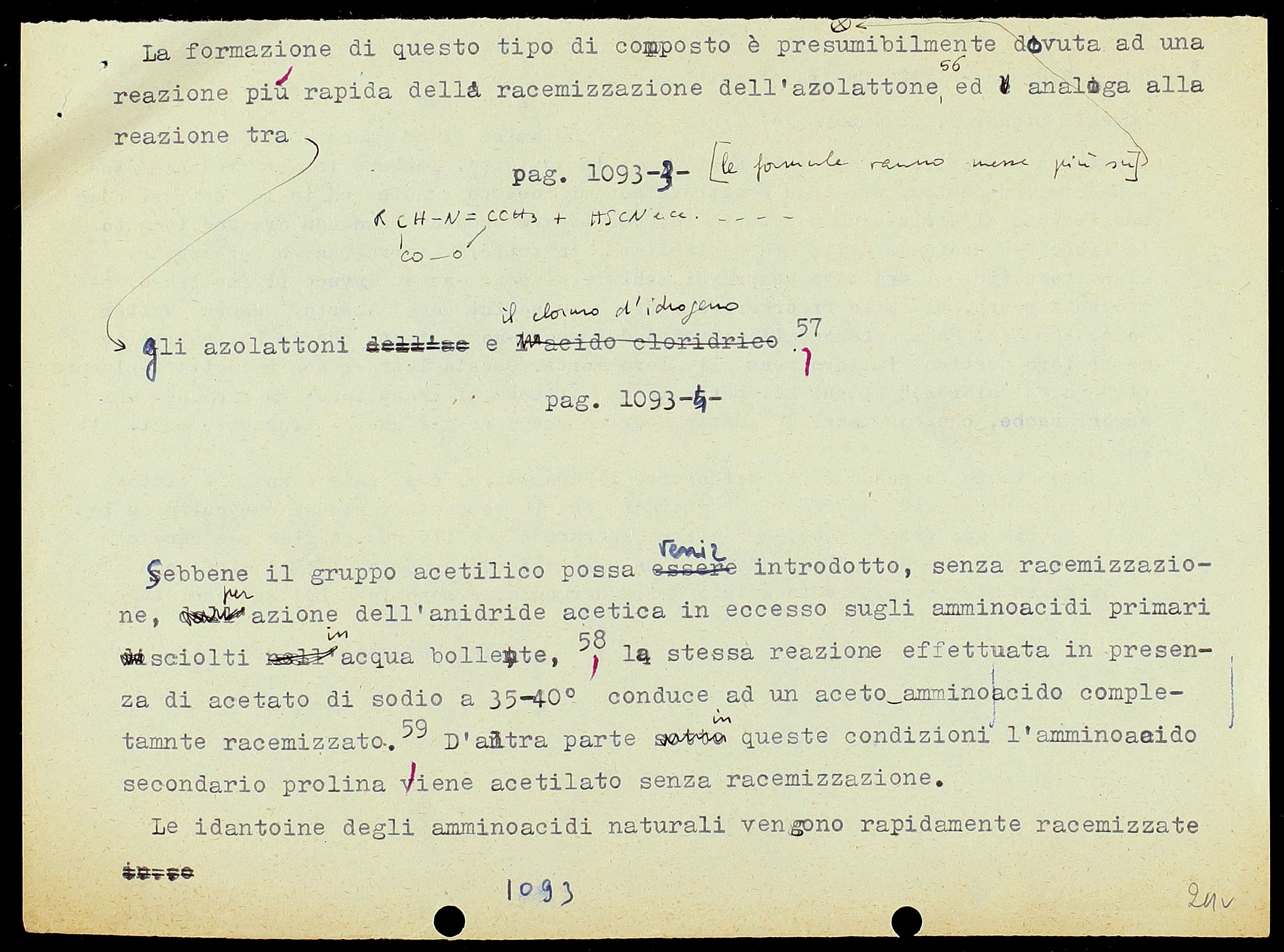
Description:handwritten letter in blue fountain pen with a handwritten insertion in blue ballpoint pen (perhaps by Levi). Translation by Levi (f. 211r) typewritten on a cut sheet of white paper; in the lower margin of the sheet, Levi notes by hand in blue ballpoint pen: “Risposto 13/10” (“Answered 13/10”); on the back of the sheet (f. 211v) is a passage of the translation of Organic Chemistry by Henry Gilman. mm 220x163.
Archive: Archivio privato di Primo Levi, Turin
Series: Complesso di fondi Primo Levi, Fondo Primo Levi, Corrispondenza, Corrispondenti particolari, Fasc. 20, sottofasc. 1, doc. 075, ff. 209, 210, 211r/v (traduzione).
Folio: 2 front only, 1 front and back
DOI: https://doi.org/10.15160/nd3d-ba64
1Above “Crailsheim” the street number “(718)” is noted by hand in blue ballpoint pen, probably by Levi.
2Alberto Dalla Volta (1922-1945) is one of the main characters in If This Is a Man. Levi considered him his “best friend” in the Lager. He died during the “Death March” on January 18, 1945. In the Einaudi edition published in 1958, Levi made a few additions and some of the most significant regard Alberto. There is a memorable portrait of him in the chapter “Our Nights”: “He is only twenty-two, two years younger than me, but none of us Italians have shown a capacity for adaptation like him. Alberto entered the Lager head high, and lives in the Lager unscathed and uncorrupted. He understood, before any of us, that this life is war; he allowed himself no indulgences, he wasted no time complaining or feeling sorry for himself and others, but entered the battle from the outset. He is sustained by intelligence and intuition. He reasons correctly; often he does not even reason but is right just the same. He grasps everything immediately; he knows only a little French but understands whatever the Germans and Poles tell him. He responds in Italian and with gestures, he makes himself understood and at once wins sympathy. He fights for his life but remains everybody’s friend. He ‘knows’ whom to corrupt, whom to avoid, whose compassion to arouse, whom to resist. Yet (and it is for this virtue of his that his memory is still dear and close to me) he did not become corrupt himself. I always saw, and still see in him, the rare figure of the strong yet gentle man against whom the weapons of the night are blunted” (CW I, p. 54). Regarding the life of Alberto Dalla Volta and the story of his family, cf. G. Dalla Volta, Vite da ariani, Bologna: Damiani Editore, 2024.
3Resnyk was Primo Levi’s bunkmate and the main character in the chapter “The Work.” According to the description Levi provides in these pages, Resnyk was a prisoner of Polish origin and was thirty years old when he was deported to Auschwitz. Before his arrest, he had lived in Paris for twenty years (CW I, p. 62). Based on this information, it can be surmised that the person in question is Petro Resnyk, born in Hungary in 1903. When the war ended, his brother-in-law Roman Faszchuk contacted the International Tracing Service in an attempt to track him down. The files in the Arolsen Archives reveal that the last communication between Petro Resnyk and his family date back to 1929, when he was living in France.
4Walter Bonn and Schmulek appear in the chapter “Ka Be;” they slept in the bunk next to Levi’s during his stay in the Lager’s infirmary (CW I, pp. 48-50). As opposed to Levi, their health did not improve and they were selected for the gas chamber in 1944.
5The reference is to what Levi wrote in the chapter “The Drowned and the Saved” in If This Is a Man regarding the figure of the Muselmänner: “They crowd my memory with their faceless presence [ohne Antlitz, in the German translation by Riedt], and if I could encompass all the evil of our time in one image, I would choose this image, which is familiar to me: an emaciated man, head bowed and shoulders bent, on whose face and in whose eyes no trace of thought can be seen” (CW I, p. 85).
6Frau Mayer was the secretary at the laboratory in Buna. Primo Levi talks about her in the chapter “Die drei Leute vom Labor.” However, Redmann attributes to Frau Mayer a statement that was actually made by Fräulein Liczba, one of the four civilian chemists at the laboratory in Buna, cf. CW I, pp. 136-37.
I
Italicized in the text is Primo Levi's translation of the letter.