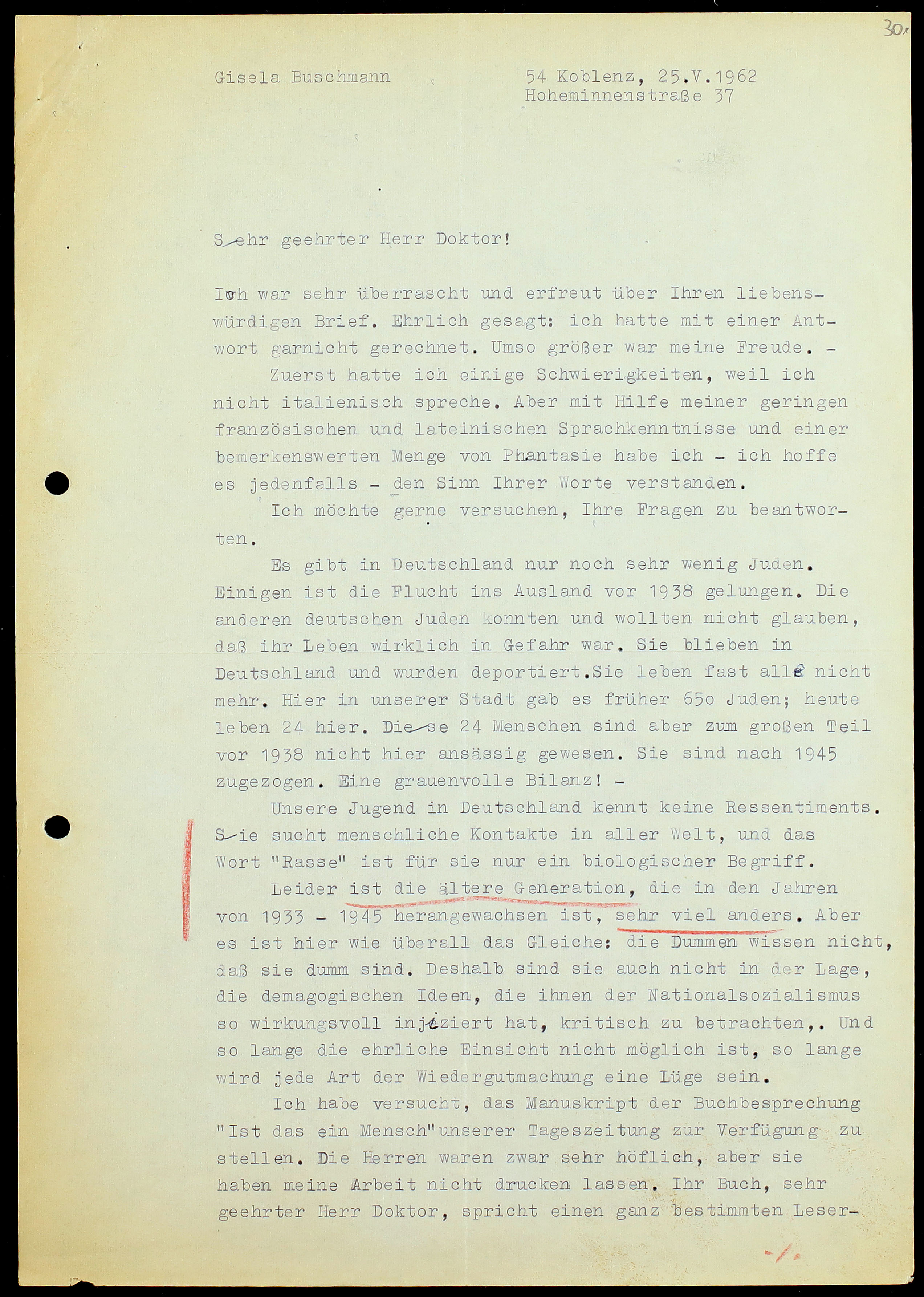
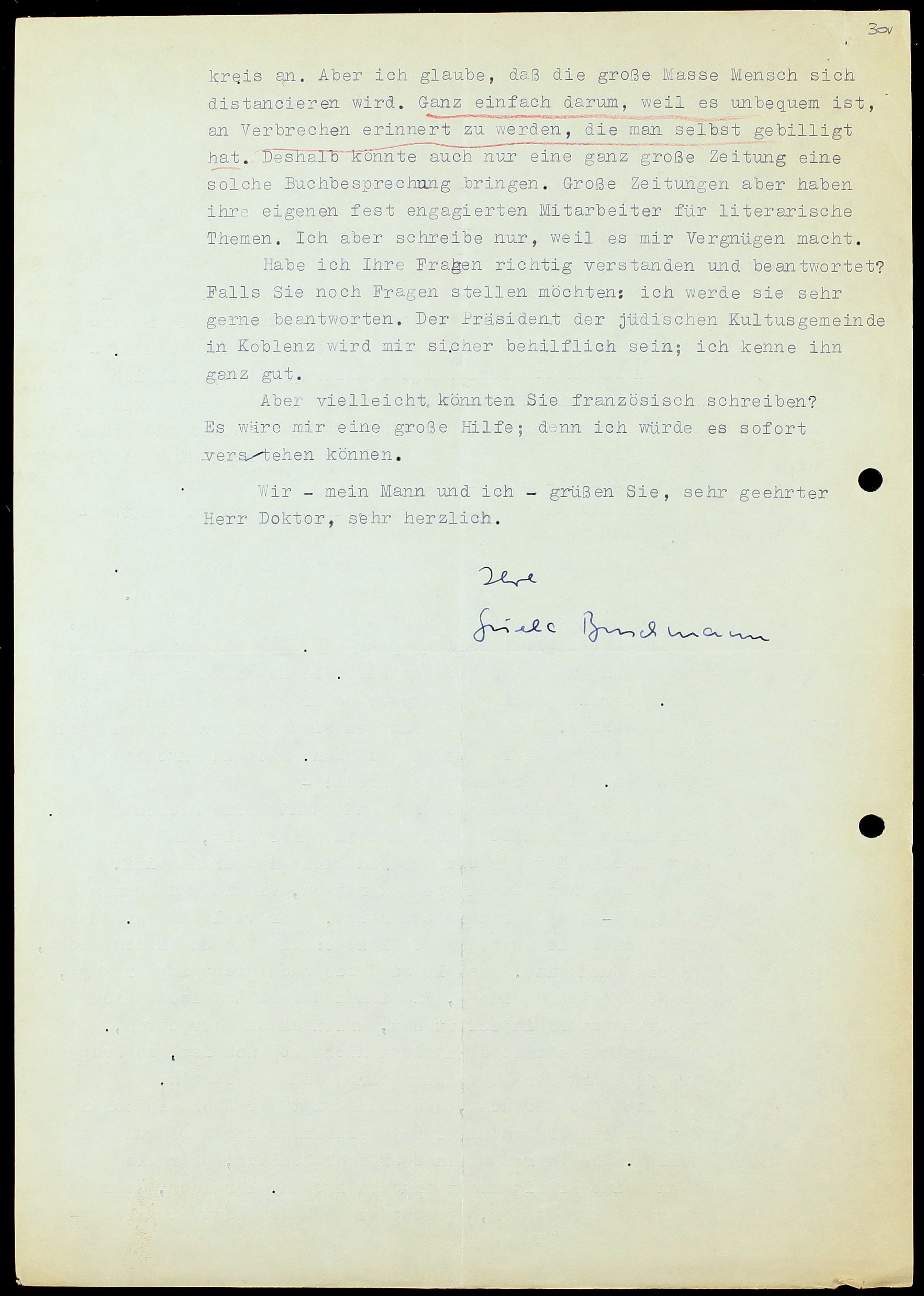
Rallegrandosi per la risposta ricevuta, Buschmann risponde alle domande di Levi.
Gisela Buschmann
54 Koblenz,, 25.V.1962
Hoheminnenstraße 37
Sehr geehrter Herr Doktor!
Ich war sehr überrascht und erfreut über Ihren liebenswürdigen Brief. Ehrlich gesagt: ich hatte mit einer Antwort garnicht gerechnet. Umso größer war meine Freude. –
Zuerst hatte ich einige Schwierigkeiten, weil ich nicht italienisch spreche. Aber mit Hilfe meiner geringen französischen und lateinischen Sprachkenntnisse und einer bemerkenswerten Menge von Phantasie habe ich – ich hoffe es jedenfalls – den Sinn Ihrer Worte verstanden.
Ich möchte gerne versuchen, Ihre Fragen zu beantworten.
Es gibt in Deutschland nur noch sehr wenig Juden. Einigen ist die Flucht ins Ausland vor 1938 gelungen. Die anderen deutschen Juden konnten und wollten nicht glauben, daß ihr Leben wirklich in Gefahr war. Sie blieben in Deutschland und wurden deportiert. Sie leben fast alle nicht mehr. Hier in unserer Stadt gab es früher 650 Juden; heute leben 24 hier. Diese 24 Menschen sind aber zum großen Teil vor 1938 nicht hier ansässig gewesen. Sie sind nach 1945 zugezogen. Eine grauenvolle Bilanz! –
Unsere Jugend in Deutschland kennt keine Ressentiments. Sie sucht menschliche Kontakte in aller Welt, und das Wort „Rasse“ ist für sie nur ein biologischer Begriff.
Leider ist die ältere Generation, die in den Jahren von 1933-1945 herangewachsen ist, sehr viel anders.[1] Aber es ist hier wie überall das Gleiche: die Dummen wissen nicht, daß sie dumm sind. Deshalb sind sie auch nicht in der Lage, die demagogischen Ideen, die ihnen der Nationalsozialismus so wirkungsvoll injiziert hat, kritisch zu betrachten. Und so lange die ehrliche Einsicht nicht möglich ist, so lange wird jede Art der Wiedergutmachung eine Lüge sein.
Ich habe versucht, das Manuskript der Buchbesprechung Ist das ein Mensch unserer Tageszeitung[2] zur Verfügung zu stellen. Die Herren waren zwar sehr höflich, aber sie haben meine Arbeit nicht drucken lassen. Ihr Buch, sehr geehrter Herr Doktor, spricht einen ganz bestimmten Leserkreis an. Aber ich glaube, daß die große Masse Mensch sich distancieren wird. Ganz einfach darum, weil es unbequem ist, an Verbrechen erinnert zu werden, die man selbst gebilligt hat.[3] Deshalb könnte auch nur eine ganz große Zeitung eine solche Buchbesprechung bringen. Große Zeitungen aber haben ihre eigenen fest engagierten Mitarbeiter für literarische Themen. Ich aber schreibe nur, weil es mir Vergnügen macht.
Habe ich Ihre Fragen richtig verstanden und beantwortet? Falls Sie noch Fragen stellen möchten: ich werde sie sehr gerne beantworten. Der Präsidentder jüdischen Kultusgemeinde in Koblenzwird mir sicher behilflich sein; ich kenne ihn ganz gut.
Aber vielleicht könnten Sie französisch schreiben?
Es wäre mir eine große Hilfe; denn ich würde es sofort verstehen können.
Wir – mein Mann und ich – grüßen Sie, sehr geehrter Herr Doktor, sehr herzlich.
Ihre
Gisela Buschmann
Gisela Buschmann
54 Coblenza, 25 maggio 1962
Hoheminnenstraße 37
Stimatissimo Dottor Levi,
la Sua gentile lettera mi ha sorpresa e rallegrata molto. A dire il vero, non mi aspettavo una risposta. Tanto più grande è stata quindi la mia gioia.
All’inizio ho avuto qualche difficoltà perché non parlo italiano. Tuttavia, grazie a quella poca conoscenza che ho del francese e del latino, e con l’aiuto di una notevole dose di fantasia, credo – o almeno spero – di aver compreso il senso delle Sue parole.
Vorrei provare a rispondere alle Sue domande.
In Germania ci sono ormai pochissimi ebrei. Alcuni sono riusciti a fuggire all’estero prima del 1938. Gli altri non potevano o non volevano credere che la loro vita fosse davvero in pericolo. Così sono rimasti in Germania e sono stati deportati. La maggior parte di loro non vive più. Qui nella nostra città prima vivevano 650 ebrei; oggi sono solo 24. E gran parte di loro, prima del 1938 non risiedeva qui: sono venuti dopo il 1945. Un bilancio spaventoso!
La nostra gioventù in Germania non conosce il risentimento. Cerca contatti umani in tutto il mondo, e dà alla parola “razza” solo un significato biologico.[1]
Purtroppo, la generazione più anziana, cresciuta negli anni tra il 1933 e il 1945, è molto diversa.[2]Ma qui, come dappertutto, vale la stessa regola: gli stupidi non sanno di esserlo. E così queste persone non sono in grado di guardare con spirito critico alle idee demagogiche che il nazionalsocialismo ha instillato in loro con tanta efficacia.[3] E finché mancherà una sincera consapevolezza, ogni forma di riparazione sarà una menzogna.
Ho provato a mettere a disposizione della nostra testata locale il manoscritto della recensione di Se questo è un uomo. I redattori sono stati molto cortesi, questo sì, ma non hanno pubblicato il mio articolo. Il Suo libro, stimatissimo Dottore, si rivolge a una cerchia di lettori molto specifica. Credo però che la massa prenderà le distanze. E questo semplicemente perché è scomodo essere chiamati a ricordare crimini che si è finito per approvare.[4] Solo un grande quotidiano, dunque, potrebbe pubblicare una recensione del genere. Se non che, le testate più importanti hanno i loro collaboratori fissi per i temi letterari. Mentre io scrivo solo per piacere personale.
Ho interpretato e risposto correttamente alle Sue domande? Se volesse rivolgermene altre, sarei molto lieta di rispondere. Il presidente della comunità ebraica di Coblenza, che conosco piuttosto bene, mi aiuterebbe di certo volentieri.
O forse potrebbe scrivermi in francese?
Mi sarebbe di grande aiuto, perché impiegherei meno tempo a comprendere.
Noi – io e mio marito – Le mandiamo i nostri più cordiali saluti.
Sua
Gisela Buschmann
Gisela Buschmann
54 Koblenz, May 25, 1962 Hoheminnenstraße 37
Dear Sir!
I was very surprised and delighted to receive your kind letter. To be honest, I had not expected a reply at all. So my delight was all the greater.—
I had some difficulty, at first, because I do not speak Italian. But with the help of my limited knowledge of French and Latin, and a notable amount of imagination, I hope to have understood the meaning of your words.
I would like to try to answer your questions.
There are very few Jews left in Germany.
Some German Jews managed to go abroad before 1938. The others could not and did not want to believe that their lives were really in danger. They stayed in Germany, and were then deported. Nearly all of them are no longer alive. There used to be 650 Jews in our city; today, 24 live here. However, most of these 24 did not live here before 1938. They moved here after 1945. A horrific toll!—
The young here in Germany harbor no ill feelings. They seek human contact all over the world, and for them the word “race” is merely a biological term.[1]
Unfortunately the older generation, who grew up between 1933–1945, is quite a different matter.[2] But it is the same here as everywhere else: the stupid do not know they are stupid. That is why they are incapable of critically examining the demagoguery National Socialism so effectively instilled[3] in them. And as long as any honest insight remains out of reach, any attempted reparation will be a lie.
I offered my book review of If This is a Man to our daily newspaper. The gentlemen were very polite, but did not print my work. Your book, dear Sir, appeals to a very specific readership. But I believe that the vast majority of people will distance themselves from it. Quite simply because it is uncomfortable to be reminded of crimes that one has personally condoned.[4] That is why only a very large newspaper could publish such a book review. But large newspapers have their own dedicated staff covering literature. And I write solely for my own enjoyment anyway.
Have I understood your questions correctly, and answered? Should you have any further questions, I would be happy to answer them. The president of the Jewish community in Koblenz will certainly be able to help me; I know him quite well.
Perhaps you could write in French, though?
That would be a great help, as I would understand it much more swiftly.
We—my husband and I—send you our warmest regards, dear Sir.
Yours,
Gisela Buschmann
Gisela Buschmann
54 Koblenz,, 25.V.1962
Hoheminnenstraße 37
Sehr geehrter Herr Doktor!
Ich war sehr überrascht und erfreut über Ihren liebenswürdigen Brief. Ehrlich gesagt: ich hatte mit einer Antwort garnicht gerechnet. Umso größer war meine Freude. –
Zuerst hatte ich einige Schwierigkeiten, weil ich nicht italienisch spreche. Aber mit Hilfe meiner geringen französischen und lateinischen Sprachkenntnisse und einer bemerkenswerten Menge von Phantasie habe ich – ich hoffe es jedenfalls – den Sinn Ihrer Worte verstanden.
Ich möchte gerne versuchen, Ihre Fragen zu beantworten.
Es gibt in Deutschland nur noch sehr wenig Juden. Einigen ist die Flucht ins Ausland vor 1938 gelungen. Die anderen deutschen Juden konnten und wollten nicht glauben, daß ihr Leben wirklich in Gefahr war. Sie blieben in Deutschland und wurden deportiert. Sie leben fast alle nicht mehr. Hier in unserer Stadt gab es früher 650 Juden; heute leben 24 hier. Diese 24 Menschen sind aber zum großen Teil vor 1938 nicht hier ansässig gewesen. Sie sind nach 1945 zugezogen. Eine grauenvolle Bilanz! –
Unsere Jugend in Deutschland kennt keine Ressentiments. Sie sucht menschliche Kontakte in aller Welt, und das Wort „Rasse“ ist für sie nur ein biologischer Begriff.
Leider ist die ältere Generation, die in den Jahren von 1933-1945 herangewachsen ist, sehr viel anders.[1] Aber es ist hier wie überall das Gleiche: die Dummen wissen nicht, daß sie dumm sind. Deshalb sind sie auch nicht in der Lage, die demagogischen Ideen, die ihnen der Nationalsozialismus so wirkungsvoll injiziert hat, kritisch zu betrachten. Und so lange die ehrliche Einsicht nicht möglich ist, so lange wird jede Art der Wiedergutmachung eine Lüge sein.
Ich habe versucht, das Manuskript der Buchbesprechung Ist das ein Mensch unserer Tageszeitung[2] zur Verfügung zu stellen. Die Herren waren zwar sehr höflich, aber sie haben meine Arbeit nicht drucken lassen. Ihr Buch, sehr geehrter Herr Doktor, spricht einen ganz bestimmten Leserkreis an. Aber ich glaube, daß die große Masse Mensch sich distancieren wird. Ganz einfach darum, weil es unbequem ist, an Verbrechen erinnert zu werden, die man selbst gebilligt hat.[3] Deshalb könnte auch nur eine ganz große Zeitung eine solche Buchbesprechung bringen. Große Zeitungen aber haben ihre eigenen fest engagierten Mitarbeiter für literarische Themen. Ich aber schreibe nur, weil es mir Vergnügen macht.
Habe ich Ihre Fragen richtig verstanden und beantwortet? Falls Sie noch Fragen stellen möchten: ich werde sie sehr gerne beantworten. Der Präsidentder jüdischen Kultusgemeinde in Koblenzwird mir sicher behilflich sein; ich kenne ihn ganz gut.
Aber vielleicht könnten Sie französisch schreiben?
Es wäre mir eine große Hilfe; denn ich würde es sofort verstehen können.
Wir – mein Mann und ich – grüßen Sie, sehr geehrter Herr Doktor, sehr herzlich.
Ihre
Gisela Buschmann
Gisela Buschmann
54 Coblenza, 25 maggio 1962
Hoheminnenstraße 37
Stimatissimo Dottor Levi,
la Sua gentile lettera mi ha sorpresa e rallegrata molto. A dire il vero, non mi aspettavo una risposta. Tanto più grande è stata quindi la mia gioia.
All’inizio ho avuto qualche difficoltà perché non parlo italiano. Tuttavia, grazie a quella poca conoscenza che ho del francese e del latino, e con l’aiuto di una notevole dose di fantasia, credo – o almeno spero – di aver compreso il senso delle Sue parole.
Vorrei provare a rispondere alle Sue domande.
In Germania ci sono ormai pochissimi ebrei. Alcuni sono riusciti a fuggire all’estero prima del 1938. Gli altri non potevano o non volevano credere che la loro vita fosse davvero in pericolo. Così sono rimasti in Germania e sono stati deportati. La maggior parte di loro non vive più. Qui nella nostra città prima vivevano 650 ebrei; oggi sono solo 24. E gran parte di loro, prima del 1938 non risiedeva qui: sono venuti dopo il 1945. Un bilancio spaventoso!
La nostra gioventù in Germania non conosce il risentimento. Cerca contatti umani in tutto il mondo, e dà alla parola “razza” solo un significato biologico.[1]
Purtroppo, la generazione più anziana, cresciuta negli anni tra il 1933 e il 1945, è molto diversa.[2]Ma qui, come dappertutto, vale la stessa regola: gli stupidi non sanno di esserlo. E così queste persone non sono in grado di guardare con spirito critico alle idee demagogiche che il nazionalsocialismo ha instillato in loro con tanta efficacia.[3] E finché mancherà una sincera consapevolezza, ogni forma di riparazione sarà una menzogna.
Ho provato a mettere a disposizione della nostra testata locale il manoscritto della recensione di Se questo è un uomo. I redattori sono stati molto cortesi, questo sì, ma non hanno pubblicato il mio articolo. Il Suo libro, stimatissimo Dottore, si rivolge a una cerchia di lettori molto specifica. Credo però che la massa prenderà le distanze. E questo semplicemente perché è scomodo essere chiamati a ricordare crimini che si è finito per approvare.[4] Solo un grande quotidiano, dunque, potrebbe pubblicare una recensione del genere. Se non che, le testate più importanti hanno i loro collaboratori fissi per i temi letterari. Mentre io scrivo solo per piacere personale.
Ho interpretato e risposto correttamente alle Sue domande? Se volesse rivolgermene altre, sarei molto lieta di rispondere. Il presidente della comunità ebraica di Coblenza, che conosco piuttosto bene, mi aiuterebbe di certo volentieri.
O forse potrebbe scrivermi in francese?
Mi sarebbe di grande aiuto, perché impiegherei meno tempo a comprendere.
Noi – io e mio marito – Le mandiamo i nostri più cordiali saluti.
Sua
Gisela Buschmann
Gisela Buschmann
54 Koblenz, May 25, 1962 Hoheminnenstraße 37
Dear Sir!
I was very surprised and delighted to receive your kind letter. To be honest, I had not expected a reply at all. So my delight was all the greater.—
I had some difficulty, at first, because I do not speak Italian. But with the help of my limited knowledge of French and Latin, and a notable amount of imagination, I hope to have understood the meaning of your words.
I would like to try to answer your questions.
There are very few Jews left in Germany.
Some German Jews managed to go abroad before 1938. The others could not and did not want to believe that their lives were really in danger. They stayed in Germany, and were then deported. Nearly all of them are no longer alive. There used to be 650 Jews in our city; today, 24 live here. However, most of these 24 did not live here before 1938. They moved here after 1945. A horrific toll!—
The young here in Germany harbor no ill feelings. They seek human contact all over the world, and for them the word “race” is merely a biological term.[1]
Unfortunately the older generation, who grew up between 1933–1945, is quite a different matter.[2] But it is the same here as everywhere else: the stupid do not know they are stupid. That is why they are incapable of critically examining the demagoguery National Socialism so effectively instilled[3] in them. And as long as any honest insight remains out of reach, any attempted reparation will be a lie.
I offered my book review of If This is a Man to our daily newspaper. The gentlemen were very polite, but did not print my work. Your book, dear Sir, appeals to a very specific readership. But I believe that the vast majority of people will distance themselves from it. Quite simply because it is uncomfortable to be reminded of crimes that one has personally condoned.[4] That is why only a very large newspaper could publish such a book review. But large newspapers have their own dedicated staff covering literature. And I write solely for my own enjoyment anyway.
Have I understood your questions correctly, and answered? Should you have any further questions, I would be happy to answer them. The president of the Jewish community in Koblenz will certainly be able to help me; I know him quite well.
Perhaps you could write in French, though?
That would be a great help, as I would understand it much more swiftly.
We—my husband and I—send you our warmest regards, dear Sir.
Yours,
Gisela Buschmann
Info
Note
Tag
Mittente: Gisela Buschmann
Destinatario: Primo Levi
Data di stesura: 1962-05-25
Luogo di stesura: Coblenza
Descrizione del documento: lettera ds. su foglio bianco con sottolineature ms. a matita rossa di Levi e firma ms. a stilografica blu.
Archivio: Archivio privato di Primo Levi, Torino
Segnatura: Complesso di Fondi primo Levi, Fondo Primo Levi, Corrispondenza, Corrispondenti particolari, fasc. 20, sottofasc. 001, doc. 014, ff. 30r/v.
Fogli: 1, recto e verso
DOI: https://doi.org/10.15160/nrme-c168
1
Il capoverso da «Sie sucht menschliche» a «sehr viel anders» è contrassegnato con un segno ms. a matita rossa sul margine interno del foglio. «Ist die ältere Generation» e «sehr viel anders» sono sottolineati ms. a matita rossa.
2
Probabilmente si riferisce al Rhein-Zeitung.
3
«Ganz einfach darum…selbst gebilligt hat» è sottolineato ms. a matita rossa.