Gisela Buschmann, corrispondente di Coblenza, ringrazia Levi per Ist das ein Mensch? e allega alla sua lettera una recensione al libro da lei scritta.
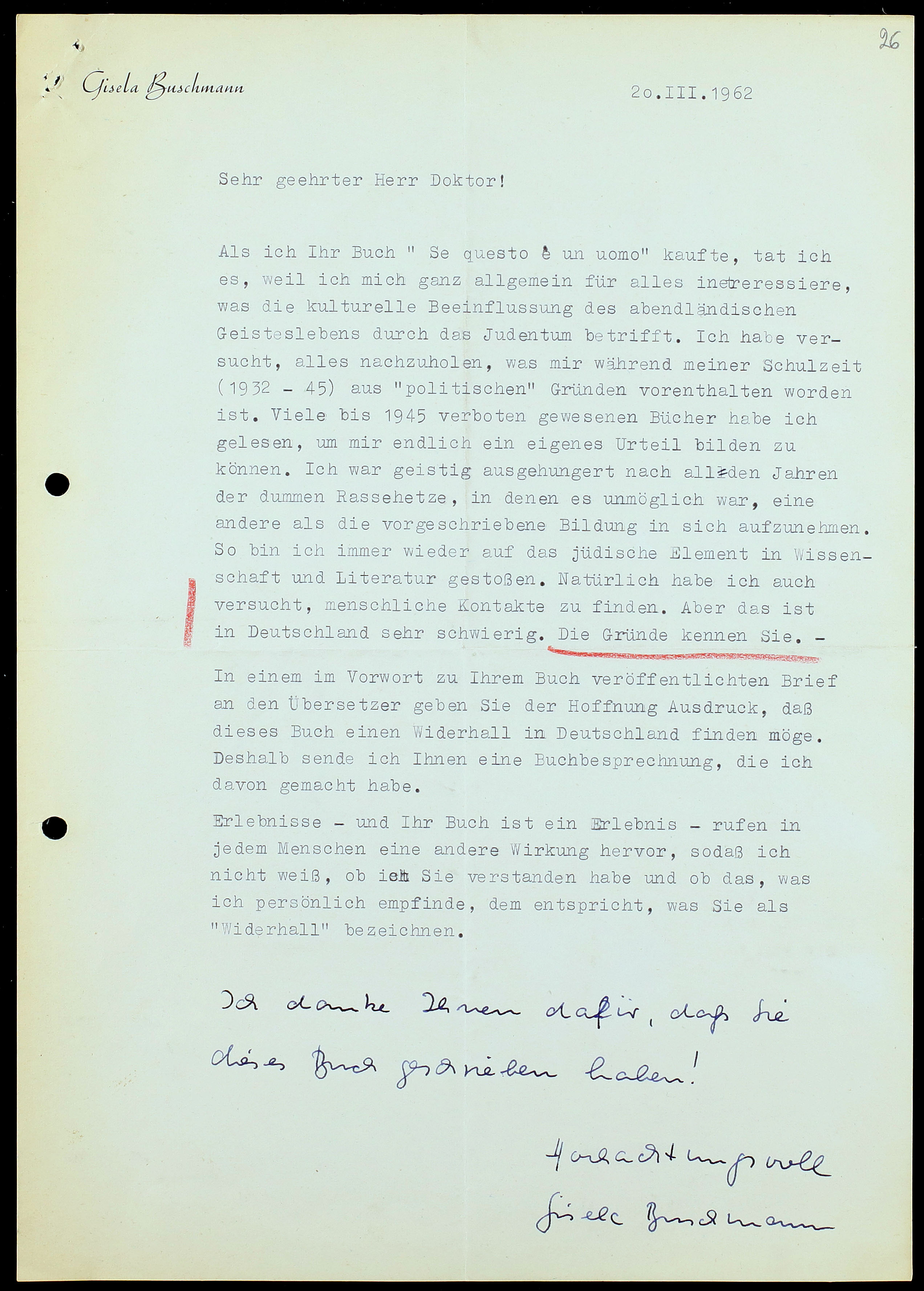
20.III.1962
Sehr geehrter Herr Doktor!
Als ich Ihr Buch Se questo è un uomo kaufte, tat ich es, weil ich mich ganz allgemein für alles interessiere, was die kulturelle Beeinflussung des abendländischen Geisteslebens durch das Judentum betrifft. Ich habe versucht, alles nachzuholen, was mir während meiner Schulzeit (1932-45) aus „politischen” Gründen vorenthalten worden ist. Viele bis 1945 verboten gewesenen Bücher habe ich gelesen, um mir endlich ein eigenes Urteil bilden zu können. Ich war geistig ausgehungert nach all den Jahren der dummen Rassehetze, in denen es unmöglich war, eine andere als die vorgeschriebene Bildung in sich aufzunehmen.
So bin ich immer wieder auf das jüdische Element in Wissenschaft und Literatur gestoßen. Natürlich habe ich auch versucht, menschliche Kontakte zu finden. Aber das ist in Deutschland sehr schwierig. Die Gründe kennen Sie. –[1]
In einem im Vorwort zu Ihrem Buch veröffentlichten Brief an den Übersetzer geben Sie der Hoffnung Ausdruck, daß dieses Buch einen Widerhall in Deutschland finden möge. Deshalb sende ich Ihnen eine Buchbesprechnung, die ich davon gemacht habe.
Erlebnisse – und Ihr Buchist ein Erlebnis – rufen in jedem Menschen eine andere Wirkung hervor, sodaß ich nicht weiß, ob ich Sie verstanden habe und ob das, was ich persönlich empfinde, dem entspricht, was Sie als „Widerhall“ bezeichnen.
Ich danke Ihnen dafür, daß Sie dieses Buch geschrieben haben!
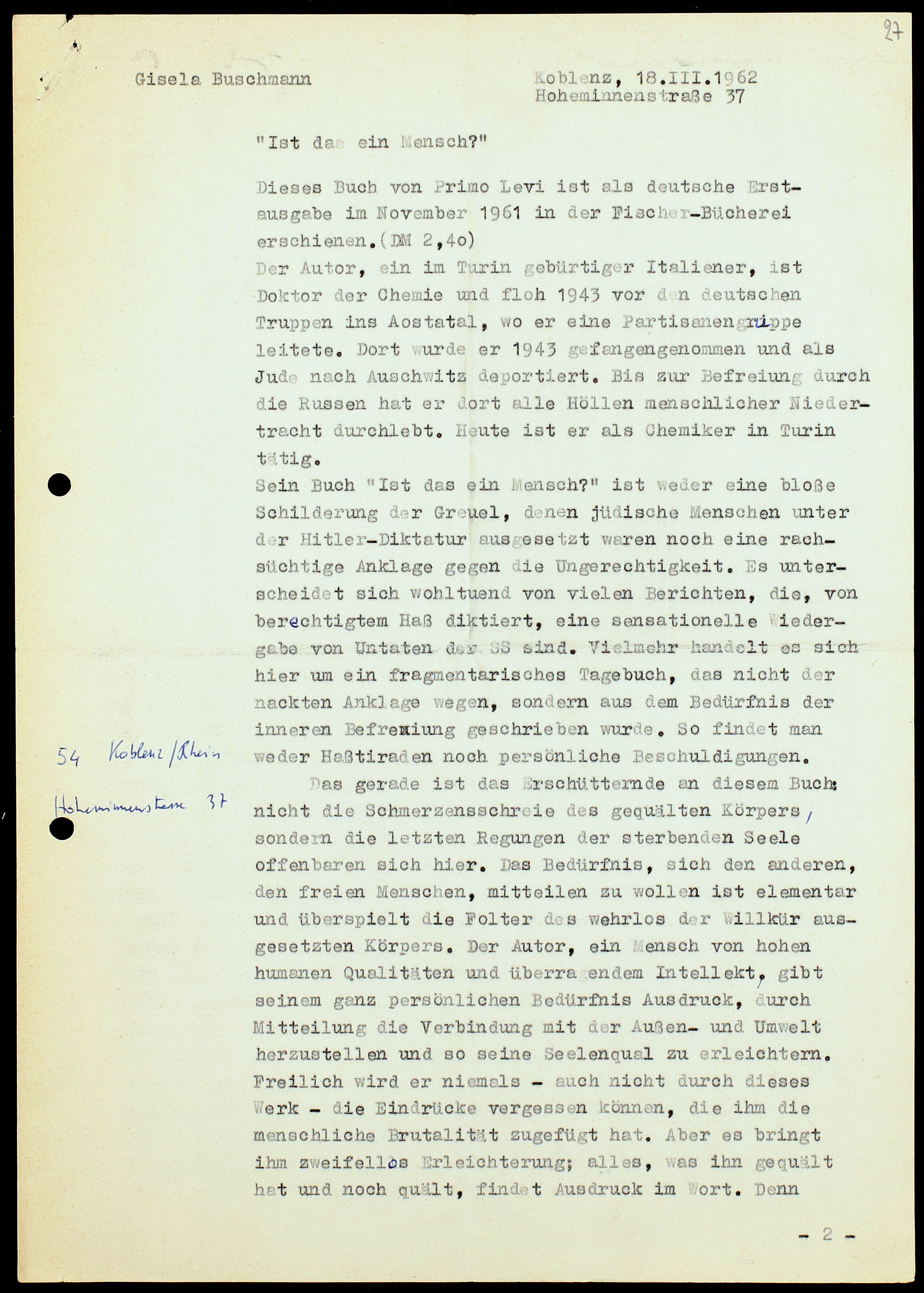
Dieses Buch von Primo Levi ist als deutsche Erstausgabe im November 1961 in der Fischer-Büchereierschienen. (DM 2,40)
Der Autor, ein im Turin gebürtiger Italiener, ist Doktor der Chemie und floh 1943 vor den deutschen Truppen ins Aostatal, wo er eine Partisanengruppe leitete.[4] Dort wurde er 1943 gefangengenommen und als Jude nach Auschwitz deportiert. Bis zur Befreiung durch die Russen hat er dort alle Höllen menschlicher Niedertracht durchlebt. Heute ist er als Chemiker in Turin tätig.
Sein Buch Ist das ein Mensch?ist weder eine bloße Schilderung der Greuel, denen jüdische Menschen unter der Hitler-Diktatur ausgesetzt waren noch eine rachsüchtige Anklage gegen die Ungerechtigkeit. Es unterscheidet sich wohltuend von vielen Berichten, die, von berechtigten Haß diktiert, eine sensationelle Wiedergabe von Untaten der SS sind. Vielmehr handelt es sich hier um ein fragmentarisches Tagebuch, das nicht der nackten Anklage wegen, sondern aus dem Bedürfnis der inneren Befreiung geschrieben wurde. So findet man weder Haßtiraden noch persönliche Beschuldigungen.
Das gerade ist das Erschütternde an diesem Buch: nicht die Schmerzensschreie des gequälten Körpers,[5] sondern die letzten Regungen der sterbenden Seele offenbaren sich hier. Das Bedürfnis, sich den anderen, den freien Menschen, mitteilen zu wollen ist elementar und überspielt die Folter des wehrlos der Willkür ausgesetzten Körpers. Der Autor, ein Mensch von hohen humanen Qualitäten und überragendem Intellekt, gibt seinem ganz persönlichen Bedürfnis Ausdruck, durch Mitteilung die Verbindung mit der Außen- und Umwelt herzustellen und so seine Seelenqual zu erleichtern.
Freilich wird er niemals – auch nicht durch dieses Werk – die Eindrücke vergessen können, die ihm die menschliche Brutalität zugefügt hat. Aber es bringt ihm zweifellos Erleichterung; alles, was ihn gequält hat und noch quält, findet Ausdruck im Wort. Denn die Freiheit des Geistes bedeutet ihm weit mehr als die äußere, die körperliche Unabhängigkeit.
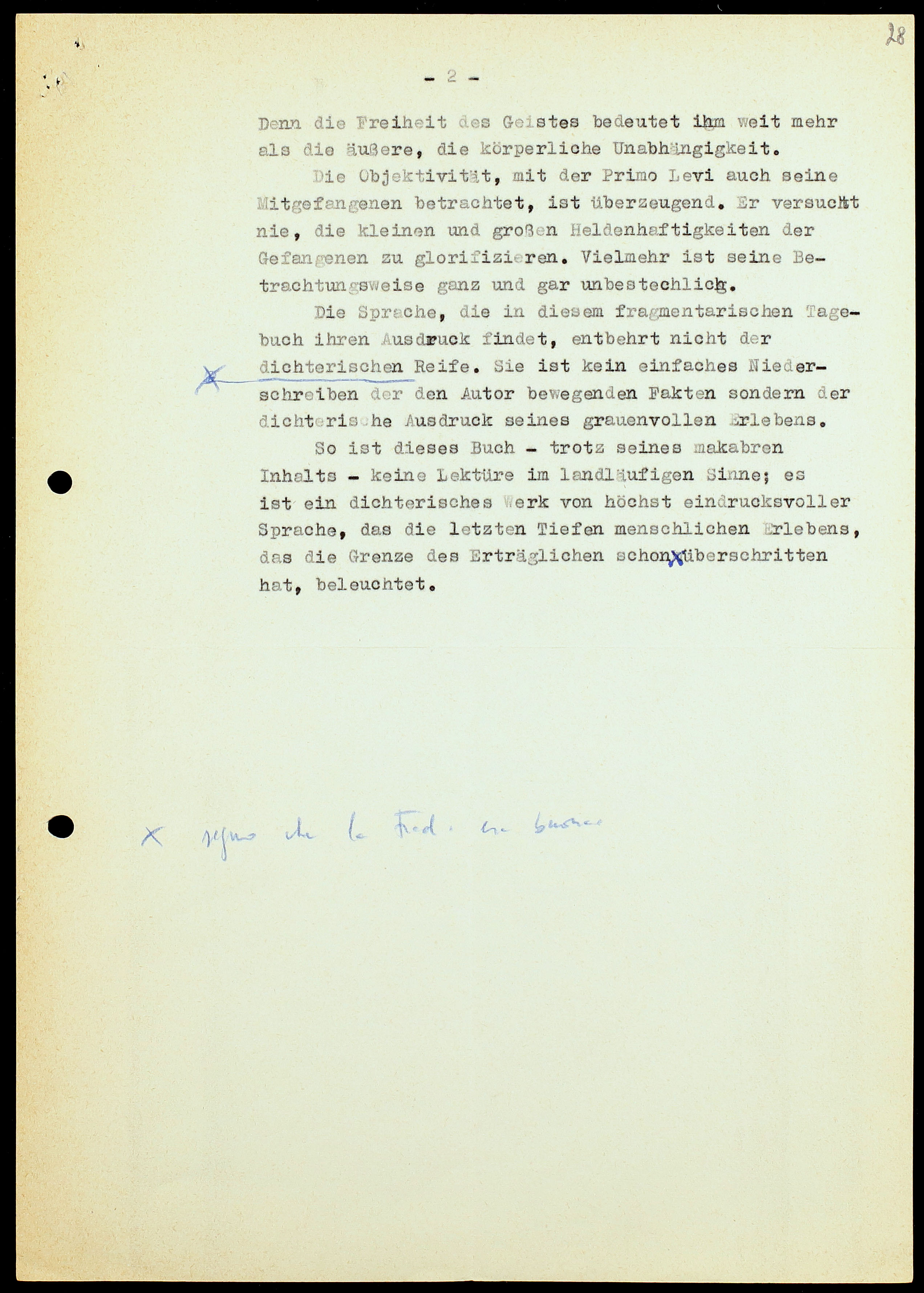
Die Objektivität, mit der Primo Levi auch seine Mitgefangenen betrachtet, ist überzeugend. Er versucht nie, die kleinen und großen Heldenhaftigkeiten der Gefangenen zu glorifizieren. Vielmehr ist seine Betrachtungsweise ganz und gar unbestechlich.
Die Sprache, die in diesem fragmentarischen Tagebuch ihren Ausdruck findet, entbehrt nicht der dichterischen[6] Reife. Sie ist kein einfaches Niederschreiben der den Autor bewegenden Fakten sondern der dichterische Ausdruck seines grauenvollen Erlebens.
So ist dieses Buch – trotz seines makabren Inhalts – keine Lektüre im landläufigen Sinne; es ist ein dichterisches Werk von höchst eindrucksvoller Sprache, das die letzten Tiefen menschlichen Erlebens, das die Grenze des Erträglichen schon überschritten[7] hat, beleuchtet.
20 marzo 1962
Gentile Dottore,
quando ho acquistato il Suo libro Se questo è un uomo, l’ho fatto perché sono interessata in generale a tutto ciò che riguarda l’influenza culturale esercitata dall’ebraismo sulla vita intellettuale in Occidente. Ho tentato di recuperare quanto, «per motivi politici», mi era stato negato al tempo in cui frequentavo la scuola (1932-45), per potermi finalmente formare un mio giudizio. Dopo tutti quegli anni di stupida propaganda razziale, durante i quali era impossibile acquisire un’istruzione diversa da quella prescritta, ero affamata di sapere.
Mi sono dunque imbattuta più e più volte nell’elemento ebraico in ambito sia scientifico sia letterario. Naturalmente ho anche cercato di stabilire contatti umani, ma questo, in Germania, è molto difficile. I motivi le sono noti –[1]
In una lettera al traduttore pubblicata nella prefazione al Suo libro esprime la speranza che questo susciti un’eco in Germania. Per questo motivo Le invio una recensione che ho scritto io.
Esperienze – e il Suo libro è un’esperienza – risvegliano un’eco diversa in ogni persona e dunque non so se io L’ho capita davvero, oppure se ciò che sento personalmente corrisponde a quanto Lei definisce «eco».
Questo libro di Primo Levi è uscito per la prima volta in edizione tedesca nel novembre del 1961 presso Fischer Bücherei(2,40 marchi).
L’autore, un italiano nato a Torino, è dottore in chimica e nel 1943 è fuggito dalle truppe tedesche rifugiandosi in Val d’Aosta, dove ha guidato una brigata partigiana.[4] In quello stesso anno è stato catturato e, in quanto ebreo, deportato ad Auschwitz. Lì ha vissuto fino alla liberazione da parte dei russi, attraversando ogni inferno dell’abiezione umana. Oggi lavora come chimico a Torino.
Il suo Se questo è un uomo non è una semplice descrizione degli orrori subiti dagli ebrei sotto la dittatura hitleriana, né una requisitoria bramosa di vendetta contro l’ingiustizia. È diverso, in senso positivo, da molte altre testimonianze che, pur dettate da un odio legittimo, tendono a offrire un resoconto sensazionalistico delle atrocità compiute dalle SS. Piuttosto si tratta di un diario frammentario, scritto non per il solo scopo di denunciare, ma per un bisogno profondo di liberazione interiore. Non vi si trovano né invettive cariche di odio, né accuse personali.
Ed è proprio questo l’aspetto più sconvolgente di questo libro: non rivela i lamenti di un corpo martoriato,[5] bensì le ultime vibrazioni di un’anima in agonia. Il bisogno di comunicare con gli altri, con chi è ancora libero, è primario e quasi tende a nascondere la tortura inflitta a un corpo esposto senza difese all’arbitrio. L’autore, un uomo di altissime qualità umane e di raro intelletto, esprime un bisogno profondamente personale: quello di ristabilire, attraverso la parola, un legame con il mondo esterno, e così dare sollievo al proprio tormento interiore.
Naturalmente, neppure quest’opera potrà mai cancellare i segni che la brutalità umana gli ha lasciato. Senza dubbio, però, gli è di conforto: tutto ciò che lo ha tormentato – e ancora lo tormenta – trova espressione nella parola. Perché la libertà dello spirito, per Levi, vale ben più di quella esteriore, dell’autonomia del corpo.
Colpisce l’obiettività con cui Levi guarda anche ai suoi compagni di prigionia. Non tenta mai di glorificarne i piccoli o i grandi atti di eroismo: il suo sguardo è del tutto incorruttibile.
La lingua di questo diario frammentario non è priva di maturità poetica.[6] Non è una mera registrazione dei fatti che hanno scosso l’autore, ma un’espressione poetica dell’orrore vissuto sulla propria pelle.
Così questo libro – nonostante il suo contenuto macabro – non è una lettura nel senso comune del termine: è un’opera letteraria scritta in una lingua estremamente incisiva, che getta luce sugli abissi dell’esperienza umana, là dove si è ormai oltrepassato il limite del sopportabile.[7]
March 20, 1962
Dear Sir!
When I bought your book If This Is a Man, I did so because I am interested in everything concerning Judaism’s cultural influence on Western intellectual life. I have tried to catch up on everything I was denied access to during my school years (1932–45) for “political” reasons. I have read many books that were banned until 1945, in order to finally form my own opinion. After all thoseyears of stupid racial propaganda, I was intellectually starved, since the only education available was the officially sanctioned kind.
So I have since repeatedly come across Jewish elements in science and literature. Of course, I have also tried to find personal, human contacts. But that is very difficult in Germany. You know the reasons.—[1]
In a letter to the translator published in the foreword to your book, you express the hope that this book will find resonance in Germany. Hence I am sending you a review I wrote of it.
Experiences—and your book is an experience—have a different effect on every person, so I do not know whether I have understood you, nor whether what I personally feel corresponds to what you call a “resonance.”
I thank you for / having written this book!
Yours truly,
Gisela Buschmann[2]
Koblenz, March 18, 1962 Hoheminnenstraße 37 Gisela Buschmann
If This is a Man[3]
This book by Primo Levi was published in German for the first time in November 1961 by Fischer-Bücherei. (DM 2.40)
The author, an Italian born in Turin, has a doctorate in chemistry, and he fled from German troops to the Aosta Valley in 1943, where he led a group of partisans.[4] He was captured there in 1943 and, as a Jew, deported to Auschwitz. Prior to being liberated by the Russians, he endured all the hells of human depravity. Today, he is employed in Turin as a chemist.
His book If This is a Man is neither a mere description of the atrocities to which Jewish people were subjected under Hitler’s dictatorship nor a vengeful indictment of injustice. It is refreshingly different from many other accounts, which, dictated by a justifiable hatred, are sensationalist accounts of the SS’s crimes. Rather, it is a fragmentary diary written not for the sake of bare accusation, but out of a need for inner liberation. Thus, one finds neither hate-filled tirades nor personal accusations.
And that is precisely what is so shocking about this book: what it reveals are not the cries of pain from the tortured body,[5] but rather the last stirrings of the dying soul. The need to communicate with others, with people who are free, is fundamental, and overshadows the arbitrary torture of a defenseless body. The author, a man of high human qualities and outstanding intellect, expresses his very personal need to establish a connection with the outside world and his environment through communication, thereby alleviating his mental anguish.
Of course, he will never—not even through this work—be able to forget the impressions that human brutality has left on him. But writing undoubtedly brings him relief; here, everything that has tormented him and still torments him is expressed in words. Mental freedom clearly means far more to him than external, physical independence.
The objectivity with which Primo Levi views even his fellow prisoners is also convincing. He never attempts to glorify the prisoners’ small and large acts of heroism. Rather, his perspective is utterly unerring.
Nor does the language deployed in this fragmentary diary lack a certain poetic maturity.[6] Rather than a simple recording of facts and events that moved the author, it is a poetic expression of his horrific experiences.
Thus, despite its macabre content, this book is no straightforward read in the conventional sense; it is a poetic, linguistically highly impressive work that sheds light on the ultimate depths of an experience that has already surpassed the outer limits of what any human can bear.[7]
20.III.1962
Sehr geehrter Herr Doktor!
Als ich Ihr Buch Se questo è un uomo kaufte, tat ich es, weil ich mich ganz allgemein für alles interessiere, was die kulturelle Beeinflussung des abendländischen Geisteslebens durch das Judentum betrifft. Ich habe versucht, alles nachzuholen, was mir während meiner Schulzeit (1932-45) aus „politischen” Gründen vorenthalten worden ist. Viele bis 1945 verboten gewesenen Bücher habe ich gelesen, um mir endlich ein eigenes Urteil bilden zu können. Ich war geistig ausgehungert nach all den Jahren der dummen Rassehetze, in denen es unmöglich war, eine andere als die vorgeschriebene Bildung in sich aufzunehmen.
So bin ich immer wieder auf das jüdische Element in Wissenschaft und Literatur gestoßen. Natürlich habe ich auch versucht, menschliche Kontakte zu finden. Aber das ist in Deutschland sehr schwierig. Die Gründe kennen Sie. –[1]
In einem im Vorwort zu Ihrem Buch veröffentlichten Brief an den Übersetzer geben Sie der Hoffnung Ausdruck, daß dieses Buch einen Widerhall in Deutschland finden möge. Deshalb sende ich Ihnen eine Buchbesprechnung, die ich davon gemacht habe.
Erlebnisse – und Ihr Buchist ein Erlebnis – rufen in jedem Menschen eine andere Wirkung hervor, sodaß ich nicht weiß, ob ich Sie verstanden habe und ob das, was ich persönlich empfinde, dem entspricht, was Sie als „Widerhall“ bezeichnen.
Ich danke Ihnen dafür, daß Sie dieses Buch geschrieben haben!
Dieses Buch von Primo Levi ist als deutsche Erstausgabe im November 1961 in der Fischer-Büchereierschienen. (DM 2,40)
Der Autor, ein im Turin gebürtiger Italiener, ist Doktor der Chemie und floh 1943 vor den deutschen Truppen ins Aostatal, wo er eine Partisanengruppe leitete.[4] Dort wurde er 1943 gefangengenommen und als Jude nach Auschwitz deportiert. Bis zur Befreiung durch die Russen hat er dort alle Höllen menschlicher Niedertracht durchlebt. Heute ist er als Chemiker in Turin tätig.
Sein Buch Ist das ein Mensch?ist weder eine bloße Schilderung der Greuel, denen jüdische Menschen unter der Hitler-Diktatur ausgesetzt waren noch eine rachsüchtige Anklage gegen die Ungerechtigkeit. Es unterscheidet sich wohltuend von vielen Berichten, die, von berechtigten Haß diktiert, eine sensationelle Wiedergabe von Untaten der SS sind. Vielmehr handelt es sich hier um ein fragmentarisches Tagebuch, das nicht der nackten Anklage wegen, sondern aus dem Bedürfnis der inneren Befreiung geschrieben wurde. So findet man weder Haßtiraden noch persönliche Beschuldigungen.
Das gerade ist das Erschütternde an diesem Buch: nicht die Schmerzensschreie des gequälten Körpers,[5] sondern die letzten Regungen der sterbenden Seele offenbaren sich hier. Das Bedürfnis, sich den anderen, den freien Menschen, mitteilen zu wollen ist elementar und überspielt die Folter des wehrlos der Willkür ausgesetzten Körpers. Der Autor, ein Mensch von hohen humanen Qualitäten und überragendem Intellekt, gibt seinem ganz persönlichen Bedürfnis Ausdruck, durch Mitteilung die Verbindung mit der Außen- und Umwelt herzustellen und so seine Seelenqual zu erleichtern.
Freilich wird er niemals – auch nicht durch dieses Werk – die Eindrücke vergessen können, die ihm die menschliche Brutalität zugefügt hat. Aber es bringt ihm zweifellos Erleichterung; alles, was ihn gequält hat und noch quält, findet Ausdruck im Wort. Denn die Freiheit des Geistes bedeutet ihm weit mehr als die äußere, die körperliche Unabhängigkeit.
Die Objektivität, mit der Primo Levi auch seine Mitgefangenen betrachtet, ist überzeugend. Er versucht nie, die kleinen und großen Heldenhaftigkeiten der Gefangenen zu glorifizieren. Vielmehr ist seine Betrachtungsweise ganz und gar unbestechlich.
Die Sprache, die in diesem fragmentarischen Tagebuch ihren Ausdruck findet, entbehrt nicht der dichterischen[6] Reife. Sie ist kein einfaches Niederschreiben der den Autor bewegenden Fakten sondern der dichterische Ausdruck seines grauenvollen Erlebens.
So ist dieses Buch – trotz seines makabren Inhalts – keine Lektüre im landläufigen Sinne; es ist ein dichterisches Werk von höchst eindrucksvoller Sprache, das die letzten Tiefen menschlichen Erlebens, das die Grenze des Erträglichen schon überschritten[7] hat, beleuchtet.
20 marzo 1962
Gentile Dottore,
quando ho acquistato il Suo libro Se questo è un uomo, l’ho fatto perché sono interessata in generale a tutto ciò che riguarda l’influenza culturale esercitata dall’ebraismo sulla vita intellettuale in Occidente. Ho tentato di recuperare quanto, «per motivi politici», mi era stato negato al tempo in cui frequentavo la scuola (1932-45), per potermi finalmente formare un mio giudizio. Dopo tutti quegli anni di stupida propaganda razziale, durante i quali era impossibile acquisire un’istruzione diversa da quella prescritta, ero affamata di sapere.
Mi sono dunque imbattuta più e più volte nell’elemento ebraico in ambito sia scientifico sia letterario. Naturalmente ho anche cercato di stabilire contatti umani, ma questo, in Germania, è molto difficile. I motivi le sono noti –[1]
In una lettera al traduttore pubblicata nella prefazione al Suo libro esprime la speranza che questo susciti un’eco in Germania. Per questo motivo Le invio una recensione che ho scritto io.
Esperienze – e il Suo libro è un’esperienza – risvegliano un’eco diversa in ogni persona e dunque non so se io L’ho capita davvero, oppure se ciò che sento personalmente corrisponde a quanto Lei definisce «eco».
Questo libro di Primo Levi è uscito per la prima volta in edizione tedesca nel novembre del 1961 presso Fischer Bücherei(2,40 marchi).
L’autore, un italiano nato a Torino, è dottore in chimica e nel 1943 è fuggito dalle truppe tedesche rifugiandosi in Val d’Aosta, dove ha guidato una brigata partigiana.[4] In quello stesso anno è stato catturato e, in quanto ebreo, deportato ad Auschwitz. Lì ha vissuto fino alla liberazione da parte dei russi, attraversando ogni inferno dell’abiezione umana. Oggi lavora come chimico a Torino.
Il suo Se questo è un uomo non è una semplice descrizione degli orrori subiti dagli ebrei sotto la dittatura hitleriana, né una requisitoria bramosa di vendetta contro l’ingiustizia. È diverso, in senso positivo, da molte altre testimonianze che, pur dettate da un odio legittimo, tendono a offrire un resoconto sensazionalistico delle atrocità compiute dalle SS. Piuttosto si tratta di un diario frammentario, scritto non per il solo scopo di denunciare, ma per un bisogno profondo di liberazione interiore. Non vi si trovano né invettive cariche di odio, né accuse personali.
Ed è proprio questo l’aspetto più sconvolgente di questo libro: non rivela i lamenti di un corpo martoriato,[5] bensì le ultime vibrazioni di un’anima in agonia. Il bisogno di comunicare con gli altri, con chi è ancora libero, è primario e quasi tende a nascondere la tortura inflitta a un corpo esposto senza difese all’arbitrio. L’autore, un uomo di altissime qualità umane e di raro intelletto, esprime un bisogno profondamente personale: quello di ristabilire, attraverso la parola, un legame con il mondo esterno, e così dare sollievo al proprio tormento interiore.
Naturalmente, neppure quest’opera potrà mai cancellare i segni che la brutalità umana gli ha lasciato. Senza dubbio, però, gli è di conforto: tutto ciò che lo ha tormentato – e ancora lo tormenta – trova espressione nella parola. Perché la libertà dello spirito, per Levi, vale ben più di quella esteriore, dell’autonomia del corpo.
Colpisce l’obiettività con cui Levi guarda anche ai suoi compagni di prigionia. Non tenta mai di glorificarne i piccoli o i grandi atti di eroismo: il suo sguardo è del tutto incorruttibile.
La lingua di questo diario frammentario non è priva di maturità poetica.[6] Non è una mera registrazione dei fatti che hanno scosso l’autore, ma un’espressione poetica dell’orrore vissuto sulla propria pelle.
Così questo libro – nonostante il suo contenuto macabro – non è una lettura nel senso comune del termine: è un’opera letteraria scritta in una lingua estremamente incisiva, che getta luce sugli abissi dell’esperienza umana, là dove si è ormai oltrepassato il limite del sopportabile.[7]
March 20, 1962
Dear Sir!
When I bought your book If This Is a Man, I did so because I am interested in everything concerning Judaism’s cultural influence on Western intellectual life. I have tried to catch up on everything I was denied access to during my school years (1932–45) for “political” reasons. I have read many books that were banned until 1945, in order to finally form my own opinion. After all thoseyears of stupid racial propaganda, I was intellectually starved, since the only education available was the officially sanctioned kind.
So I have since repeatedly come across Jewish elements in science and literature. Of course, I have also tried to find personal, human contacts. But that is very difficult in Germany. You know the reasons.—[1]
In a letter to the translator published in the foreword to your book, you express the hope that this book will find resonance in Germany. Hence I am sending you a review I wrote of it.
Experiences—and your book is an experience—have a different effect on every person, so I do not know whether I have understood you, nor whether what I personally feel corresponds to what you call a “resonance.”
I thank you for / having written this book!
Yours truly,
Gisela Buschmann[2]
Koblenz, March 18, 1962 Hoheminnenstraße 37 Gisela Buschmann
If This is a Man[3]
This book by Primo Levi was published in German for the first time in November 1961 by Fischer-Bücherei. (DM 2.40)
The author, an Italian born in Turin, has a doctorate in chemistry, and he fled from German troops to the Aosta Valley in 1943, where he led a group of partisans.[4] He was captured there in 1943 and, as a Jew, deported to Auschwitz. Prior to being liberated by the Russians, he endured all the hells of human depravity. Today, he is employed in Turin as a chemist.
His book If This is a Man is neither a mere description of the atrocities to which Jewish people were subjected under Hitler’s dictatorship nor a vengeful indictment of injustice. It is refreshingly different from many other accounts, which, dictated by a justifiable hatred, are sensationalist accounts of the SS’s crimes. Rather, it is a fragmentary diary written not for the sake of bare accusation, but out of a need for inner liberation. Thus, one finds neither hate-filled tirades nor personal accusations.
And that is precisely what is so shocking about this book: what it reveals are not the cries of pain from the tortured body,[5] but rather the last stirrings of the dying soul. The need to communicate with others, with people who are free, is fundamental, and overshadows the arbitrary torture of a defenseless body. The author, a man of high human qualities and outstanding intellect, expresses his very personal need to establish a connection with the outside world and his environment through communication, thereby alleviating his mental anguish.
Of course, he will never—not even through this work—be able to forget the impressions that human brutality has left on him. But writing undoubtedly brings him relief; here, everything that has tormented him and still torments him is expressed in words. Mental freedom clearly means far more to him than external, physical independence.
The objectivity with which Primo Levi views even his fellow prisoners is also convincing. He never attempts to glorify the prisoners’ small and large acts of heroism. Rather, his perspective is utterly unerring.
Nor does the language deployed in this fragmentary diary lack a certain poetic maturity.[6] Rather than a simple recording of facts and events that moved the author, it is a poetic expression of his horrific experiences.
Thus, despite its macabre content, this book is no straightforward read in the conventional sense; it is a poetic, linguistically highly impressive work that sheds light on the ultimate depths of an experience that has already surpassed the outer limits of what any human can bear.[7]
Info
Note
Tag
Mittente: Gisela Buschmann
Destinatario: Primo Levi
Data di stesura: 1962-03-20
Luogo di stesura: Coblenza
Descrizione del documento: lettera ds. su carta intestata con firma e inserti ms. a stilografica blu di Buschmann, e sottolineature a matita rossa di Levi.
Allegati: Allegato ds. su fogli bianchi con inserti ms. a biro blu e sottolineature ms. a matita blu (queste ultime di Levi). Entrambi i fogli (27-28) presentano il numero ds. «- 2 -» rispettivamente sul margine inferiore dx. (f.27) e superiore al centro (f.28).
Archivio: Archivio privato di Primo Levi, Torino
Segnatura: Complesso di Fondi primo Levi, Fondo Primo Levi, Corrispondenza, Corrispondenti particolari, fasc. 20, sottofasc. 001, doc. 012, ff. 26, 27-28 (allegato).
Fogli: 3, solo recto
Intestazione:Gisela Buschmann
DOI: https://doi.org/10.15160/p6e1-tm03
1
«Die Gründe kennen Sie» è sottolineato ms. a matita rossa. Sul margine interno del figlio è presente un contrassegno ms. a matita rossa.
2
«Ich danke Ihnen dafür…» fino alla firma, è inserito ms. a stilografica blu.
4
Si tratta di un’informazione errata: Levi non era al comando della brigata partigiana cui apparteneva. L'errore è presente nella nota biografica che appare nella quarta di copertina di Ist da Ein Mensch?: «Nel settembre del 1943 fuggì dalle truppe tedesche rifugiandosi in Valle d’Aosta. Qui fondò un gruppo partigiano appartenente al movimento clandestino Giustizia e Libertà (“Im September 1943 floh er vor den deutschen Truppen ins Aostatal. Dort gründete er eine zur Untergrundbewegung Giustizia e Libertà gehörende Partisanengruppe”).
5
A quest’altezza del foglio è ms. a biro blu sul margine interno: «54 Koblenz/Rhein» e «Hoheminnenstrasse 37».
6
«dichterischen» è sottolineato ms. a matita blu e contrassegnato con un asterisco che rimanda a una nota, ms. a matita blu, in calce al documento: «Segno che la trad. era buona».
7
Ds. «schonnüberschritten» ed emendato ms. a biro blu.