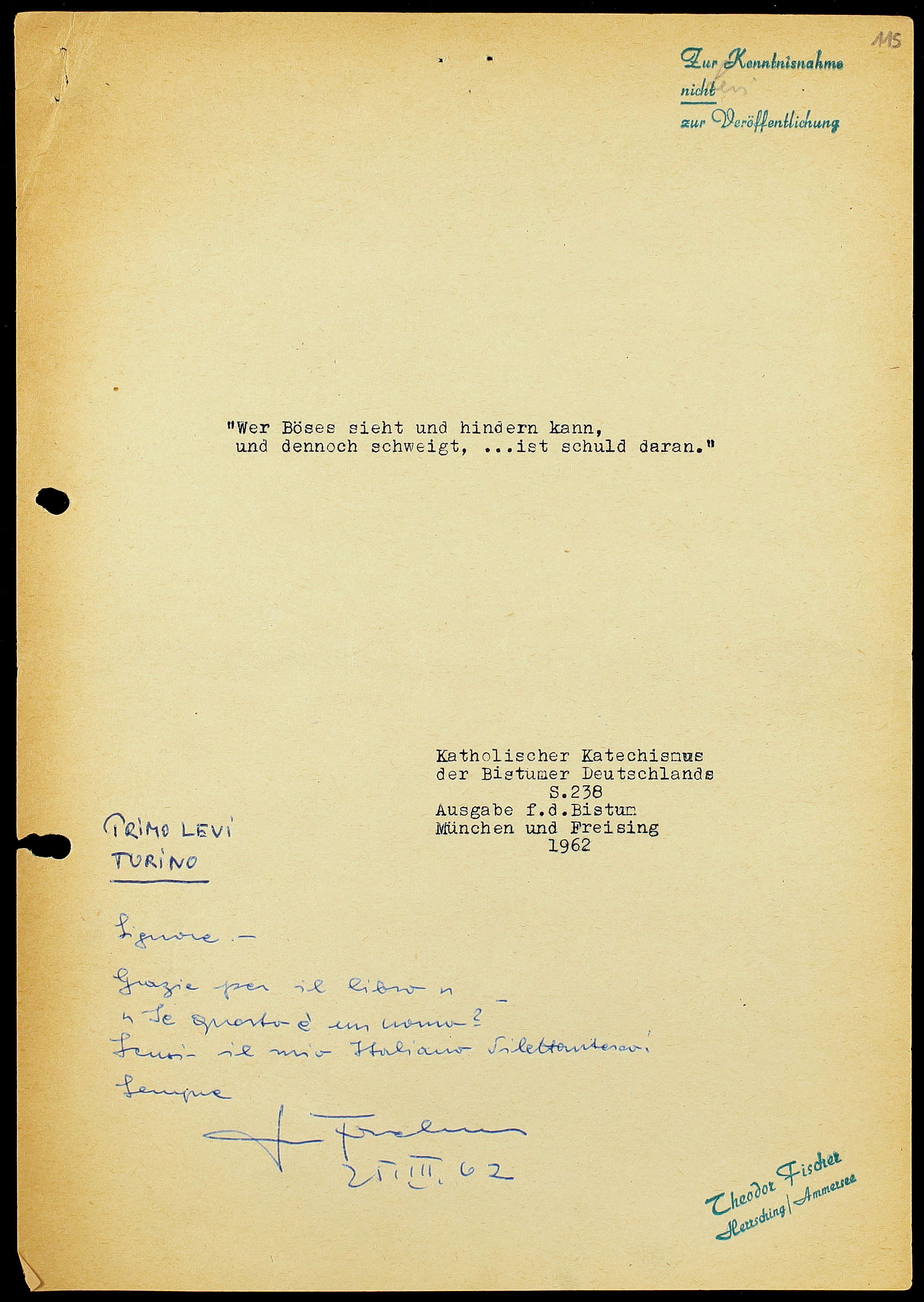
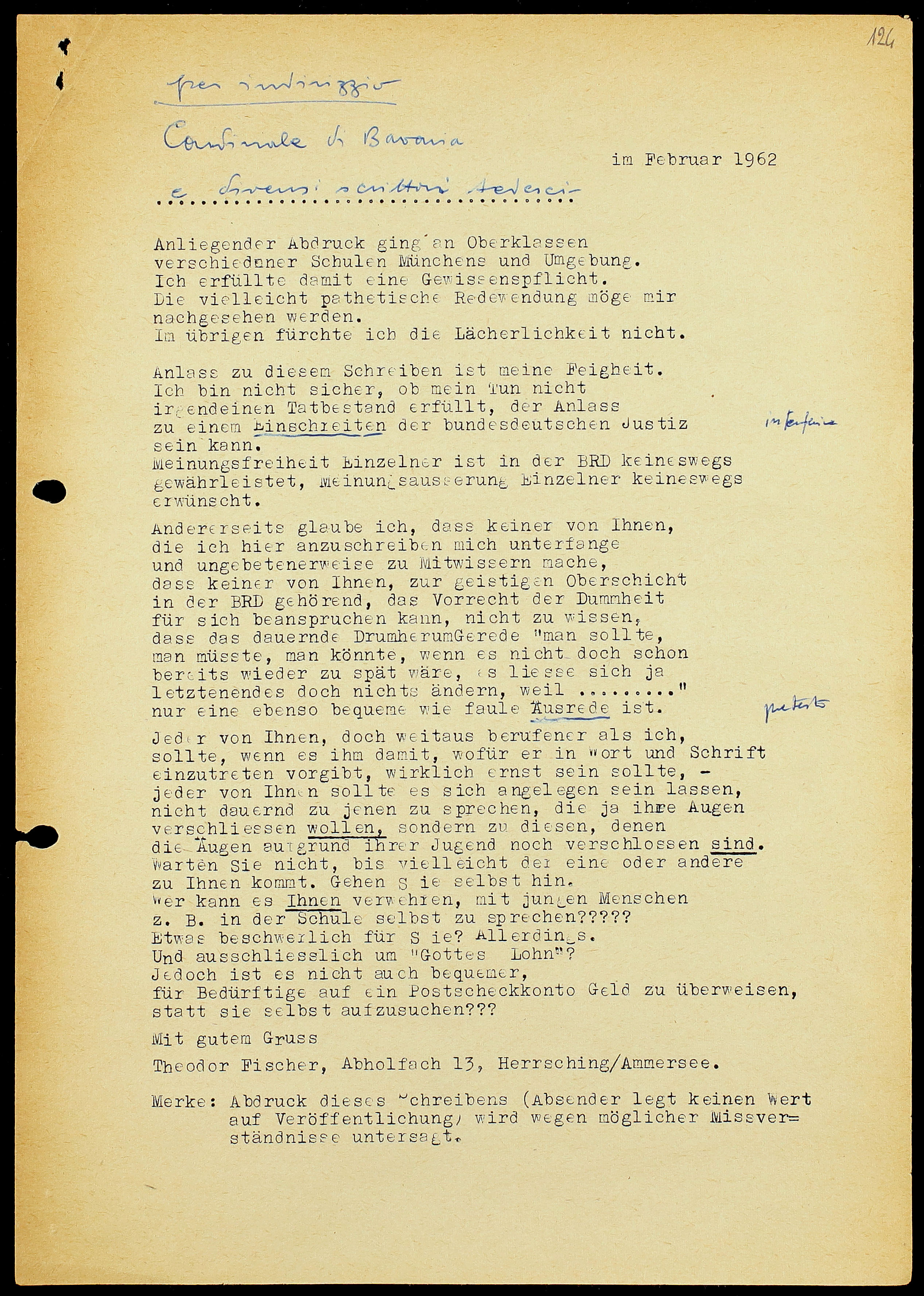
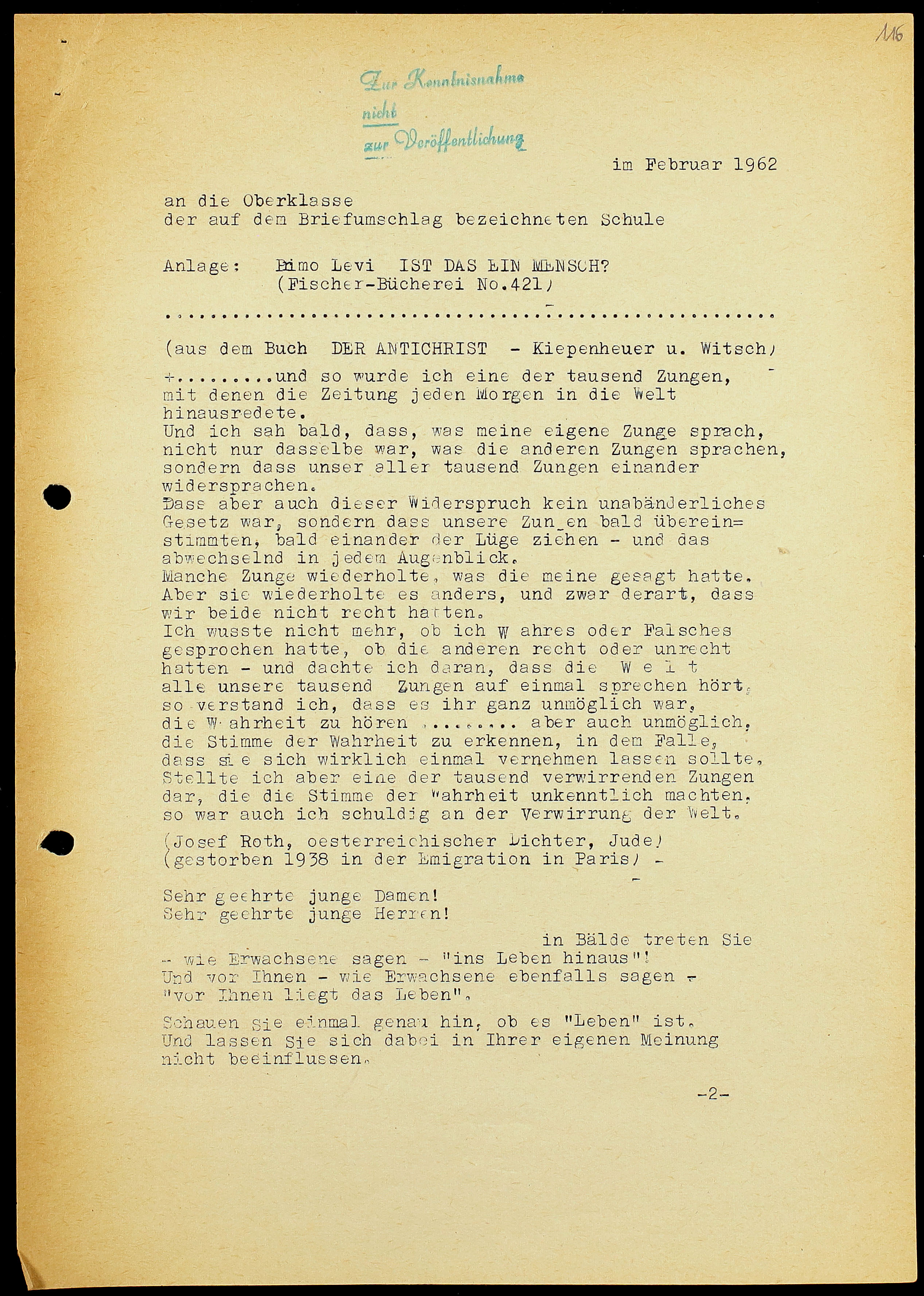
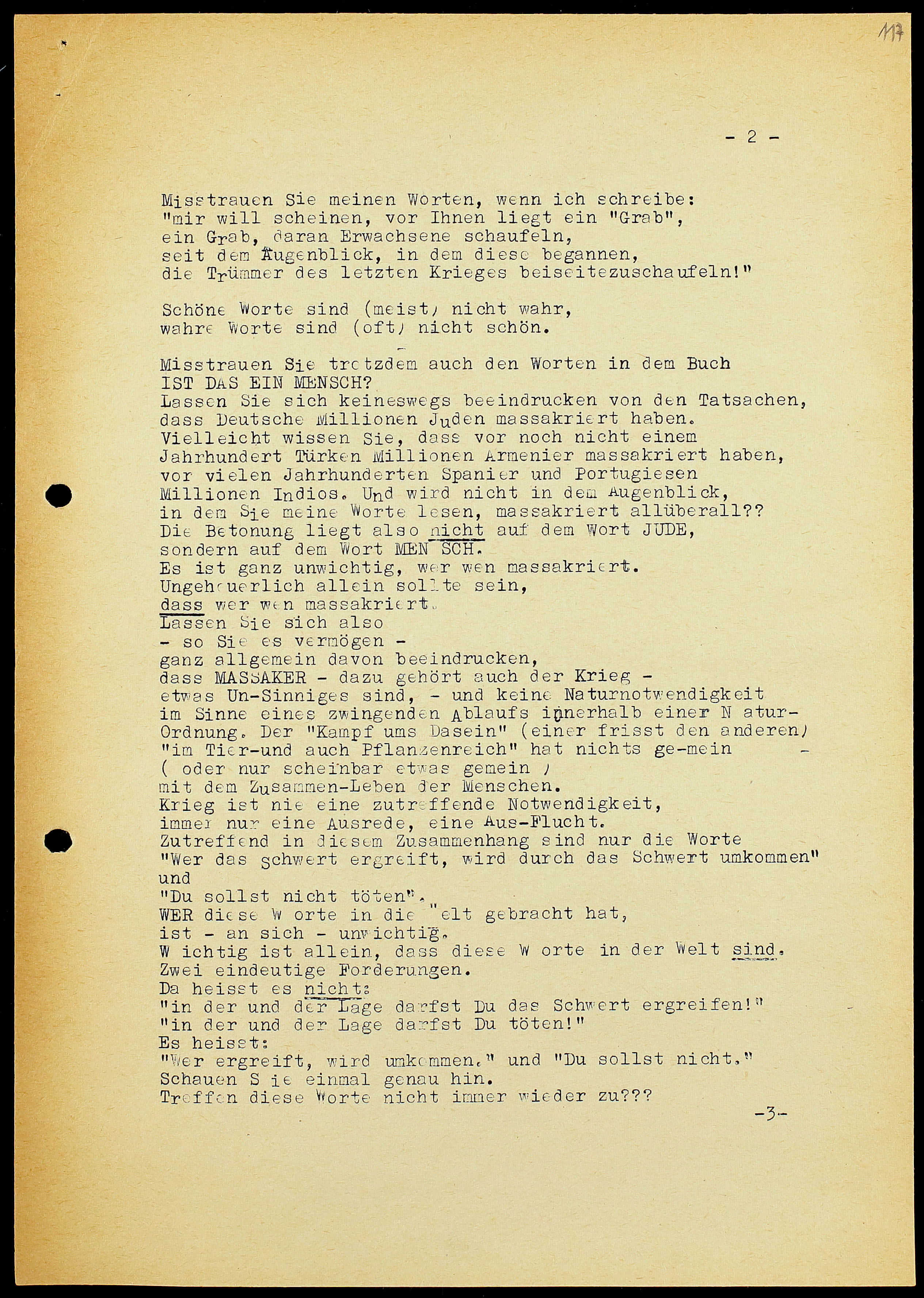
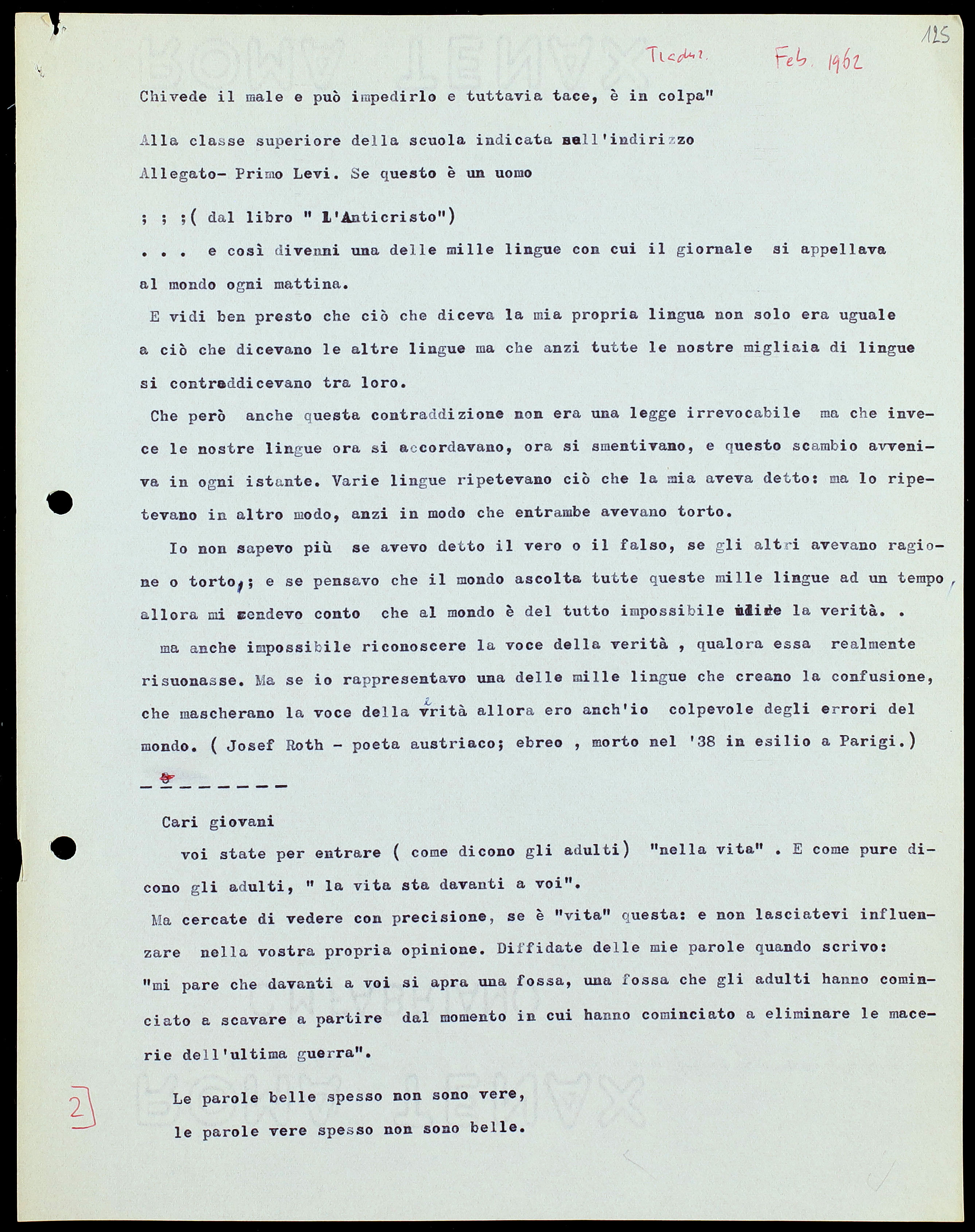
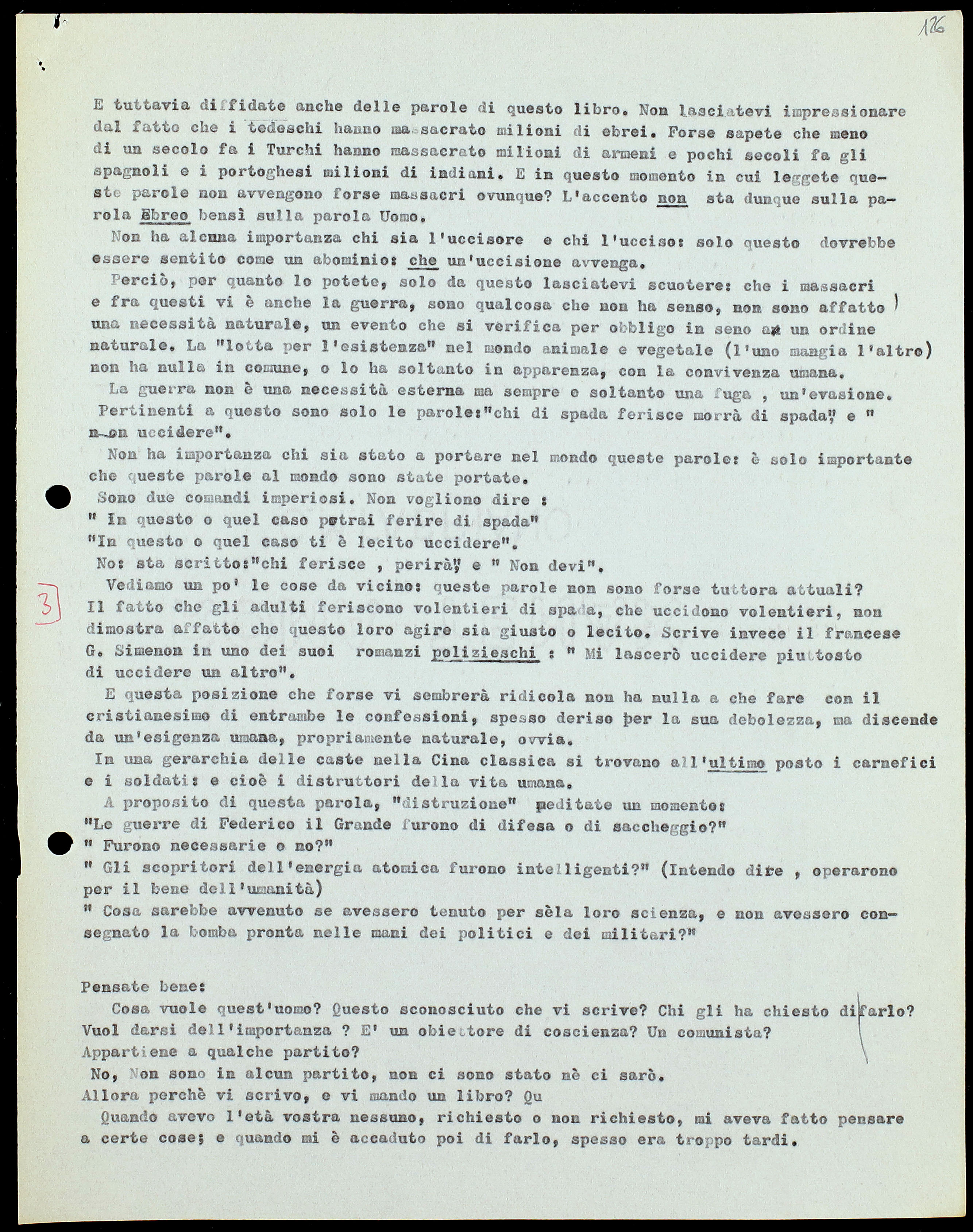
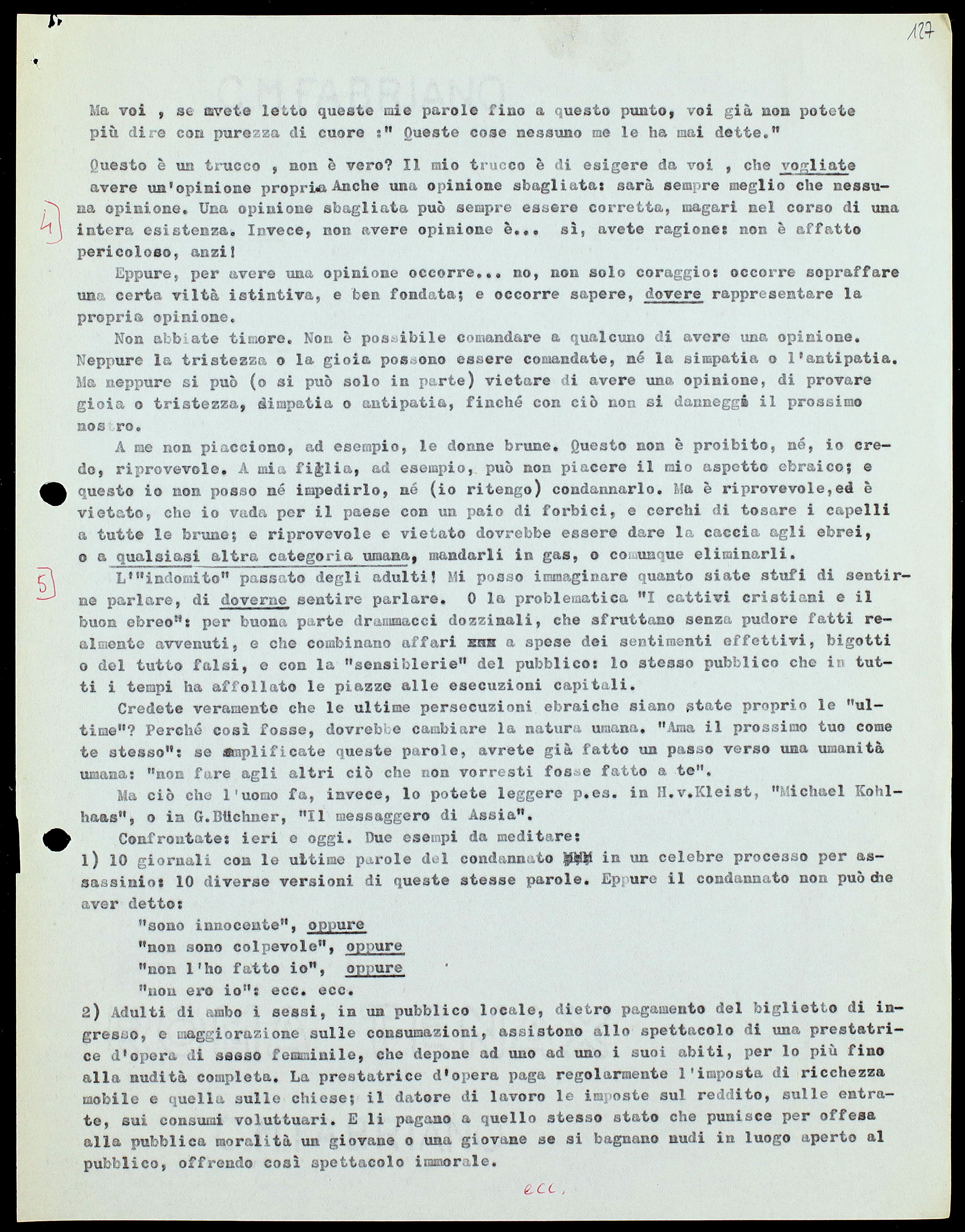
Theodor Fischer, commentatore radiofonico, scrive a Levi una lettera di poche parole di ringraziamento per SQU alla quale aggiunge due allegati: una lettera circolare inviata ad alcuni intellettuali, e delle circolari indirizzate agli alunni di alcune scuole di Monaco e dintorni.
„Wer Böses sieht und hindern kann,und dennoch schweigt, …ist schuld daran.” Katholischer Katechismusder Bigtumer Deutschlands
S. 238[1] Ausgabe f.d. Bistum München und Freising
1962
Primo Levi
Torino
Signore –
Grazie per il libro Se questo è un uomo?
Scusi il mio italiano dilettantesco!
Sempre
T Fischer
25.III.62
im Februar 1962
Anliegender Abdruck ging an Oberklassen verschiedener Schulen Münchens und Umgebung.
Ich erfüllte damit eine Gewissenspflicht.
Die vielleicht pathetische Redewendung möge mir nachgesehen werden.
Im übrigen fürchte ich die Lächerlichkeit nicht.
Anlass zu diesem Schreiben ist meine Feigheit.
Ich bin nicht sicher, ob mein Tun nicht irgendeinen Tatbestand erfüllt, der Anlass
zu einem Einschreiten[2] der bundesdeutschen Justiz sein kann.
Meinungsfreiheit Einzelner ist in der BRD keineswegs gewährleistet, Meinungsäusserung Einzelner keineswegs erwünscht.
Andererseits glaube ich, dass keiner von Ihnen, die ich hier anzuschreiben mich unterfange
und ungebetenerweise zu Mitwissern mache, dass keiner von Ihnen, zur geistigen Oberschicht in der BRD gehörend, das Vorrecht der Dummheit für sich beanspruchen kann, nicht zu wissen, dass das dauernde DrumherumGerede „man sollte, man müsste, man könnte, wenn es nicht doch schon bereits wieder zu spät wäre, es liesse sich ja letztenendes doch nichts ändern, weil…” nur eine ebenso bequeme wie faule Ausrede[3] ist.
Jeder von Ihnen, doch weitaus berufener als ich, sollte, wenn es ihm damit, wofür er in Wort und Schrift einzutreten vorgibt, wirklich ernst sein sollte, – jeder von Ihnen sollte es sich angelegen sein lassen, nicht dauernd zu jenen zu sprechen, die ja ihre Augen verschliessen wollen, sondern zu diesen, denen die Augen aufgrund ihrer Jugend noch verschlossen sind.
Warten Sie nicht, bis vielleicht der eine oder andere zu Ihnen kommt. Gehen Sie selbst hin.
Wer kann es Ihnen verwehren, mit jungen Menschen z. B. in der Schule selbst zu sprechen?????
Etwas beschwerlich für Sie? Allerdings.
Und ausschliesslich um „Gottes Lohn”?
Jedoch ist es nicht auch bequemer, für Bedürftige auf ein Postscheckkonto Geld zu überweisen, statt sie selbst aufzusuchen???
im Februar 1962
an die Oberklasse
der auf dem Briefumschlag bezeichneten Schule
Anlage: Primo Levi Ist das ein Mensch?
(Fischer-Bücherei No.421)
…………………………………………………………………
(aus dem Buch Der Antichrist– Kiepenheuer u. Witsch)
… und so wurde ich eine der tausend Zungen, mit denen die Zeitung jeden Morgen in die Welt hinausredete.
Und ich sah bald, dass, was meine eigene Zunge sprach, nicht nur dasselbe war, was die anderen Zungen sprachen, sondern dass unser aller tausend Zungen einander widersprechen.
Dass aber auch dieser Widerspruch kein unabänderliches Gesetz war, sondern dass unsere Zungen bald übereinstimmen, bald einander der Lüge ziehen – und das abwechselnd in jedem Augenblick.
Manche Zunge wiederholte, was die meine gesagt hatte. Aber sie wiederholte es anders, und zwar derart, dass wir beide nicht recht hatten.
Ich wusste nicht mehr, ob ich Wahres oder Falsches gesprochen hatte, ob die anderen recht oder unrecht hatten – und dachte ich daran, dass die Welt alle unsere tausend Zungen auf einmal sprechen hört, so verstand ich, dass es ihr ganz unmöglich war, die Wahrheit zu hören… aber auch unmöglich, die Stimme der Wahrheit zu erkennen, in dem Falle, dass sie sich wirklich einmal vernehmen lassen sollte.
Stellte ich aber eine der tausend verwirrenden Zungen dar, die die Stimme der Wahrheit unkenntlich machten, so war auch ich schuldig an der Verwirrung der Welt.
(Josef Roth, österreichischer Dichter, Jude)
(gestorben 1938 in der Emigration in Paris) –
Sehr geehrte junge Damen!
Sehr geehrte junge Herren!
in Bälde treten Sie
– wie Erwachsene sagen – „ins Leben hinaus”!
Und vor Ihnen – wie Erwachsene ebenfalls sagen –
„vor Ihnen liegt das Leben”.
Schauen Sie einmal genau hin, ob es „Leben” ist.
Und lassen Sie sich dabei in Ihrer eigenen Meinung nicht beeinflussen.
Misstrauen Sie meinen Worten, wenn ich schreibe:
„mir will scheinen, vor Ihnen liegt ein “Grab”,
ein Grab, daran Erwachsene schaufeln,
seit dem Augenblick, in dem diese begannen,
die Trümmer des letzten Krieges beiseitezuschaufeln!”
Schöne Worte sind (meist) nicht wahr,
wahre Worte sind (oft) nicht schön.
Misstrauen Sie trotzdem auch den Worten in dem Buch Ist das ein Mensch? Lassen Sie sich keineswegs beeindrucken von den Tatsachen, dass Deutsche Millionen Juden massakriert haben.
Vielleicht wissen Sie, dass vor noch nicht einem Jahrhunderten Türken Millionen Armenier massakriert haben, vor vielen Jahrhunderten Spanier und Portugiesen Millionen Indios. Und wird nicht in dem Augenblick, in dem Sie meine Worte lesen, massakriert allüberall??
Die Betonung liegt also nicht auf dem Wort JUDE, sondern auf dem Wort MENSCH.
Es ist ganz unwichtig, wer wen massakriert.
Ungeheuerlich allein sollte sein, dass wer wen massakriert.
Lassen Sie sich also
– so Sie es vermögen –
ganz allgemein davon beeindrucken,
dass MASSAKER – dazu gehört der Krieg –
etwas Un-Sinniges sind, – und keine Naturnotwendigkeit im Sinne eines zwingenden Ablaufs innerhalb einer Natur – Ordnung. Der „Kampf ums Dasein”(einer frisst den anderen)
„im Tier-und auch Pflanzenreich” hat nichts ge-mein ( oder nur scheinbar etwas gemein)
mit dem Zusammen-Leben der Menschen.
Krieg ist nie eine zutreffende Notwendigkeit, immer nur eine Ausrede, eine Aus-Flucht.
Zutreffend in diesem Zusammenhang sind nur die Worte „Wer das Schwert ergreift, wird durch das Schwert umkommen”[4] und „Du sollst nicht töten”.[5]
WER diese Worte in die Welt gebracht hat,
ist – an sich – unwichtig.
Wichtig ist allein, dass diese Worte in der Welt sind.
Zwei eindeutige Forderungen.
Da heisst es nicht:
„in der und der Lage darfst Du das Schwert ergreifen!”
„in der und der Lage darfst Du töten!”
Es heisst:
„Wer ergreift, wird umkommen.” und „Du sollst nicht.”
Schauen Sie einmal genau hin.
Treffen diese Worte nicht immer wieder zu???
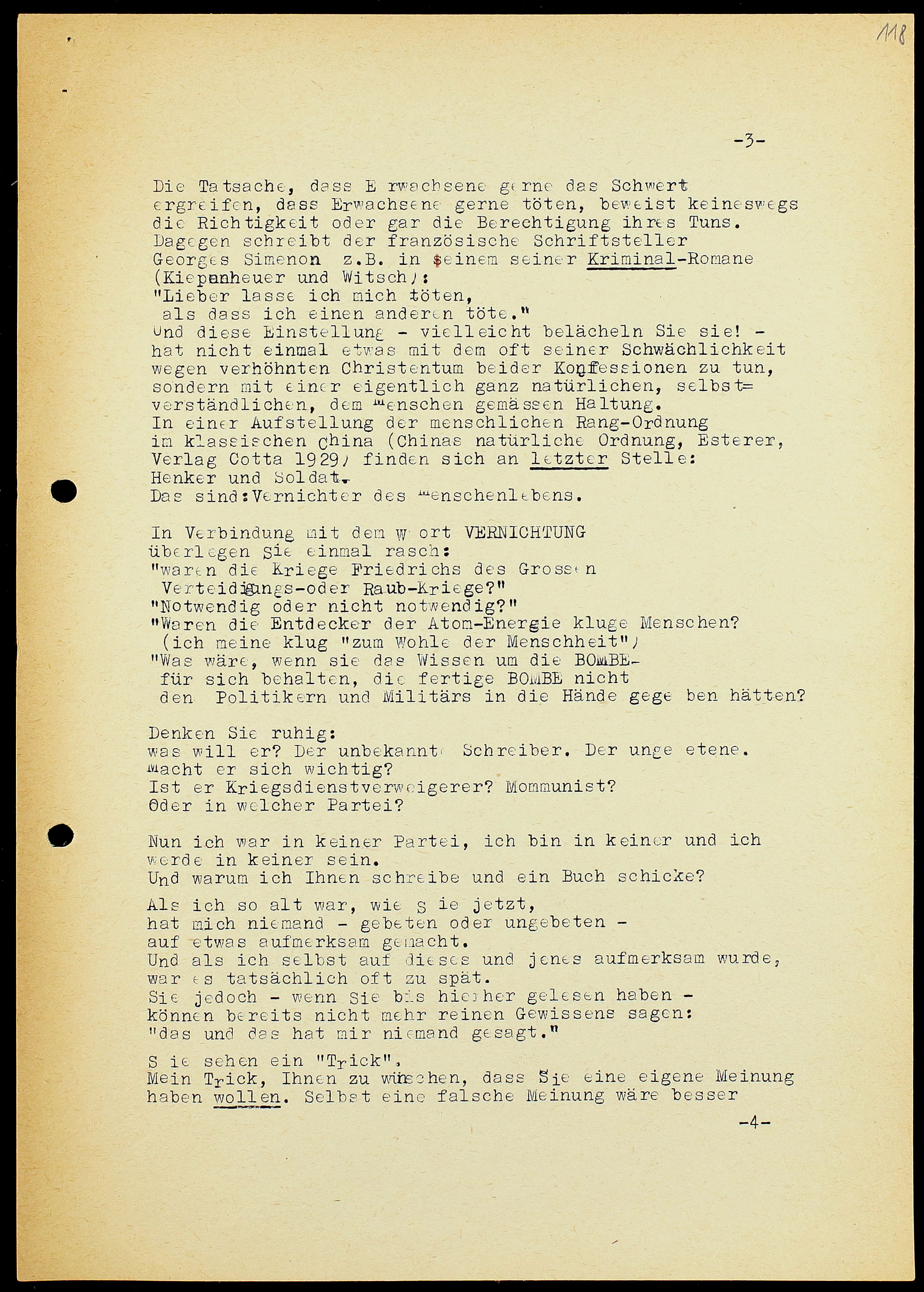
Die Tatsache, dass Erwachsene gerne das Schwert ergreifen, dass Erwachsene gerne toten, beweist keineswegs die Richtigkeit oder gar die Berechtigung ihres Tuns.
Dagegen schreibt der französische Schriftsteller Georges Simenon[6]z.B. in einem [7] seiner Kriminal-Romane (Kiepenheuer und Witsch):
„Lieber lasse ich mich toten,
als dass ich einen anderen tote.”
Und diese Einstellung – vielleicht belächeln Sie sie! – hat nicht einmal etwas mit dem oft seiner Schwächlichkeit wegen verhöhnten Christentum beider Konfessionen zu tun, sondern mit einer eigentlich ganz natürlichen, selbstverständlichen, dem Menschen gemässen Haltung.
In einer Aufstellung der menschlichen Rang-Ordnung im klassischen China (Chinas natürliche Ordnung, Esterer, Verlag Cotta 1929) finden sich an letzter Stelle:
Henker und Soldat
Das sind: Vernichter des Menschenlebens.
In Verbindung mit dem Wort VERNICHTUNG überlegen Sie einmal rasch:
„waren die Kriege Friedrichs des Grossen Verteidigungs-oder Raub-Kriege?”
„Notwendig oder nicht notwendig?”
“Waren die Entdecker der Atom-Energie kluge Menschen?
(ich meine klug „zum Wohle der Menschheit”),
„Was wäre, wenn sie das Wissen um die BOMBE –
für sich behalten, die fertige BOMBE nicht
den Politikern und Militärs in die Hände gegeben hätten?
Denken Sie ruhig:
was will er? Der unbekannte Schreiber. Der unge etene.
Macht er sich wichtig?
Ist er Kriegsdienstverweigerer? Kommunist?
Oder in welcher Partei?
Nun ich war in keiner Partei, ich bin in keiner und ich werde in keiner sein.
Und warum ich Ihnen schreibe und ein Buch schicke?
Als ich so alt war, wie Sie jetzt,
hat mich niemand – gebeten oder ungebeten –
auf etwas aufmerksam gemacht.
Und als ich selbst auf dieses und jenes aufmerksam wurde, war es tatsächlich oft zu spät.
Sie jedoch – wenn Sie bis hierher gelesen haben –
können bereits nicht mehr reinen Gewissens sagen:
„das und das hat mir niemand gesagt.”
Sie sehen ein „Trick”.
Mein Trick, Ihnen zu wünschen, dass Sie eine eigene Meinung haben wollen. Selbst eine falsche Meinung wäre
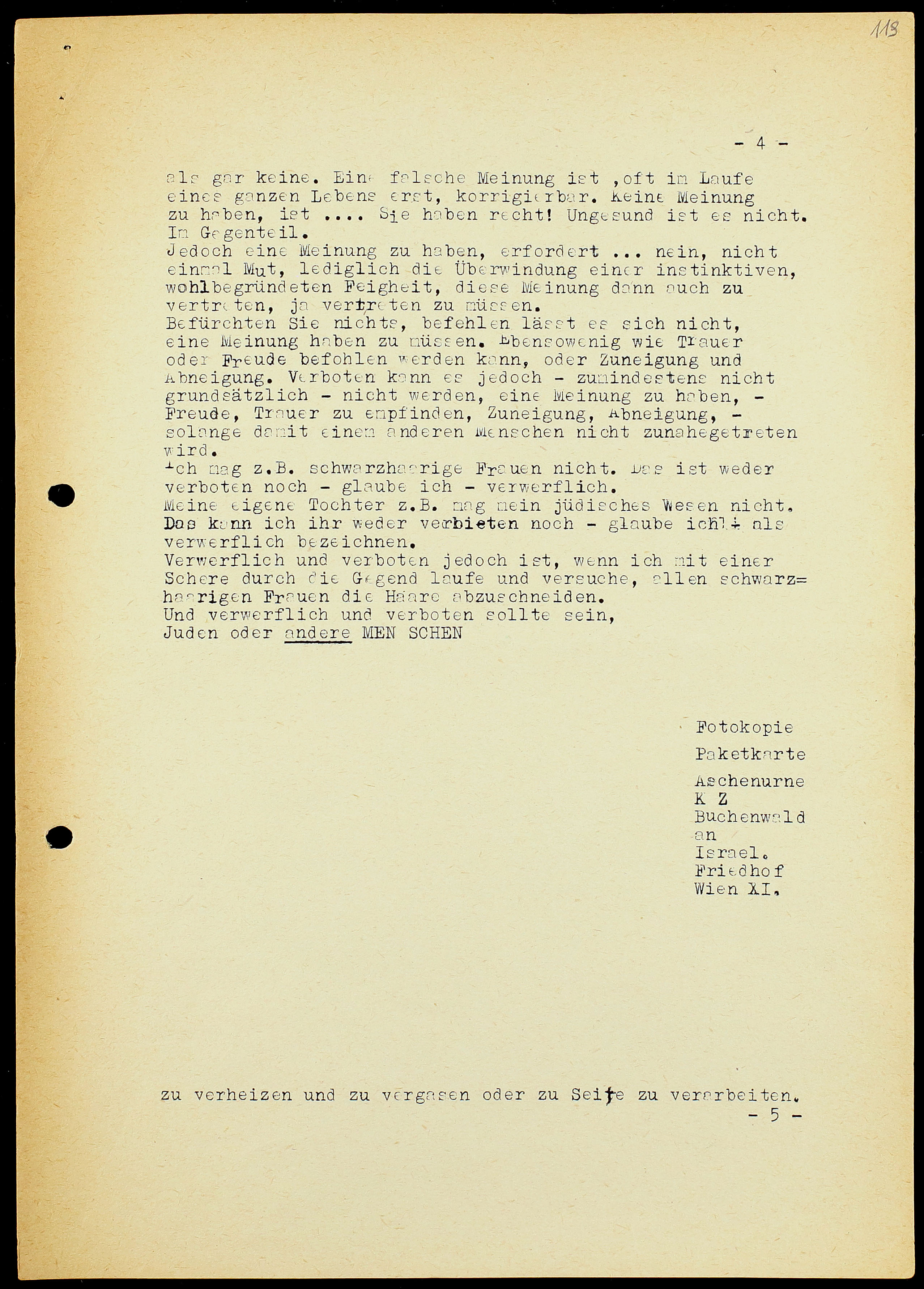
besser als gar keine. Eine falsche Meinung ist, oft im Laufe eines ganzen Lebens erst, korrigierbar. Keine Meinung zu haben, ist… Sie haben recht! Ungesund ist es nicht.
Im Gegenteil.
Jedoch eine Meinung zu haben, erfordert … nein, nicht einmal Mut, lediglich die Überwindung einer instinktiven, wohlbegründeten Feigheit, diese Meinung dann auch zu vertreten, ja vertreten zu müssen.
Befürchten Sie nichts, befehlen lässt es sich nicht, eine Meinung haben zu müssen. Ebensowenig wie Trauer oder Freude befohlen werden kann, oder Zuneigung und Abneigung. Verboten kann es jedoch – zumindestens nicht grundsätzlich – nicht werden, eine Meinung zu haben, – Freude, Trauer zu empfinden, Zuneigung, Abneigung, – solange damit einem anderen Menschen nicht zunahegetreten wird.
Ich mag z.B. schwarzhaarige Frauen nicht. Das ist weder verboten noch – glaube ich – verwerflich.
Meine eigene Tochter z.B. mag mein jüdisches Wesen nicht. Das kann ich ihr weder verbieten noch – glaube ich – als verwerflich bezeichnen.
Verwerflich und verboten jedoch ist, wenn ich mit einer Schere durch die Gegend laufe und versuche, allen schwarzhaarigen Frauen die Haare abzuschneiden.
Und verwerflich und verboten sollte sein,
Juden oder andere MENSCHEN
Fotokopie
Paketkarte
Aschenurne
K Z
Buchenwald
an
Israel.
Friedhof
Wien XI.
zu verheizen und zu vergasen oder zu Seite zu verarbeiten.
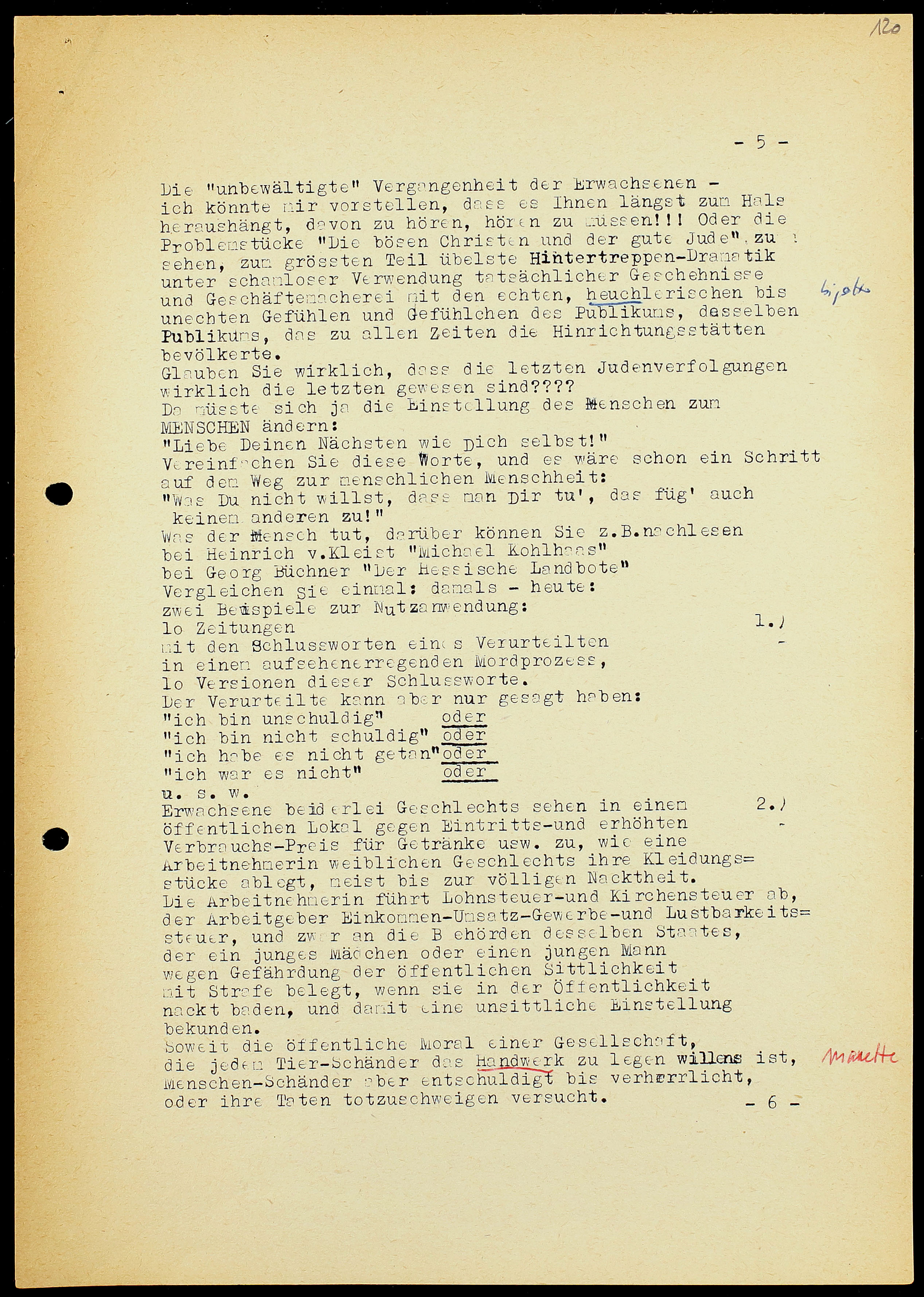
Die „unbewältigte” Vergangenheit der Erwachsenen – ich konnte mir vorstellen, dass es Ihnen längst zum Hals heraushängt, davon zu hören, hören zu müssen!!! Oder die Problemstücke „Die bösen Christen und der gute Jude”, zu sehen, zum grössten Teil übelste Hintertreppen-Dramatik unter schamloser Verwendung tatsächlicher Geschehnisse und Geschäftemacherei mit den echten, heuchlerischen[8] bis unechten Gefühlen und Gefühlchen des Publikums, desselben Publikums, das zu allen Zeiten die Hinrichtungsstätten bevölkerte.
Glauben Sie wirklich, dass die letzten Judenverfolgungen wirklich die letzten gewesen sind????
Da müsste sich ja die Einstellung des Menschen zum MENSCHEN ändern: „Liebe Deinen Nächsten wie Dich selbst!” Vereinfachen Sie diese Worte, und es wäre schon ein Schritt auf dem Weg zur menschlichen Menschheit: „Was Du nicht willst, dass man Dir tu, das füg auch keinem anderen zu!”
Was der Mensch tut, darüber können Sie z.B.nachlesen
bei Heinrich v.KleistMichael Kohlhaas bei Georg Büchner Der Hessische Landbote[9]
Vergleichen Sie einmal: damals – heute:
zwei Beispiele zur Nutzanwendung:
1.) 10 Zeitungen mit den Schlussworten eines Verurteilten
in einen aufsehenerregenden Mordprozess,
10 Versionen dieser Schlussworte.
Der Verurteilte kann aber nur gesagt haben:
„ich bin unschuldig” oder „ich bin nicht schuldig” oder „ich habe es nicht getan”oder „ich war es nicht” oder u. s. w.
2.) Erwachsene beiderlei Geschlechts sehen in einem öffentlichen Lokal gegen Eintritts-und erhöhten Verbrauchs-Preis für Getränke usw. zu, wie eine Arbeitnehmerin weiblichen Geschlechts ihre Kleidungsstücke ablegt, meist bis zur völligen Nacktheit.
Die Arbeitnehmerin führt Lohnsteuer-und Kirchensteuer ab, der Arbeitgeber Einkommen-Umsatz-Gewerbe-und Lustbarkeitssteuer, und zwar an die Behörden desselben Staates, der ein junges Mädchen oder einen jungen Mann wegen Gefährdung der öffentlichen Sittlichkeit mit Strafe belegt, wenn sie in der Öffentlichkeit nackt baden, und damit eine unsittliche Einstellung bekunden.
Soweit die öffentliche Moral einer Gesellschaft, die jedem Tier-Schänder das Handwerk[10] zu legen willens Menschen-Schänder aber entschuldigt bis verherrlicht, oder ihre Taten totzuschweigen versucht.
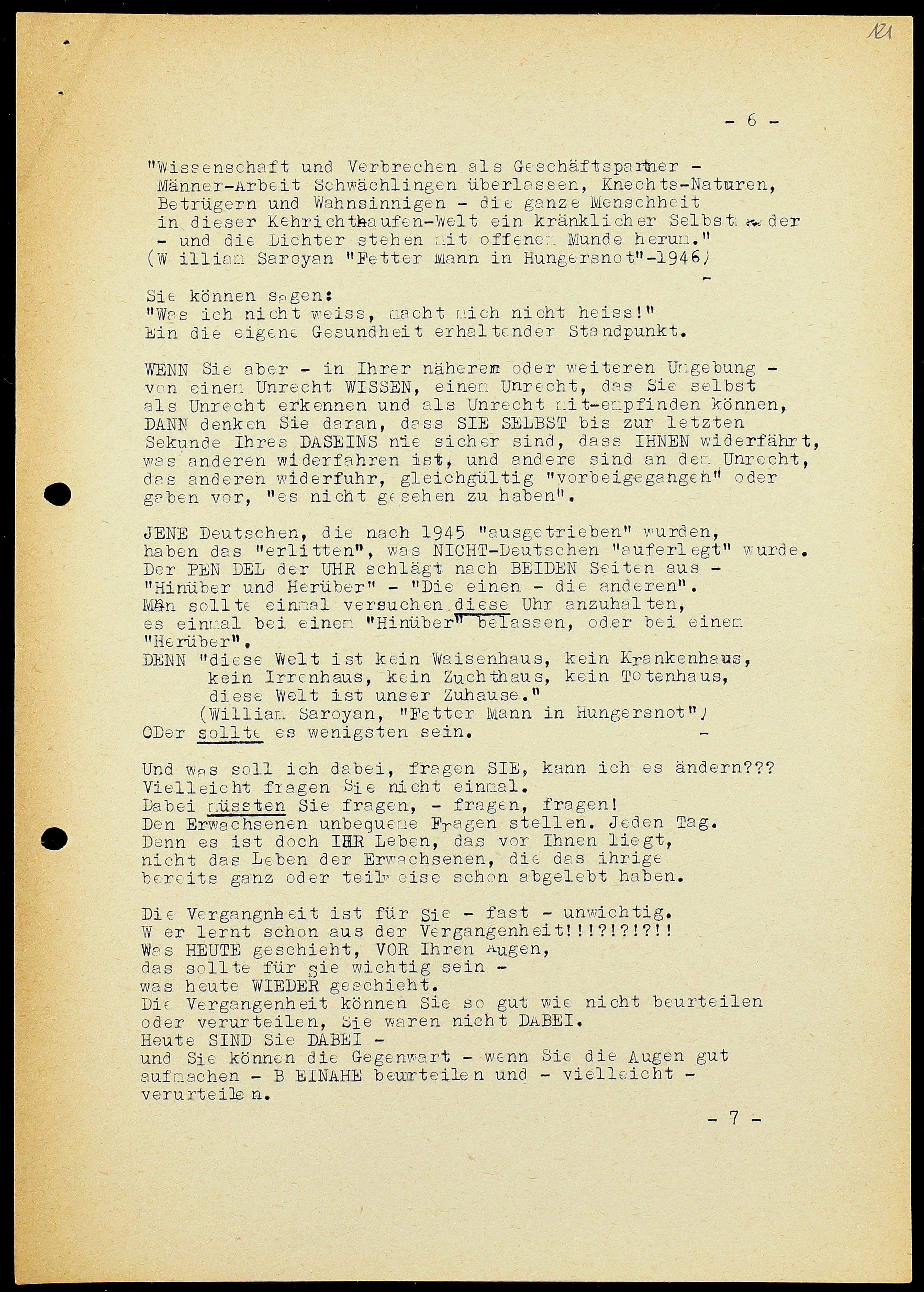
„Wissenschaft und Verbrechen als Geschäftspartner – Männer-Arbeit Schwächlingen überlassen, Knechts-Naturen, Betrügern und Wahnsinnigen – die ganze Menschheit
in dieser Kehrichthaufen-Welt ein kränklicher Selbst der – und die Dichter stehen mit offenem Munde herum.”
(William Saroyan Fetter Mann in Hungersnot – 1946)
Sie können sagen:
„Was ich nicht weiss, macht mich nicht heiss!”
Ein die eigene Gesundheit erhaltender Standpunkt.
WENN Sie aber – in Ihrer näheren oder weiteren Umgebung – von einem Unrecht WISSEN, einem Unrecht, das Sie selbst als Unrecht erkennen als Unrecht mit-empfinden können, DANN denken Sie daran, dass SIE SELBST bis zur letzten Sekunde Ihres DASEINS nie sicher sind, dass IHNEN widerfährt, was anderen widerfahren ist, und andere sind an dem Unrecht, das anderen widerfuhr, gleichgültig „vorbeigegangen” oder gaben vor, „es nicht gesehen zu haben”.
JENE Deutschen, die nach 1945 „ausgetrieben” wurden, haben das „erlitten”, was NICHT-Deutschen „auferlegt” wurde.[11] Der PENDEL der UHR schlägt nach BEIDEN Seiten aus – „Hinüber und Herüber” – „Die einen – die anderen”.
Man sollte einmal versuchen diese Uhr anzuhalten, es einmal bei einem „Hinüber” belassen, oder bei einem „Herüber”.
DENN „diese Welt ist kein Waisenhaus, kein Krankenhaus,
kein Irrenhaus, kein Zuchthaus, kein Totenhaus,
diese Welt ist unser Zuhause.”
(William Saroyan, Fetter Mann in Hungersnot)
Oder sollte es wenigsten sein.
Und was soll ich dabei, fragen SIE, kann ich es ändern???
Vielleicht fragen Sie nicht einmal.
Dabei müssten Sie fragen, – fragen, fragen!
Den Erwachsenen unbequeme Fragen stellen. Jeden Tag.
Denn es ist doch IHR Leben, das vor Ihnen liegt,
nicht das Leben der Erwachsenen, die das ihrige
bereits ganz oder teilweise schon abgelebt haben.
Die Vergangenheit ist für Sie – fast – unwichtig.
Wer lernt schon aus der Vergangenheit!!!?!?!?!!
Was HEUTE geschieht, VOR Ihren Augen,
das sollte für Sie wichtig sein –
was heute WIEDER geschient.
Die Vergangenheit können Sie so gut wie nicht beurteilen oder verurteilen, Sie waren nicht DABEI.
Heute SIND Sie DABEI – und Sie können die Gegenwart – wenn Sie die Augen gut aufmachen – BEINAHE beurteilen und – vielleicht – verurteilen.
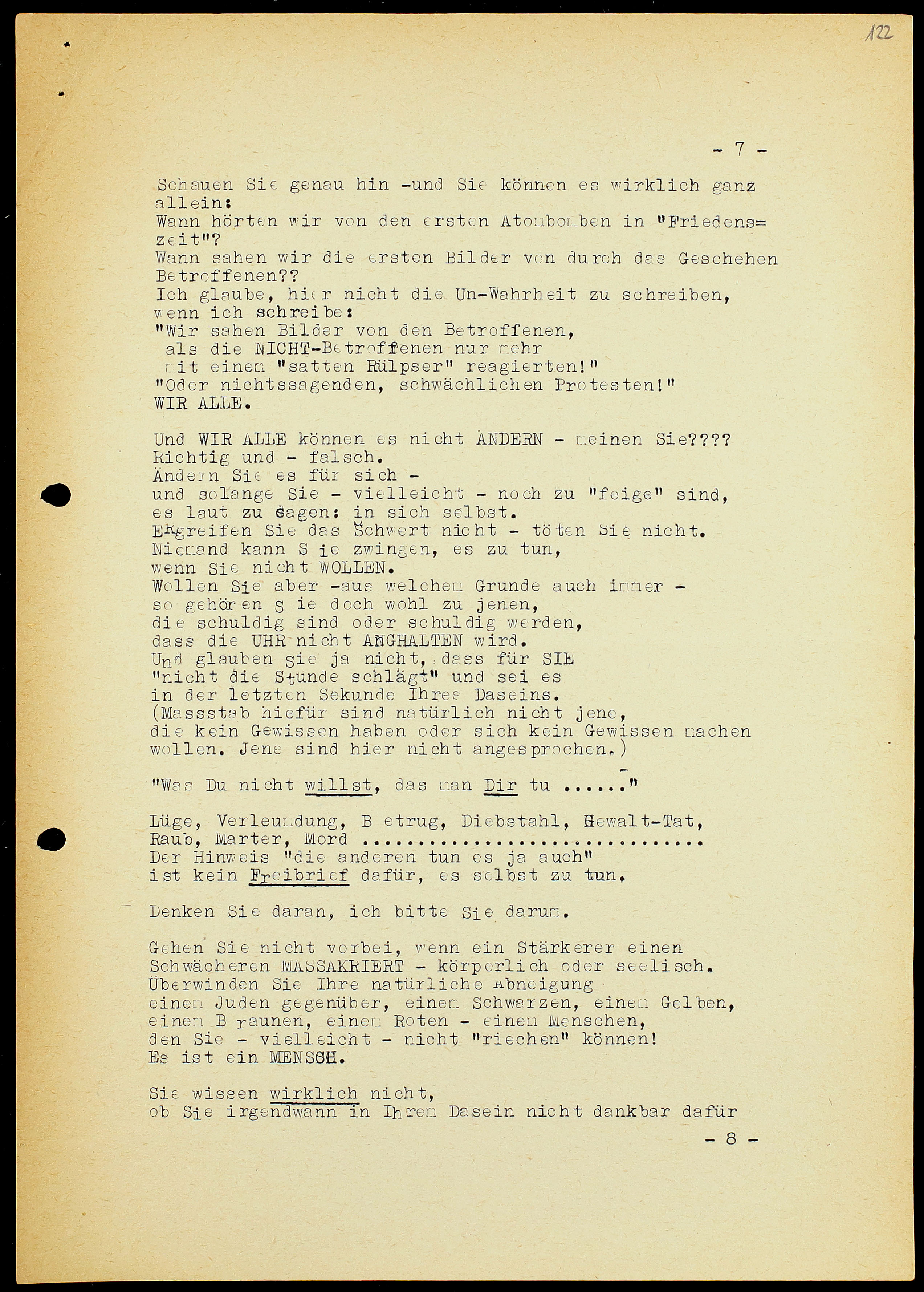
Schauen Sie genau hin – und Sie können es wirklich ganz allein:
Wann hörten wir von den ersten Atombomben in “Friedenszeit”?
Wann sahen wir die ersten Bilder von durch das Geschehen Betroffenen??
Ich glaube, hier nicht die Un-Wahrheit zu schreiben, wenn ich schreibe:
„Wir sahen Bilder von den Betroffenen,
als die NICHT-Betroffenen nur mehr
mit einem „satten Rülpser” reagierten!”
„Oder nichtssagenden, schwächlichen Protesten!”
WIR ALLE.
Und WIR ALLE können es nicht ANDERN – meinen Sie????
Richtig und – falsch.
Ändern Sie es für sich –
und solange Sie – vielleicht – noch zu „feige” sind, es laut zu sagen: in sich selbst.
Ergreifen Sie das Schwert nicht – töten Sie nicht.
Niemand kann Sie zwingen, es zu tun, wenn Sie nicht WOLLEN.
Wollen Sie aber -aus welchem Grunde auch immer – so gehören Sie doch wohl zu jenen,
die schuldig sind oder schuldig werden, dass die UHR nicht ANGHALTEN wird.
Und glauben Sie ja nicht, dass für SIE
„nicht die Stunde schlägt” und sei es
in der letzten Sekunde Ihres Daseins.
(Massstab hierfür sind natürlich nicht jene, die kein Gewissen haben oder sich kein Gewissen machen wollen. Jene sind hier nicht angesprochen. )
„Was Du nicht willst, das man Dir tu…”
Lüge, Verleumdung, Betrug, Diebstahl, Gewalt-Tat,
Raub, Marter, Mord ………………………………………….
Der Hinweis „die anderen tun es ja auch”
ist kein Freibrief dafür, es selbst zu tun.
Denken Sie daran, ich bitte Sie darum.
Gehen Sie nicht vorbei, wenn ein Stärkerer einen Schwächeren MASSAKRIERT – körperlich oder seelisch.
Überwinden Sie Ihre natürliche Abneigung einem Juden gegenüber, einer Schwarzen, einem Gelben, einem Braunen, einem Roten – einem Menschen, den Sie – vielleicht – nicht „riechen” können!
Es ist ein MENSCH.
Sie wissen wirklich nicht,
ob Sie irgendwann in Ihrem Dasein nicht dankbar dafür
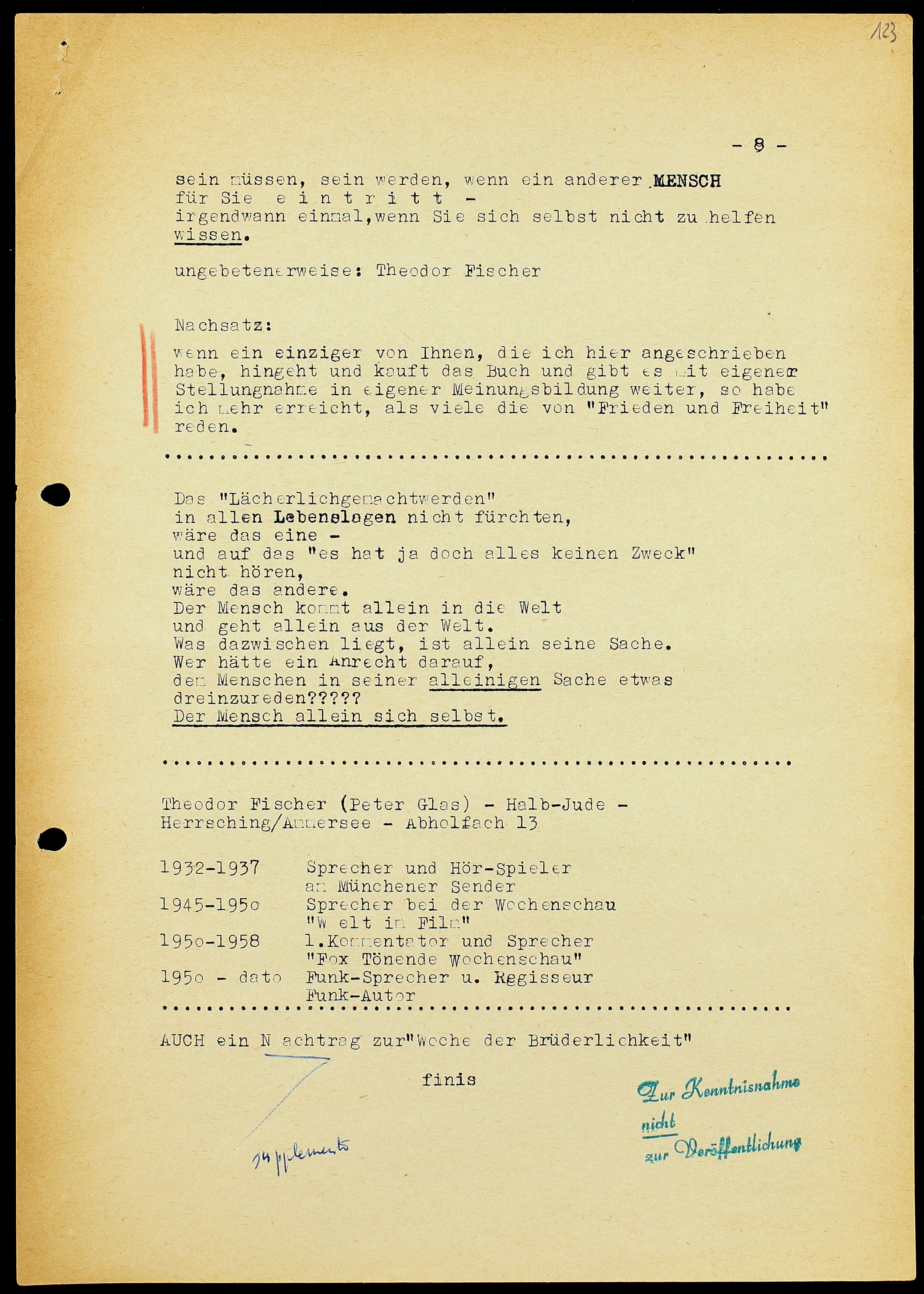
sein müssen, sein werden, wenn ein anderer MENSCH für Sie eintritt – irgendwann einmal, wenn Sie sich selbst nicht zu helfen wissen.
ungebetenerweise: Theodor Fischer
Nachsatz:
wenn ein einziger von Ihnen, die ich hier angeschrieben habe, hingeht und kauft das Buch und gibt es mit eigenen Stellungnahme in eigener Meinungsbildung weiter, so habe
ich mehr erreicht, als viele die von „Frieden und Freiheit” reden.[12]
Das „Lächerlichgemachtwerden”
in allen Lebenslagen nicht fürchten,
wäre das eine –
und auf das „es hat ja doch alles keinen Zweck”
nicht hören,
wäre das andere.
Der Mensch kommt allein in die Welt
und geht allein aus der Welt.
Was dazwischen liegt, ist allein seine Sache.
Wer hätte ein Anrecht darauf,
dem Menschen in seiner alleinigen Sache etwas
dreinzureden????? Der Mensch allein sich selbst.
AUCH ein Nachtrag[13] zur „Woche der Brüderlichkeit”[14]
finis
«Chi vede il male e può impedirlo e tuttavia tace, è in colpa» Catechismo cattolico della Germania settentrionale
p. 238[1]
Edizione per la diocesi di Monaco e Frisinga
1962
Primo Levi Torino
Signore –
Grazie per il libro Se questo è un uomo?
Scusi il mio italiano dilettantesco!
Sempre
T Fischer
25.III.62
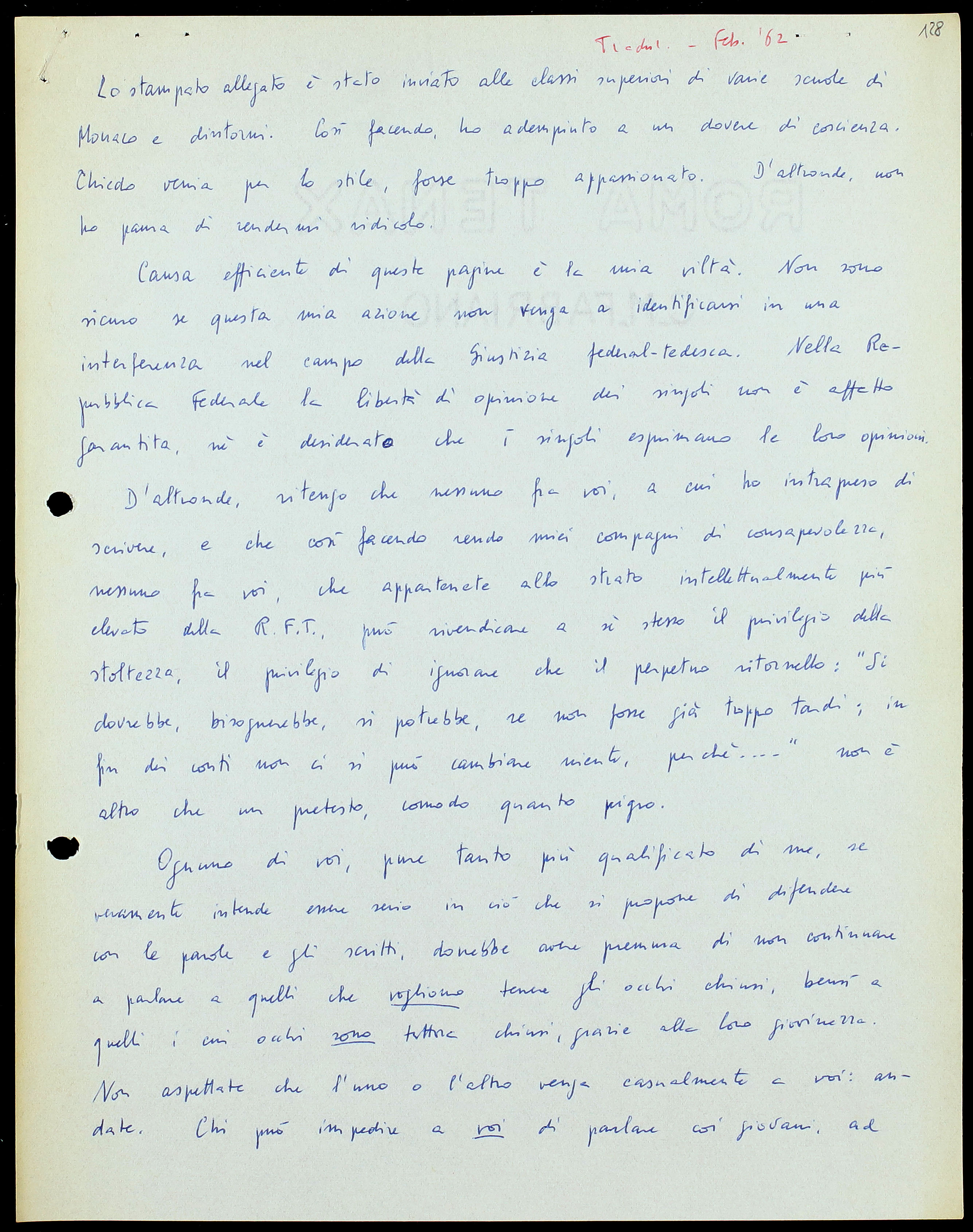
Lo stampato allegato è stato inviato alle classi superiori di varie scuole di Monaco e dintorni. Così facendo ho adempiuto a un dovere di coscienza. Chiedo venia per lo stile, forse troppo appassionato. D’altronde, non ho paura di rendermi ridicolo.
Causa efficiente di queste pagine è la mia viltà. Non sono sicuro se questa mia azione non venga a identificarsi in un’interferenza[2]nel campo della giustizia federal-tedesca. Nella Repubblica Federale la libertà d’opinione dei singoli non è affatto garantita, né è desiderato che i singoli esprimano le loro opinioni.
D’altronde, ritengo che nessuno fra voi, a cui ho intrapreso di scrivere, e che così facendo rendo miei compagni di consapevolezza, nessuno fra voi, che appartenete allo strato intellettualmente più elevato della R.F.T., può rivendicare a sé stesso il privilegio della stoltezza, il privilegio di ignorare che il perpetuo ritornello: «Si dovrebbe, bisognerebbe, si potrebbe, se non fosse già troppo tardi; in fin dei conti non ci si può cambiare niente, perché….» non è altro che un pretesto, comodo quanto[3]pigro.
Ognuno di voi, pure tanto più qualificato di me, se veramente intende essere serio in ciò che si propone di difendere con le parole e gli scritti, dovrebbe avere anche premura di non continuare a parlare a quelli che vogliono tenere gli occhi chiusi, bensì a quelli i cui occhi sono tuttora chiusi, grazie alla loro giovinezza.
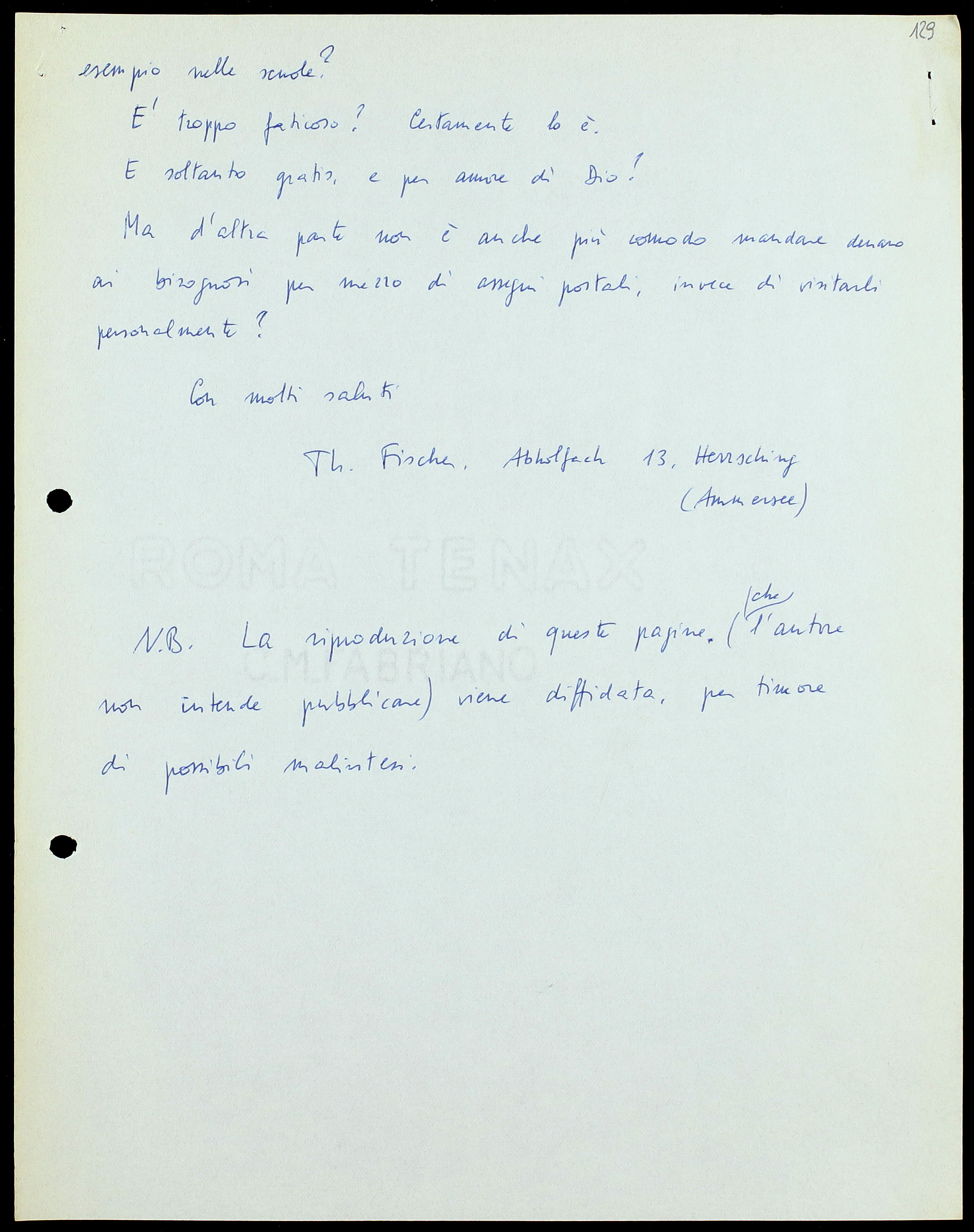
Non aspettate che l’uno o l’altro venga casualmente a voi: andate. Chi può impedire a voi di parlare coi giovani, ad esempio nelle scuole?
È troppo faticoso? Certamente lo è. E soltanto gratis, e per amore di Dio!
Ma d’altra parte non è anche più comodo mandare denaro ai bisognosi per mezzo di assegni, invece di visitarli personalmente?
Con molti saluti
Theodor Fischer, Abholfach 13, Herrsching
(Ammersee)
N.B. La riproduzione di queste pagine (che l’autore non intende pubblicare) viene diffidata, per timore di possibili malintesi.
Alla classe superiore della scuola indicata nell’indirizzo Allegato – Primo Levi. Se questo è un uomo
(dal libroL’Anticristo)
…e così divenni una delle mille lingue con cui il giornale si appellava al mondo ogni mattina.
E vidi ben presto che ciò che diceva la mia propria lingua non solo era uguale a ciò che dicevano le altre lingue ma che anzi tutte le nostre migliaia di lingue si contraddicevano tra loro.
Che però anche questa contraddizione non era una legge irrevocabile me che invece le nostre lingue ora si accordavano, ora si smentivano, e questo scambio avveniva in ogni istante. Varie lingue ripetevano ciò che la mia aveva detto: ma lo ripetevano in altro modo, anzi in modo che entrambe avevano torto.
Io non sapevo più se avevo detto il vero o il falso, se gli altri avevano ragione o torto; e se pensavo che il mondo ascolta tutte queste mille lingue ad un tempo, allora mi rendevo conto che al mondo è del tutto impossibile udire la verità…
ma anche impossibile riconoscere la voce della verità, qualora essa realmente risuonasse. Ma se io rappresentavo una delle mille lingue che creano la confusione, che mascherano la voce della verità, allora ero anch’io colpevole degli errori del mondo. (Josef Roth – poeta austriaco; ebreo, morto nel ’38 in esilio a Parigi.)
Cari giovani voi state per entrare (come dicono gli adulti) «nella vita». E come pure dicono gli adulti, «la vita sta davanti a voi».Ma cercate di vedere con precisione, se è «vita» questa: e non lasciatevi influenzare nella vostra propria opinione. Diffidate delle mie parole quando scrivo:
«mi pare che davanti a voi si apra una fossa, una fossa che gli adulti hanno cominciato a scavare a partire dal momento in cui hanno cominciato a eliminare le macerie dell’ultima guerra».
Le parole belle spesso non sono vere, le parole vere spesso non sono belle.
E tuttavia diffidate anche delle parole di questo libro. Non lasciatevi impressionare dal fatto che i tedeschi hanno massacrato milioni di ebrei. Forse sapete che meno di un secolo fa i Turchi hanno massacrato milioni di armeni e pochi secoli fa gli spagnoli e i portoghesi milioni di indiani. E in questo momento in cui leggete queste parole non avvengono forse massacri ovunque? L’accento non sta dunque sulla parola «ebreo» bensì sulla parola «uomo».
Non ha alcuna importanza chi sia l’uccisore e chi l’ucciso: solo questo dovrebbe essere sentito come un abominio: che un’uccisione avvenga.
Perciò, per quanto lo potete, solo da questo lasciatevi scuotere: che i massacri, e fra questi vi è anche la guerra, sono qualcosa che non ha senso, non sono affatto una necessità naturale, un evento che si verifica per obbligo in seno o un ordine naturale. La «lotta per l’esistenza» nel mondo animale e vegetale (l’uno mangia l’altro) non ha nulla in comune, o lo ha soltanto in apparenza, con la convivenza umana.
La guerra non è una necessità esterna ma sempre e soltanto una fuga, un’evasione.
Pertinenti e questo sono solo le parole: «chi di spada ferisce morrà di spada»[4], e «non uccidere»[5].
Non ha importanza chi sia stato a portare nel mondo queste parole: è solo importante che queste parole al mondo sono state portate.
Sono due comandi imperiosi. Non vogliono dire: «In questo o quel caso potrai ferire di spada» «In questo o quel caso ti è lecito uccidere». No: sta scritto: «chi ferisce, perirà», e «Non devi». Vediamo un po’ le cose da vicino: queste parole non sono forse tuttora attuali?
Il fatto che gli adulti feriscono volentieri di spada, che uccidono volentieri, non dimostra affatto che questo loro agire sia giusto o lecito. Scrive invece il francese Georges Simenon [6] in uno [7]dei suoi romanzi polizieschi: «Mi lascerò uccidere piuttosto di uccidere un altro».
E questa posizione che forse vi sembrerà ridicola non ha nulla a che fare con il cristianesimo di entrambe le confessioni, spesso deriso per la sua debolezza, ma discende da un’esigenza umana, propriamente naturale, ovvia.
In una gerarchia delle caste nella Cina classica si trovano all’ultimo posto i carnefici e i soldati: e cioè i distruttori della vita umane.
A proposito di questa parola, «distruzione», meditate un momento: «Le guerre di Federico il Grande furono di difesa o di saccheggio?» «Furono necessarie o no?» «Gli scopritori dell’energia atomica furono intelligenti?» (Intendo dire, se operarono per il bene dell’umanità) «Cose sarebbe avvenuto se avessero tenuto per sé la loro scienza, e non avessero consegnato la bomba pronta nelle mani dei politici e dei militari?»
Pensate bene:
Cosa vuole quest’uomo? Questo sconosciuto che vi scrive? Chi gli ha chiesto di farlo? Vuol darsi dell’importanza? È un obiettore di coscienza? Un comunista? Appartiene a qualche partito? No, non sono in alcun partito, non ci sono stato né ci sarò. Allora perché vi scrivo, e vi mando un libro? Quando avevo l’età vostra nessuno, richiesto o non richiesto, mi aveva fatto pensare a certe cose; e quando mi è accaduto poi di farlo, spesso era troppo tardi.
Ma voi, se avete letto queste mie parole fino a questo punto, voi già non potete più dire con purezza di cuore: «Queste cose nessuno me le ha mai dette».
Questo è un trucco, non è vero? Il mio trucco è di esigere da voi, che vogliate avere un’opinione propria. Anche un’opinione sbagliata: sarà sempre meglio che nessuna opinione. Un’opinione sbagliata può sempre essere corretta, magari nel corso di una intera esistenza. Invece, non avere opinione è… sì, avete ragione: non è effetto pericoloso, anzi!
Eppure, per avere una opinione occorre… no, non solo coraggio: occorre sopraffare una certa viltà istintiva, e ben fondata; e occorre sapere, dovere rappresentare la propria opinione.
Non abbiate timore. Non è possibile comandare a qualcuno di avere una opinione. Neppure la tristezza o la gioia possono essere comandate, né la simpatia o l’antipatia. Ma neppure si può (o si può solo in parte) vietare di avere una opinione, di provare gioia o tristezza, simpatia o antipatia, finché con ciò non si danneggi il prossimo nostro.
A me piacciono, ad esempio, le donne brune. Questo non è proibito, né, io credo, riprovevole. A mia figlia, ad esempio, può non piacere il mio aspetto ebraico; e questo io non posso né impedirlo, né (io ritengo) condannarlo. Ma è riprovevole, ed è vietato, che io vada per il paese con un paio di forbici, e cerchi di tosare i capelli a tutte le brune; e riprovevole e vietato dovrebbe essere dare la caccia agli ebrei, o a qualsiasi altra categoria umana, mandarli in gas, o comunque eliminarli.
L’«indomito» passato degli adulti! Mi posso immaginare quanto siate stufi di sentirne parlare, di doverne sentire parlare. O la problematica «I cattivi cristiani e il buon ebreo»; per buona parte drammacci dozzinali, che sfruttano senza pudore fatti realmente avvenuti, e che combinano affari a spese dei sentimenti effettivi, bigotti[8]o del tutto falsi, e con la «sensiblerie» del pubblico: lo stesso pubblico che in tutti i tempi ha affollato le piazze alle esecuzioni capitali.
Credete veramente che le ultime persecuzioni ebraiche siano state proprio le «ultime»? Perché se così fosse, dovrebbe cambiare la natura umana. «Ama il prossimo tuo come te stesso»: se amplificate queste parole, avrete già fatto un passo verso una umanità umana: «non fare agli altri ciò che non vorresti fosse fatto a te».
Ma ciò che l’uomo fa, invece, lo potete leggere per esempio in H.v. Kleist, Michael Kohlhaas, o in G. Büchner, Il messaggero di Assia.[9]
Confrontate: ieri e oggi. Due esempi da meditare:
1) 10 giornali con le ultime parole del condannato in un celebre processo per assassinio: 10 diverse versioni di queste stesse parole. Eppure il condannato non può che aver detto:
«sono innocente», oppure «non sono colpevole», oppure «non l’ho fatto io», oppure «non ero io»: ecc. ecc.
2) Adulti di ambo i sessi, in un pubblico locale, dietro pagamento del biglietto di ingresso, e maggiorazione sulle consumazioni, assistono allo spettacolo di una prestatrice d’opera di sesso femminile, che depone ad uno ad uno i suoi abiti, per lo più fino alla nudità completa. La prestatrice d’opera paga regolarmente l’imposta di ricchezza mobile e quella sulle chiese; il datore di lavoro le imposte sul reddito, sulle entrate, sui consumi voluttuari. E li pagano a quello stesso stato che punisce per offesa alla pubblica moralità un giovane o una giovane se si bagnano nudi in luogo aperto al pubblico, offrendo così spettacolo immorale.
ecc.[ii]
Questa è la morale pubblica di una società che vuole in manette[10] chi maltratta gli animali, ma che giustifica o addirittura glorifica chi maltratta gli esseri umani, o cerca di passare le loro azioni sotto silenzio.
«Scienza e crimine, soci in affare – lavoro da uomini affidato a deboli, servi, truffatori e pazzi – tutta l’umanità, in questo mondo che è un cumulo di spazzatura, malato di sé e di… e i poeti se ne stanno lì a bocca aperta».
(William Saroyan, Uomo grasso in carestia – 1946)
Potete dire:
«Quello che non so non mi fa impazzire di curiosità!» Un punto di vista utile per tenersi in salute.
Ma SE venite a conoscenza di un’ingiustizia commessa nel vostro ambiente più o meno prossimo, un’ingiustizia che voi stessi riconoscete e sentite come tale, ALLORA ricordate che NEPPURE VOI potrete mai essere certi, fino all’ultimo secondo della vostra ESISTENZA, che non VI capiti ciò che è capitato ad altri, e che qualcuno, di fronte all’ingiustizia subita da qualcun altro, non «passi oltre» senza curarsene o fingendo di «non aver visto».
QUEI tedeschi che dopo il 1945 sono stati «espulsi» hanno «subìto» ciò che prima era stato «inflitto» ai NON tedeschi.[11] Il PENDOLO dell’OROLOGIO oscilla in ENTRAMBE le direzioni – «di qua e di là» – «ora agli uni – ora agli altri». Bisognerebbe provare a fermare questo orologio, lasciarlo una volta per tutte su un «di qua» o su un «di là». PERCHÉ «questo mondo non è un orfanotrofio, non è un ospedale, non è un manicomio, non è una prigione, non è un obitorio, questo mondo è casa nostra». (William Saroyan, Uomo grasso in carestia) O almeno dovrebbe esserlo.
E cosa posso fare io, domanderete VOI, posso io cambiare qualcosa??? Ma forse voi nemmeno domandate. Eppure dovreste domandare, domandare, domandare! Porre domande scomode agli adulti. Ogni giorno. Perché è la VOSTRA vita che vi aspetta, non quella degli adulti che hanno già vissuto la loro in tutto o in parte.
Il passato è – quasi – roba di poco conto per voi. Chi impara mai dal passato!!!?!?!?!! Quello che accade OGGI, SOTTO i vostri occhi, questo dovrebbe importarvi: quello che OGGI accade DI NUOVO. Il passato non potete giudicarlo o condannarlo, voi non eravate PRESENTI.
Oggi SIETE PRESENTI – e l’oggi – se aprite bene gli occhi – potete QUASI giudicarlo e – forse – condannarlo.
Guardate attentamente – e potete davvero farlo anche da soli. Quand’è che abbiamo sentito parlare delle prime bombe atomiche in «tempo di pace»? Quand’è che abbiamo visto le prime immagini delle vittime di quegli eventi? Non credo di scrivere il falso se scrivo: «Abbiamo visto le immagini delle vittime, mentre le NON vittime reagivano solo con un rutto a pancia piena»! «O con proteste fiacche, insulse!»
TUTTI NOI.
E TUTTI NOI non possiamo CAMBIARE le cose, è questo che pensate???? Vero e… falso. Cambiate le cose per voi stessi e finché – forse – siete ancora troppo «codardi» per dirlo ad alta voce: cambiatele dentro di voi. Non ferite di spada, non uccidete. Nessuno può costringervi a farlo se non VOLETE. Ma se volete, qualunque sia il motivo, allora appartenete a coloro che sono o saranno colpevoli del fatto che l’OROLOGIO non SI FERMERÀ. E non crediate che per VOI «non suonerà l’ora», anche se fosse nell’ultimo secondo della vostra esistenza. (metro di giudizio non sono naturalmente quelli che non hanno coscienza o che non vogliono farsene una, non è a loro che mi rivolgo).
«Non fare agli altri ciò che non vuoi sia fatto a te…»
Menzogne, calunnie, frodi, furti, atti di violenza, rapine, torture, omicidi ……………………………….. Dire «anche gli altri lo fanno» non è un lasciapassare per fare le stesse cose anche voi.
Ricordatevelo, ve lo chiedo per favore.
Non passate oltre quando il più forte MASSACRA il più debole, nel corpo o nell’anima. Superate la vostra naturale avversione nei confronti di un ebreo, un nero, un giallo, un bruno, un rosso, un essere umano che forse non «sopportate»! È un ESSERE UMANO.
Davvero non potete sapere se a un certo punto della vostra esistenza non vi toccherà essere, non sarete grati perché un altro ESSERE UMANO interverrà in vostra difesa, un giorno, quando non saprete più come aiutarvi da soli.
Non interpellato: Theodor Fischer
Postilla:
se anche uno solo di voi, ai quali ho scritto qui, andrà a comprare il libro e lo passerà ad altri con la propria opinione e il proprio punto di vista, allora avrò
ottenuto più di molti che parlano di «pace e libertà».[12]
Non temere di essere «ridicolizzato» in ogni situazione della vita sarebbe una cosa; non dare ascolto al «tanto non serve a niente» sarebbe un’altra. L’uomo viene al mondo da solo e da solo se ne va. Ciò che sta in mezzo non è che affar suo. Chi avrebbe il diritto di mettere bocca nelle questioni che riguardano esclusivamente l’uomo ????? L’uomo stesso soltanto.
Theodor Fischer (Peter Glas) – mezzo ebreo – Herrsching/ Ammersee – Abholfach 13
1932-1937 Speaker e attore radiofonico
presso l’emittente radiofonica di Monaco
1945-1950 Speaker nei cinegiornali
«Welt im Film»
1950-1958 Primo commentatore e speaker
di «Fox Tönende Wochenschau»
dal 1950 Speaker e regista radiofonico
autore radiofonico
ANCHE una postilla[13] alla «Settimana della Fratellanza»[14]
finis
“Whoever sees evil and can prevent it, yet remains silent… is guilty of it.”[1]
Catholic Catechism of the Dioceses of Germany p. 238
Edition for the Diocese of Munich and Freising 1962
Primo Levi Turin
Sir—
Thank you for your book If This is a Man
Please excuse my amateurish Italian!
Always,
T. Fischer
March 25, 1962
February 1962
The enclosed document was sent to senior-years students at various schools in Munich and the vicinity. In so doing, I fulfilled a moral obligation. Please forgive me for this perhaps overly dramatic turn of phrase. Incidentally, I do not fear ridicule.
The reason for this letter is my own cowardice. I am not sure whether my actions constitute an offense that could give rise to intervention[2] by the German federal judiciary.
Freedom of expression for individuals is by no means guaranteed in the Federal Republic of Germany, and the expression of opinion by individuals is by no means desired.
On the other hand, I believe that none of you whom I dare to write to here, thereby making you my uninvited confidants, that none of you, belonging to the intellectual upper class in the Federal Republic of Germany, can claim the privilege of stupidity for yourselves, claim not to know that the constant chatter along the lines of “one should, one must, one could, if it weren’t already too late, ultimately nothing could be changed because…” is just a convenient and lazy excuse.[3]
Each of you, who are far more qualified than I am, should, if you are really serious about what you claim to stand for in words both spoken and written, make it your business not to constantly speak to those who want to close their eyes, but to those who are so young that their eyes are still closed.
Do not wait for one or the other to come to you. Go to them yourself.
Who can prevent you from speaking to young people yourself, for example at school?????
A bit of a chore for you? Certainly.
And solely to receive “God’s reward”?
But isn’t it also more convenient to transfer money to a checking account for those in need instead of seeking them out yourself?
February 1962
to the senior class
of the school indicated on the envelope
Enclosure: Primo Levi, If This is a Man
(Fischer-Bücherei No. 421)
…………………………………………………………………
(from the book The Antichrist—Kiepenheuer & Witsch)
Thus I began to serve him and so became one of the thousand tongues with which the newspapers meddle in the world every morning.
I soon saw, however, that what my own tongue said was not only different from what the other tongues said, but that all our thousand tongues were contradicting one another;
and that even this contradiction was no immutable law, as at one moment our tongues agreed, while at another they accused each other of lying, and this
changed from moment to moment.
Many tongues repeated what mine had said but repeated it differently and in such a way that we were both wrong.
I no longer knew if I had spoken the truth or falsehood or whether the others were right or wrong, and when I realized that the world hears all our thousand tongues at the same time, then I understood that it is entirely impossible for the world to hear the truth… but also impossible to recognize the voice of truth even if it should one day be heard.
But if I was one of the thousand confusing tongues that made the voice of truth unrecognizable then I was also guilty of confusing the world.
(Joseph Roth, Austrian poet, Jew) (died in 1938 in exile in Paris)—
Dear young ladies! Dear young gentlemen!
Soon you shall —as adults say—“step out into life”! And ahead of you—as adults also say— “your whole life lies ahead of you.”
Take a close look to see whether it really is “life.” And don’t let anyone steer you away from formulating your own opinion.
Be wary of my words when I write: “It seems to me that before you lies a ‘grave,’ a grave adults have been digging since the moment they began shoveling aside the rubble of the last war!”
Beautiful words are (mostly) not true, true words are (often) not beautiful.
Nevertheless, be equally wary of the words in the book If This is a Man. Do not in any way be impressed by the fact that Germans massacred millions of Jews.
Perhaps you know that less than a century ago, Turks massacred millions of Armenians, and many centuries ago, Spaniards and Portuguese massacred millions of indigenous South Americans. And isn’t there massacre everywhere at this very moment as you read my words?
The emphasis is therefore not on the word JEW, but on the word HUMAN. It is completely irrelevant who massacres whom. The only thing that should be outrageous is that someone massacres someone else.
So let yourself —if you can— be impressed in general by the fact that MASSACRE—including war—
is utterly senseless,—and not a natural necessity in the sense of a compelling process within a natural order. The “struggle for existence” (one devours the other)
“in the animal and plant kingdoms” has nothing in common (or only seemingly something in common) with human coexistence. War is never a true necessity, but always just an excuse, an escape.
The only words relevant in this regard are “Those who take up the sword by the sword shall perish”[4]and “Thou shalt not kill.”[5]
WHO brought these words into the world is, in itself, unimportant.
The only thing that matters is that these words exist in the world. Two clear demands. It does not say:
“In such and such a situation, you may take up the sword!” “In such and such a situation, you may kill!”
It says: “Whoever takes up the sword shall perish,” and “Thou shalt not.” Take a closer look. Don’t these words apply again and again???
The fact that adults like to take up the sword, that adults like to kill, in no way proves the correctness or even the justification of their actions.
In contrast, French [sic] author Georges Simenon[6] writes, for example, in one[7] of his crime novels (Kiepenheuer & Witsch):
“I’d rather let myself be killed than kill another person.”
And this attitude—perhaps you will smile at it!—has nothing to do with Christianity of either denomination, which is often ridiculed for its weakness, but rather with an attitude that is actually quite natural, self-evident, and appropriate to human beings.
In a list of the human hierarchy in classical China (China’s Natural Order, Esterer, Verlag Cotta 1929) at the very bottom one finds:
Executioners and soldiers They are destroyers of human life.
In connection with the word EXTERMINATION, quickly consider: “Were the wars of Frederick the Great defensive or predatory wars?” “Necessary or unnecessary?” “Were the discoverers of atomic energy smart people?” (I mean smart “for the good of humanity”), “What if they had kept the knowledge of the BOMB— to themselves, and not handed the finished BOMB over to politicians and the military?”
Think for a moment: What does he want? The unknown writer. The uninvited one. Is he trying to make himself important? Is he a conscientious objector? A communist? Or in a particular party?
Well, I was not in any party, I am not in any, and I will not be in any. So why am I writing to you and sending you a book?
When I was your age, no one—invited or uninvited— brought my attention to certain things. And when I became aware of those things on my own, it was often too late. But you—if you’ve read this far— can no longer say with a clear conscience: “Nobody told me about this and that.”
You see, it’s a “trick,”
my trick, to encourage you to want to have your own opinion. Even a wrong opinion would be better than none at all. A wrong opinion, over the course of a lifetime, can often be corrected. Having no opinion is… You’re right! It’s not unhealthy.
On the contrary.
However, having an opinion requires… no, not even courage, but rather one must overcome an instinctive, well-founded cowardice, to then also express this opinion
and indeed have to defend it.
Fear not, having an opinion cannot be commanded. Just as grief and joy cannot be commanded, nor can affection or aversion. Nor—at least not in principle—can having an opinion be forbidden, or feeling joy, grief, affection, aversion, as long as it does not offend another person.
For example, I don’t like black-haired women. That is neither forbidden nor, I believe, reprehensible.
My own daughter, for example, does not like my being Jewish. I can neither forbid her from doing so nor, I believe, call it reprehensible.
What is reprehensible and forbidden, however, is if I run around with a pair of scissors and try to cut off the hair of all black-haired women.
And it should be reprehensible and forbidden to
Send Jews or other HUMAN BEINGS
photocopy mailing form cremation urn concentration camp Buchenwald to Jewish cemetery 11th district, Vienna
to the slaughter or to be gassed or aside to be processed.
The “unresolved” past of adults—I could imagine that you are fed up with hearing about it, having to hear about it!!! Or the thesis plays “The Evil Christian and the Good Jew,” for the most part the worst kind of back-alley drama, shamelessly exploiting actual events and profiteering off of the feelings and emotions, ranging from genuine to hypocritical[8] to insincere, of the audience, the same audience that has always been found at execution sites.
Do you really believe that the last persecutions of the Jews were truly the last????
That would require a change in people’s attitude toward HUMANITY: “Love your neighbor as yourself!” Simplify these words, and it would already be a step on the path toward a humane humanity: “Do unto others as you would have them do unto you!” You can read all about what humans do, for example, in Heinrich von Kleist’s Michael Kohlhaas. Georg Büchner’s The Hessian Courier[9] And compare, then—now: two practical examples:
1.) 10 newspapers with the final words of a convicted man in a sensational murder trial, 10 versions of his final words. But the convicted man could only have said: “I am innocent” or “I am not guilty” or “I didn’t do it” or “It wasn’t me” or etc.
2.) Adults of both sexes pay an entrance fee and inflated prices for drinks etc. in a public establishment to watch a female employee remove her clothes, usually until she is completely naked.
The employee pays income tax and church tax, the employer pays income tax, sales tax, trade tax, and entertainment tax to the authorities of the same state that punishes a young girl or a young man for endangering public morality if they bathe naked in public, thereby expressing an immoral attitude.
Such is the public morality of a society that is willing to put a stop to[10] animal abusers but excuses and even glorifies human abusers, or tries to pretend their deeds never happened.
“Science and crime as business partners—men’s work left to weaklings, the servile, swindlers, and madmen—the whole of humanity in this garbage heap of a world, a sickly self—and the poets just stand there with their mouths open.”
(William Saroyan, Jim Dandy:Fat Man in a Famine—1946)
You might say:
“What I don’t know can’t hurt me!” A viewpoint that preserves one’s own health.
But IF you KNOW of an injustice in your immediate or further surroundings, an injustice that you yourself recognize as wrong and can empathize with, THEN remember that YOU YOURSELF are never safe, up until the very last second of your EXISTENCE, from what has happened to others, and that others have indifferently “walked on by” the injustice that befell others, or pretended “not to have seen it.”
THOSE Germans who were “expelled” after 1945 “suffered” what was “imposed” on non-Germans.[11] The PENDULUM of the CLOCK swings in BOTH directions—“back and forth”—“from one side to the other.” One should try to stop this clock, leave it at “over there” or “over here.” BECAUSE “this world is no orphanage, no hospital, no madhouse, no prison, no morgue, this world is our home.” (William Saroyan, Jim Dandy:Fat Man in a Famine)
Or at least it should be.
And what can I do about it? YOU ask, Can I change it??? Maybe you don’t even ask. But you should ask—ask, ask! Ask adults uncomfortable questions. Every day. Because it is YOUR life that lies ahead of you, not the lives of adults, who have already either fully lived or partially died.
For you, the past is—almost—irrelevant. Who learns from the past!!!?!?!?!! What happens TODAY, BEFORE your very eyes, that should be important to you— what matters AGAIN today. You can hardly judge or condemn the past, you weren’t THERE. Today you ARE THERE— and—if you open your eyes wide enough—you can ALMOST judge the present and—perhaps—condemn it.
Take a close look—and you really can do this all on your own: When did we hear about the first atomic bombs in “peacetime”? When did we see the first images of what happened and of the affected? I don’t think I’m writing untruths when I write: “We saw images of those affected, while those NOT affected merely reacted with a ‘satisfied burp’! “Or meaningless, feeble protests!”
ALL OF US.
And WE ALL can’t CHANGE a thing—is that what you think???? Right and—wrong. Change it for yourself— and as long as you are still—perhaps—too “cowardly” to say it out loud: within yourself. Don’t take up the sword—don’t kill. No one can force you to do it if you don’t WANT to. But if you want to—for whatever reason—then you probably belong to those who who are guilty or will become guilty, and the CLOCK will not STOP. And don’t think for a moment that for YOU “the hour will not strike,” even if it does so in the very last second of your existence.
(The benchmark for this is not, of course, those who have no conscience or do not want to have a conscience. They are not the ones being addressed here.)
“Do unto others as you would have them do unto you…”
Lies, slander, fraud, theft, acts of violence, robbery, torture, murder…………………………………………. The argument “others do it too” is no license to do it yourself.
Please, I beg you, remember this.
Don’t just walk on by when someone stronger is MASSACRING someone weaker—physically or emotionally.
Overcome your natural aversion to a Jew, a black person, a yellow person, a brown person, a red person—a human being whom you—perhaps—cannot “stand”!
That person is a HUMAN BEING.
You really cannot know
whether at some point in your life you will have to be grateful when another HUMAN BEING stands up for you—sometime in the future, when you do not know to help yourself.
Uninvitedly, Theodor Fischer
Postscript:
If even one of you whom I have written to here goes and buys the book and passes it on with your own comments and your own opinion, then I will have achieved more than many who talk about “peace and freedom.”[12]
Not fearing “being ridiculed” in all situations in life, that would be one thing— and not having to listening to “it’s all pointless anyway” would be another. People come into the world alone and leave the world alone. What lies in between is strictly their own business. Who would have the right to interfere in a person’s own business?????? That person, they alone.
Theodor Fischer (Peter Glas)—half-Jew— Herrsching/Ammersee—P.O. Box 13
1932–1937 Radio announcer and voice actor
Munich radio station
1945–1950 Announcer for the weekly newsreel
“Welt im Film”
1950–1958 1st commentator and announcer
“Fox Tönende Wochenschau”
1950–present Radio announcer and director
Scriptwriter for radio
ALSO an addendum[13] to the Woche der Brüderlichkeit (“Week of Brotherhood”)[14]
end
„Wer Böses sieht und hindern kann,und dennoch schweigt, …ist schuld daran.” Katholischer Katechismusder Bigtumer Deutschlands
S. 238[1] Ausgabe f.d. Bistum München und Freising
1962
Primo Levi
Torino
Signore –
Grazie per il libro Se questo è un uomo?
Scusi il mio italiano dilettantesco!
Sempre
T Fischer
25.III.62
im Februar 1962
Anliegender Abdruck ging an Oberklassen verschiedener Schulen Münchens und Umgebung.
Ich erfüllte damit eine Gewissenspflicht.
Die vielleicht pathetische Redewendung möge mir nachgesehen werden.
Im übrigen fürchte ich die Lächerlichkeit nicht.
Anlass zu diesem Schreiben ist meine Feigheit.
Ich bin nicht sicher, ob mein Tun nicht irgendeinen Tatbestand erfüllt, der Anlass
zu einem Einschreiten[2] der bundesdeutschen Justiz sein kann.
Meinungsfreiheit Einzelner ist in der BRD keineswegs gewährleistet, Meinungsäusserung Einzelner keineswegs erwünscht.
Andererseits glaube ich, dass keiner von Ihnen, die ich hier anzuschreiben mich unterfange
und ungebetenerweise zu Mitwissern mache, dass keiner von Ihnen, zur geistigen Oberschicht in der BRD gehörend, das Vorrecht der Dummheit für sich beanspruchen kann, nicht zu wissen, dass das dauernde DrumherumGerede „man sollte, man müsste, man könnte, wenn es nicht doch schon bereits wieder zu spät wäre, es liesse sich ja letztenendes doch nichts ändern, weil…” nur eine ebenso bequeme wie faule Ausrede[3] ist.
Jeder von Ihnen, doch weitaus berufener als ich, sollte, wenn es ihm damit, wofür er in Wort und Schrift einzutreten vorgibt, wirklich ernst sein sollte, – jeder von Ihnen sollte es sich angelegen sein lassen, nicht dauernd zu jenen zu sprechen, die ja ihre Augen verschliessen wollen, sondern zu diesen, denen die Augen aufgrund ihrer Jugend noch verschlossen sind.
Warten Sie nicht, bis vielleicht der eine oder andere zu Ihnen kommt. Gehen Sie selbst hin.
Wer kann es Ihnen verwehren, mit jungen Menschen z. B. in der Schule selbst zu sprechen?????
Etwas beschwerlich für Sie? Allerdings.
Und ausschliesslich um „Gottes Lohn”?
Jedoch ist es nicht auch bequemer, für Bedürftige auf ein Postscheckkonto Geld zu überweisen, statt sie selbst aufzusuchen???
im Februar 1962
an die Oberklasse
der auf dem Briefumschlag bezeichneten Schule
Anlage: Primo Levi Ist das ein Mensch?
(Fischer-Bücherei No.421)
…………………………………………………………………
(aus dem Buch Der Antichrist– Kiepenheuer u. Witsch)
… und so wurde ich eine der tausend Zungen, mit denen die Zeitung jeden Morgen in die Welt hinausredete.
Und ich sah bald, dass, was meine eigene Zunge sprach, nicht nur dasselbe war, was die anderen Zungen sprachen, sondern dass unser aller tausend Zungen einander widersprechen.
Dass aber auch dieser Widerspruch kein unabänderliches Gesetz war, sondern dass unsere Zungen bald übereinstimmen, bald einander der Lüge ziehen – und das abwechselnd in jedem Augenblick.
Manche Zunge wiederholte, was die meine gesagt hatte. Aber sie wiederholte es anders, und zwar derart, dass wir beide nicht recht hatten.
Ich wusste nicht mehr, ob ich Wahres oder Falsches gesprochen hatte, ob die anderen recht oder unrecht hatten – und dachte ich daran, dass die Welt alle unsere tausend Zungen auf einmal sprechen hört, so verstand ich, dass es ihr ganz unmöglich war, die Wahrheit zu hören… aber auch unmöglich, die Stimme der Wahrheit zu erkennen, in dem Falle, dass sie sich wirklich einmal vernehmen lassen sollte.
Stellte ich aber eine der tausend verwirrenden Zungen dar, die die Stimme der Wahrheit unkenntlich machten, so war auch ich schuldig an der Verwirrung der Welt.
(Josef Roth, österreichischer Dichter, Jude)
(gestorben 1938 in der Emigration in Paris) –
Sehr geehrte junge Damen!
Sehr geehrte junge Herren!
in Bälde treten Sie
– wie Erwachsene sagen – „ins Leben hinaus”!
Und vor Ihnen – wie Erwachsene ebenfalls sagen –
„vor Ihnen liegt das Leben”.
Schauen Sie einmal genau hin, ob es „Leben” ist.
Und lassen Sie sich dabei in Ihrer eigenen Meinung nicht beeinflussen.
Misstrauen Sie meinen Worten, wenn ich schreibe:
„mir will scheinen, vor Ihnen liegt ein “Grab”,
ein Grab, daran Erwachsene schaufeln,
seit dem Augenblick, in dem diese begannen,
die Trümmer des letzten Krieges beiseitezuschaufeln!”
Schöne Worte sind (meist) nicht wahr,
wahre Worte sind (oft) nicht schön.
Misstrauen Sie trotzdem auch den Worten in dem Buch Ist das ein Mensch? Lassen Sie sich keineswegs beeindrucken von den Tatsachen, dass Deutsche Millionen Juden massakriert haben.
Vielleicht wissen Sie, dass vor noch nicht einem Jahrhunderten Türken Millionen Armenier massakriert haben, vor vielen Jahrhunderten Spanier und Portugiesen Millionen Indios. Und wird nicht in dem Augenblick, in dem Sie meine Worte lesen, massakriert allüberall??
Die Betonung liegt also nicht auf dem Wort JUDE, sondern auf dem Wort MENSCH.
Es ist ganz unwichtig, wer wen massakriert.
Ungeheuerlich allein sollte sein, dass wer wen massakriert.
Lassen Sie sich also
– so Sie es vermögen –
ganz allgemein davon beeindrucken,
dass MASSAKER – dazu gehört der Krieg –
etwas Un-Sinniges sind, – und keine Naturnotwendigkeit im Sinne eines zwingenden Ablaufs innerhalb einer Natur – Ordnung. Der „Kampf ums Dasein”(einer frisst den anderen)
„im Tier-und auch Pflanzenreich” hat nichts ge-mein ( oder nur scheinbar etwas gemein)
mit dem Zusammen-Leben der Menschen.
Krieg ist nie eine zutreffende Notwendigkeit, immer nur eine Ausrede, eine Aus-Flucht.
Zutreffend in diesem Zusammenhang sind nur die Worte „Wer das Schwert ergreift, wird durch das Schwert umkommen”[4] und „Du sollst nicht töten”.[5]
WER diese Worte in die Welt gebracht hat,
ist – an sich – unwichtig.
Wichtig ist allein, dass diese Worte in der Welt sind.
Zwei eindeutige Forderungen.
Da heisst es nicht:
„in der und der Lage darfst Du das Schwert ergreifen!”
„in der und der Lage darfst Du töten!”
Es heisst:
„Wer ergreift, wird umkommen.” und „Du sollst nicht.”
Schauen Sie einmal genau hin.
Treffen diese Worte nicht immer wieder zu???
Die Tatsache, dass Erwachsene gerne das Schwert ergreifen, dass Erwachsene gerne toten, beweist keineswegs die Richtigkeit oder gar die Berechtigung ihres Tuns.
Dagegen schreibt der französische Schriftsteller Georges Simenon[6]z.B. in einem [7] seiner Kriminal-Romane (Kiepenheuer und Witsch):
„Lieber lasse ich mich toten,
als dass ich einen anderen tote.”
Und diese Einstellung – vielleicht belächeln Sie sie! – hat nicht einmal etwas mit dem oft seiner Schwächlichkeit wegen verhöhnten Christentum beider Konfessionen zu tun, sondern mit einer eigentlich ganz natürlichen, selbstverständlichen, dem Menschen gemässen Haltung.
In einer Aufstellung der menschlichen Rang-Ordnung im klassischen China (Chinas natürliche Ordnung, Esterer, Verlag Cotta 1929) finden sich an letzter Stelle:
Henker und Soldat
Das sind: Vernichter des Menschenlebens.
In Verbindung mit dem Wort VERNICHTUNG überlegen Sie einmal rasch:
„waren die Kriege Friedrichs des Grossen Verteidigungs-oder Raub-Kriege?”
„Notwendig oder nicht notwendig?”
“Waren die Entdecker der Atom-Energie kluge Menschen?
(ich meine klug „zum Wohle der Menschheit”),
„Was wäre, wenn sie das Wissen um die BOMBE –
für sich behalten, die fertige BOMBE nicht
den Politikern und Militärs in die Hände gegeben hätten?
Denken Sie ruhig:
was will er? Der unbekannte Schreiber. Der unge etene.
Macht er sich wichtig?
Ist er Kriegsdienstverweigerer? Kommunist?
Oder in welcher Partei?
Nun ich war in keiner Partei, ich bin in keiner und ich werde in keiner sein.
Und warum ich Ihnen schreibe und ein Buch schicke?
Als ich so alt war, wie Sie jetzt,
hat mich niemand – gebeten oder ungebeten –
auf etwas aufmerksam gemacht.
Und als ich selbst auf dieses und jenes aufmerksam wurde, war es tatsächlich oft zu spät.
Sie jedoch – wenn Sie bis hierher gelesen haben –
können bereits nicht mehr reinen Gewissens sagen:
„das und das hat mir niemand gesagt.”
Sie sehen ein „Trick”.
Mein Trick, Ihnen zu wünschen, dass Sie eine eigene Meinung haben wollen. Selbst eine falsche Meinung wäre
besser als gar keine. Eine falsche Meinung ist, oft im Laufe eines ganzen Lebens erst, korrigierbar. Keine Meinung zu haben, ist… Sie haben recht! Ungesund ist es nicht.
Im Gegenteil.
Jedoch eine Meinung zu haben, erfordert … nein, nicht einmal Mut, lediglich die Überwindung einer instinktiven, wohlbegründeten Feigheit, diese Meinung dann auch zu vertreten, ja vertreten zu müssen.
Befürchten Sie nichts, befehlen lässt es sich nicht, eine Meinung haben zu müssen. Ebensowenig wie Trauer oder Freude befohlen werden kann, oder Zuneigung und Abneigung. Verboten kann es jedoch – zumindestens nicht grundsätzlich – nicht werden, eine Meinung zu haben, – Freude, Trauer zu empfinden, Zuneigung, Abneigung, – solange damit einem anderen Menschen nicht zunahegetreten wird.
Ich mag z.B. schwarzhaarige Frauen nicht. Das ist weder verboten noch – glaube ich – verwerflich.
Meine eigene Tochter z.B. mag mein jüdisches Wesen nicht. Das kann ich ihr weder verbieten noch – glaube ich – als verwerflich bezeichnen.
Verwerflich und verboten jedoch ist, wenn ich mit einer Schere durch die Gegend laufe und versuche, allen schwarzhaarigen Frauen die Haare abzuschneiden.
Und verwerflich und verboten sollte sein,
Juden oder andere MENSCHEN
Fotokopie
Paketkarte
Aschenurne
K Z
Buchenwald
an
Israel.
Friedhof
Wien XI.
zu verheizen und zu vergasen oder zu Seite zu verarbeiten.
Die „unbewältigte” Vergangenheit der Erwachsenen – ich konnte mir vorstellen, dass es Ihnen längst zum Hals heraushängt, davon zu hören, hören zu müssen!!! Oder die Problemstücke „Die bösen Christen und der gute Jude”, zu sehen, zum grössten Teil übelste Hintertreppen-Dramatik unter schamloser Verwendung tatsächlicher Geschehnisse und Geschäftemacherei mit den echten, heuchlerischen[8] bis unechten Gefühlen und Gefühlchen des Publikums, desselben Publikums, das zu allen Zeiten die Hinrichtungsstätten bevölkerte.
Glauben Sie wirklich, dass die letzten Judenverfolgungen wirklich die letzten gewesen sind????
Da müsste sich ja die Einstellung des Menschen zum MENSCHEN ändern: „Liebe Deinen Nächsten wie Dich selbst!” Vereinfachen Sie diese Worte, und es wäre schon ein Schritt auf dem Weg zur menschlichen Menschheit: „Was Du nicht willst, dass man Dir tu, das füg auch keinem anderen zu!”
Was der Mensch tut, darüber können Sie z.B.nachlesen
bei Heinrich v.KleistMichael Kohlhaas bei Georg Büchner Der Hessische Landbote[9]
Vergleichen Sie einmal: damals – heute:
zwei Beispiele zur Nutzanwendung:
1.) 10 Zeitungen mit den Schlussworten eines Verurteilten
in einen aufsehenerregenden Mordprozess,
10 Versionen dieser Schlussworte.
Der Verurteilte kann aber nur gesagt haben:
„ich bin unschuldig” oder „ich bin nicht schuldig” oder „ich habe es nicht getan”oder „ich war es nicht” oder u. s. w.
2.) Erwachsene beiderlei Geschlechts sehen in einem öffentlichen Lokal gegen Eintritts-und erhöhten Verbrauchs-Preis für Getränke usw. zu, wie eine Arbeitnehmerin weiblichen Geschlechts ihre Kleidungsstücke ablegt, meist bis zur völligen Nacktheit.
Die Arbeitnehmerin führt Lohnsteuer-und Kirchensteuer ab, der Arbeitgeber Einkommen-Umsatz-Gewerbe-und Lustbarkeitssteuer, und zwar an die Behörden desselben Staates, der ein junges Mädchen oder einen jungen Mann wegen Gefährdung der öffentlichen Sittlichkeit mit Strafe belegt, wenn sie in der Öffentlichkeit nackt baden, und damit eine unsittliche Einstellung bekunden.
Soweit die öffentliche Moral einer Gesellschaft, die jedem Tier-Schänder das Handwerk[10] zu legen willens Menschen-Schänder aber entschuldigt bis verherrlicht, oder ihre Taten totzuschweigen versucht.
„Wissenschaft und Verbrechen als Geschäftspartner – Männer-Arbeit Schwächlingen überlassen, Knechts-Naturen, Betrügern und Wahnsinnigen – die ganze Menschheit
in dieser Kehrichthaufen-Welt ein kränklicher Selbst der – und die Dichter stehen mit offenem Munde herum.”
(William Saroyan Fetter Mann in Hungersnot – 1946)
Sie können sagen:
„Was ich nicht weiss, macht mich nicht heiss!”
Ein die eigene Gesundheit erhaltender Standpunkt.
WENN Sie aber – in Ihrer näheren oder weiteren Umgebung – von einem Unrecht WISSEN, einem Unrecht, das Sie selbst als Unrecht erkennen als Unrecht mit-empfinden können, DANN denken Sie daran, dass SIE SELBST bis zur letzten Sekunde Ihres DASEINS nie sicher sind, dass IHNEN widerfährt, was anderen widerfahren ist, und andere sind an dem Unrecht, das anderen widerfuhr, gleichgültig „vorbeigegangen” oder gaben vor, „es nicht gesehen zu haben”.
JENE Deutschen, die nach 1945 „ausgetrieben” wurden, haben das „erlitten”, was NICHT-Deutschen „auferlegt” wurde.[11] Der PENDEL der UHR schlägt nach BEIDEN Seiten aus – „Hinüber und Herüber” – „Die einen – die anderen”.
Man sollte einmal versuchen diese Uhr anzuhalten, es einmal bei einem „Hinüber” belassen, oder bei einem „Herüber”.
DENN „diese Welt ist kein Waisenhaus, kein Krankenhaus,
kein Irrenhaus, kein Zuchthaus, kein Totenhaus,
diese Welt ist unser Zuhause.”
(William Saroyan, Fetter Mann in Hungersnot)
Oder sollte es wenigsten sein.
Und was soll ich dabei, fragen SIE, kann ich es ändern???
Vielleicht fragen Sie nicht einmal.
Dabei müssten Sie fragen, – fragen, fragen!
Den Erwachsenen unbequeme Fragen stellen. Jeden Tag.
Denn es ist doch IHR Leben, das vor Ihnen liegt,
nicht das Leben der Erwachsenen, die das ihrige
bereits ganz oder teilweise schon abgelebt haben.
Die Vergangenheit ist für Sie – fast – unwichtig.
Wer lernt schon aus der Vergangenheit!!!?!?!?!!
Was HEUTE geschieht, VOR Ihren Augen,
das sollte für Sie wichtig sein –
was heute WIEDER geschient.
Die Vergangenheit können Sie so gut wie nicht beurteilen oder verurteilen, Sie waren nicht DABEI.
Heute SIND Sie DABEI – und Sie können die Gegenwart – wenn Sie die Augen gut aufmachen – BEINAHE beurteilen und – vielleicht – verurteilen.
Schauen Sie genau hin – und Sie können es wirklich ganz allein:
Wann hörten wir von den ersten Atombomben in “Friedenszeit”?
Wann sahen wir die ersten Bilder von durch das Geschehen Betroffenen??
Ich glaube, hier nicht die Un-Wahrheit zu schreiben, wenn ich schreibe:
„Wir sahen Bilder von den Betroffenen,
als die NICHT-Betroffenen nur mehr
mit einem „satten Rülpser” reagierten!”
„Oder nichtssagenden, schwächlichen Protesten!”
WIR ALLE.
Und WIR ALLE können es nicht ANDERN – meinen Sie????
Richtig und – falsch.
Ändern Sie es für sich –
und solange Sie – vielleicht – noch zu „feige” sind, es laut zu sagen: in sich selbst.
Ergreifen Sie das Schwert nicht – töten Sie nicht.
Niemand kann Sie zwingen, es zu tun, wenn Sie nicht WOLLEN.
Wollen Sie aber -aus welchem Grunde auch immer – so gehören Sie doch wohl zu jenen,
die schuldig sind oder schuldig werden, dass die UHR nicht ANGHALTEN wird.
Und glauben Sie ja nicht, dass für SIE
„nicht die Stunde schlägt” und sei es
in der letzten Sekunde Ihres Daseins.
(Massstab hierfür sind natürlich nicht jene, die kein Gewissen haben oder sich kein Gewissen machen wollen. Jene sind hier nicht angesprochen. )
„Was Du nicht willst, das man Dir tu…”
Lüge, Verleumdung, Betrug, Diebstahl, Gewalt-Tat,
Raub, Marter, Mord ………………………………………….
Der Hinweis „die anderen tun es ja auch”
ist kein Freibrief dafür, es selbst zu tun.
Denken Sie daran, ich bitte Sie darum.
Gehen Sie nicht vorbei, wenn ein Stärkerer einen Schwächeren MASSAKRIERT – körperlich oder seelisch.
Überwinden Sie Ihre natürliche Abneigung einem Juden gegenüber, einer Schwarzen, einem Gelben, einem Braunen, einem Roten – einem Menschen, den Sie – vielleicht – nicht „riechen” können!
Es ist ein MENSCH.
Sie wissen wirklich nicht,
ob Sie irgendwann in Ihrem Dasein nicht dankbar dafür
sein müssen, sein werden, wenn ein anderer MENSCH für Sie eintritt – irgendwann einmal, wenn Sie sich selbst nicht zu helfen wissen.
ungebetenerweise: Theodor Fischer
Nachsatz:
wenn ein einziger von Ihnen, die ich hier angeschrieben habe, hingeht und kauft das Buch und gibt es mit eigenen Stellungnahme in eigener Meinungsbildung weiter, so habe
ich mehr erreicht, als viele die von „Frieden und Freiheit” reden.[12]
Das „Lächerlichgemachtwerden”
in allen Lebenslagen nicht fürchten,
wäre das eine –
und auf das „es hat ja doch alles keinen Zweck”
nicht hören,
wäre das andere.
Der Mensch kommt allein in die Welt
und geht allein aus der Welt.
Was dazwischen liegt, ist allein seine Sache.
Wer hätte ein Anrecht darauf,
dem Menschen in seiner alleinigen Sache etwas
dreinzureden????? Der Mensch allein sich selbst.
AUCH ein Nachtrag[13] zur „Woche der Brüderlichkeit”[14]
finis
«Chi vede il male e può impedirlo e tuttavia tace, è in colpa» Catechismo cattolico della Germania settentrionale
p. 238[1]
Edizione per la diocesi di Monaco e Frisinga
1962
Primo Levi Torino
Signore –
Grazie per il libro Se questo è un uomo?
Scusi il mio italiano dilettantesco!
Sempre
T Fischer
25.III.62
Lo stampato allegato è stato inviato alle classi superiori di varie scuole di Monaco e dintorni. Così facendo ho adempiuto a un dovere di coscienza. Chiedo venia per lo stile, forse troppo appassionato. D’altronde, non ho paura di rendermi ridicolo.
Causa efficiente di queste pagine è la mia viltà. Non sono sicuro se questa mia azione non venga a identificarsi in un’interferenza[2]nel campo della giustizia federal-tedesca. Nella Repubblica Federale la libertà d’opinione dei singoli non è affatto garantita, né è desiderato che i singoli esprimano le loro opinioni.
D’altronde, ritengo che nessuno fra voi, a cui ho intrapreso di scrivere, e che così facendo rendo miei compagni di consapevolezza, nessuno fra voi, che appartenete allo strato intellettualmente più elevato della R.F.T., può rivendicare a sé stesso il privilegio della stoltezza, il privilegio di ignorare che il perpetuo ritornello: «Si dovrebbe, bisognerebbe, si potrebbe, se non fosse già troppo tardi; in fin dei conti non ci si può cambiare niente, perché….» non è altro che un pretesto, comodo quanto[3]pigro.
Ognuno di voi, pure tanto più qualificato di me, se veramente intende essere serio in ciò che si propone di difendere con le parole e gli scritti, dovrebbe avere anche premura di non continuare a parlare a quelli che vogliono tenere gli occhi chiusi, bensì a quelli i cui occhi sono tuttora chiusi, grazie alla loro giovinezza.
Non aspettate che l’uno o l’altro venga casualmente a voi: andate. Chi può impedire a voi di parlare coi giovani, ad esempio nelle scuole?
È troppo faticoso? Certamente lo è. E soltanto gratis, e per amore di Dio!
Ma d’altra parte non è anche più comodo mandare denaro ai bisognosi per mezzo di assegni, invece di visitarli personalmente?
Con molti saluti
Theodor Fischer, Abholfach 13, Herrsching
(Ammersee)
N.B. La riproduzione di queste pagine (che l’autore non intende pubblicare) viene diffidata, per timore di possibili malintesi.
Alla classe superiore della scuola indicata nell’indirizzo Allegato – Primo Levi. Se questo è un uomo
(dal libroL’Anticristo)
…e così divenni una delle mille lingue con cui il giornale si appellava al mondo ogni mattina.
E vidi ben presto che ciò che diceva la mia propria lingua non solo era uguale a ciò che dicevano le altre lingue ma che anzi tutte le nostre migliaia di lingue si contraddicevano tra loro.
Che però anche questa contraddizione non era una legge irrevocabile me che invece le nostre lingue ora si accordavano, ora si smentivano, e questo scambio avveniva in ogni istante. Varie lingue ripetevano ciò che la mia aveva detto: ma lo ripetevano in altro modo, anzi in modo che entrambe avevano torto.
Io non sapevo più se avevo detto il vero o il falso, se gli altri avevano ragione o torto; e se pensavo che il mondo ascolta tutte queste mille lingue ad un tempo, allora mi rendevo conto che al mondo è del tutto impossibile udire la verità…
ma anche impossibile riconoscere la voce della verità, qualora essa realmente risuonasse. Ma se io rappresentavo una delle mille lingue che creano la confusione, che mascherano la voce della verità, allora ero anch’io colpevole degli errori del mondo. (Josef Roth – poeta austriaco; ebreo, morto nel ’38 in esilio a Parigi.)
Cari giovani voi state per entrare (come dicono gli adulti) «nella vita». E come pure dicono gli adulti, «la vita sta davanti a voi».Ma cercate di vedere con precisione, se è «vita» questa: e non lasciatevi influenzare nella vostra propria opinione. Diffidate delle mie parole quando scrivo:
«mi pare che davanti a voi si apra una fossa, una fossa che gli adulti hanno cominciato a scavare a partire dal momento in cui hanno cominciato a eliminare le macerie dell’ultima guerra».
Le parole belle spesso non sono vere, le parole vere spesso non sono belle.
E tuttavia diffidate anche delle parole di questo libro. Non lasciatevi impressionare dal fatto che i tedeschi hanno massacrato milioni di ebrei. Forse sapete che meno di un secolo fa i Turchi hanno massacrato milioni di armeni e pochi secoli fa gli spagnoli e i portoghesi milioni di indiani. E in questo momento in cui leggete queste parole non avvengono forse massacri ovunque? L’accento non sta dunque sulla parola «ebreo» bensì sulla parola «uomo».
Non ha alcuna importanza chi sia l’uccisore e chi l’ucciso: solo questo dovrebbe essere sentito come un abominio: che un’uccisione avvenga.
Perciò, per quanto lo potete, solo da questo lasciatevi scuotere: che i massacri, e fra questi vi è anche la guerra, sono qualcosa che non ha senso, non sono affatto una necessità naturale, un evento che si verifica per obbligo in seno o un ordine naturale. La «lotta per l’esistenza» nel mondo animale e vegetale (l’uno mangia l’altro) non ha nulla in comune, o lo ha soltanto in apparenza, con la convivenza umana.
La guerra non è una necessità esterna ma sempre e soltanto una fuga, un’evasione.
Pertinenti e questo sono solo le parole: «chi di spada ferisce morrà di spada»[4], e «non uccidere»[5].
Non ha importanza chi sia stato a portare nel mondo queste parole: è solo importante che queste parole al mondo sono state portate.
Sono due comandi imperiosi. Non vogliono dire: «In questo o quel caso potrai ferire di spada» «In questo o quel caso ti è lecito uccidere». No: sta scritto: «chi ferisce, perirà», e «Non devi». Vediamo un po’ le cose da vicino: queste parole non sono forse tuttora attuali?
Il fatto che gli adulti feriscono volentieri di spada, che uccidono volentieri, non dimostra affatto che questo loro agire sia giusto o lecito. Scrive invece il francese Georges Simenon [6] in uno [7]dei suoi romanzi polizieschi: «Mi lascerò uccidere piuttosto di uccidere un altro».
E questa posizione che forse vi sembrerà ridicola non ha nulla a che fare con il cristianesimo di entrambe le confessioni, spesso deriso per la sua debolezza, ma discende da un’esigenza umana, propriamente naturale, ovvia.
In una gerarchia delle caste nella Cina classica si trovano all’ultimo posto i carnefici e i soldati: e cioè i distruttori della vita umane.
A proposito di questa parola, «distruzione», meditate un momento: «Le guerre di Federico il Grande furono di difesa o di saccheggio?» «Furono necessarie o no?» «Gli scopritori dell’energia atomica furono intelligenti?» (Intendo dire, se operarono per il bene dell’umanità) «Cose sarebbe avvenuto se avessero tenuto per sé la loro scienza, e non avessero consegnato la bomba pronta nelle mani dei politici e dei militari?»
Pensate bene:
Cosa vuole quest’uomo? Questo sconosciuto che vi scrive? Chi gli ha chiesto di farlo? Vuol darsi dell’importanza? È un obiettore di coscienza? Un comunista? Appartiene a qualche partito? No, non sono in alcun partito, non ci sono stato né ci sarò. Allora perché vi scrivo, e vi mando un libro? Quando avevo l’età vostra nessuno, richiesto o non richiesto, mi aveva fatto pensare a certe cose; e quando mi è accaduto poi di farlo, spesso era troppo tardi.
Ma voi, se avete letto queste mie parole fino a questo punto, voi già non potete più dire con purezza di cuore: «Queste cose nessuno me le ha mai dette».
Questo è un trucco, non è vero? Il mio trucco è di esigere da voi, che vogliate avere un’opinione propria. Anche un’opinione sbagliata: sarà sempre meglio che nessuna opinione. Un’opinione sbagliata può sempre essere corretta, magari nel corso di una intera esistenza. Invece, non avere opinione è… sì, avete ragione: non è effetto pericoloso, anzi!
Eppure, per avere una opinione occorre… no, non solo coraggio: occorre sopraffare una certa viltà istintiva, e ben fondata; e occorre sapere, dovere rappresentare la propria opinione.
Non abbiate timore. Non è possibile comandare a qualcuno di avere una opinione. Neppure la tristezza o la gioia possono essere comandate, né la simpatia o l’antipatia. Ma neppure si può (o si può solo in parte) vietare di avere una opinione, di provare gioia o tristezza, simpatia o antipatia, finché con ciò non si danneggi il prossimo nostro.
A me piacciono, ad esempio, le donne brune. Questo non è proibito, né, io credo, riprovevole. A mia figlia, ad esempio, può non piacere il mio aspetto ebraico; e questo io non posso né impedirlo, né (io ritengo) condannarlo. Ma è riprovevole, ed è vietato, che io vada per il paese con un paio di forbici, e cerchi di tosare i capelli a tutte le brune; e riprovevole e vietato dovrebbe essere dare la caccia agli ebrei, o a qualsiasi altra categoria umana, mandarli in gas, o comunque eliminarli.
L’«indomito» passato degli adulti! Mi posso immaginare quanto siate stufi di sentirne parlare, di doverne sentire parlare. O la problematica «I cattivi cristiani e il buon ebreo»; per buona parte drammacci dozzinali, che sfruttano senza pudore fatti realmente avvenuti, e che combinano affari a spese dei sentimenti effettivi, bigotti[8]o del tutto falsi, e con la «sensiblerie» del pubblico: lo stesso pubblico che in tutti i tempi ha affollato le piazze alle esecuzioni capitali.
Credete veramente che le ultime persecuzioni ebraiche siano state proprio le «ultime»? Perché se così fosse, dovrebbe cambiare la natura umana. «Ama il prossimo tuo come te stesso»: se amplificate queste parole, avrete già fatto un passo verso una umanità umana: «non fare agli altri ciò che non vorresti fosse fatto a te».
Ma ciò che l’uomo fa, invece, lo potete leggere per esempio in H.v. Kleist, Michael Kohlhaas, o in G. Büchner, Il messaggero di Assia.[9]
Confrontate: ieri e oggi. Due esempi da meditare:
1) 10 giornali con le ultime parole del condannato in un celebre processo per assassinio: 10 diverse versioni di queste stesse parole. Eppure il condannato non può che aver detto:
«sono innocente», oppure «non sono colpevole», oppure «non l’ho fatto io», oppure «non ero io»: ecc. ecc.
2) Adulti di ambo i sessi, in un pubblico locale, dietro pagamento del biglietto di ingresso, e maggiorazione sulle consumazioni, assistono allo spettacolo di una prestatrice d’opera di sesso femminile, che depone ad uno ad uno i suoi abiti, per lo più fino alla nudità completa. La prestatrice d’opera paga regolarmente l’imposta di ricchezza mobile e quella sulle chiese; il datore di lavoro le imposte sul reddito, sulle entrate, sui consumi voluttuari. E li pagano a quello stesso stato che punisce per offesa alla pubblica moralità un giovane o una giovane se si bagnano nudi in luogo aperto al pubblico, offrendo così spettacolo immorale.
ecc.[ii]
Questa è la morale pubblica di una società che vuole in manette[10] chi maltratta gli animali, ma che giustifica o addirittura glorifica chi maltratta gli esseri umani, o cerca di passare le loro azioni sotto silenzio.
«Scienza e crimine, soci in affare – lavoro da uomini affidato a deboli, servi, truffatori e pazzi – tutta l’umanità, in questo mondo che è un cumulo di spazzatura, malato di sé e di… e i poeti se ne stanno lì a bocca aperta».
(William Saroyan, Uomo grasso in carestia – 1946)
Potete dire:
«Quello che non so non mi fa impazzire di curiosità!» Un punto di vista utile per tenersi in salute.
Ma SE venite a conoscenza di un’ingiustizia commessa nel vostro ambiente più o meno prossimo, un’ingiustizia che voi stessi riconoscete e sentite come tale, ALLORA ricordate che NEPPURE VOI potrete mai essere certi, fino all’ultimo secondo della vostra ESISTENZA, che non VI capiti ciò che è capitato ad altri, e che qualcuno, di fronte all’ingiustizia subita da qualcun altro, non «passi oltre» senza curarsene o fingendo di «non aver visto».
QUEI tedeschi che dopo il 1945 sono stati «espulsi» hanno «subìto» ciò che prima era stato «inflitto» ai NON tedeschi.[11] Il PENDOLO dell’OROLOGIO oscilla in ENTRAMBE le direzioni – «di qua e di là» – «ora agli uni – ora agli altri». Bisognerebbe provare a fermare questo orologio, lasciarlo una volta per tutte su un «di qua» o su un «di là». PERCHÉ «questo mondo non è un orfanotrofio, non è un ospedale, non è un manicomio, non è una prigione, non è un obitorio, questo mondo è casa nostra». (William Saroyan, Uomo grasso in carestia) O almeno dovrebbe esserlo.
E cosa posso fare io, domanderete VOI, posso io cambiare qualcosa??? Ma forse voi nemmeno domandate. Eppure dovreste domandare, domandare, domandare! Porre domande scomode agli adulti. Ogni giorno. Perché è la VOSTRA vita che vi aspetta, non quella degli adulti che hanno già vissuto la loro in tutto o in parte.
Il passato è – quasi – roba di poco conto per voi. Chi impara mai dal passato!!!?!?!?!! Quello che accade OGGI, SOTTO i vostri occhi, questo dovrebbe importarvi: quello che OGGI accade DI NUOVO. Il passato non potete giudicarlo o condannarlo, voi non eravate PRESENTI.
Oggi SIETE PRESENTI – e l’oggi – se aprite bene gli occhi – potete QUASI giudicarlo e – forse – condannarlo.
Guardate attentamente – e potete davvero farlo anche da soli. Quand’è che abbiamo sentito parlare delle prime bombe atomiche in «tempo di pace»? Quand’è che abbiamo visto le prime immagini delle vittime di quegli eventi? Non credo di scrivere il falso se scrivo: «Abbiamo visto le immagini delle vittime, mentre le NON vittime reagivano solo con un rutto a pancia piena»! «O con proteste fiacche, insulse!»
TUTTI NOI.
E TUTTI NOI non possiamo CAMBIARE le cose, è questo che pensate???? Vero e… falso. Cambiate le cose per voi stessi e finché – forse – siete ancora troppo «codardi» per dirlo ad alta voce: cambiatele dentro di voi. Non ferite di spada, non uccidete. Nessuno può costringervi a farlo se non VOLETE. Ma se volete, qualunque sia il motivo, allora appartenete a coloro che sono o saranno colpevoli del fatto che l’OROLOGIO non SI FERMERÀ. E non crediate che per VOI «non suonerà l’ora», anche se fosse nell’ultimo secondo della vostra esistenza. (metro di giudizio non sono naturalmente quelli che non hanno coscienza o che non vogliono farsene una, non è a loro che mi rivolgo).
«Non fare agli altri ciò che non vuoi sia fatto a te…»
Menzogne, calunnie, frodi, furti, atti di violenza, rapine, torture, omicidi ……………………………….. Dire «anche gli altri lo fanno» non è un lasciapassare per fare le stesse cose anche voi.
Ricordatevelo, ve lo chiedo per favore.
Non passate oltre quando il più forte MASSACRA il più debole, nel corpo o nell’anima. Superate la vostra naturale avversione nei confronti di un ebreo, un nero, un giallo, un bruno, un rosso, un essere umano che forse non «sopportate»! È un ESSERE UMANO.
Davvero non potete sapere se a un certo punto della vostra esistenza non vi toccherà essere, non sarete grati perché un altro ESSERE UMANO interverrà in vostra difesa, un giorno, quando non saprete più come aiutarvi da soli.
Non interpellato: Theodor Fischer
Postilla:
se anche uno solo di voi, ai quali ho scritto qui, andrà a comprare il libro e lo passerà ad altri con la propria opinione e il proprio punto di vista, allora avrò
ottenuto più di molti che parlano di «pace e libertà».[12]
Non temere di essere «ridicolizzato» in ogni situazione della vita sarebbe una cosa; non dare ascolto al «tanto non serve a niente» sarebbe un’altra. L’uomo viene al mondo da solo e da solo se ne va. Ciò che sta in mezzo non è che affar suo. Chi avrebbe il diritto di mettere bocca nelle questioni che riguardano esclusivamente l’uomo ????? L’uomo stesso soltanto.
Theodor Fischer (Peter Glas) – mezzo ebreo – Herrsching/ Ammersee – Abholfach 13
1932-1937 Speaker e attore radiofonico
presso l’emittente radiofonica di Monaco
1945-1950 Speaker nei cinegiornali
«Welt im Film»
1950-1958 Primo commentatore e speaker
di «Fox Tönende Wochenschau»
dal 1950 Speaker e regista radiofonico
autore radiofonico
ANCHE una postilla[13] alla «Settimana della Fratellanza»[14]
finis
“Whoever sees evil and can prevent it, yet remains silent… is guilty of it.”[1]
Catholic Catechism of the Dioceses of Germany p. 238
Edition for the Diocese of Munich and Freising 1962
Primo Levi Turin
Sir—
Thank you for your book If This is a Man
Please excuse my amateurish Italian!
Always,
T. Fischer
March 25, 1962
February 1962
The enclosed document was sent to senior-years students at various schools in Munich and the vicinity. In so doing, I fulfilled a moral obligation. Please forgive me for this perhaps overly dramatic turn of phrase. Incidentally, I do not fear ridicule.
The reason for this letter is my own cowardice. I am not sure whether my actions constitute an offense that could give rise to intervention[2] by the German federal judiciary.
Freedom of expression for individuals is by no means guaranteed in the Federal Republic of Germany, and the expression of opinion by individuals is by no means desired.
On the other hand, I believe that none of you whom I dare to write to here, thereby making you my uninvited confidants, that none of you, belonging to the intellectual upper class in the Federal Republic of Germany, can claim the privilege of stupidity for yourselves, claim not to know that the constant chatter along the lines of “one should, one must, one could, if it weren’t already too late, ultimately nothing could be changed because…” is just a convenient and lazy excuse.[3]
Each of you, who are far more qualified than I am, should, if you are really serious about what you claim to stand for in words both spoken and written, make it your business not to constantly speak to those who want to close their eyes, but to those who are so young that their eyes are still closed.
Do not wait for one or the other to come to you. Go to them yourself.
Who can prevent you from speaking to young people yourself, for example at school?????
A bit of a chore for you? Certainly.
And solely to receive “God’s reward”?
But isn’t it also more convenient to transfer money to a checking account for those in need instead of seeking them out yourself?
February 1962
to the senior class
of the school indicated on the envelope
Enclosure: Primo Levi, If This is a Man
(Fischer-Bücherei No. 421)
…………………………………………………………………
(from the book The Antichrist—Kiepenheuer & Witsch)
Thus I began to serve him and so became one of the thousand tongues with which the newspapers meddle in the world every morning.
I soon saw, however, that what my own tongue said was not only different from what the other tongues said, but that all our thousand tongues were contradicting one another;
and that even this contradiction was no immutable law, as at one moment our tongues agreed, while at another they accused each other of lying, and this
changed from moment to moment.
Many tongues repeated what mine had said but repeated it differently and in such a way that we were both wrong.
I no longer knew if I had spoken the truth or falsehood or whether the others were right or wrong, and when I realized that the world hears all our thousand tongues at the same time, then I understood that it is entirely impossible for the world to hear the truth… but also impossible to recognize the voice of truth even if it should one day be heard.
But if I was one of the thousand confusing tongues that made the voice of truth unrecognizable then I was also guilty of confusing the world.
(Joseph Roth, Austrian poet, Jew) (died in 1938 in exile in Paris)—
Dear young ladies! Dear young gentlemen!
Soon you shall —as adults say—“step out into life”! And ahead of you—as adults also say— “your whole life lies ahead of you.”
Take a close look to see whether it really is “life.” And don’t let anyone steer you away from formulating your own opinion.
Be wary of my words when I write: “It seems to me that before you lies a ‘grave,’ a grave adults have been digging since the moment they began shoveling aside the rubble of the last war!”
Beautiful words are (mostly) not true, true words are (often) not beautiful.
Nevertheless, be equally wary of the words in the book If This is a Man. Do not in any way be impressed by the fact that Germans massacred millions of Jews.
Perhaps you know that less than a century ago, Turks massacred millions of Armenians, and many centuries ago, Spaniards and Portuguese massacred millions of indigenous South Americans. And isn’t there massacre everywhere at this very moment as you read my words?
The emphasis is therefore not on the word JEW, but on the word HUMAN. It is completely irrelevant who massacres whom. The only thing that should be outrageous is that someone massacres someone else.
So let yourself —if you can— be impressed in general by the fact that MASSACRE—including war—
is utterly senseless,—and not a natural necessity in the sense of a compelling process within a natural order. The “struggle for existence” (one devours the other)
“in the animal and plant kingdoms” has nothing in common (or only seemingly something in common) with human coexistence. War is never a true necessity, but always just an excuse, an escape.
The only words relevant in this regard are “Those who take up the sword by the sword shall perish”[4]and “Thou shalt not kill.”[5]
WHO brought these words into the world is, in itself, unimportant.
The only thing that matters is that these words exist in the world. Two clear demands. It does not say:
“In such and such a situation, you may take up the sword!” “In such and such a situation, you may kill!”
It says: “Whoever takes up the sword shall perish,” and “Thou shalt not.” Take a closer look. Don’t these words apply again and again???
The fact that adults like to take up the sword, that adults like to kill, in no way proves the correctness or even the justification of their actions.
In contrast, French [sic] author Georges Simenon[6] writes, for example, in one[7] of his crime novels (Kiepenheuer & Witsch):
“I’d rather let myself be killed than kill another person.”
And this attitude—perhaps you will smile at it!—has nothing to do with Christianity of either denomination, which is often ridiculed for its weakness, but rather with an attitude that is actually quite natural, self-evident, and appropriate to human beings.
In a list of the human hierarchy in classical China (China’s Natural Order, Esterer, Verlag Cotta 1929) at the very bottom one finds:
Executioners and soldiers They are destroyers of human life.
In connection with the word EXTERMINATION, quickly consider: “Were the wars of Frederick the Great defensive or predatory wars?” “Necessary or unnecessary?” “Were the discoverers of atomic energy smart people?” (I mean smart “for the good of humanity”), “What if they had kept the knowledge of the BOMB— to themselves, and not handed the finished BOMB over to politicians and the military?”
Think for a moment: What does he want? The unknown writer. The uninvited one. Is he trying to make himself important? Is he a conscientious objector? A communist? Or in a particular party?
Well, I was not in any party, I am not in any, and I will not be in any. So why am I writing to you and sending you a book?
When I was your age, no one—invited or uninvited— brought my attention to certain things. And when I became aware of those things on my own, it was often too late. But you—if you’ve read this far— can no longer say with a clear conscience: “Nobody told me about this and that.”
You see, it’s a “trick,”
my trick, to encourage you to want to have your own opinion. Even a wrong opinion would be better than none at all. A wrong opinion, over the course of a lifetime, can often be corrected. Having no opinion is… You’re right! It’s not unhealthy.
On the contrary.
However, having an opinion requires… no, not even courage, but rather one must overcome an instinctive, well-founded cowardice, to then also express this opinion
and indeed have to defend it.
Fear not, having an opinion cannot be commanded. Just as grief and joy cannot be commanded, nor can affection or aversion. Nor—at least not in principle—can having an opinion be forbidden, or feeling joy, grief, affection, aversion, as long as it does not offend another person.
For example, I don’t like black-haired women. That is neither forbidden nor, I believe, reprehensible.
My own daughter, for example, does not like my being Jewish. I can neither forbid her from doing so nor, I believe, call it reprehensible.
What is reprehensible and forbidden, however, is if I run around with a pair of scissors and try to cut off the hair of all black-haired women.
And it should be reprehensible and forbidden to
Send Jews or other HUMAN BEINGS
photocopy mailing form cremation urn concentration camp Buchenwald to Jewish cemetery 11th district, Vienna
to the slaughter or to be gassed or aside to be processed.
The “unresolved” past of adults—I could imagine that you are fed up with hearing about it, having to hear about it!!! Or the thesis plays “The Evil Christian and the Good Jew,” for the most part the worst kind of back-alley drama, shamelessly exploiting actual events and profiteering off of the feelings and emotions, ranging from genuine to hypocritical[8] to insincere, of the audience, the same audience that has always been found at execution sites.
Do you really believe that the last persecutions of the Jews were truly the last????
That would require a change in people’s attitude toward HUMANITY: “Love your neighbor as yourself!” Simplify these words, and it would already be a step on the path toward a humane humanity: “Do unto others as you would have them do unto you!” You can read all about what humans do, for example, in Heinrich von Kleist’s Michael Kohlhaas. Georg Büchner’s The Hessian Courier[9] And compare, then—now: two practical examples:
1.) 10 newspapers with the final words of a convicted man in a sensational murder trial, 10 versions of his final words. But the convicted man could only have said: “I am innocent” or “I am not guilty” or “I didn’t do it” or “It wasn’t me” or etc.
2.) Adults of both sexes pay an entrance fee and inflated prices for drinks etc. in a public establishment to watch a female employee remove her clothes, usually until she is completely naked.
The employee pays income tax and church tax, the employer pays income tax, sales tax, trade tax, and entertainment tax to the authorities of the same state that punishes a young girl or a young man for endangering public morality if they bathe naked in public, thereby expressing an immoral attitude.
Such is the public morality of a society that is willing to put a stop to[10] animal abusers but excuses and even glorifies human abusers, or tries to pretend their deeds never happened.
“Science and crime as business partners—men’s work left to weaklings, the servile, swindlers, and madmen—the whole of humanity in this garbage heap of a world, a sickly self—and the poets just stand there with their mouths open.”
(William Saroyan, Jim Dandy:Fat Man in a Famine—1946)
You might say:
“What I don’t know can’t hurt me!” A viewpoint that preserves one’s own health.
But IF you KNOW of an injustice in your immediate or further surroundings, an injustice that you yourself recognize as wrong and can empathize with, THEN remember that YOU YOURSELF are never safe, up until the very last second of your EXISTENCE, from what has happened to others, and that others have indifferently “walked on by” the injustice that befell others, or pretended “not to have seen it.”
THOSE Germans who were “expelled” after 1945 “suffered” what was “imposed” on non-Germans.[11] The PENDULUM of the CLOCK swings in BOTH directions—“back and forth”—“from one side to the other.” One should try to stop this clock, leave it at “over there” or “over here.” BECAUSE “this world is no orphanage, no hospital, no madhouse, no prison, no morgue, this world is our home.” (William Saroyan, Jim Dandy:Fat Man in a Famine)
Or at least it should be.
And what can I do about it? YOU ask, Can I change it??? Maybe you don’t even ask. But you should ask—ask, ask! Ask adults uncomfortable questions. Every day. Because it is YOUR life that lies ahead of you, not the lives of adults, who have already either fully lived or partially died.
For you, the past is—almost—irrelevant. Who learns from the past!!!?!?!?!! What happens TODAY, BEFORE your very eyes, that should be important to you— what matters AGAIN today. You can hardly judge or condemn the past, you weren’t THERE. Today you ARE THERE— and—if you open your eyes wide enough—you can ALMOST judge the present and—perhaps—condemn it.
Take a close look—and you really can do this all on your own: When did we hear about the first atomic bombs in “peacetime”? When did we see the first images of what happened and of the affected? I don’t think I’m writing untruths when I write: “We saw images of those affected, while those NOT affected merely reacted with a ‘satisfied burp’! “Or meaningless, feeble protests!”
ALL OF US.
And WE ALL can’t CHANGE a thing—is that what you think???? Right and—wrong. Change it for yourself— and as long as you are still—perhaps—too “cowardly” to say it out loud: within yourself. Don’t take up the sword—don’t kill. No one can force you to do it if you don’t WANT to. But if you want to—for whatever reason—then you probably belong to those who who are guilty or will become guilty, and the CLOCK will not STOP. And don’t think for a moment that for YOU “the hour will not strike,” even if it does so in the very last second of your existence.
(The benchmark for this is not, of course, those who have no conscience or do not want to have a conscience. They are not the ones being addressed here.)
“Do unto others as you would have them do unto you…”
Lies, slander, fraud, theft, acts of violence, robbery, torture, murder…………………………………………. The argument “others do it too” is no license to do it yourself.
Please, I beg you, remember this.
Don’t just walk on by when someone stronger is MASSACRING someone weaker—physically or emotionally.
Overcome your natural aversion to a Jew, a black person, a yellow person, a brown person, a red person—a human being whom you—perhaps—cannot “stand”!
That person is a HUMAN BEING.
You really cannot know
whether at some point in your life you will have to be grateful when another HUMAN BEING stands up for you—sometime in the future, when you do not know to help yourself.
Uninvitedly, Theodor Fischer
Postscript:
If even one of you whom I have written to here goes and buys the book and passes it on with your own comments and your own opinion, then I will have achieved more than many who talk about “peace and freedom.”[12]
Not fearing “being ridiculed” in all situations in life, that would be one thing— and not having to listening to “it’s all pointless anyway” would be another. People come into the world alone and leave the world alone. What lies in between is strictly their own business. Who would have the right to interfere in a person’s own business?????? That person, they alone.
Theodor Fischer (Peter Glas)—half-Jew— Herrsching/Ammersee—P.O. Box 13
1932–1937 Radio announcer and voice actor
Munich radio station
1945–1950 Announcer for the weekly newsreel
“Welt im Film”
1950–1958 1st commentator and announcer
“Fox Tönende Wochenschau”
1950–present Radio announcer and director
Scriptwriter for radio
ALSO an addendum[13] to the Woche der Brüderlichkeit (“Week of Brotherhood”)[14]
end
Info
Note
Tag
Mittente: Theodor Fischer
Destinatario: Primo Levi
Data di stesura: 1962-03-25
Luogo di stesura: Herrsching am Ammersee
Descrizione del documento: Lettera ms. a biro blu con epigrafi ds; sono presenti due timbri a inchiostro verde rispettivamente sul margine superiore e inferiore del foglio, a destra. Sul margine superiore si legge: «Zur Kenntnisnahme | nicht | zur Veröffentlichung» («per conoscenza | non | per pubblicazione») e su quello inferiore: «Theodor Fischer Herrsching | Ammersee». Sotto il timbro, sul margine superiore destro, in corrispondenza di «nicht», Fischer annota a matita «Levi», a identificare probabilmente la copia dell’allegato da inviare allo scrittore torinese. Traduzione di Levi degli allegati ff. 125-129: la trad. dell’allegato 1 (ff. 128-129) è ms. a biro blu su fogli bianchi, la trad. dell’allegato 2 (ff. 125-127) è ds. su fogli bianchi. In entrambe, Levi ms. a biro rossa sul margine alto (ff. 125, 128): «Traduz. Feb. 1962).
Allegati:Allegato 1 (lettera circolare ad alcuni intellettuali): (f. 124). Allegato ds. con inserti ms. a biro blu di Fischer e di Levi; sul margine superiore del foglio, Fischer annota ms. a biro blu: «Per indirizzo | Cardinale di Bavaria | e diversi scrittori tedesci».
Allegato 2 (circolari inviate nelle scuole): (ff. 116-124). In tutti i fogli compaiono due numeri di pagina progressivi ds. sul margine superiore e inferiore esterno del foglio ad eccezione del f. 116, che presenta solo il numero «(-2-)» nel margine inferiore destro. Nei ff. 116 e 123 è ripetuto il timbro «Zur Kenntnisnahme | nicht | zur Veröffentlichung» («per conoscenza | non | per pubblicazione») presente nella lettera (f.115). I fogli presentano contrassegni e inserti di Levi ms. a biro blu e matita rossa.
Archivio: Archivio privato di Primo Levi, Torino
Segnatura: Complesso di fondi Primo Levi, Fondo Primo Levi, Corrispondenza, Corrispondenti particolari, Fasc. 20, sottofasc. 1, , f. 115 (LETT.), ff. 116-123 (ALL 2), f. 124 (ALL 1), ff. 125-127 (TRAD. ALL 2), ff. 128-129 (TRAD. ALL 1).
Fogli: 15, solo recto
DOI: https://doi.org/10.15160/09z2-tg03
1Il Catechismo Cattolico delle Diocesi di Germania, noto anche come Catechismo Verde per la sua copertina, fu redatto dalla conferenza episcopale tedesca e pubblicato nel 1955. Il volume era rivolto principalmente ai più giovani, bambini e ragazzi (10-13 anni). La citazione che apre la lettera di Fischer è tratta dalla conclusione del Lehrstück 119 Die Sorge für das ewige Heil des Nächsten (“La preoccupazione per la salvezza eterna del prossimo”), al cui centro vi sono le «sette opere di misericordia spirituale» (sieben geistigen Werke der Barmherzigkeit), complementari alle «sette opere di misericordia corporale» trattate nel Lehrstück 118 Leib und Leben des Nächsten (“Il corpo e la vita del prossimo”).Quest’ultimo sarà oggetto della Lettera 141. Nel testo si trova inoltre scritto (pp. 236-237): «Molti peccano contro la salvezza del prossimo. Alcuni sono indifferenti al fatto che i loro simili seguano strade buone o cattive [...]. Ad esempio, alcuni prestano libri cattivi o portano altri in cattive compagnie [...]. Chiunque induca il prossimo a un peccato mortale commette un peccato terribile».
2
«Einschreiten» è sottolineato da Levi ms. a biro blu; sul margine esterno del foglio Levi annota ms. a biro blu la traduzione: «interferire».
3
«Ausrede» è sottolineato da Levi ms. a biro blu; sul margine esterno Levi annota ms. a biro blu la traduzione: «pretesto».
4
Matteo 25,52: «Allora Gesù gli disse: “Rimetti la spada nel fodero, perché tutti quelli che mettono mano alla spada periranno di spada”»
5
Esodo 20,13.
6Sotto lo pseudonimo di Peter Glas, nel 1955, Fischer aveva diretto per la Bayerischer Rundfunkun radiodramma basato sul romanzo Maigret e l’uomo della panchina (1953) di Georges Simenon.
7
Ds. «seinem» ed emendato ms. a matita rossa.
8
«heuchlesischen» è sottolineato da Levi ms. a biro blu; nel margine esterno del foglio, Levi annota la traduzione «bigotto».
9Nel capitolo “Violenza inutile” dei Sommersi e i salvati, Levi citerà l’opera teatrale incompiuta Woyzek di Büchner per esprimere la «logica» dominatrice operante dietro alle sofferenze inflitte ai prigionieri del Lager: «Tutte queste sofferenze erano lo svolgimento di un tema, quello del presunto diritto del popolo superiore di asservire o eliminare il popolo inferiore; tale era anche quell’appello, che nei nostri sogni del “dopo” era diventato l’emblema stesso del Lager, assommando in sé la fatica, il freddo, la fame e la frustrazione. La sofferenza che provocava, e che ogni giorno d’inverno provocava qualche collasso o qualche morte, stava dentro il sistema, dentro la tradizione del Drill, della feroce pratica militaresca che era eredità prussiana, e che Büchner ha eternato nel Woyzek» (OC II, p. 1218).
10
Sino al 1972, sarà in vigore in Germania Ovest la Tierschutzgesetz (legge sul benessere animale) emanata dal governo nazista il 24 novembre del 1933 (Reichstierschutzgesetz). L’articolo 9 sulle disposizioni penali (Strafbestimmungen) prevedeva infatti la reclusione fino a due anni nel caso di torture e maltrattamenti inutili, e sino a sei mesi per esperimenti vivisettivi condotti senza l’autorizzazione preventiva del ministero degli interni (articolo 6). «Handwerk» è sottolineato a biro rossa da Levi, che nel margine esterno del foglio annota: «manette».
11
Il riferimento è all’espulsione della popolazione tedesca dalle aree dell’Europa centrale e orientale a partire dalla fine della Seconda guerra mondiale. In quei territori il Terzo Reich aveva riconosciuto lo “spazio vitale” della Germania; li aveva quindi occupati e operato una pulizia etnica in vista di un ripopolamento tedesco.
12
Il paragrafo è contrassegnato da Levi con un segno ms. a matita rossa sul margine interno del foglio.
13
«Nachtrag» è sottolineato da Levi ms. a biro blu e accompagnato dalla traduzione «supplemento» nel margine inferiore del foglio.
14
La “Settimana della fratellanza” è un’iniziativa che si svolge annualmente in Germania allo scopo di promuovere un avvicinamento tra la confessione ebraica e quelle cristiane.