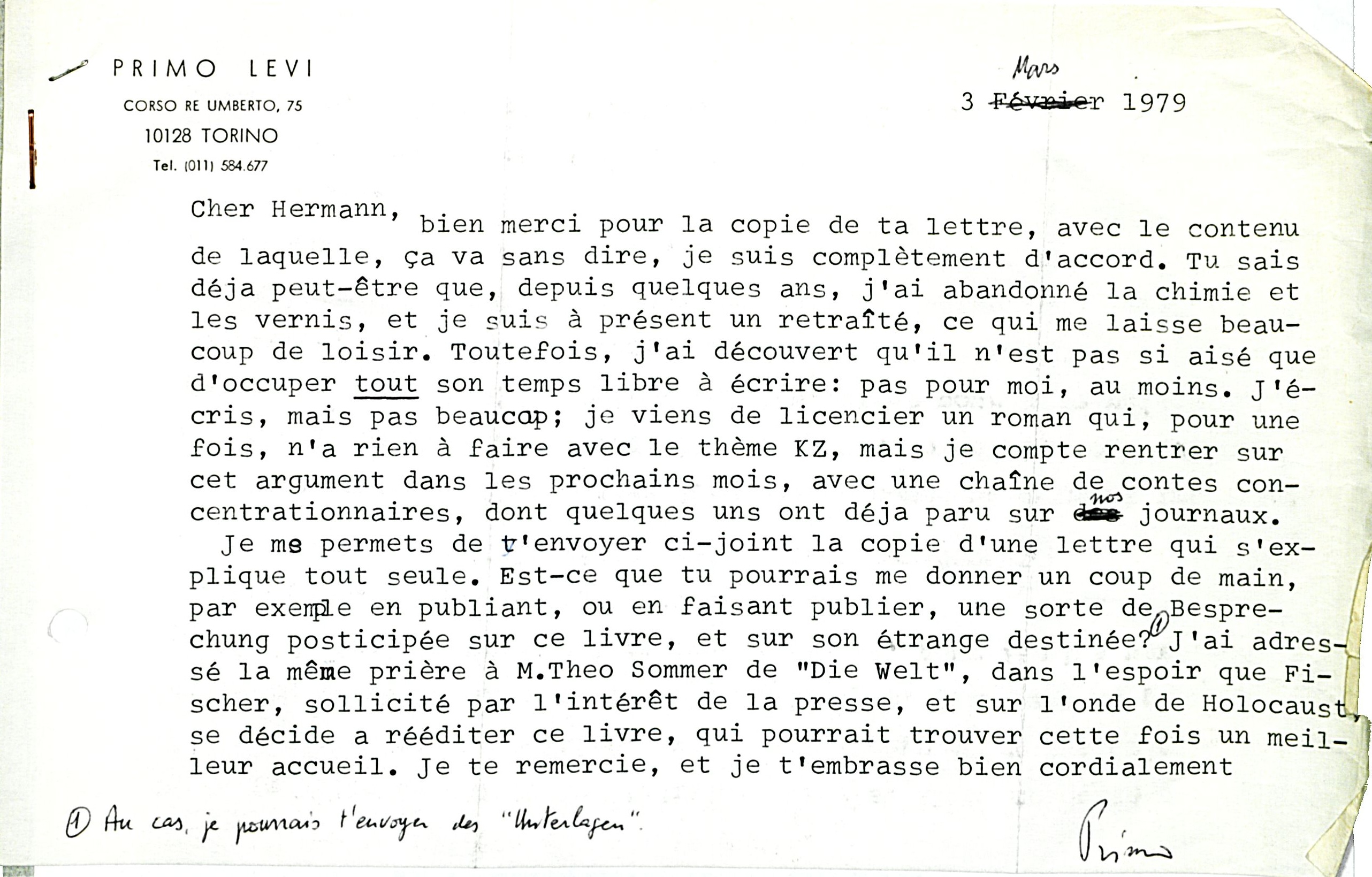
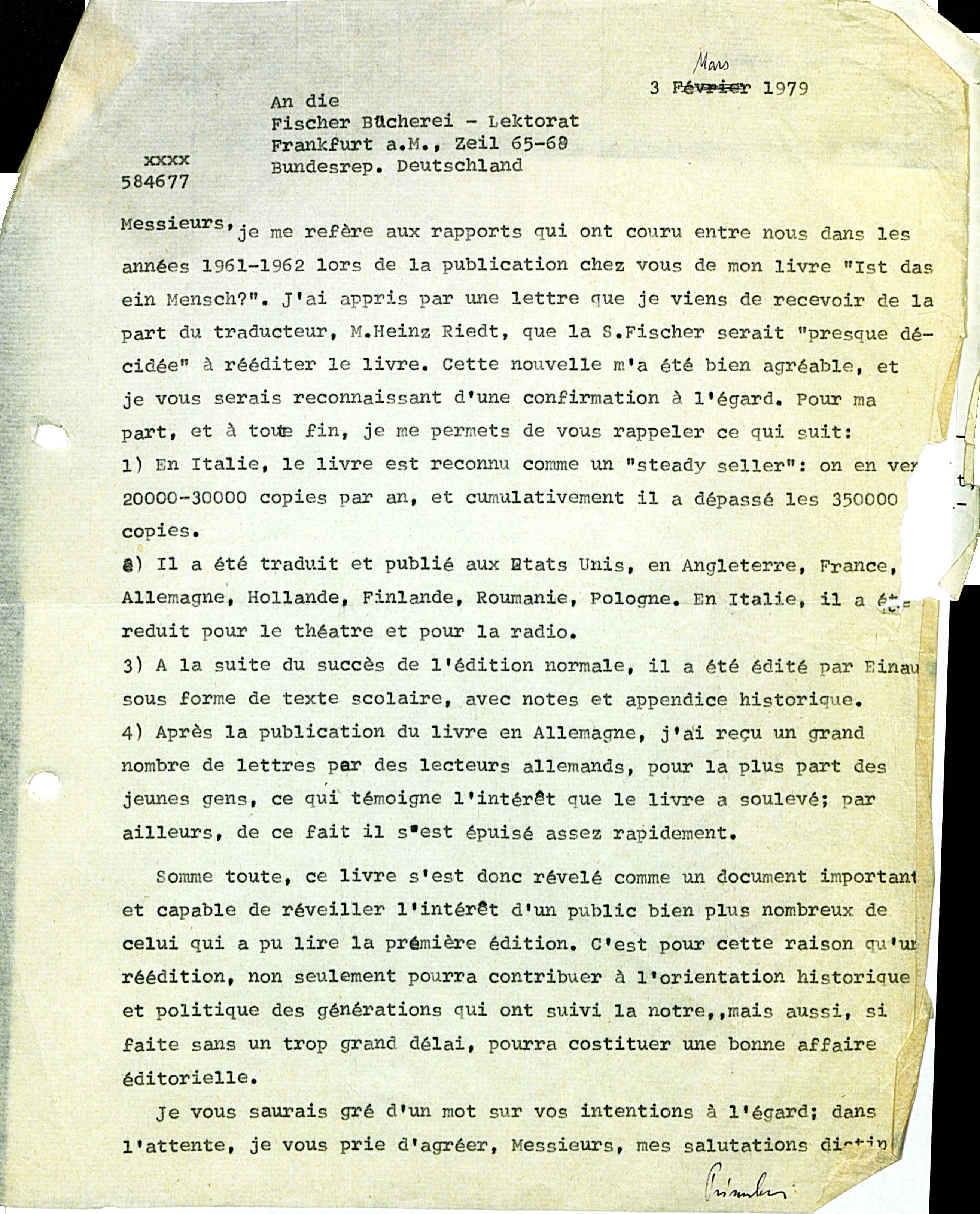
Three years after his last letter, Levi takes advantage of a circular letter by Langbein to get back in touch with his friend; among other things, he asks for his help in convincing Fischer to republish Ist das ein Mensch? (If This Is a Man) in Germany.
bien merci pour la copie de ta lettre,[2] avec le contenu de laquelle, ça va sans dire, je suis complètement d’accord. Tu sais déja peut-être que, depuis quelques ans, j’ai abandonné la chimie et les vernis, et je suis à présent un retraîté, ce qui me laisse beaucoup de loisir. Toutefois, j’ai découvert qu’il n’est pas si aisé que d’occuper tout son temps libre à écrire: pas pour moi, au moins. J’écris, mais pas beaucoup; je viens de licencier un roman qui, pour une fois, n’a rien à faire avec le thème KZ,[3] mais je compte rentrer sur cet argument dans les prochains mois, avec une chaîne de contes concentrationnaires, dont quelques uns ont déja paru sur nos[4] journaux.[5]
Je me permets de t’envoyer ci-joint la copie d’une lettre qui s’explique tout seule.[6] Est-ce que tu pourrais me donner un coup de main, par exemple en publiant, ou en faisant publier, une sorte de Besprechung posticipée sur ce livre, et sur son étrange destinée?[7]J’ai adressé la même prière à M. Theo Sommer de «Die Welt», dans l’espoir que Fischer, sollicité par l’intérêt de la presse, et sur l’onde de Holocaust[8]se décide a rééditer ce livre, qui pourrait trouver cette fois un meilleur accueil. Je te remercie, et je t’embrasse bien cordialement
Primo
3 Mars 1979[9]
An die
Fischer Bücherei – Lektorat
Frankfurt a.M., Zeil 65-60
Bundesrep. Deutschland
Messieurs,
je me refère aux rapports qui ont couru entre nous dans les années 1961-1962 lors de la publication chez vous de mon livre Ist das ein Mensch?. J’ai appris par une lettre que je viens de recevoir de la part du traducteur, M. Heinz Riedt,[10] que la S. Fischer serait «presque décidée» à rééditer le livre. Cette nouvelle m’a été bien agréable, et je vous serais reconnaissant d’une confirmation à l’égard. Pour ma part, et à toute fin, je me permets de vous rappeler ce qui suit:
1) En Italie, le livre est reconnu comme un «steady seller»: on en ve<…>[11] 20000-30000 copies par an, et cumulativement il a dépassé les 350000 copies.
2) Il a été traduit et publié aux Etats Unis, en Angleterre, France, Allemagne, Hollande, Finlande, Roumanie, Pologne.[12] En Italie, il a été reduit pour le théatre et pour la radio.[13]
3) A la suite du succès de l’édition normale, il a été édité par Einaudi sous forme de texte scolaire, avec notes et appendice historique.[14]
4) Après la publication du livre en Allemagne, j’ai reçu un grand nombre de lettres par des lecteurs allemands, pour la plus part des jeunes gens, ce qui témoigne l’intérêt que le livre a soulevé; par ailleurs, de ce fait il s’est épuisé assez rapidement.
Somme toute, ce livre s’est donc révelé comme un document important et capable de réveiller l’intérêt d’un public bien plus nombreux de celui qui a pu lire la prémière édition. C’est pour cette raison qu’une réédition, non seulement pourra contribuer à l’orientation historique et politique des générations qui ont suivi la notre, mais aussi, si faite sans un trop grand délai, pourra costituer une bonne affaire éditorielle.
Je vous saurais gré d’un mot sur vos intentions à l’égard; dans l’attente, je vous prie d’agréer, Messieurs, mes salutations distin<…>
Primo Levi
3 marzo 1979[1]
Caro Hermann,
grazie molte per la copia della tua lettera,[2] con il cui contenuto mi trovo, com’è ovvio, in completo accordo. Forse sai già che da qualche anno ho abbandonato la chimica e le vernici, e adesso sono un pensionato, cosa che mi concede molti momenti di ozio. Sennonché ho scoperto che non è così semplice occupare tutto il tempo libero con la scrittura: almeno, non per me. Scrivo, ma non molto; ho appena dato alle stampe un romanzo che, per una volta, non ha nulla a che fare con il tema dei Lager,[3] ma conto di tornare sull’argomento nei prossimi mesi, con una serie di racconti concentrazionari, alcuni dei quali già pubblicati[4] sui nostri giornali.[5]
Mi permetto di allegare la copia di una lettera che si spiega da sé.[6] Potresti darmi una mano, per esempio pubblicando, o facendo pubblicare, una specie di recensione postuma su questo libro, e sul suo insolito destino?[7]Ho rivolto la stessa richiesta al signor Theo Sommer di «Die Welt», sperando che Fischer, sollecitato dall’interesse della stampa e sull’onda di Holocaust,[8] si decida a ristampare il libro, che potrebbe trovare questa volta un’accoglienza migliore. Ti ringrazio e ti abbraccio con affetto
Primo
3 marzo 1979[9]
Alla
Fischer Bücherei – Redazione
Frankfurt a.M., Zeil 65-60
Bundesrep. Deutschland
Signori,
faccio riferimento ai rapporti fra noi intercorsi negli anni 1961-1962, alla pubblicazione da parte vostra del mio libro Se questo è un uomo. Ho saputo, attraverso una recente lettera del traduttore, il signor Heinz Riedt, [10] che la S. Fischer sarebbe «quasi decisa» a ridare il libro alle stampe. La notizia mi è giunta gradita e vi sarei riconoscente se voleste confermarla. Da parte mia, e ad ogni buon fine, mi permetto di ricordarvi quanto segue:
1) In Italia il libro è considerato uno «steady seller»:[11] 20000-30000 copie all’anno, e nel complesso ha superato le 350000 copie.
2) È stato tradotto e pubblicato negli Stati Uniti, in Inghilterra, Francia, Germania, Olanda, Finlandia, Romania, Polonia.[12] In Italia è stato adattato per il teatro e la radio.[13]
3) In seguito al successo dell’edizione normale, Einaudi l’ha ristampato come testo scolastico, con note e appendice storica.[14]
4) Dopo la pubblicazione del libro in Germania, ho ricevuto un gran numero di lettere da lettori tedeschi, per lo più giovani, a testimonianza dell’interesse che il libro ha sollevato; è per questo motivo, peraltro, che l’edizione si è esaurita velocemente.
Si può concludere, insomma, che il libro si è rivelato un documento importante, in grado di risvegliare l’interesse di un pubblico molto più vasto di quello che ha potuto leggere la prima edizione. È per questo che una ristampa non solo potrà contribuire a formare storicamente e politicamente le generazioni successive alla nostra, ma, se tempestiva, potrà costituire un buon affare editoriale.
Se voleste informarmi delle vostre intenzioni, ve ne sarei grato; per intanto, vi porgo i miei più distinti saluti
Primo Levi
March 3, 1979[1]
Dear Hermann,
Thank you very much for the copy of your letter,[2] whose contents, it goes without saying, I agree with completely. Perhaps you already know that, for a few years now, I have given up chemistry and varnishes, and I am now retired, which leaves me a great deal of leisure. However, I have discovered that it is not so easy to devote all of one’s free time to writing: not for me, at least. I am writing, but not much; I have just completed a novel which, for once, has nothing to do with the theme of the concentration camp,[3]but I plan on returning to this subject matter in the coming months, with a series of concentration camp stories, some of which have already appeared in our[4] newspapers.[5]
I am taking the liberty of enclosing for you here the copy of a letter that is self-explanatory.[6] Could you give me a hand, for instance, by publishing, or by having published, a kind of belated review of this book, and on its strange fate?[7]I made the same request to Mr. Theo Sommer of Die Welt, in the hopes that Fischer, drawn by the interest of the press, and with the Holocaust wave[8], will decide to reprint this book, which could find a better reception this time. With thanks and very fond wishes
Primo
March 3, 1979[9]
To the
Fischer Bücherei – Lektorat
Frankfurt a.M., Zeil 65-60
Bundesrep. Deutschland
Dear Sirs,
I refer to the relations that were in effect between us in the years 1961-1962 during the publication by your press of my book Ist das ein Mensch?. I have learned from a letter that I have just received from the translator, Mr. Heinz Riedt, that the S. Fischer has “almost decided” to reprint the book.[10] I was very pleased at this news, and I would be grateful if you could confirm it. As for me, if helpful, I would like to remind you the following:
1) In Italy, the book is recognized as a “steady seller”:[11] 20,000-30,000 copies are sold per year, and it has sold over 350,000 copies overall.
2) It has been translated and published in the United States, England, France, Germany, Holland, Finland, Romania, and Poland.[12] In Italy, it has been adapted for the theaterand for the radio.[13]
3) Following the success of the regular edition, it was published by Einaudi as a book for schools, with notes and a historical appendix.[14]
4) After the book’s publication in Germany, I received many letters from German readers, most of them young people, which shows the interest the book has inspired; moreover, due to this, it sold out quite rapidly.
Overall, this book has thus turned out to be an important document that can revive the interest of a public that is much larger than the readership of the first edition. For this reason, a new edition will not only be able to contribute to the historical and political guidance of the generations that have followed our own, but could also, if published without too much delay, constitute good business for the publisher.
I would be grateful to hear from you about your intentions on this matter; until then, my very best regards
Primo Levi
3 Mars 1979[1]
Cher Hermann,
bien merci pour la copie de ta lettre,[2] avec le contenu de laquelle, ça va sans dire, je suis complètement d’accord. Tu sais déja peut-être que, depuis quelques ans, j’ai abandonné la chimie et les vernis, et je suis à présent un retraîté, ce qui me laisse beaucoup de loisir. Toutefois, j’ai découvert qu’il n’est pas si aisé que d’occuper tout son temps libre à écrire: pas pour moi, au moins. J’écris, mais pas beaucoup; je viens de licencier un roman qui, pour une fois, n’a rien à faire avec le thème KZ,[3] mais je compte rentrer sur cet argument dans les prochains mois, avec une chaîne de contes concentrationnaires, dont quelques uns ont déja paru sur nos[4] journaux.[5]
Je me permets de t’envoyer ci-joint la copie d’une lettre qui s’explique tout seule.[6] Est-ce que tu pourrais me donner un coup de main, par exemple en publiant, ou en faisant publier, une sorte de Besprechung posticipée sur ce livre, et sur son étrange destinée?[7]J’ai adressé la même prière à M. Theo Sommer de «Die Welt», dans l’espoir que Fischer, sollicité par l’intérêt de la presse, et sur l’onde de Holocaust[8]se décide a rééditer ce livre, qui pourrait trouver cette fois un meilleur accueil. Je te remercie, et je t’embrasse bien cordialement
Primo
3 Mars 1979[9]
An die
Fischer Bücherei – Lektorat
Frankfurt a.M., Zeil 65-60
Bundesrep. Deutschland
Messieurs,
je me refère aux rapports qui ont couru entre nous dans les années 1961-1962 lors de la publication chez vous de mon livre Ist das ein Mensch?. J’ai appris par une lettre que je viens de recevoir de la part du traducteur, M. Heinz Riedt,[10] que la S. Fischer serait «presque décidée» à rééditer le livre. Cette nouvelle m’a été bien agréable, et je vous serais reconnaissant d’une confirmation à l’égard. Pour ma part, et à toute fin, je me permets de vous rappeler ce qui suit:
1) En Italie, le livre est reconnu comme un «steady seller»: on en ve<…>[11] 20000-30000 copies par an, et cumulativement il a dépassé les 350000 copies.
2) Il a été traduit et publié aux Etats Unis, en Angleterre, France, Allemagne, Hollande, Finlande, Roumanie, Pologne.[12] En Italie, il a été reduit pour le théatre et pour la radio.[13]
3) A la suite du succès de l’édition normale, il a été édité par Einaudi sous forme de texte scolaire, avec notes et appendice historique.[14]
4) Après la publication du livre en Allemagne, j’ai reçu un grand nombre de lettres par des lecteurs allemands, pour la plus part des jeunes gens, ce qui témoigne l’intérêt que le livre a soulevé; par ailleurs, de ce fait il s’est épuisé assez rapidement.
Somme toute, ce livre s’est donc révelé comme un document important et capable de réveiller l’intérêt d’un public bien plus nombreux de celui qui a pu lire la prémière édition. C’est pour cette raison qu’une réédition, non seulement pourra contribuer à l’orientation historique et politique des générations qui ont suivi la notre, mais aussi, si faite sans un trop grand délai, pourra costituer une bonne affaire éditorielle.
Je vous saurais gré d’un mot sur vos intentions à l’égard; dans l’attente, je vous prie d’agréer, Messieurs, mes salutations distin<…>
Primo Levi
3 marzo 1979[1]
Caro Hermann,
grazie molte per la copia della tua lettera,[2] con il cui contenuto mi trovo, com’è ovvio, in completo accordo. Forse sai già che da qualche anno ho abbandonato la chimica e le vernici, e adesso sono un pensionato, cosa che mi concede molti momenti di ozio. Sennonché ho scoperto che non è così semplice occupare tutto il tempo libero con la scrittura: almeno, non per me. Scrivo, ma non molto; ho appena dato alle stampe un romanzo che, per una volta, non ha nulla a che fare con il tema dei Lager,[3] ma conto di tornare sull’argomento nei prossimi mesi, con una serie di racconti concentrazionari, alcuni dei quali già pubblicati[4] sui nostri giornali.[5]
Mi permetto di allegare la copia di una lettera che si spiega da sé.[6] Potresti darmi una mano, per esempio pubblicando, o facendo pubblicare, una specie di recensione postuma su questo libro, e sul suo insolito destino?[7]Ho rivolto la stessa richiesta al signor Theo Sommer di «Die Welt», sperando che Fischer, sollecitato dall’interesse della stampa e sull’onda di Holocaust,[8] si decida a ristampare il libro, che potrebbe trovare questa volta un’accoglienza migliore. Ti ringrazio e ti abbraccio con affetto
Primo
3 marzo 1979[9]
Alla
Fischer Bücherei – Redazione
Frankfurt a.M., Zeil 65-60
Bundesrep. Deutschland
Signori,
faccio riferimento ai rapporti fra noi intercorsi negli anni 1961-1962, alla pubblicazione da parte vostra del mio libro Se questo è un uomo. Ho saputo, attraverso una recente lettera del traduttore, il signor Heinz Riedt, [10] che la S. Fischer sarebbe «quasi decisa» a ridare il libro alle stampe. La notizia mi è giunta gradita e vi sarei riconoscente se voleste confermarla. Da parte mia, e ad ogni buon fine, mi permetto di ricordarvi quanto segue:
1) In Italia il libro è considerato uno «steady seller»:[11] 20000-30000 copie all’anno, e nel complesso ha superato le 350000 copie.
2) È stato tradotto e pubblicato negli Stati Uniti, in Inghilterra, Francia, Germania, Olanda, Finlandia, Romania, Polonia.[12] In Italia è stato adattato per il teatro e la radio.[13]
3) In seguito al successo dell’edizione normale, Einaudi l’ha ristampato come testo scolastico, con note e appendice storica.[14]
4) Dopo la pubblicazione del libro in Germania, ho ricevuto un gran numero di lettere da lettori tedeschi, per lo più giovani, a testimonianza dell’interesse che il libro ha sollevato; è per questo motivo, peraltro, che l’edizione si è esaurita velocemente.
Si può concludere, insomma, che il libro si è rivelato un documento importante, in grado di risvegliare l’interesse di un pubblico molto più vasto di quello che ha potuto leggere la prima edizione. È per questo che una ristampa non solo potrà contribuire a formare storicamente e politicamente le generazioni successive alla nostra, ma, se tempestiva, potrà costituire un buon affare editoriale.
Se voleste informarmi delle vostre intenzioni, ve ne sarei grato; per intanto, vi porgo i miei più distinti saluti
Primo Levi
March 3, 1979[1]
Dear Hermann,
Thank you very much for the copy of your letter,[2] whose contents, it goes without saying, I agree with completely. Perhaps you already know that, for a few years now, I have given up chemistry and varnishes, and I am now retired, which leaves me a great deal of leisure. However, I have discovered that it is not so easy to devote all of one’s free time to writing: not for me, at least. I am writing, but not much; I have just completed a novel which, for once, has nothing to do with the theme of the concentration camp,[3]but I plan on returning to this subject matter in the coming months, with a series of concentration camp stories, some of which have already appeared in our[4] newspapers.[5]
I am taking the liberty of enclosing for you here the copy of a letter that is self-explanatory.[6] Could you give me a hand, for instance, by publishing, or by having published, a kind of belated review of this book, and on its strange fate?[7]I made the same request to Mr. Theo Sommer of Die Welt, in the hopes that Fischer, drawn by the interest of the press, and with the Holocaust wave[8], will decide to reprint this book, which could find a better reception this time. With thanks and very fond wishes
Primo
March 3, 1979[9]
To the
Fischer Bücherei – Lektorat
Frankfurt a.M., Zeil 65-60
Bundesrep. Deutschland
Dear Sirs,
I refer to the relations that were in effect between us in the years 1961-1962 during the publication by your press of my book Ist das ein Mensch?. I have learned from a letter that I have just received from the translator, Mr. Heinz Riedt, that the S. Fischer has “almost decided” to reprint the book.[10] I was very pleased at this news, and I would be grateful if you could confirm it. As for me, if helpful, I would like to remind you the following:
1) In Italy, the book is recognized as a “steady seller”:[11] 20,000-30,000 copies are sold per year, and it has sold over 350,000 copies overall.
2) It has been translated and published in the United States, England, France, Germany, Holland, Finland, Romania, and Poland.[12] In Italy, it has been adapted for the theaterand for the radio.[13]
3) Following the success of the regular edition, it was published by Einaudi as a book for schools, with notes and a historical appendix.[14]
4) After the book’s publication in Germany, I received many letters from German readers, most of them young people, which shows the interest the book has inspired; moreover, due to this, it sold out quite rapidly.
Overall, this book has thus turned out to be an important document that can revive the interest of a public that is much larger than the readership of the first edition. For this reason, a new edition will not only be able to contribute to the historical and political guidance of the generations that have followed our own, but could also, if published without too much delay, constitute good business for the publisher.
I would be grateful to hear from you about your intentions on this matter; until then, my very best regards
Primo Levi
Info
Notes
Tag
Sender: Primo Levi
Addressee: Hermann Langbein
Date of Drafting: 1979-03-03
Place of Writing: Turin
Description: typewritten letter on letterhead paper, handwritten signature and insertions in black ballpoint pen, mm225x140.
Enclosures: carbon copy on onionskin paper of typewritten letter with handwritten signature and insertions in black ballpoint pen, dated 3 March, 1979 and sent by Primo Levi to the Fischer publishing house (Österreichisches Staatsarchiv, Vienna, Langbein E/1797: Schwarze Ordner “Deutschland”, 101 Italien).
Letterhead: PRIMO LEVI | CORSO RE UMBERTO 75 | 10128 TORINO | Tel. (011) 584.677
DOI: https://doi.org/10.15160/e4zy-bp70
1
A handwritten correction by Levi in black ballpoint pen changes “Février” to “Mars.”
2
Levi refers to the circular letter Langbein sent to all the authors of the anthology; cf. the relative Box.
3
The reference is to La chiave a stella (The Wrench), which had been published the year before by Einaudi.
4
A handwritten correction by Levi changes “des” to “nos.”
5
This is the short story collection Lilìth e altri racconti (Lilith), which was published in 1981 and is divided into three sections: Passato prossimo (Present Perfect), Presente indicativo (Present Indicative), and Futuro anteriore (Future Anterior). The first section contains short stories about the concentration camp, while the other two contain fantasy short stories along the lines of those in Storie naturali (Natural Histories, 1966) and Vizio di forma (Flaw of Form, 1971).
6
A letter written by Levi to the publishing company Fischer dated March 3, 1979, cf. enclosure.
7
After “destinée” (“fate”), a “l,” circled by hand in black ballpoint pen by Levi, refers to a note (again, handwritten by Levi in black ink) in the lower margin of the sheet of paper: (“1 Au cas, je pourrais t’envoyer des ‘Unterlagen,’”, “In case, I could send you some documents”).
8
Holocaust, the TV miniseries directed in 1978 by Marvin J. Chomsky, starring Meryl Streep and James Woods, was broadcast in the United States in April 1978; it was broadcast in Italy the following year, between May 20 and early July, 1979, on Rai 1 in six episodes. It was also broadcast in 1979 in West Germany (January) and Austria (March). For more information concerning Levi’s remarks about the series and the debate it sparked in Germany, cf. the dedicated Box.
9
The date’s month is corrected by hand in black ballpoint pen by Levi; “Février” can be read beneath the correction.
10
Riedt’s letter, not yet published, is dated January 29, 1979 and can be found here. Riedt writes: “Proprio ieri – che combinazione – ho avuto anche una telefonata con la S. Fischer che sembra decisa, come da tempo io sollecito, di fare una ristampa di Se questo e non più tascabile, ma in hardcover.” (“Just yesterday – what a coincidence – I also talked on the phone with S. Fischer, which seems to have decided, as I have long urged them, to make a reprint of Se questo, and not in paperback but as a hardcover book.”)
11
There is a gap due to a rip in the piece of paper: probably “vendues” (“sold”).
12
In the order in which Levi mentions them: Survival in Auschwitz, the Nazi Assault on Humanity, tr. by Stuart Woolf, New York: Collier Book, 1961; If This Is a Man, tr. by Stuart Woolf, Florence: The Orion Press, 1959; J’étais un homme, tr. by Michèle Causse, Paris: Éditions Buchet-Chastel, 1961; Ist das ein Mensch?, tr. by Heinz Riedt, Frankfurt a.M.: Fischer, 1961; Eens was ik een mens, tr. by M.I. Borel, Amsterdam: Arbeiderspers, 1963; Tällainenko on ihminen, tr. by Hiisivaara, Tapio, Jyväskylä: Gummerus, 1962; Mai e acesta oare un om?, tr. by Doina Condrea-Derer, Bucharest: Univers, 1974; Czy to jest człowiek, tr. by Halszka Wiśniowska, Cracow: Wydawnictwo Literackie, 1978.
13
The radio adaptation of Se questo è un uomo (If This Is a Man) was broadcast on RAI on April 24, 1964 (OC I, pp. 1261-9). The theatrical version, directed by Pieralberto Marché, was staged in 1966 and published by Einaudi that same year as no. 99 of the series “Collezione di teatro” (OC I, pp. 1195-1260).
14
The edition for schools of Se questo è un uomo (If This Is a Man) was published in 1972 by Einaudi, with annotations and a preface by Levi himself (they can be read in OC I, pp. 1407-2). In 1976, it was republished with a long Appendice (Appendix) that included questions the students asked Levi most often during the dozens of encounters in schools in which he had participated up until then (OC I, pp. 279-304).