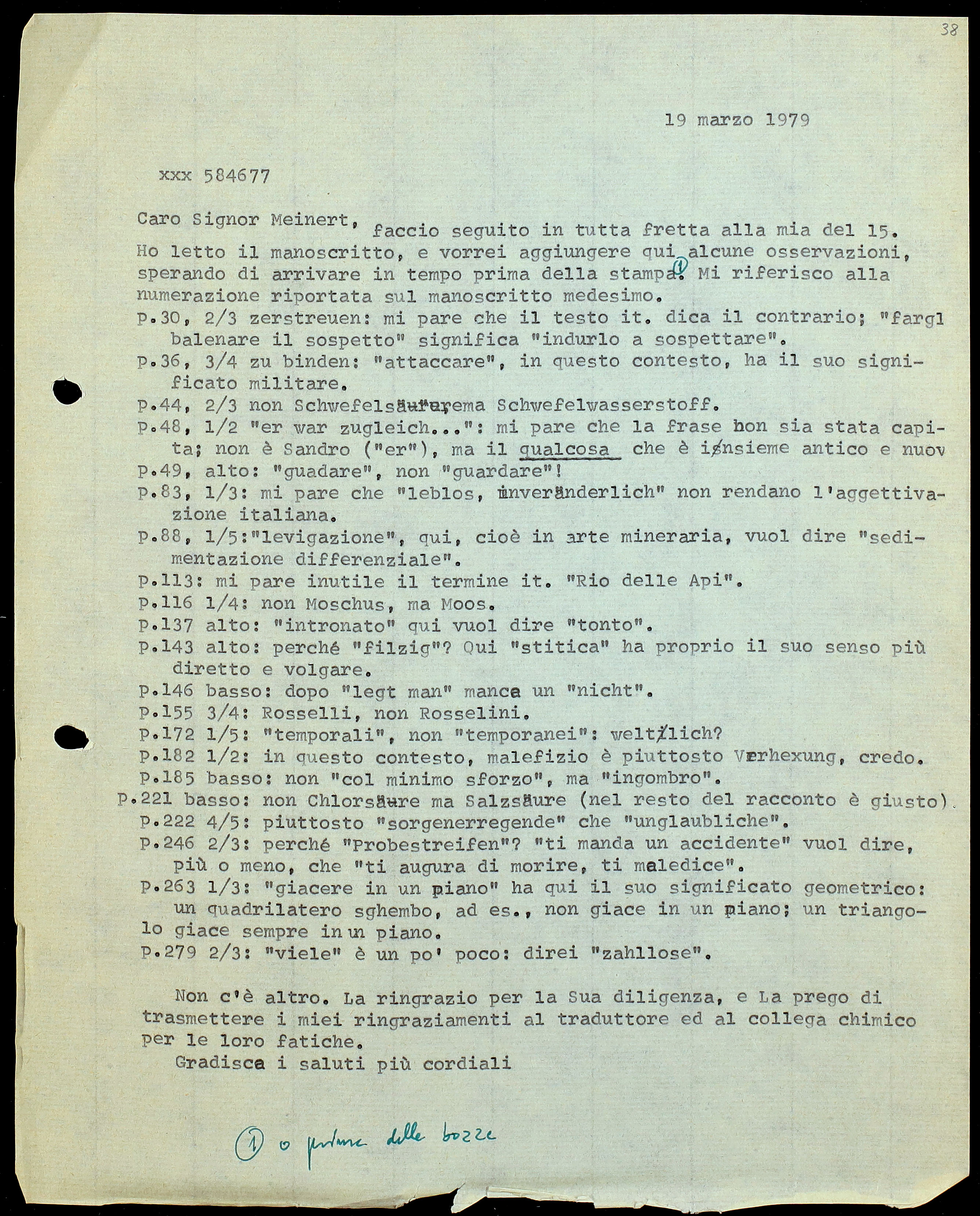
Primo Levi writes to Meinert by return post with a series of additional observations regarding the translation of The Periodic Table.
19 marzo 1979
XXX 584677
Caro Signor Meinert,
faccio seguito in tutta fretta alla mia del 15.
Ho letto il manoscritto, e vorrei aggiungere qui alcune osservazioni, sperando di arrivare in tempo prima della stampa![1] Mi riferisco alla numerazione riportata sul manoscritto medesimo.
p. 30, 2/3 zerstreuen: mi pare che il testo italiano dica il contrario; «fargli balenare il sospetto» significa «indurlo a sospettare».[2]
p. 36, 3/4 zu binden: «attaccare», in questo contesto, ha il suo significato militare.[3]
p. 44, 2/3 non Schwefelsaure ma Schwefelwasserstoff.[4]
p. 48, 1/2 «er war zugleich…»: mi pare che la frase non sia stata capita; non è Sandro («er»), ma il qualcosa che è insieme antico e nuovo.[5]
p. 49, alto: «guadare», non «guardare»!
p. 83, 1/3: mi pare che «leblos, unveränderlich» non rendano l’aggettivazione italiana.[6]
p. 88, 1/5: «levigazione», qui, cioè in arte mineraria, vuol dire «sedimentazione differenziale».[7]
p. 113: mi pare inutile il termine italiano «Rio delle Api».[8]
p. 116 1/4: non Moschus, ma Moos.[9]
p. 137 alto: «intronato» qui vuol dire «tonto».[10]
p. 143 alto: perché «filzig»? Qui «stitica» ha proprio il suo senso più diretto e volgare.[11]
p. 146 basso: dopo «legt man» manca un «nicht».[12]
p. 155 3/4: Rosselli, non Rosselini.[13]
p. 172 1/5: «temporali», non «temporanei»: weltlich?[14]
p. 182 1/2: in questo contesto, malefizio è piuttosto Verhexung, credo.[15]
p. 185 basso: non «col minimo sforzo», ma «ingombro».[16]
p. 221 basso: non Chlorsäure ma Salzsäure (nel resto del racconto è giusto).[17]
p. 222 4/5: piuttosto «sorgenerregende» che «unglaubliche».[18]
p. 246 2/3: perché «Probestreifen»? «ti manda un accidente» vuol dire, più o meno, che «ti augura di morire, ti maledice».[19]
p. 263 1/3: «giacere in un piano» ha qui il suo significato geometrico: un quadrilatero sghembo, ad esempio, non giace in un piano; un triangolo giace sempre in piano.[20]
p. 279 2/3: «viele» è un po’ poco: direi «zahllose».[21]
Non c’è altro. La ringrazio per la sua diligenza, e La prego di trasmettere i miei ringraziamenti al traduttore ed al collega chimico per le loro fatiche.
Gradisca i saluti più cordiali
19 marzo 1979
XXX 584677
Caro Signor Meinert,
faccio seguito in tutta fretta alla mia del 15.
Ho letto il manoscritto, e vorrei aggiungere qui alcune osservazioni, sperando di arrivare in tempo prima della stampa![1] Mi riferisco alla numerazione riportata sul manoscritto medesimo.
p. 30, 2/3 zerstreuen: mi pare che il testo italiano dica il contrario; «fargli balenare il sospetto» significa «indurlo a sospettare».[2]
p. 36, 3/4 zu binden: «attaccare», in questo contesto, ha il suo significato militare.[3]
p. 44, 2/3 non Schwefelsaure ma Schwefelwasserstoff.[4]
p. 48, 1/2 «er war zugleich…»: mi pare che la frase non sia stata capita; non è Sandro («er»), ma il qualcosa che è insieme antico e nuovo.[5]
p. 49, alto: «guadare», non «guardare»!
p. 83, 1/3: mi pare che «leblos, unveränderlich» non rendano l’aggettivazione italiana.[6]
p. 88, 1/5: «levigazione», qui, cioè in arte mineraria, vuol dire «sedimentazione differenziale».[7]
p. 113: mi pare inutile il termine italiano «Rio delle Api».[8]
p. 116 1/4: non Moschus, ma Moos.[9]
p. 137 alto: «intronato» qui vuol dire «tonto».[10]
p. 143 alto: perché «filzig»? Qui «stitica» ha proprio il suo senso più diretto e volgare.[11]
p. 146 basso: dopo «legt man» manca un «nicht».[12]
p. 155 3/4: Rosselli, non Rosselini.[13]
p. 172 1/5: «temporali», non «temporanei»: weltlich?[14]
p. 182 1/2: in questo contesto, malefizio è piuttosto Verhexung, credo.[15]
p. 185 basso: non «col minimo sforzo», ma «ingombro».[16]
p. 221 basso: non Chlorsäure ma Salzsäure (nel resto del racconto è giusto).[17]
p. 222 4/5: piuttosto «sorgenerregende» che «unglaubliche».[18]
p. 246 2/3: perché «Probestreifen»? «ti manda un accidente» vuol dire, più o meno, che «ti augura di morire, ti maledice».[19]
p. 263 1/3: «giacere in un piano» ha qui il suo significato geometrico: un quadrilatero sghembo, ad esempio, non giace in un piano; un triangolo giace sempre in piano.[20]
p. 279 2/3: «viele» è un po’ poco: direi «zahllose».[21]
Non c’è altro. La ringrazio per la sua diligenza, e La prego di trasmettere i miei ringraziamenti al traduttore ed al collega chimico per le loro fatiche.
Gradisca i saluti più cordiali
March 19, 1979
XXX 584677
Dear Mr. Meinert,
A quick follow-up to my letter dated March 15.
I have read the manuscript and I would like to add a few observations, in the hope that they arrive in time, before it goes to print![1] I am referring to the numbering on the manuscript itself.
p. 30, 2/3 zerstreuen: it seems to me that the Italian text says the opposite; “fargli balenare il sospetto” means “to cause him to suspect.”[2]
p. 36, 3/4 zu binden: “attack,” in this context, is used in the military sense.[3]
p. 44, 2/3 not Schwefelsaure but Schwefelwasserstoff.[4]
p. 48, 1/2 “er war zugleich…”: it seems to me that the phrase was misunderstood; it is not Sandro (“er”), but something that is both ancient and new.[5]
p. 49, top: “guadare” (“to ford”), not “guardare! (“to look”)!
p. 83, 1/3: it seems to me that “leblos, unveränderlich” do not render the Italian adjectivization.[6]
p. 88, 1/5: “grinding,” here, in mining terminology, means “differential sedimentation.” [7]
p. 113: the Italian term “Rio delle Api” strikes me as useless.[8]
p. 116 1/4: not Moschus, but Moos.[9]
p. 137, top: here, “intronato” means “stupid.”[10]
p. 143, top: why “filzig”? Here, “stitica” (“constipated”) has exactly its most direct and vulgar meaning.[11]
p. 146, bottom: a “nicht” is missing after “legt man.”[12]
p. 155 3/4: Rosselli, not Rosselini.[13]
p. 172 1/5: “temporali (“temporal”), not “temporanei” (“temporary”): weltlich?[14]
p. 182 1/2: in this context, I believe that “malefizio” (“evil spell”) is, rather, Verhexung.[15]
p. 185, bottom: not “col minimo sforzo” (“with the least effort”) but “ingombro” (“mass”).[16]
p. 221, bottom: not Chlorsäure but Salzsäure (in the rest of the short story it is correct).[17]
p. 222 4/5: better “sorgenerregende” than “unglaubliche.”[18]
p. 246 2/3: why “Probestreifen”? “ti manda un accidente” means, more or less, “he hopes you die; he curses you.”[19]
p. 263 1/3: here, “giacere in un piano” (“to lie on a flat surface”) is in the geometrical sense: for example, a crooked quadrilateral does not lie flat; a triangle always lies flat.[20]
p. 279 2/3: “viele” (“many”) is not enough: I’d say “zahllose” (“numberless”).[21]
That is all. I thank you for your diligence and I ask you to convey my thanks to the translator and to my chemist colleague for their efforts.
Please accept my most cordial greetings
19 marzo 1979
XXX 584677
Caro Signor Meinert,
faccio seguito in tutta fretta alla mia del 15.
Ho letto il manoscritto, e vorrei aggiungere qui alcune osservazioni, sperando di arrivare in tempo prima della stampa![1] Mi riferisco alla numerazione riportata sul manoscritto medesimo.
p. 30, 2/3 zerstreuen: mi pare che il testo italiano dica il contrario; «fargli balenare il sospetto» significa «indurlo a sospettare».[2]
p. 36, 3/4 zu binden: «attaccare», in questo contesto, ha il suo significato militare.[3]
p. 44, 2/3 non Schwefelsaure ma Schwefelwasserstoff.[4]
p. 48, 1/2 «er war zugleich…»: mi pare che la frase non sia stata capita; non è Sandro («er»), ma il qualcosa che è insieme antico e nuovo.[5]
p. 49, alto: «guadare», non «guardare»!
p. 83, 1/3: mi pare che «leblos, unveränderlich» non rendano l’aggettivazione italiana.[6]
p. 88, 1/5: «levigazione», qui, cioè in arte mineraria, vuol dire «sedimentazione differenziale».[7]
p. 113: mi pare inutile il termine italiano «Rio delle Api».[8]
p. 116 1/4: non Moschus, ma Moos.[9]
p. 137 alto: «intronato» qui vuol dire «tonto».[10]
p. 143 alto: perché «filzig»? Qui «stitica» ha proprio il suo senso più diretto e volgare.[11]
p. 146 basso: dopo «legt man» manca un «nicht».[12]
p. 155 3/4: Rosselli, non Rosselini.[13]
p. 172 1/5: «temporali», non «temporanei»: weltlich?[14]
p. 182 1/2: in questo contesto, malefizio è piuttosto Verhexung, credo.[15]
p. 185 basso: non «col minimo sforzo», ma «ingombro».[16]
p. 221 basso: non Chlorsäure ma Salzsäure (nel resto del racconto è giusto).[17]
p. 222 4/5: piuttosto «sorgenerregende» che «unglaubliche».[18]
p. 246 2/3: perché «Probestreifen»? «ti manda un accidente» vuol dire, più o meno, che «ti augura di morire, ti maledice».[19]
p. 263 1/3: «giacere in un piano» ha qui il suo significato geometrico: un quadrilatero sghembo, ad esempio, non giace in un piano; un triangolo giace sempre in piano.[20]
p. 279 2/3: «viele» è un po’ poco: direi «zahllose».[21]
Non c’è altro. La ringrazio per la sua diligenza, e La prego di trasmettere i miei ringraziamenti al traduttore ed al collega chimico per le loro fatiche.
Gradisca i saluti più cordiali
19 marzo 1979
XXX 584677
Caro Signor Meinert,
faccio seguito in tutta fretta alla mia del 15.
Ho letto il manoscritto, e vorrei aggiungere qui alcune osservazioni, sperando di arrivare in tempo prima della stampa![1] Mi riferisco alla numerazione riportata sul manoscritto medesimo.
p. 30, 2/3 zerstreuen: mi pare che il testo italiano dica il contrario; «fargli balenare il sospetto» significa «indurlo a sospettare».[2]
p. 36, 3/4 zu binden: «attaccare», in questo contesto, ha il suo significato militare.[3]
p. 44, 2/3 non Schwefelsaure ma Schwefelwasserstoff.[4]
p. 48, 1/2 «er war zugleich…»: mi pare che la frase non sia stata capita; non è Sandro («er»), ma il qualcosa che è insieme antico e nuovo.[5]
p. 49, alto: «guadare», non «guardare»!
p. 83, 1/3: mi pare che «leblos, unveränderlich» non rendano l’aggettivazione italiana.[6]
p. 88, 1/5: «levigazione», qui, cioè in arte mineraria, vuol dire «sedimentazione differenziale».[7]
p. 113: mi pare inutile il termine italiano «Rio delle Api».[8]
p. 116 1/4: non Moschus, ma Moos.[9]
p. 137 alto: «intronato» qui vuol dire «tonto».[10]
p. 143 alto: perché «filzig»? Qui «stitica» ha proprio il suo senso più diretto e volgare.[11]
p. 146 basso: dopo «legt man» manca un «nicht».[12]
p. 155 3/4: Rosselli, non Rosselini.[13]
p. 172 1/5: «temporali», non «temporanei»: weltlich?[14]
p. 182 1/2: in questo contesto, malefizio è piuttosto Verhexung, credo.[15]
p. 185 basso: non «col minimo sforzo», ma «ingombro».[16]
p. 221 basso: non Chlorsäure ma Salzsäure (nel resto del racconto è giusto).[17]
p. 222 4/5: piuttosto «sorgenerregende» che «unglaubliche».[18]
p. 246 2/3: perché «Probestreifen»? «ti manda un accidente» vuol dire, più o meno, che «ti augura di morire, ti maledice».[19]
p. 263 1/3: «giacere in un piano» ha qui il suo significato geometrico: un quadrilatero sghembo, ad esempio, non giace in un piano; un triangolo giace sempre in piano.[20]
p. 279 2/3: «viele» è un po’ poco: direi «zahllose».[21]
Non c’è altro. La ringrazio per la sua diligenza, e La prego di trasmettere i miei ringraziamenti al traduttore ed al collega chimico per le loro fatiche.
Gradisca i saluti più cordiali
March 19, 1979
XXX 584677
Dear Mr. Meinert,
A quick follow-up to my letter dated March 15.
I have read the manuscript and I would like to add a few observations, in the hope that they arrive in time, before it goes to print![1] I am referring to the numbering on the manuscript itself.
p. 30, 2/3 zerstreuen: it seems to me that the Italian text says the opposite; “fargli balenare il sospetto” means “to cause him to suspect.”[2]
p. 36, 3/4 zu binden: “attack,” in this context, is used in the military sense.[3]
p. 44, 2/3 not Schwefelsaure but Schwefelwasserstoff.[4]
p. 48, 1/2 “er war zugleich…”: it seems to me that the phrase was misunderstood; it is not Sandro (“er”), but something that is both ancient and new.[5]
p. 49, top: “guadare” (“to ford”), not “guardare! (“to look”)!
p. 83, 1/3: it seems to me that “leblos, unveränderlich” do not render the Italian adjectivization.[6]
p. 88, 1/5: “grinding,” here, in mining terminology, means “differential sedimentation.” [7]
p. 113: the Italian term “Rio delle Api” strikes me as useless.[8]
p. 116 1/4: not Moschus, but Moos.[9]
p. 137, top: here, “intronato” means “stupid.”[10]
p. 143, top: why “filzig”? Here, “stitica” (“constipated”) has exactly its most direct and vulgar meaning.[11]
p. 146, bottom: a “nicht” is missing after “legt man.”[12]
p. 155 3/4: Rosselli, not Rosselini.[13]
p. 172 1/5: “temporali (“temporal”), not “temporanei” (“temporary”): weltlich?[14]
p. 182 1/2: in this context, I believe that “malefizio” (“evil spell”) is, rather, Verhexung.[15]
p. 185, bottom: not “col minimo sforzo” (“with the least effort”) but “ingombro” (“mass”).[16]
p. 221, bottom: not Chlorsäure but Salzsäure (in the rest of the short story it is correct).[17]
p. 222 4/5: better “sorgenerregende” than “unglaubliche.”[18]
p. 246 2/3: why “Probestreifen”? “ti manda un accidente” means, more or less, “he hopes you die; he curses you.”[19]
p. 263 1/3: here, “giacere in un piano” (“to lie on a flat surface”) is in the geometrical sense: for example, a crooked quadrilateral does not lie flat; a triangle always lies flat.[20]
p. 279 2/3: “viele” (“many”) is not enough: I’d say “zahllose” (“numberless”).[21]
That is all. I thank you for your diligence and I ask you to convey my thanks to the translator and to my chemist colleague for their efforts.
Please accept my most cordial greetings
Info
Notes
Tag
Sender: Primo Levi
Addressee: Joachim Meinert
Date of Drafting: 1979-03-19
Place of Writing: Turin
Description: carbon copy on onionskin paper of a typewritten letter
1
Levi inserts a “1” with a circle around it, written by hand in light blue ballpoint pen, which refers to a note at the foot of the letter: “o prima delle bozze” (“or before the proofs”).
2
“zerstreuen” means “to dissolve;” Levi is referring to a passage in “Hydrogen” that recounts a chemical experiment he conducted at home when he was in high school (CW II pp. 774-5).
3
“zu binden” means “attaccare” (“attack”) but here “attaccare” means “attach, bind together;” the context is a university laboratory experiment in the short story “Zinc” (CW II, p. 779).
4
“Schwefelsaure” is sulfuric acid, whereas in the text of “Iron” that Levi recalls here, what is mentioned is sulfidic acid, “Schwefelwasserstoff” (OC I, p. 889); Levi also adds a note on this point in the 1979 Italian school edition of The Periodic Table (OC I, p. 1425).
5
er war zugleich…” that is, “it was both…” We are still in “Iron,” at the point where Levi describes the effect that his philosophical musings about chemistry had on Sandro (CW II, p. 787).
6
“leblos, unveränderlich” means lifeless, unchangeable. Levi might be referring to the following passage in “Nickel”: “Quantitative analysis, so stingy with emotions, as heavy as granite, became lively, true, and useful when inserted in a serious and concrete job” (CW II, p. 812).
7
The context is still the short story “Nickel,” set in the asbestos mines in the Lanzo Valleys, where Levi worked in 1941 after graduating (CW II, p. 815).
8
In “Lead,” “River of the Bees” is translated as “Bak der Binnen,” the name that the protagonist Rodmund, in uncertain German, assigns to the village he founded on the island of Ichnusa/Sardegna (CW II, p. 830 and OC I, p. 1431 for the relative note Levi wrote for the Italian school edition published in 1979). The correct spelling should be “Bach der Bienen,” as Edith Plackmeyer points out in her translation: “Bak der Binnen, was ‘Bach der Bienen.’” Cf. P. Levi, Das periodische System, p. 109.
9
On the imaginary island of Desolation, where the story of “Mercury” plays out, the water tastes like moss, “Moos” (CW II, p. 832); in turn, “Moschus” indicates a secretion of animal origin.
10
The adjective refers to Ambrogio, one of the colleagues at the Milanese pharmaceutical company that provides the backdrop for the short story “Phosphorus” (CW II p. 845).
11
“filzig” means “felted;” in “Phosphorus,” Levi uses the adjective “constipated” with regard to Signorina Paglietta, the librarian at the Milanese pharmaceutical company where the young chemist goes to work during the summer of 1942 (CW II p. 849).
12
Levi is referring to a passage in “Phosphorus” about the laboratory rabbits used for testing pharmaceutical compounds: “if you don’t put in the spindle [legt man das Holz nicht], the rabbit cuts the tube with its teeth, swallows it, and dies (CW II, p. 852).
13
The name of the Rosselli brothers is mentioned in the short story “Gold” along with that of other figures associated with the founding and ideology of the Action Party (CW II, p. 858).
14
The “temporal advantages” are those that, in “Cerium,” can derive from the mutual friendship between Levi and Alberto (CW II, p. 869).
15
“malefizi” is Levi’s translation of the “ghastly tale” recounted outside the church by Coleridge’s Ancient Mariner, evoked in “Chromium” (CW II, p. 876) and in many other places in his oeuvre as his literary double.
16
In “Chromium,” Levi reflects on the positive effect that his encounter with his future wife had on his writing (CW II, p. 878).
17
“Chlorsäure” is chloric acid, whereas in the passage in “Tin” that Levi indicates, as in the rest of the short story, he talks of hydrochloric acid, “Salzsäure” (CW II, pp. 904-5).
18
“Unglaubliche” means incredible, unheard of; in turn, in “Tin,” Levi uses the adjective “alarming” (“sorgenerregende”) to describe the “eagerness for experiment” of Emilio’s father, the coprotagonist of the short story. In the end, the translator opted for “beängstigende,” cf. page 1979.
19
“Probestreifen” means “test strip.” The phrase in question can be found in “Silver”: “But you have to remember that, if film malfunctions for amateurs, nine times out of ten the user thinks it’s his fault; or, if not, at worst he’ll curse you out in a letter, which doesn’t arrive because the address was incomplete” (CW II, p. 922). The translator did not grasp the figurative meaning of “ti manda qualche accidente,” (“curse you out”) and interpreted the passage in a technical sense.
20
The metaphor is used in “Vanadium” to introduce the letter from Lothar Müller (CW II, p. 933).
21
“viel” means “many;” in “Carbon,” Levi uses the adjective “innumerable,” “zahllos” (CW II, p. 945).