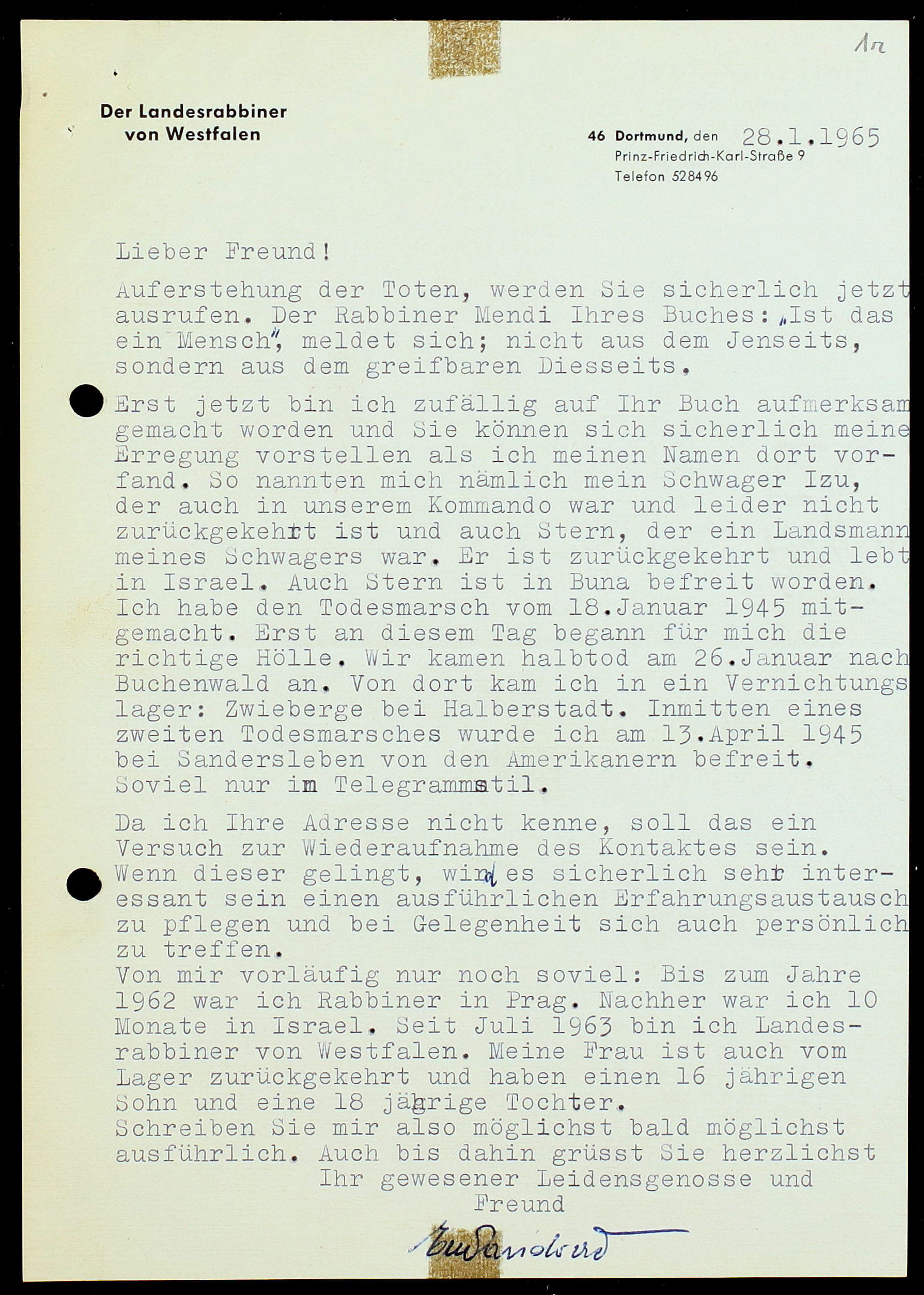
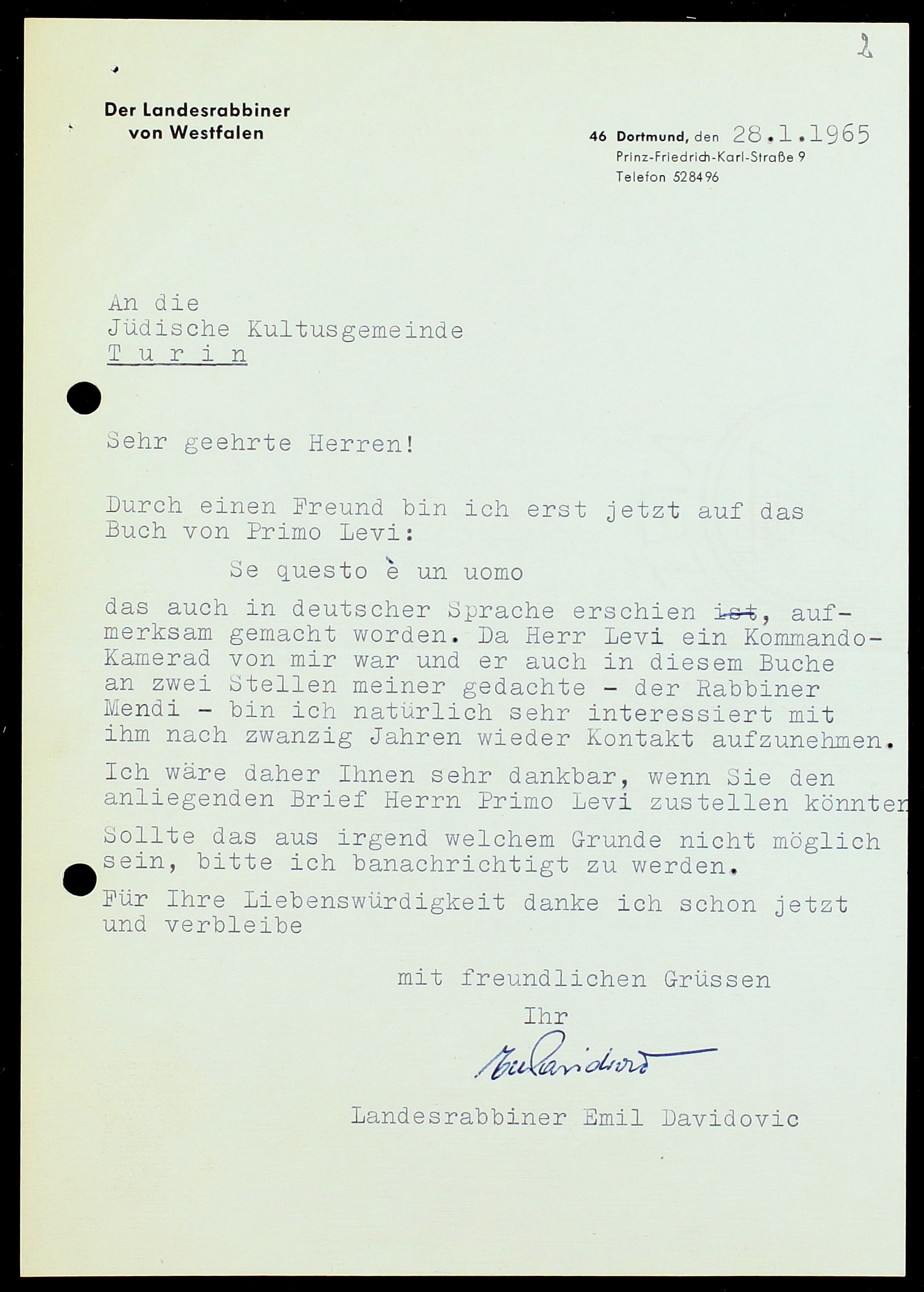
After reading Ist das ein Mensch? and recognizing himself in the figure of the rabbi Mendi, Davidovic tries to re-establish contact with Levi and sends this letter to the Jewish Community of Turin.
28.1.1965
Lieber Freund!
Auferstehung der Toten, werden Sie sicherlich jetzt ausrufen. Der Rabbiner Mendi Ihres Buches:[1]Ist das ein Mensch, meldet sich; nicht aus dem Jenseits, sondern aus dem greifbaren Diesseits.
Erst jetzt bin ich zufällig auf Ihr Buch aufmerksam gemacht worden und Sie können sich sicherlich meine Erregung vorstellen als ich meinen Namen dort vorfand. So nannten mich nämlich mein Schwager Izu, der auch in unserem Kommando war und leider nicht zurückgekehrt ist und auch Stern, der ein Landsmann meines Schwagers war. Er ist zurückgekehrt und lebt in Israel. Auch Stern ist in Buna befreit worden.[2]
Ich habe den Todesmarsch vom 18. Januar 1945 mitgemacht. Erst an diesem Tag begann für mich die richtige Hölle. Wir kamen halbtod am 26. Januar nach Buchenwald an. Von dort kam ich in ein Vernichtungslager: Zwieberge bei Halberstadt. Inmitten eines zweiten Todesmarsches wurde ich am 13. April 1945 bei Sandersleben von den Amerikanern befreit. Soviel nur im Telegrammstil.
Da ich Ihre Adresse nicht kenne, soll das ein Versuch zur Wiederaufnahme des Kontaktes sein.
Wenn dieser gelingt, wird es sicherlich sehr interessant sein einen ausführlichen Erfahrungsaustausch zu pflegen und bei Gelegenheit sich auch persönlich zu treffen.
Von mir vorläufig nur noch soviel: Bis zum Jahre 1962 war ich Rabbiner in Prag. Nachher war ich 10 Monate in Israel. Seit Juli 1963 bin ich Landesrabbiner von Westfalen. Meine Frau ist auch vom Lager zurückgekehrt und haben einen 16 jährigen Sohnund eine 18 jährige Tochter.[3]
Quindi scrivimi il prima possibile, con il maggior numero di dettagli possibile. Fino ad allora, vi salutiamo cordialmente
Ihr gewesener Leidensgenosse und
Freund
EmDavidovic
28.1.1965
An die Jüdische Kultusgemeinde Turin
Sehr geehrte Herren!
Durch einen Freund bin ich erst jetzt auf das Buch von Primo Levi:
Se questo è un uomo
das auch in deutscher Sprache erschien, aufmerksam gemacht worden. Da Herr Levi ein Kommando-Kamerad von mir war und er auch in diesem Buche an zwei Stellen meiner gedachte – der Rabbiner Mendi – bin ich natürlich sehr interessiert mit ihm nach zwanzig Jahren wieder Kontakt aufzunehmen.
Ich wäre daher Ihnen sehr dankbar, wenn Sie den anliegenden Brief Herrn Primo Levi zustellen könnten.
Sollte das aus irgend welchem Grunde nicht möglich sein, bitte ich benachrichtigt zu werden.
Für Ihre Liebenswürdigkeit danke ich schon jetzt und verbleibe
mit freundlichen Grüssen
Ihr
EmDavidovic
Landesrabbiner Emil Davidovic
28.1.1965
Mio caro amico!
i morti risorgono, starà sicuramente esclamando. Il rabbino Mendi del Suo libro Se questo è un uomo batte un colpo;[1] non dall’aldilà, ma dal tangibile aldiquà.
Solo adesso, per caso, qualcuno ha richiamato la mia attenzione sul Suo libro, e potrà ben immaginare la mia emozione quando vi ho trovato il mio nome. Così mi chiamavano infatti mio cognato Izu, che era nel nostro Kommando e purtroppo non è più tornato, e Stern, un suo conterraneo, che invece è tornato e vive in Israele. Anche Stern è stato liberato a Buna.[2]
Ho partecipato alla marcia della morte del 18 gennaio 1945. Per me il vero inferno è cominciato quel giorno. Siamo arrivati a Buchenwald il 26 gennaio, ridotti allo stremo. Da lì sono finito in un campo di sterminio: Zwieberge, nei pressi di Halberstadt. Gli americani mi hanno liberato il 13 aprile 1945 nel mezzo di una seconda marcia della morte, nei pressi di Sanderslebenl. Questo, per ora, in estrema sintesi.
Non conoscendo il Suo indirizzo, questa mia vuol essere un tentativo di riallacciare i contatti. Se andrà a buon fine, sarà di sicuro molto interessante intrattenere uno scambio approfondito sulle nostre esperienze e magari, se ci sarà l’occasione, incontrarsi di persona.
Per il momento non ho molto altro da dire su di me: fino al 1962 sono stato rabbino a Praga. Poi ho trascorso 10 mesiin Israele. Dal luglio 1963 sono stato rabbino capo della Vestfalia. Anche mia moglie è tornata dal Lager; abbiamo un figlio di sedici anni e una figlia di diciotto.[3]
Mi scriva appena può e mi racconti il più possibile. Nell’attesa, La saluta con grande cordialità
il Suo vecchio compagno di sventure e
amico
EmDavidovic
28 gennaio 1965
Alla Comunità ebraica di Torino
Egregi Signori!
solo di recente, tramite un amico, sono venuto a conoscenza dell’opera di Primo Levi
Se questo è un uomo
pubblicata anche in lingua tedesca. Poiché il signor Levi è stato nel mio stesso Kommando e in questo libro mi ha anchericordato in due passaggi – il rabbino Mendi – sono naturalmente molto interessato a riallacciare i contatti con lui dopo vent’anni.
Vi sarei dunque molto grato se poteste recapitare al signor Primo Levi la lettera qui allegata.
Se per qualche motivo non fosse possibile, Vi prego di darmene notizia.
Ringraziandovi fin d’ora per la Vostra cortesia, Vi porgo
i miei saluti più cari
Vostro
Rabbino capo Emil Davidovic
January 28, 1965
Dear friend!
The dead are resurrected, you must surely be thinking. Yes, it is Rabbi Mendi, from your book[1]If This is a Man, getting back in touch; not from the afterlife, but from the tangible world of the living.
I just now happened to come across your book, and you can surely imagine my excitement upon finding my name in it. That is what my brother-in-law Izu—who was also in our unit and, sadly, never returned—and Stern, who was my brother-in-law’s fellow countryman, used to call me. Stern did return, and now lives in Israel. He, too, was liberated in Buna.[2]
I took part in the death march of January 18, 1945. That day was when hell truly began for me. We arrived, half dead, at Buchenwald on January 26. From there, I was sent to an extermination camp: Zwieberge, outside Halberstadt. In the midst of a second death march, I was liberated by the Americans on April 13, 1945, near Sandersleben. That is all I will say for now.
Since I do not know your address, this is merely an attempt to reestablish contact.
If this reaches you, it will certainly be interesting for us to share our experiences in detail and, if the opportunity arises, to meet in person as well.
As for me, my brief updates: I was a rabbi in Prague up until 1962. Afterward, I spent 10 months in Israel. Since July 1963, I have been the Chief Rabbi of Westphalia. My wife is also a survivor of the camps, and we have a 16-year-old son and an 18-year-old daughter.[3]
Please write me as soon as possible and in as much detail as possible. Until then, I send you my warmest regards
Your old fellow survivor and
friend
EmDavidovic
January 28, 1965
To the Jewish Community Turin
Dear Sirs!
I just recently, through a friend, came across Primo Levi’s book:
If This Is a Man
which has also been published in German.Since Mr. Levi was a fellow prisoner in my same Kommando and he also mentions me in two places in this book—as Rabbi Mendi—I am, of course, very interested in reestablishing contact with him after these past twenty years.
I would therefore be very grateful if you could forward the enclosed letter to Mr. Primo Levi.
If, for whatever reason, that is not possible, please let me know.
Thank you in advance for your kindness,
with warm regards,
sincerely yours,
Chief Rabbi Emil Davidovic
28.1.1965
Lieber Freund!
Auferstehung der Toten, werden Sie sicherlich jetzt ausrufen. Der Rabbiner Mendi Ihres Buches:[1]Ist das ein Mensch, meldet sich; nicht aus dem Jenseits, sondern aus dem greifbaren Diesseits.
Erst jetzt bin ich zufällig auf Ihr Buch aufmerksam gemacht worden und Sie können sich sicherlich meine Erregung vorstellen als ich meinen Namen dort vorfand. So nannten mich nämlich mein Schwager Izu, der auch in unserem Kommando war und leider nicht zurückgekehrt ist und auch Stern, der ein Landsmann meines Schwagers war. Er ist zurückgekehrt und lebt in Israel. Auch Stern ist in Buna befreit worden.[2]
Ich habe den Todesmarsch vom 18. Januar 1945 mitgemacht. Erst an diesem Tag begann für mich die richtige Hölle. Wir kamen halbtod am 26. Januar nach Buchenwald an. Von dort kam ich in ein Vernichtungslager: Zwieberge bei Halberstadt. Inmitten eines zweiten Todesmarsches wurde ich am 13. April 1945 bei Sandersleben von den Amerikanern befreit. Soviel nur im Telegrammstil.
Da ich Ihre Adresse nicht kenne, soll das ein Versuch zur Wiederaufnahme des Kontaktes sein.
Wenn dieser gelingt, wird es sicherlich sehr interessant sein einen ausführlichen Erfahrungsaustausch zu pflegen und bei Gelegenheit sich auch persönlich zu treffen.
Von mir vorläufig nur noch soviel: Bis zum Jahre 1962 war ich Rabbiner in Prag. Nachher war ich 10 Monate in Israel. Seit Juli 1963 bin ich Landesrabbiner von Westfalen. Meine Frau ist auch vom Lager zurückgekehrt und haben einen 16 jährigen Sohnund eine 18 jährige Tochter.[3]
Quindi scrivimi il prima possibile, con il maggior numero di dettagli possibile. Fino ad allora, vi salutiamo cordialmente
Ihr gewesener Leidensgenosse und
Freund
EmDavidovic
28.1.1965
An die Jüdische Kultusgemeinde Turin
Sehr geehrte Herren!
Durch einen Freund bin ich erst jetzt auf das Buch von Primo Levi:
Se questo è un uomo
das auch in deutscher Sprache erschien, aufmerksam gemacht worden. Da Herr Levi ein Kommando-Kamerad von mir war und er auch in diesem Buche an zwei Stellen meiner gedachte – der Rabbiner Mendi – bin ich natürlich sehr interessiert mit ihm nach zwanzig Jahren wieder Kontakt aufzunehmen.
Ich wäre daher Ihnen sehr dankbar, wenn Sie den anliegenden Brief Herrn Primo Levi zustellen könnten.
Sollte das aus irgend welchem Grunde nicht möglich sein, bitte ich benachrichtigt zu werden.
Für Ihre Liebenswürdigkeit danke ich schon jetzt und verbleibe
mit freundlichen Grüssen
Ihr
EmDavidovic
Landesrabbiner Emil Davidovic
28.1.1965
Mio caro amico!
i morti risorgono, starà sicuramente esclamando. Il rabbino Mendi del Suo libro Se questo è un uomo batte un colpo;[1] non dall’aldilà, ma dal tangibile aldiquà.
Solo adesso, per caso, qualcuno ha richiamato la mia attenzione sul Suo libro, e potrà ben immaginare la mia emozione quando vi ho trovato il mio nome. Così mi chiamavano infatti mio cognato Izu, che era nel nostro Kommando e purtroppo non è più tornato, e Stern, un suo conterraneo, che invece è tornato e vive in Israele. Anche Stern è stato liberato a Buna.[2]
Ho partecipato alla marcia della morte del 18 gennaio 1945. Per me il vero inferno è cominciato quel giorno. Siamo arrivati a Buchenwald il 26 gennaio, ridotti allo stremo. Da lì sono finito in un campo di sterminio: Zwieberge, nei pressi di Halberstadt. Gli americani mi hanno liberato il 13 aprile 1945 nel mezzo di una seconda marcia della morte, nei pressi di Sanderslebenl. Questo, per ora, in estrema sintesi.
Non conoscendo il Suo indirizzo, questa mia vuol essere un tentativo di riallacciare i contatti. Se andrà a buon fine, sarà di sicuro molto interessante intrattenere uno scambio approfondito sulle nostre esperienze e magari, se ci sarà l’occasione, incontrarsi di persona.
Per il momento non ho molto altro da dire su di me: fino al 1962 sono stato rabbino a Praga. Poi ho trascorso 10 mesiin Israele. Dal luglio 1963 sono stato rabbino capo della Vestfalia. Anche mia moglie è tornata dal Lager; abbiamo un figlio di sedici anni e una figlia di diciotto.[3]
Mi scriva appena può e mi racconti il più possibile. Nell’attesa, La saluta con grande cordialità
il Suo vecchio compagno di sventure e
amico
EmDavidovic
28 gennaio 1965
Alla Comunità ebraica di Torino
Egregi Signori!
solo di recente, tramite un amico, sono venuto a conoscenza dell’opera di Primo Levi
Se questo è un uomo
pubblicata anche in lingua tedesca. Poiché il signor Levi è stato nel mio stesso Kommando e in questo libro mi ha anchericordato in due passaggi – il rabbino Mendi – sono naturalmente molto interessato a riallacciare i contatti con lui dopo vent’anni.
Vi sarei dunque molto grato se poteste recapitare al signor Primo Levi la lettera qui allegata.
Se per qualche motivo non fosse possibile, Vi prego di darmene notizia.
Ringraziandovi fin d’ora per la Vostra cortesia, Vi porgo
i miei saluti più cari
Vostro
Rabbino capo Emil Davidovic
January 28, 1965
Dear friend!
The dead are resurrected, you must surely be thinking. Yes, it is Rabbi Mendi, from your book[1]If This is a Man, getting back in touch; not from the afterlife, but from the tangible world of the living.
I just now happened to come across your book, and you can surely imagine my excitement upon finding my name in it. That is what my brother-in-law Izu—who was also in our unit and, sadly, never returned—and Stern, who was my brother-in-law’s fellow countryman, used to call me. Stern did return, and now lives in Israel. He, too, was liberated in Buna.[2]
I took part in the death march of January 18, 1945. That day was when hell truly began for me. We arrived, half dead, at Buchenwald on January 26. From there, I was sent to an extermination camp: Zwieberge, outside Halberstadt. In the midst of a second death march, I was liberated by the Americans on April 13, 1945, near Sandersleben. That is all I will say for now.
Since I do not know your address, this is merely an attempt to reestablish contact.
If this reaches you, it will certainly be interesting for us to share our experiences in detail and, if the opportunity arises, to meet in person as well.
As for me, my brief updates: I was a rabbi in Prague up until 1962. Afterward, I spent 10 months in Israel. Since July 1963, I have been the Chief Rabbi of Westphalia. My wife is also a survivor of the camps, and we have a 16-year-old son and an 18-year-old daughter.[3]
Please write me as soon as possible and in as much detail as possible. Until then, I send you my warmest regards
Your old fellow survivor and
friend
EmDavidovic
January 28, 1965
To the Jewish Community Turin
Dear Sirs!
I just recently, through a friend, came across Primo Levi’s book:
If This Is a Man
which has also been published in German.Since Mr. Levi was a fellow prisoner in my same Kommando and he also mentions me in two places in this book—as Rabbi Mendi—I am, of course, very interested in reestablishing contact with him after these past twenty years.
I would therefore be very grateful if you could forward the enclosed letter to Mr. Primo Levi.
If, for whatever reason, that is not possible, please let me know.
Thank you in advance for your kindness,
with warm regards,
sincerely yours,
Chief Rabbi Emil Davidovic
Info
Notes
Tag
Sender: Emil Davidovič
Addressee: Primo Levi
Date of Drafting: 1965-01-28
Place of Writing: Dortmund
Description:typewritten letter on A5 letterhead paper (mm210x147) with handwritten signature in blue ballpoint pen. The upper and lower margins of sheet 1r/v, in the center, bear signs of adhesive tape. “Emil Davidovic | Landesrabbiner | 46 Dortmund | Prinz-Friedrich-Karl.Str. 9” is stamped on the back of the sheet in the upper left-hand margin.
Enclosures:Description of the Enclosure: Typewritten letter on Davidovic’s A5 (mm210x147)letterhead paper with handwritten corrections and signature in blue ballpoint pen.
1The character Mendi appears for the first time in the chapter “The Work” in If This Is a Man, in which he is briefly presented as a “modernist rabbi” (CW I, p. 64). More details about him are provided in the chapter “Chemistry Examination”: “Mendi is a rabbi; he comes from Subcarpathian Russia, from that confusion of peoples where everyone speaks at least three languages, and Mendi speaks seven. He knows a great number of things; besides being a rabbi, he is a militant Zionist, and a linguist, he has been a partisan, and has a law degree; he is not a chemist, but he wants to try all the same, he is a stubborn, courageous, keen little man” (CW I, p. 99).
2Schmul Stern appears briefly in the chapter “The Canto of Ulysses”: Levi describes him as a “squinting Transylvanian” who had “fallen into disgrace” following a theft in the Buna warehouse (CW I, p. 105). He and Pikolo (Jean Samuel) had been assigned the daily task of picking up the ration of soup but this was taken away from him after the incident, which also earned him twenty-five lashes. Through Pikolo’s intercession, Levi takes Stern’s place, and it is in this context that the chapter’s conversation about Dante takes place. In the list of members of the Chemical Kommando at Auschwitz which Levi sends to Jean Samuel on July 31, 1961, Stern is remembered as “a Hungarian merchant (who) had been to Palestine and spoke Hebrew” (cf. J. Samuel and J. Dreyfus, Mi chiamava Pikolo, Milan: Frassinelli, 2008, p. 153). In 1968, Primo Levi met his former prison companion in Tel Aviv, during his first and only trip to Israel (cf. I. Thomson, Primo Levi. A Life, cit., p. 412).
3Emil Davidovic summarizes here the major stages of his first decade as a rabbi (which began in 1953); a biographical detour that is actually very complex and non-linear. For a detailed reconstruction, cf. the relative biography. Before Alice and Robert, the Davidovic couple had had two other children, Tibor and Jafa, who were born in 1942 and 1943. They were deported to Auschwitz with their parents in May 1944 and were killed upon arrival.