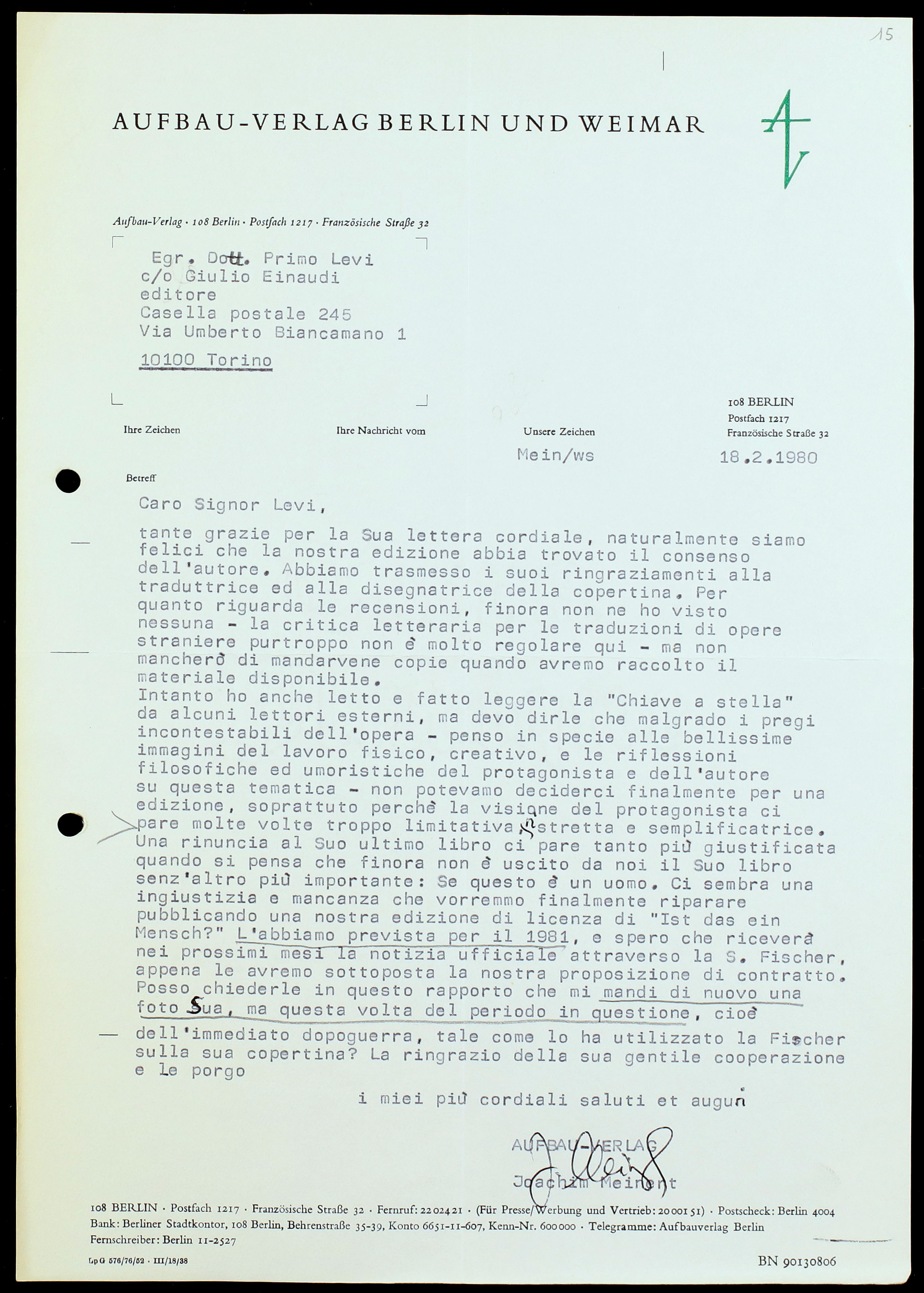
Meinert says he will send Levi any reviews The Periodic Table receives. He also informs him that Aufbau will not publish The Wrench; but the rejection is accompanied by their willingness to work on an edition of If This Is a Man, which had not yet been published in East Germany, by the end of 1981.
Egr. Dott. Primo Levi
c/o Giulio Einaudi editore
Casella postale 245
Via Umberto Biancamano 1
10100 Torino
Italia
18.02.1980
Caro Signor Levi,
Tante grazie per la Sua lettera cordiale, naturalmente siamo felici che la nostra edizione abbia trovato il consenso dell’autore. Abbiamo trasmesso i suoi ringraziamenti alla traduttrice ed alla disegnatrice della copertina. Per quanto riguarda le recensioni, finora non ne ho visto nessuna – la critica letteraria per le traduzioni di opere straniere purtroppo non è molto regolare qui – ma non mancherò di mandarvene copie quando avremo raccolto il materiale disponibile.
Intanto ho anche letto e fatto leggere la Chiave a stella da alcuni lettori esterni, ma devo dirle che malgrado i pregi incontestabili dell’opera – penso in specie alle bellissime immagini del lavoro fisico, creativo, e le riflessioni filosofiche ed umoristiche del protagonista e dell’autore su questa tematica – non potevamo deciderci finalmente per una edizione, soprattutto perché la visione del protagonista ci pare molte volte troppo limitativa, ristretta[1] e semplificatrice.[2]
Una rinuncia al Suo ultimo libro ci pare tanto più giustificata quando si pensa che finora non è uscito da noi il Suo libro senz’altro più importante: Se questo è un uomo. Ci sembra una ingiustizia e mancanza che vorremmo finalmente riparare pubblicando una nostra edizione di licenza di Ist das ein Mensch?. L’abbiamo prevista per il 1981,[3] e spero che ricaverà nei prossimi mesi la notizia ufficiale attraverso la S. Fischer, appena le avremo sottoposta la nostra proposizione di contratto.
Posso chiederle in questo rapporto che mi mandi di nuovo una foto Sua, ma questa volta del periodo in questione,[4] cioè dell’immediato dopoguerra, tale come lo ha utilizzato la Fischersulla sua copertina? La ringrazio della sua gentile cooperazione e le porgo
i miei più cordiali saluti et auguri
AUFBAU-VERLAG
Joachim Meinert
Egr. Dott. Primo Levi
c/o Giulio Einaudi editore
Casella postale 245
Via Umberto Biancamano 1
10100 Torino
Italia
18.02.1980
Caro Signor Levi,
Tante grazie per la Sua lettera cordiale, naturalmente siamo felici che la nostra edizione abbia trovato il consenso dell’autore. Abbiamo trasmesso i suoi ringraziamenti alla traduttrice ed alla disegnatrice della copertina. Per quanto riguarda le recensioni, finora non ne ho visto nessuna – la critica letteraria per le traduzioni di opere straniere purtroppo non è molto regolare qui – ma non mancherò di mandarvene copie quando avremo raccolto il materiale disponibile.
Intanto ho anche letto e fatto leggere la Chiave a stella da alcuni lettori esterni, ma devo dirle che malgrado i pregi incontestabili dell’opera – penso in specie alle bellissime immagini del lavoro fisico, creativo, e le riflessioni filosofiche ed umoristiche del protagonista e dell’autore su questa tematica – non potevamo deciderci finalmente per una edizione, soprattutto perché la visione del protagonista ci pare molte volte troppo limitativa, ristretta[1] e semplificatrice.[2]
Una rinuncia al Suo ultimo libro ci pare tanto più giustificata quando si pensa che finora non è uscito da noi il Suo libro senz’altro più importante: Se questo è un uomo. Ci sembra una ingiustizia e mancanza che vorremmo finalmente riparare pubblicando una nostra edizione di licenza di Ist das ein Mensch?. L’abbiamo prevista per il 1981,[3] e spero che ricaverà nei prossimi mesi la notizia ufficiale attraverso la S. Fischer, appena le avremo sottoposta la nostra proposizione di contratto.
Posso chiederle in questo rapporto che mi mandi di nuovo una foto Sua, ma questa volta del periodo in questione,[4] cioè dell’immediato dopoguerra, tale come lo ha utilizzato la Fischersulla sua copertina? La ringrazio della sua gentile cooperazione e le porgo
i miei più cordiali saluti et auguri
AUFBAU-VERLAG
Joachim Meinert
Egr. Dott. Primo Levi c/o Giulio Einaudi editore Casella postale 245 Via Umberto Biancamano 1 10100 Torino Italia
18.02.1980
Dear Mr. Levi,
Many thanks for your cordial letter; naturally, we are happy that our edition has gained the author’s approval. We have conveyed your thanks to the translator and to the artist who designed the cover. Regarding the reviews, I have not yet seen any – unfortunately, literary reviews of translations of foreign books are not very regular here – but I will not fail to send you copies when we have gathered the available material.
In the meantime, I have read and also had external readers read The Wrenchbut I must tell you that despite the indisputable qualities of the book – in particular, I am thinking of the beautiful images of physical, creative work and the philosophical and humorous reflections of the protagonist and the author on this topic – ultimately we could not decide to publish it, above all because the protagonist’s vision seems to us too limitative, restricted,[1] and simplifying.[2]
Passing on your latest book seems to us even more justified if you consider that, until now, what is without a doubt your most important book, If This Is a Man, has not been published here. It strikes us as an injustice and a shortcoming that we would finally like to put to rights by publishing a license edition of our own of Ist das ein Mensch?. We have planned it for 1981,[3] and I hope that in the next few months you will receive official notification through S. Fischer, as soon as we have submitted our contract proposal to them.
May I ask you in this letter if you would send me another photograph of yourself, but this time from the period in question,[4] that is, the immediate post-war period, like the one Fischer used on its cover? I thank you for your kind cooperation and send you
My most cordial greetings and best wishes
AUFBAU-VERLAG Joachim Meinert
Egr. Dott. Primo Levi
c/o Giulio Einaudi editore
Casella postale 245
Via Umberto Biancamano 1
10100 Torino
Italia
18.02.1980
Caro Signor Levi,
Tante grazie per la Sua lettera cordiale, naturalmente siamo felici che la nostra edizione abbia trovato il consenso dell’autore. Abbiamo trasmesso i suoi ringraziamenti alla traduttrice ed alla disegnatrice della copertina. Per quanto riguarda le recensioni, finora non ne ho visto nessuna – la critica letteraria per le traduzioni di opere straniere purtroppo non è molto regolare qui – ma non mancherò di mandarvene copie quando avremo raccolto il materiale disponibile.
Intanto ho anche letto e fatto leggere la Chiave a stella da alcuni lettori esterni, ma devo dirle che malgrado i pregi incontestabili dell’opera – penso in specie alle bellissime immagini del lavoro fisico, creativo, e le riflessioni filosofiche ed umoristiche del protagonista e dell’autore su questa tematica – non potevamo deciderci finalmente per una edizione, soprattutto perché la visione del protagonista ci pare molte volte troppo limitativa, ristretta[1] e semplificatrice.[2]
Una rinuncia al Suo ultimo libro ci pare tanto più giustificata quando si pensa che finora non è uscito da noi il Suo libro senz’altro più importante: Se questo è un uomo. Ci sembra una ingiustizia e mancanza che vorremmo finalmente riparare pubblicando una nostra edizione di licenza di Ist das ein Mensch?. L’abbiamo prevista per il 1981,[3] e spero che ricaverà nei prossimi mesi la notizia ufficiale attraverso la S. Fischer, appena le avremo sottoposta la nostra proposizione di contratto.
Posso chiederle in questo rapporto che mi mandi di nuovo una foto Sua, ma questa volta del periodo in questione,[4] cioè dell’immediato dopoguerra, tale come lo ha utilizzato la Fischersulla sua copertina? La ringrazio della sua gentile cooperazione e le porgo
i miei più cordiali saluti et auguri
AUFBAU-VERLAG
Joachim Meinert
Egr. Dott. Primo Levi
c/o Giulio Einaudi editore
Casella postale 245
Via Umberto Biancamano 1
10100 Torino
Italia
18.02.1980
Caro Signor Levi,
Tante grazie per la Sua lettera cordiale, naturalmente siamo felici che la nostra edizione abbia trovato il consenso dell’autore. Abbiamo trasmesso i suoi ringraziamenti alla traduttrice ed alla disegnatrice della copertina. Per quanto riguarda le recensioni, finora non ne ho visto nessuna – la critica letteraria per le traduzioni di opere straniere purtroppo non è molto regolare qui – ma non mancherò di mandarvene copie quando avremo raccolto il materiale disponibile.
Intanto ho anche letto e fatto leggere la Chiave a stella da alcuni lettori esterni, ma devo dirle che malgrado i pregi incontestabili dell’opera – penso in specie alle bellissime immagini del lavoro fisico, creativo, e le riflessioni filosofiche ed umoristiche del protagonista e dell’autore su questa tematica – non potevamo deciderci finalmente per una edizione, soprattutto perché la visione del protagonista ci pare molte volte troppo limitativa, ristretta[1] e semplificatrice.[2]
Una rinuncia al Suo ultimo libro ci pare tanto più giustificata quando si pensa che finora non è uscito da noi il Suo libro senz’altro più importante: Se questo è un uomo. Ci sembra una ingiustizia e mancanza che vorremmo finalmente riparare pubblicando una nostra edizione di licenza di Ist das ein Mensch?. L’abbiamo prevista per il 1981,[3] e spero che ricaverà nei prossimi mesi la notizia ufficiale attraverso la S. Fischer, appena le avremo sottoposta la nostra proposizione di contratto.
Posso chiederle in questo rapporto che mi mandi di nuovo una foto Sua, ma questa volta del periodo in questione,[4] cioè dell’immediato dopoguerra, tale come lo ha utilizzato la Fischersulla sua copertina? La ringrazio della sua gentile cooperazione e le porgo
i miei più cordiali saluti et auguri
AUFBAU-VERLAG
Joachim Meinert
Egr. Dott. Primo Levi c/o Giulio Einaudi editore Casella postale 245 Via Umberto Biancamano 1 10100 Torino Italia
18.02.1980
Dear Mr. Levi,
Many thanks for your cordial letter; naturally, we are happy that our edition has gained the author’s approval. We have conveyed your thanks to the translator and to the artist who designed the cover. Regarding the reviews, I have not yet seen any – unfortunately, literary reviews of translations of foreign books are not very regular here – but I will not fail to send you copies when we have gathered the available material.
In the meantime, I have read and also had external readers read The Wrenchbut I must tell you that despite the indisputable qualities of the book – in particular, I am thinking of the beautiful images of physical, creative work and the philosophical and humorous reflections of the protagonist and the author on this topic – ultimately we could not decide to publish it, above all because the protagonist’s vision seems to us too limitative, restricted,[1] and simplifying.[2]
Passing on your latest book seems to us even more justified if you consider that, until now, what is without a doubt your most important book, If This Is a Man, has not been published here. It strikes us as an injustice and a shortcoming that we would finally like to put to rights by publishing a license edition of our own of Ist das ein Mensch?. We have planned it for 1981,[3] and I hope that in the next few months you will receive official notification through S. Fischer, as soon as we have submitted our contract proposal to them.
May I ask you in this letter if you would send me another photograph of yourself, but this time from the period in question,[4] that is, the immediate post-war period, like the one Fischer used on its cover? I thank you for your kind cooperation and send you
My most cordial greetings and best wishes
AUFBAU-VERLAG Joachim Meinert
Info
Notes
Tag
Sender: Joachim Meinert
Addressee: Primo Levi
Date of Drafting: 1980-02-18
Place of Writing: East Berlin
Description: typewritten letter on a sheet of letterhead paper with handwritten signature in blue ballpoint pen. Besides the letterhead, the sheet also has a pre-printed section located between the address and the body of the letter: “Ihre Zeichen Ihre Nachricht vom Unsere Zeichen 108 BERLIN | Postfach 1217 | Französische Straße 32 | Betreff.” The sheet also has two alphanumerical codes: “87 RA Ag 426/47/70 20 4695” and one on the lower margin, to the right and just below the foot of the letter: “BN 90 130 806.”
Letterhead: AUFBAU-VERLAG BERLIN UND WEIMAR| Aufbau-Verlag 108 Berlin Postfach 1217 Französische Straße 32; at the foot of the page: 108 BERLIN • Postfach 1217• Französische Straße 32 • Fernruf: 225421 • (Für Presse/Werbung und Vertrieb: 2001 SI) • Postscheck: Berlin 4004 | Bank: Berliner Stadtkontor, 108 Berlin, Behrenstraße 35-39, Konto 6651-11-607, Kenn-Nr. 600000 • Telegramme: Aufbauverlag Berlin Fernschreiber; Berlin II-2527. The Aufbau logo is printed in green in the upper right-hand corner.
DOI:
1
The comma and the prefix “ri” of “ristretta” (“restricted”) were added by hand in black ballpoint pen. A mark has been written by hand in pencil in the inner margin of the sheet, alongside this line.
2
Similar criticism was printed by Italy’s radical left-wing press. On December 30, 1978, in the daily Lotta Continua, the editor Enrico Deaglio published a long commentary on The Wrench, in which, despite appreciation for having given voice to a “worker from Turin” after “twenty years of silence,” he stressed how the character Faussone represented a hermetic case of individual emancipation, a symbol of the fragmentation of the working class during the years of rising delocalization. Cf. E. Deaglio, “La nevrosi dell’operaio Faussone,” in Lotta Continua, December 30, 1978, pp. 6-7. The steelworker-author Tommaso Di Ciaula replied to Deaglio in a letter on January 15, 1979. Here, Levi’s book was described as a “conservative and Stakhanovite” novel, the mouthpiece of a bourgeoisie “that interferes everywhere” without understanding the true condition of exploitation and alienation of the working class. Cf. T. Di Ciaula, “L’operaio Faussone per caso è analfabeta?,” in Lotta Continua, January 14-15, 1979, p. 5.
3
“L’abbiamo prevista per il 1981” (“We have planned it for 1981”) is underlined by hand in pencil.
4
“mi mandi… in questione” (“if you would send me… in question”) is underlined by hand in pencil.