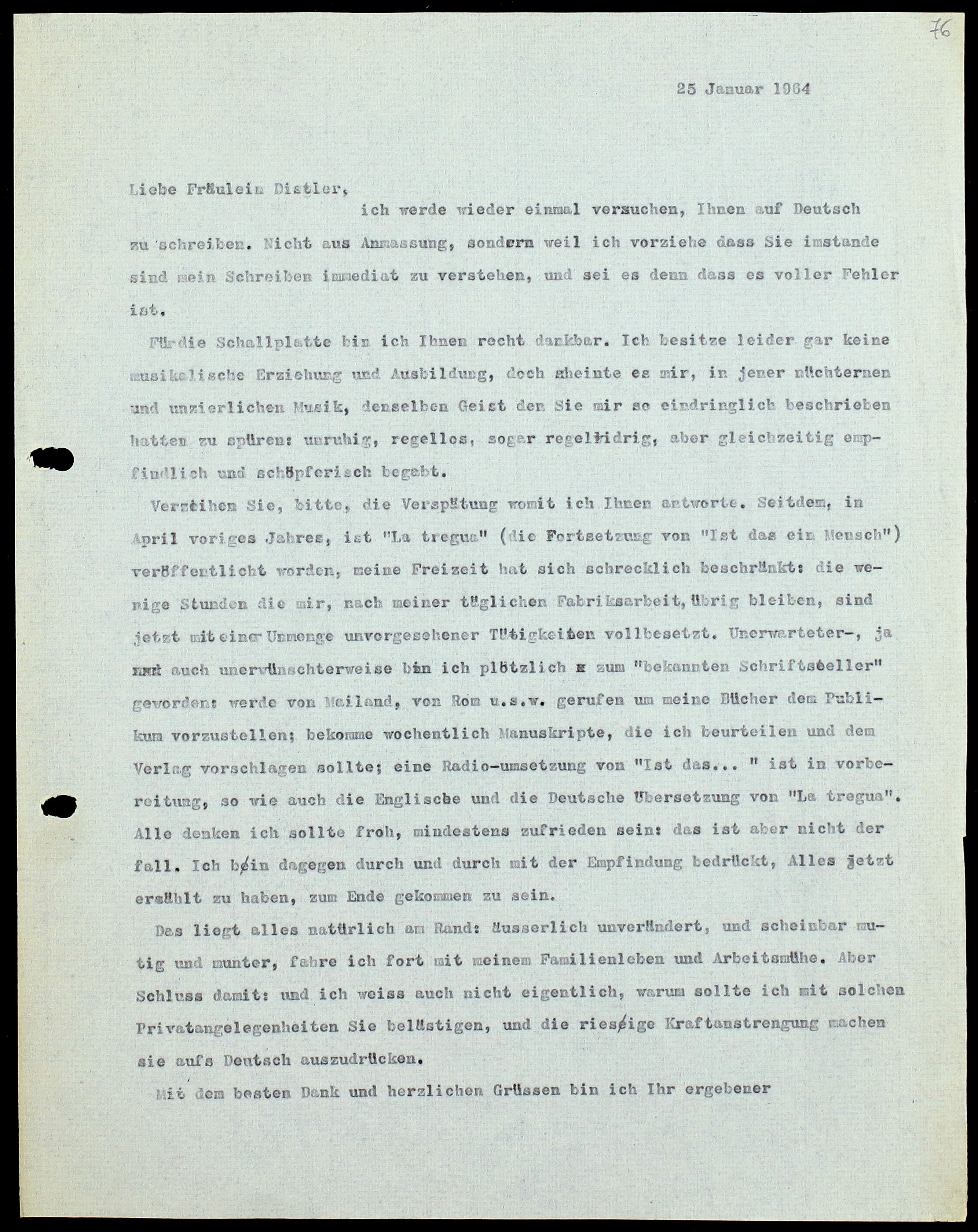
Levi thanks Distler for the record she sent and shares with her his feeling that, with the publication of The Truce, he has come to an end with recounting his experiences.
25 Januar 1964
Liebe Fräulein Distler,
ich werde wieder einmal versuchen, Ihnen auf Deutsch zu schreiben. Nicht aus Anmassung, sondern weil ich vorziehe dass Sie imstande sind mein Schreiben immediat zu verstehen, und sei es denn dass es voller Fehler ist.
Für die Schallplatte bin ich Ihnen recht dankbar. Ich besitze leider gar keine musikalische Erziehung und Ausbildung, doch scheinte[1] es mir, in jener nüchternen und unzierlichen Musik, denselben Geist den Sie mir so eindringlich beschrieben hatten zu spüren: unruhig, regellos, sogar regelwidrig, aber gleichzeitig empfindlich und schöpferisch begabt.
Verzeihen Sie, bitte, die Verspätung womit ich Ihnen antworte. Seitdem, in April voriges Jahres, ist La tregua (die Fortsetzung von Ist das ein Mensch) veröffentlicht worden, meine Freizeit hat sich schrecklich beschränkt: die wenige Stunden die mir, nach meiner täglichen Fabriksarbeit, übrig bleiben, sind jetzt mit einer Unmenge unvorgesehener Tätigkeiten vollbesetzt. Unerwarteter –, ja auch unerwünschterweise bin ich plötzlich zum „bekannten Schriftsteller” geworden: werde von Meilend, von Rom u.s.w. gerufen um meine Bücher den Publikum vorzustellen;[2] bekomme wochentlich Manuskripte, die ich beurteilen und dem Verlag vorschlagen sollte; eine Radio-umsetzungvon „Ist das…”ist in vorbereitung,[3] so wie auch die Englische und die Deutsche Übersetzung von La tregua.[4] Alle denken ich sollte froh, mindestens zufrieden sein: das ist aber nicht der fall. Ich bin dagegen durch und durch mit der Empfindung bedrückt, Alles jetzt erzählt zu haben, zum Ende gekommen zu sein.[5]
Das liegt alles natürlich am Rand: äusserlich unverändert, und scheinbar mutig und munter, fahre ich fort mit meinem Familienleben und Arbeitsmühe. Aber Schluss damit: und ich weiss auch nicht eigentlich, warum sollte ich mit solchen Privatangelegenheiten Sie belästigen, und die riesige Kraftanstrengung machen sie aufs Deutsch auszudrücken.
Mit dem besten Dank und herzlichen Grüssen bin ich Ihr ergebener
25 gennaio 1964
Cara signorina Distler,
provo ancora una volta a scriverLe in tedesco. Non per presunzione, ma perché preferisco che Lei possa intendere subito la mia lettera, anche se piena di errori.
La ringrazio davvero molto per il disco. Purtroppo, non ho alcuna educazione musicale, eppure mi è sembrato[1] di riconoscere, in quella musica scarna e priva di ornamenti, lo stesso spirito che Lei mi aveva descritto con parole così pregnanti: inquieto, smanioso, persino refrattario alle regole, e insieme sensibile e dotato di forza creativa.
La prego di scusarmi per il ritardo della mia risposta. Da quando, nell’aprile scorso, è uscito La tregua (la continuazione di Se questo è un uomo), il mio tempo libero si è ridotto a nulla: le poche ore che mi restano dopo il lavoro in fabbrica sono occupate da una quantità di impegni imprevisti. All’improvviso, e anche mio malgrado, sono diventato uno “scrittore noto”: mi chiamano a Milano, a Roma e via dicendo, per presentare al pubblico i miei libri;[2] ogni settimana ricevo manoscritti da valutare e proporre all’editore; è in preparazione un adattamento radiofonico di Se questo...,[3] e sono in corso le traduzioni inglese e tedesca de La tregua.[4] Tutti pensano che io debba esserne contento o almeno soddisfatto, ma non è così. Mi sento, al contrario, oppresso dalla sensazione di aver già detto tutto, di essere giunto alla fine.[5]
Tutto ciò resta, naturalmente, ai margini: all’esterno nulla è mutato, e in apparenza continuo a vivere allegro e impavido la mia vita in famiglia e i miei impegni lavorativi. Ma basta: non so nemmeno perché io debba importunarla con queste vicende private, e fare la fatica immensa di esprimerle in tedesco.
Con i migliori ringraziamenti e cordiali saluti, Suo devoto
January 25, 1964
Dear Ms. Distler,
I will try once again to write to you in German. Not out of presumption, but because I prefer that you be able to understand my letter immediately, even if it is full of mistakes.
I am very grateful to you for the record. Unfortunately, I have no musical education or training, but it seemed[1] to me that in that sober and unadorned music, I could sense the same spirit that you had described to me so vividly: restless, irregular, even transgressive, but at the same time sensitive and creatively gifted.
Please forgive the delay in my reply. Since The Truce(the sequel to If This is a Man) was published in April last year, my free time has been terribly limited: the few hours I have left after my daily factory work are now filled with a myriad of unforeseen activities. Unexpectedly—and, indeed, undesirably—I have suddenly become a “well-known writer”: I receive calls from Milan, Rome, etc., to present my books to the public;[2]every week I receive manuscripts that I am supposed to evaluate and recommend to the publisher; a radio adaptation of If This is…[3] is in preparation, as are the English and German translations of The Truce.[4]Everyone thinks I should be happy, or at least satisfied, but that is not the case. On the contrary, I am thoroughly depressed by the feeling that I have now said everything I have to say, that I have come to the end.[5]
Of course, all this is superficial: outwardly unchanged, and seemingly courageous and cheerful, I continue with my family life and work. But enough of that: I do not really know why I should pester you with such private matters and make the enormous effort to express them in German.
With many thanks and warm regards, I remain yours sincerely,
25 Januar 1964
Liebe Fräulein Distler,
ich werde wieder einmal versuchen, Ihnen auf Deutsch zu schreiben. Nicht aus Anmassung, sondern weil ich vorziehe dass Sie imstande sind mein Schreiben immediat zu verstehen, und sei es denn dass es voller Fehler ist.
Für die Schallplatte bin ich Ihnen recht dankbar. Ich besitze leider gar keine musikalische Erziehung und Ausbildung, doch scheinte[1] es mir, in jener nüchternen und unzierlichen Musik, denselben Geist den Sie mir so eindringlich beschrieben hatten zu spüren: unruhig, regellos, sogar regelwidrig, aber gleichzeitig empfindlich und schöpferisch begabt.
Verzeihen Sie, bitte, die Verspätung womit ich Ihnen antworte. Seitdem, in April voriges Jahres, ist La tregua (die Fortsetzung von Ist das ein Mensch) veröffentlicht worden, meine Freizeit hat sich schrecklich beschränkt: die wenige Stunden die mir, nach meiner täglichen Fabriksarbeit, übrig bleiben, sind jetzt mit einer Unmenge unvorgesehener Tätigkeiten vollbesetzt. Unerwarteter –, ja auch unerwünschterweise bin ich plötzlich zum „bekannten Schriftsteller” geworden: werde von Meilend, von Rom u.s.w. gerufen um meine Bücher den Publikum vorzustellen;[2] bekomme wochentlich Manuskripte, die ich beurteilen und dem Verlag vorschlagen sollte; eine Radio-umsetzungvon „Ist das…”ist in vorbereitung,[3] so wie auch die Englische und die Deutsche Übersetzung von La tregua.[4] Alle denken ich sollte froh, mindestens zufrieden sein: das ist aber nicht der fall. Ich bin dagegen durch und durch mit der Empfindung bedrückt, Alles jetzt erzählt zu haben, zum Ende gekommen zu sein.[5]
Das liegt alles natürlich am Rand: äusserlich unverändert, und scheinbar mutig und munter, fahre ich fort mit meinem Familienleben und Arbeitsmühe. Aber Schluss damit: und ich weiss auch nicht eigentlich, warum sollte ich mit solchen Privatangelegenheiten Sie belästigen, und die riesige Kraftanstrengung machen sie aufs Deutsch auszudrücken.
Mit dem besten Dank und herzlichen Grüssen bin ich Ihr ergebener
25 gennaio 1964
Cara signorina Distler,
provo ancora una volta a scriverLe in tedesco. Non per presunzione, ma perché preferisco che Lei possa intendere subito la mia lettera, anche se piena di errori.
La ringrazio davvero molto per il disco. Purtroppo, non ho alcuna educazione musicale, eppure mi è sembrato[1] di riconoscere, in quella musica scarna e priva di ornamenti, lo stesso spirito che Lei mi aveva descritto con parole così pregnanti: inquieto, smanioso, persino refrattario alle regole, e insieme sensibile e dotato di forza creativa.
La prego di scusarmi per il ritardo della mia risposta. Da quando, nell’aprile scorso, è uscito La tregua (la continuazione di Se questo è un uomo), il mio tempo libero si è ridotto a nulla: le poche ore che mi restano dopo il lavoro in fabbrica sono occupate da una quantità di impegni imprevisti. All’improvviso, e anche mio malgrado, sono diventato uno “scrittore noto”: mi chiamano a Milano, a Roma e via dicendo, per presentare al pubblico i miei libri;[2] ogni settimana ricevo manoscritti da valutare e proporre all’editore; è in preparazione un adattamento radiofonico di Se questo...,[3] e sono in corso le traduzioni inglese e tedesca de La tregua.[4] Tutti pensano che io debba esserne contento o almeno soddisfatto, ma non è così. Mi sento, al contrario, oppresso dalla sensazione di aver già detto tutto, di essere giunto alla fine.[5]
Tutto ciò resta, naturalmente, ai margini: all’esterno nulla è mutato, e in apparenza continuo a vivere allegro e impavido la mia vita in famiglia e i miei impegni lavorativi. Ma basta: non so nemmeno perché io debba importunarla con queste vicende private, e fare la fatica immensa di esprimerle in tedesco.
Con i migliori ringraziamenti e cordiali saluti, Suo devoto
January 25, 1964
Dear Ms. Distler,
I will try once again to write to you in German. Not out of presumption, but because I prefer that you be able to understand my letter immediately, even if it is full of mistakes.
I am very grateful to you for the record. Unfortunately, I have no musical education or training, but it seemed[1] to me that in that sober and unadorned music, I could sense the same spirit that you had described to me so vividly: restless, irregular, even transgressive, but at the same time sensitive and creatively gifted.
Please forgive the delay in my reply. Since The Truce(the sequel to If This is a Man) was published in April last year, my free time has been terribly limited: the few hours I have left after my daily factory work are now filled with a myriad of unforeseen activities. Unexpectedly—and, indeed, undesirably—I have suddenly become a “well-known writer”: I receive calls from Milan, Rome, etc., to present my books to the public;[2]every week I receive manuscripts that I am supposed to evaluate and recommend to the publisher; a radio adaptation of If This is…[3] is in preparation, as are the English and German translations of The Truce.[4]Everyone thinks I should be happy, or at least satisfied, but that is not the case. On the contrary, I am thoroughly depressed by the feeling that I have now said everything I have to say, that I have come to the end.[5]
Of course, all this is superficial: outwardly unchanged, and seemingly courageous and cheerful, I continue with my family life and work. But enough of that: I do not really know why I should pester you with such private matters and make the enormous effort to express them in German.
With many thanks and warm regards, I remain yours sincerely,
Info
Notes
Tag
Sender: Primo Levi
Addressee: Brigitte Distler
Date of Drafting: 1964-01-25
Place of Writing: Turin
Description:carbon copy on onionskin paper of typewritten letter.
Archive: Archivio privato di Primo Levi, Turin
Series: Complesso di Fondi primo Levi, Fondo Primo Levi, Corrispondenza, Corrispondenti particolari, fasc. 20, sottofasc. 001, doc. 026, f. 76.
Folio: 1, front only
DOI: https://doi.org/10.15160/055x-sx77
1An incorrect form of the past tense of the verb scheinen.
2
In July 1963, Levi participated at the Premio Strega award ceremony in Rome; he was one of the finalists with The Truce, along with Natalia Ginzburg (who won the prize) and Tommaso Landolfi (Ian Thomson, Primo Levi. A Life, cit., pp. 369-70). That same year, Levi won the first edition of the Premio Campiello.
3
The day after The Truce was published in March 1963, Levi received a letter from Canada informing him that a radio adaptation was being prepared of If This Is a Man, based on the English translation by Stuart Woolf. Recording was to begin in January 1964 but it would not be broadcast until January 1965. Levi was enthusiastic about the initiative and proposed to Radio Rai his own version, which was broadcast on April 24, 1964 (OC I, p. 1195-1197). For an overview, cf. G. Episcopo, “On Solid Air: Primo Levi and the Radio RAI,” in Interpreting Primo Levi: Interdisciplinary Perspectives, edited by M. Vuohelainen, A. Chapman, New York: Palgrave, 2016, pp. 203-218. From a letter to Heinz Riedt dated January 16, 1964 we know that by mid-month Levi was already working on the script: “and finally, something I am enjoying very much: Rai has asked me to prepare a radio script of If This Is a Man that will be broadcast on the occasion of the events for the twentieth anniversary of the Resistance, in April.” Cf. Il carteggio con Heinz Riedt, cit., p. 153.
4
In his correspondence with Heinz Riedt, Levi provides a behind-the-scenes account of the publication of The Truce in Germany (Il carteggio con Heinz Riedt, cit., pp. 139-156). Riedt, who had translated If This Is a Man for Fischer, was not hired by the editor Wagner, who instead entrusted the translation of Levi’s second book to a husband-and-wife team, Robert and Barbara Picht. In the correspondence with Riedt, the English translation is also briefly mentioned: “I received a sample translation from Mr. Picht, over a month ago by now, and I returned it corrected with the meticulousness you know so well. Since then, I have not heard a thing. The translation seems substantially good, even though there is a clear tendency to get by ‘with minimum effort’ in the difficult situations: I note that The Truce is full of these situations, above all Cesare’s dialogues that are partly in dialect. At the moment, I am rereading the English translation made by that friend of mine Woolf, I might have mentioned him to you: and I am sweating through it for the same reason” (p. 152). Ultimately, Levi was dissatisfied with the German version, which was published in 1964 with the title Atempause.
5
In an interview with Pier Maria Paoletti published in Il Giorno on August 7, 1963, Levi had already publicly expressed this frame of mind. “‘So then, with the experience in the Lager, it is all over?’ asked Paoletti. ‘Oh yes, not even one word. No more. What I had to say, I have said it all. Completely over’” (OC III, p. 11).