Falter writes once again to Levi, emphasizing the moral turmoil his book has caused in her, her feelings of guilt over the crimes committed by her people, and her desire to do something as a sign of atonement. She was particularly struck by the destiny of Lorenzo Perrone.
20. VIII. 1969
Sehr geehrter Signor Dr. Primo Levi!
Ihre gütige und freundliche Antwort auf meine Briefe bewegt mich nochmal an Sie zu schreiben, um Ihnen meinen herzlichsten Dank auszusprechen. Leider kann ich nur deutsch schreiben, da ich einer anderen Sprache unkundig bin und mein Neffe, der mir zwar Ihnen werten Brief sehr gut übersetzte, beherrscht die englische Sprache doch nicht so vollkommen, daß er meinen Brief an Sie, englisch zu schreiben gewagt hätte.
Verehrter Signor Dr. Levi! Daß Ihnen Ihre Aufgabe, die Menschen, und besonders uns Deutsche, aufzurufen zur Besinnung, und die Reaktion auf diesen, Ihren Aufruf, einiger maßen Trost und Genugtuung gab, beruhigt mich ein wenig und freut mich für Sie, aber es genügt nicht, um den gewaltigen Sturm in meinem Innern zu stillen. Sie haben mir den Blick in die Tiefe geöffnet, in einen Abgrund so voll furchtbaren Leiden und entsetzlicher Schuld, daß ich mich der Fähigkeit schäme, jemals noch einer Stunde meines Daseins froh werden zu können.
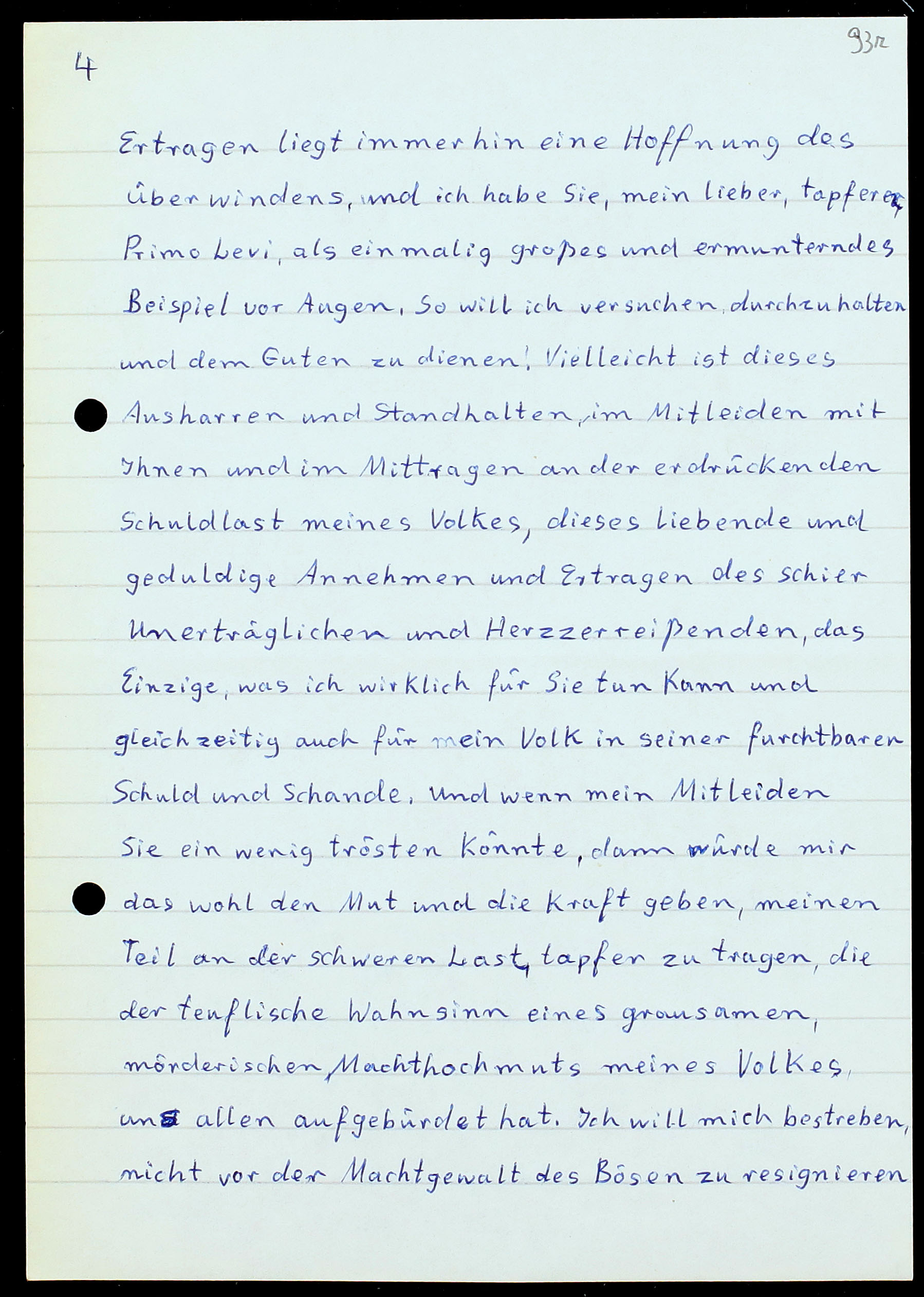
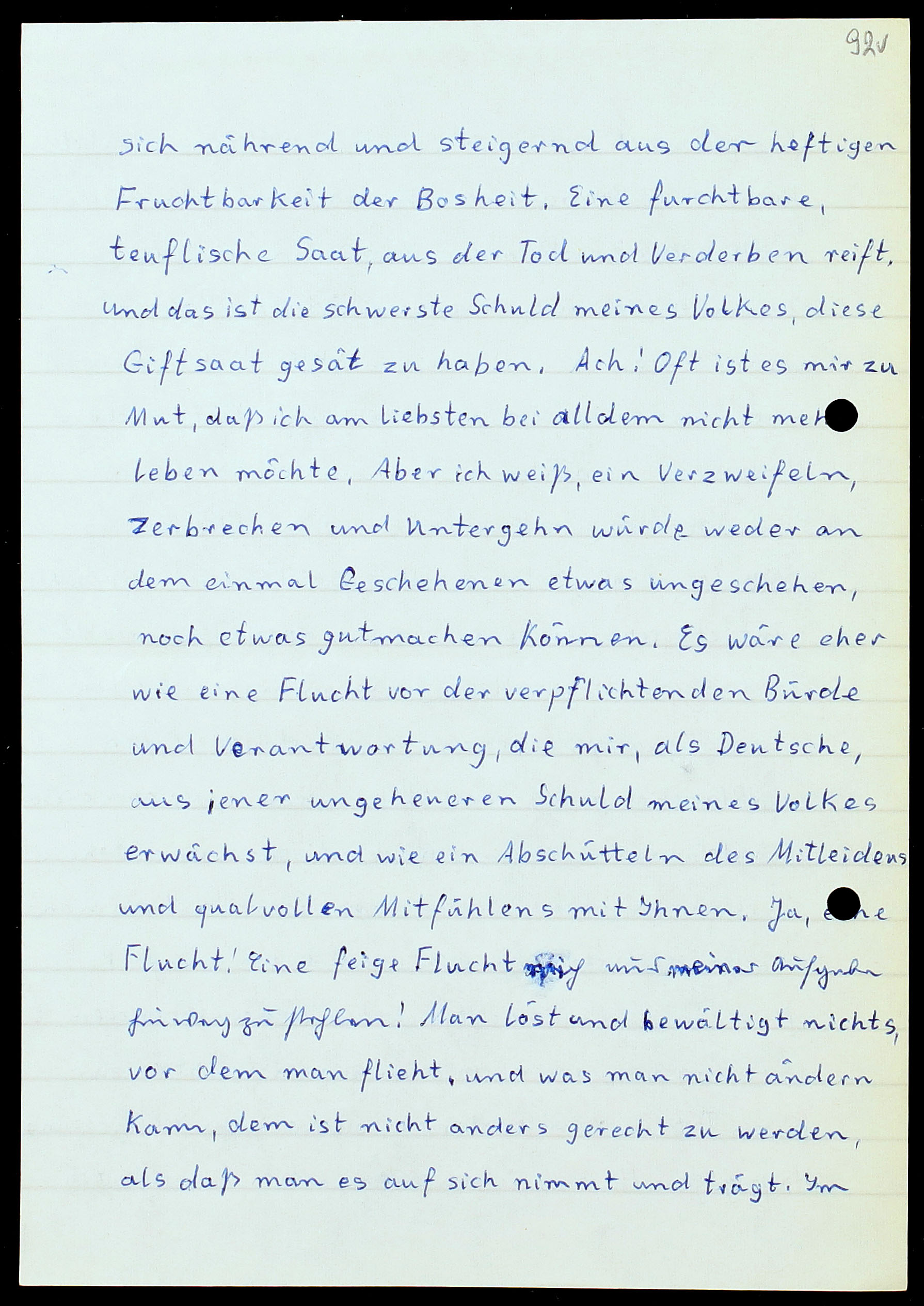
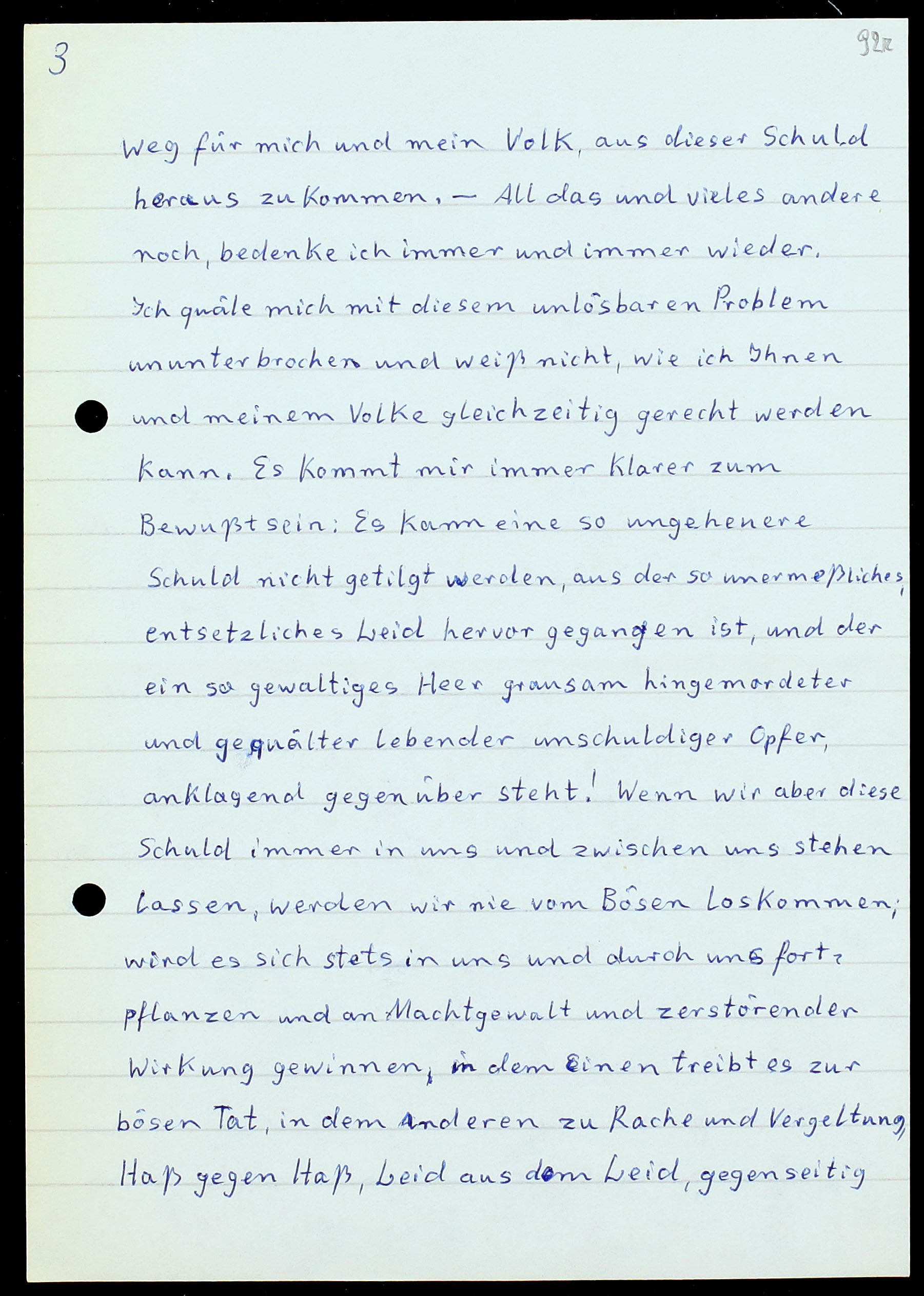
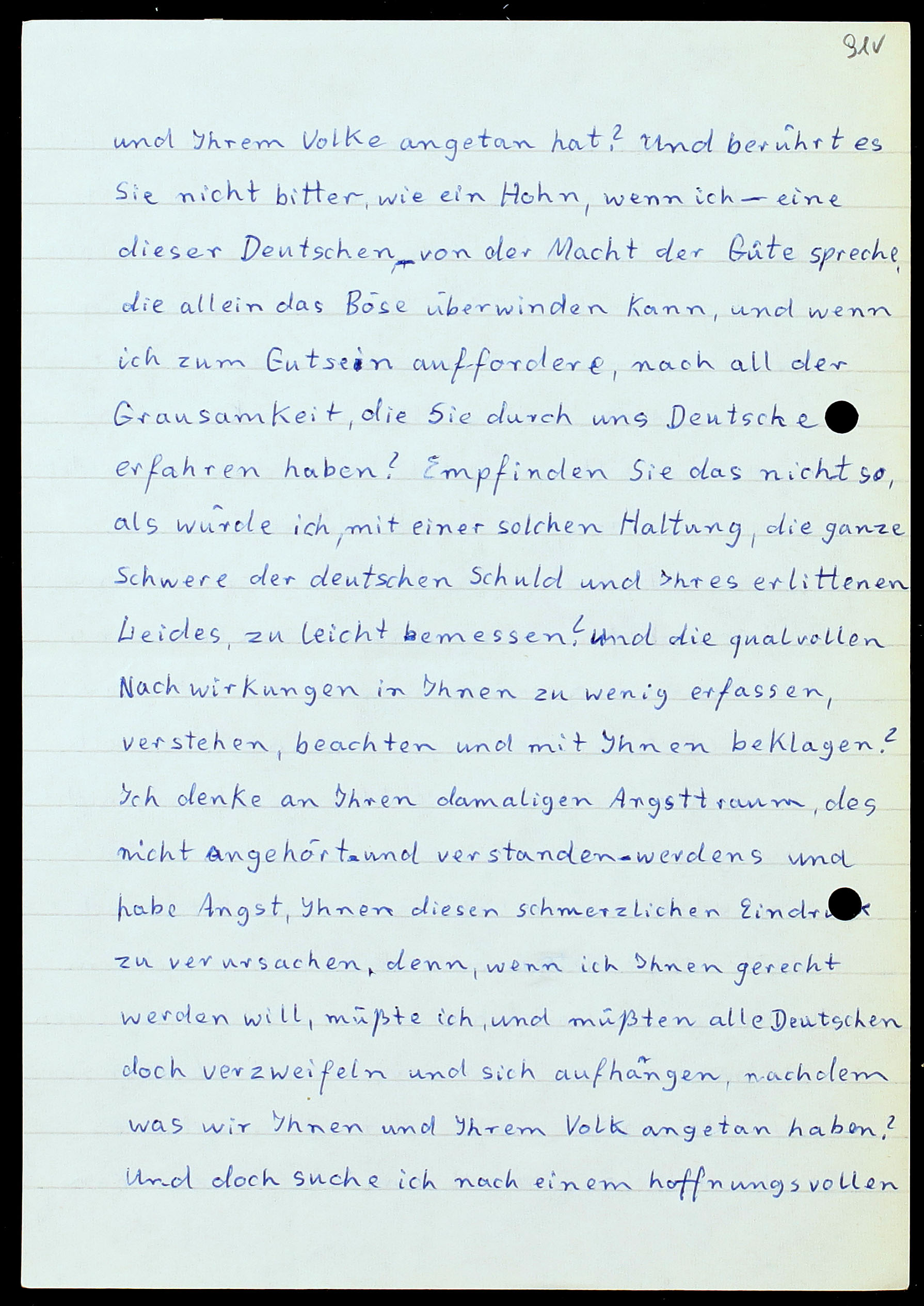
Mein Denken kommt nicht mehr zur Ruhe. Dieses Thema, die grauenvollen, unermeßlich schweren verbrechen meines Volkes gegen die Menschlichkeit, hat mich vorher tief bewegt und viel beschäftigt, aber noch nie so verdringlich und aufwühlend wie jetzt, seit dieser, für mich so eindrucksvollen und bedeutsamen, geistigen Begegnung mit Ihnen, mit Ihren Persönlichkeit, Ihrem Schicksal und Ihren Mitteilungen und Gedanken darüber in Ihren Büchern. Dadurch ist mir dieses ernste Thema zu einem Phänomen in meinem eigenen Dasein geworden; zu einer Aufgabe, der ich mich stellen will und stellen muß, wenn ich Ihnen gegenüber und vor meinem Gewissen und der Forderung meines eigenen Herzens, bestehen soll. Es drängt mich unwiderstehlich, etwas zu tun, zu helfen, zu sühnen! Aber was kann ich tun? Was soll ich tun? Kann man in diesem Fall überhaupt noch etwas wirksam tun und recht machen? diese furchtbare Schuld meines Volkes steht, quälend, zwischen mir und Ihren und zwischen mir und meinem Volke, und das ist das gräßlichste, denn es ist “mein Volk”, das Ihr und Ihres Volkes entsetzliche Leiden verschuldete, und darum trage ich mit an dieser Schuld und werde selber schuldig, denn ich muß mit dem tiefsten Abscheu meines Herzens und Gewissens verurteilen und verwerfen, was mein Volk getan hat und stelle mich so gegen mein eigenes Volk, von dem ich mich doch nicht lossagen kann, nicht lossagen darf, denn ich bin und bleibe ein Kind dieses Volkes und liebe es, wie man Vater Mutter libet. da ich mich aber so sehr meinem Volke verbunden fühle, werde ich schuldig gegen Sie, mein lieber Primo Levi, und Ihre Leidensgefährten, denn müßte ich nicht mein eigenes Volk verfluchen über all dem Leid, das es Ihnen und Ihrem Volke angetan hat? Und berührtes Sie nicht bitter, wie ein Hohn, wenn ich – eine dieser Deutschen – von der Macht der Güte spreche, die allein das Böse überwinden kann, und wenn ich zum Gutsein auffordere, nach all der Grausamkeit, die Sie durch uns Deutsche erfahren haben? Empfinden Sie das nicht so, als würde ich, mit einer solchen Haltung, die ganze Schwere der deutschen Schuld und Ihres erlittenen Leides, zu leicht bemessen? Und die qualvollen Nachwirkungen in Ihnen zu wenig erfassen, verstehen, beachten und mit Ihnen beklagen? Ich denke an Ihren damaligen Angsttraum, das nicht Angehört und verstanden-werdens und habe Angst, Ihnen diesen schmerzlichen Eindruck zu verursachen, denn, wenn ich Ihnen gerecht werden will, müßte ich, und müßten alle Deutschen doch verzweifeln und sich aufhängen, nachdem was wir Ihnen und Ihrem Volk angetan haben? Und doch suche ich nach einem hoffnungsvollen Weg für mich und mein Volk, aus dieser Schuld heraus zukommen. – All das und vieles andere noch, bedenke ich immer und immer wieder. Ich quäle mich mit diesem unlösbaren Problem ununterbrochen und weiß nicht, wie ich Ihnen und meinem Volke gleichzeitig gerecht werden kann. Es kommt mir immer klarer zum Bewußtsein. Es kann eine so unge heuere Schuld nicht getilgt werden, aus der so unermeßliches, entsetzliches Leid hervor gegangen ist, und der ein so gewaltiges Heer grausam hingemordeter und gequälter lebender unschuldiger Opfer, anklagend gegenüber steht! Wenn wir aber diese Schuld immer in uns und zwischen uns stehen lassen, werden wir nie vom Bösen loskommen, wind es sich stets in uns und durch uns fortpflanzen und an Machtgewalt und zerstörenden Wirkung gewinnen, in dem einen treibt es zur bösen Tat, in dem Anderen zu Rache und Vergeltung, Haß gegen Haß, Leid aus dem Leid, gegenseitig sich nährend und steigernd aus der heftigen Fruchtbarkeit der Bosheit. Ein furchtbare, teuflische Saat, aus der Tod und Verderben reift, und das ist die schwerste Schuld meines Volkes, diese Giftsaat gesät zu haben. Ach! Oft ist es mir zu Mut, daß ich am liebsten bei all dem nicht mehr leben möchte. aber ich weiß, ein Verzweifeln, zerbrechen und Untergehn würde weder an dem einmal Geschehen etwas ungeschehen, noch etwas gutmachen können. Es wäre eher wie eine Flucht vor der verpflichtenden Bürde und Verantwortung, die mir, als Deutsche, aus jener ungeheuren Schuld meines Volkes erwächst, und wie ein Abschütteln des Mitleidens und qualvollen Mitfühlens mit Ihnen. Ja, eine Flucht! Eine feige Flucht <…> <…> meines auf<…> <….> zu <….>! Man löst und bewältigt nichts, vor dem man flieht, und was man nicht ändern kann, dem ist nicht anders gerecht zu werden, als daß man es auf sich nimmt und trägt. Im Ertragen liegt immerhin eine Hoffnung des Überwindens, und ich habe Sie, mein lieber, tapferer Primo Levi, als einmalig großes und ermunterndes Beispiel vor Augen. SO will ich versuchen durchzuhalten und dem Guten zu dienen! Vielleicht ist dieses Ausharren und Standhalten, im Mitleiden mit Ihnen und im Mittragen an der erdrückenden Schuldlast meines Volkes, dieses liebende und geduldige Annehmen und Ertragen des schier Unerträglichen und Herzzerreißenden, das Einzige, was ich wirklich für Sie tun kann und gleichzeitig auch für mein Volk in seiner furchtbaren Schuld und Schande. Und wenn mein Mitleiden Sie ein wenig trösten könnte, dann würde mir das wohl den Mut und die Kraft geben, meinen Teil an der schweren Last, tapfer zu tragen, die der teuflische Wahnsinn eines grausamen, mörderischen Machthochmuts meines Volkes, uns allen aufgebürdet hat. Ich will mich bestreben, nicht vor der Machtgewalt des Bösen zu resignieren sondern immer wieder an das Gute zu glauben und es zu verwirklichen.
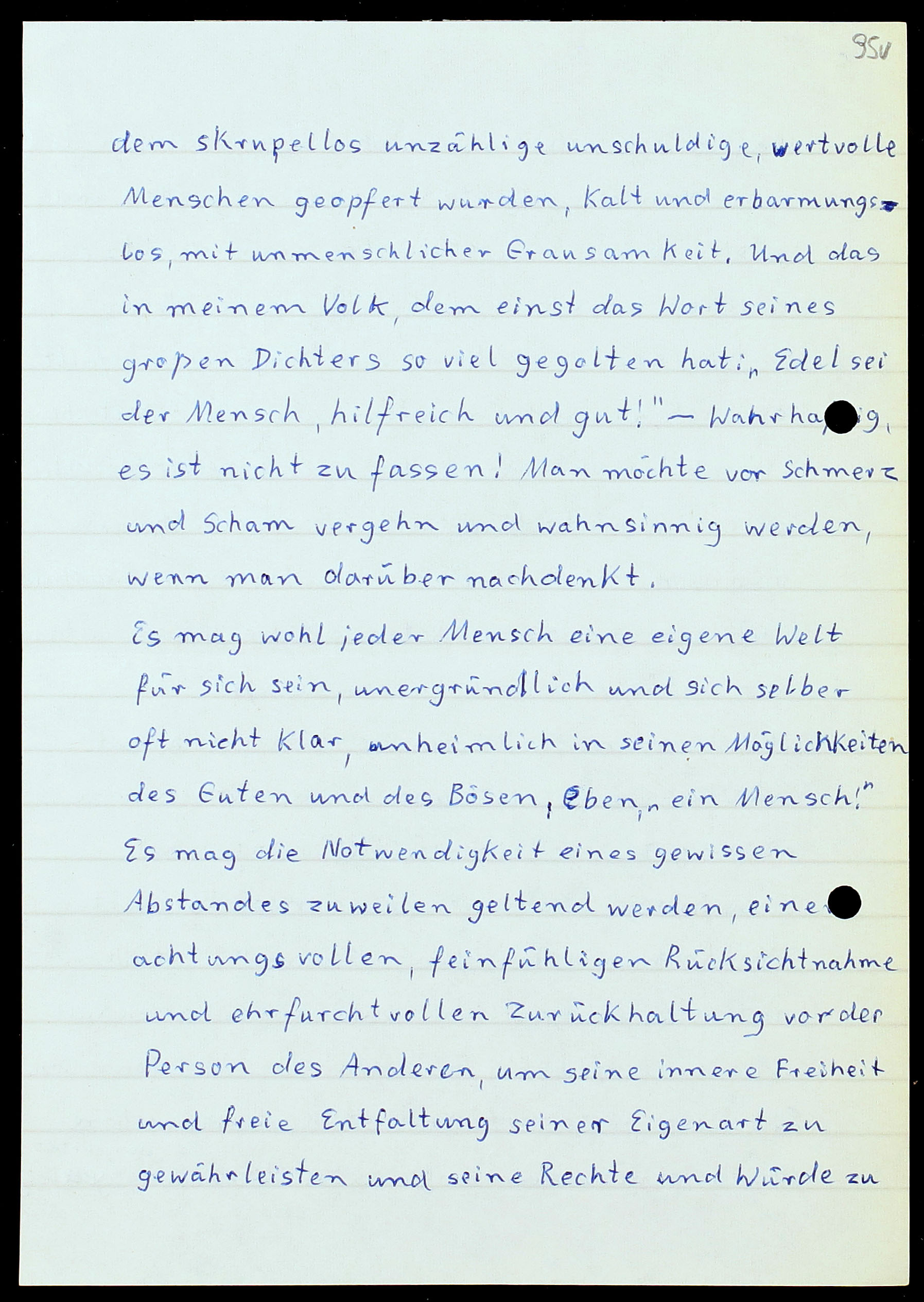
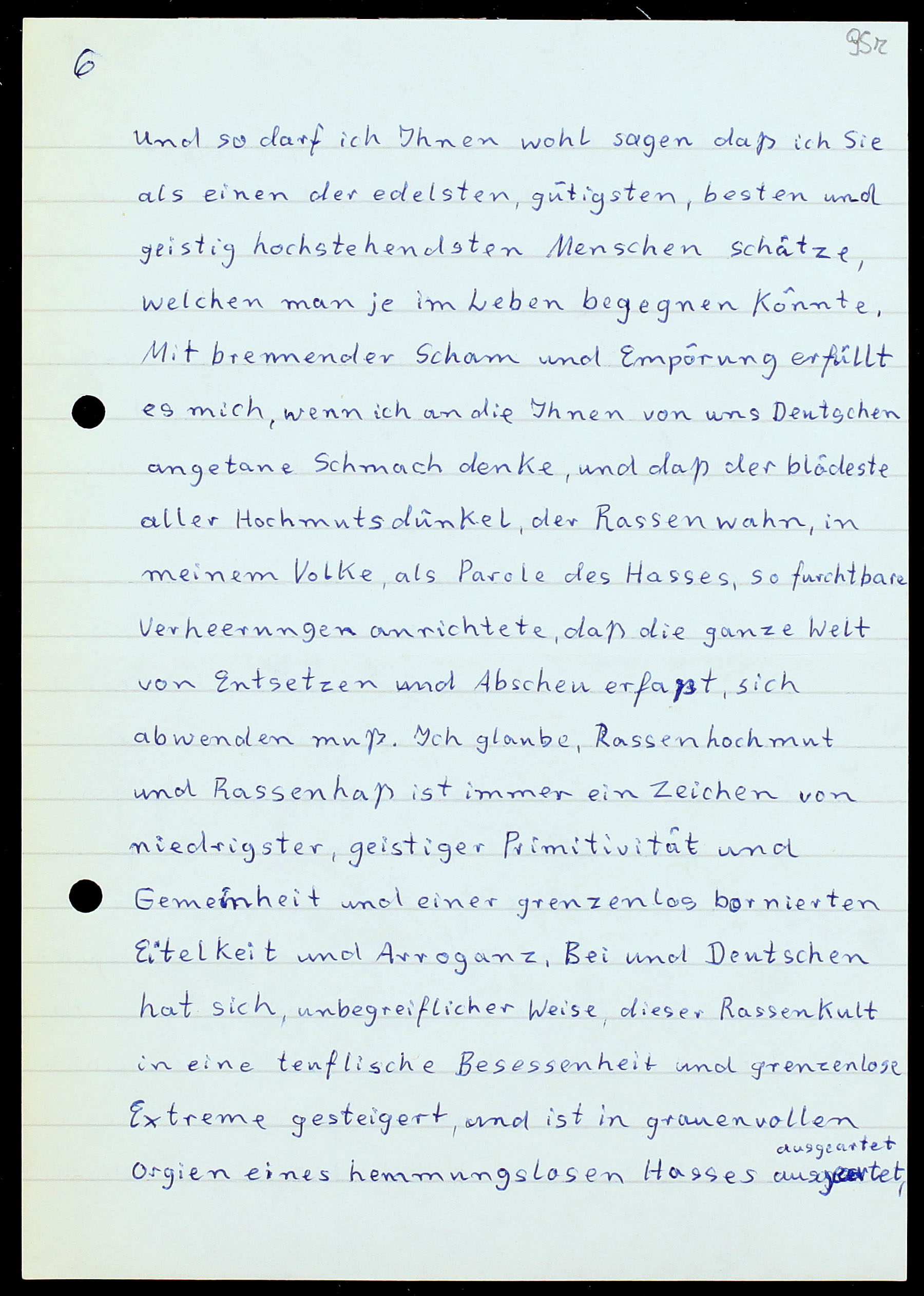
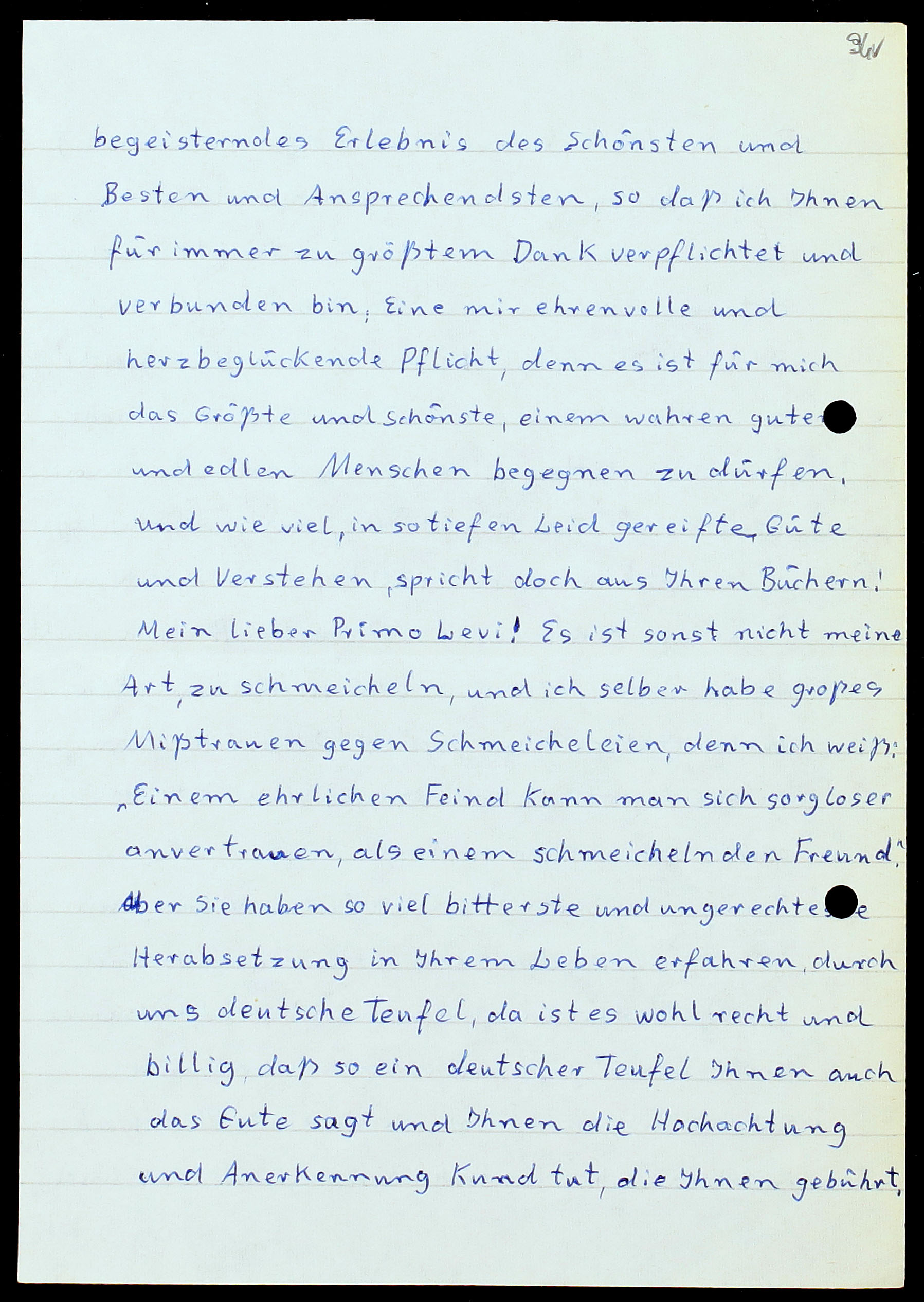
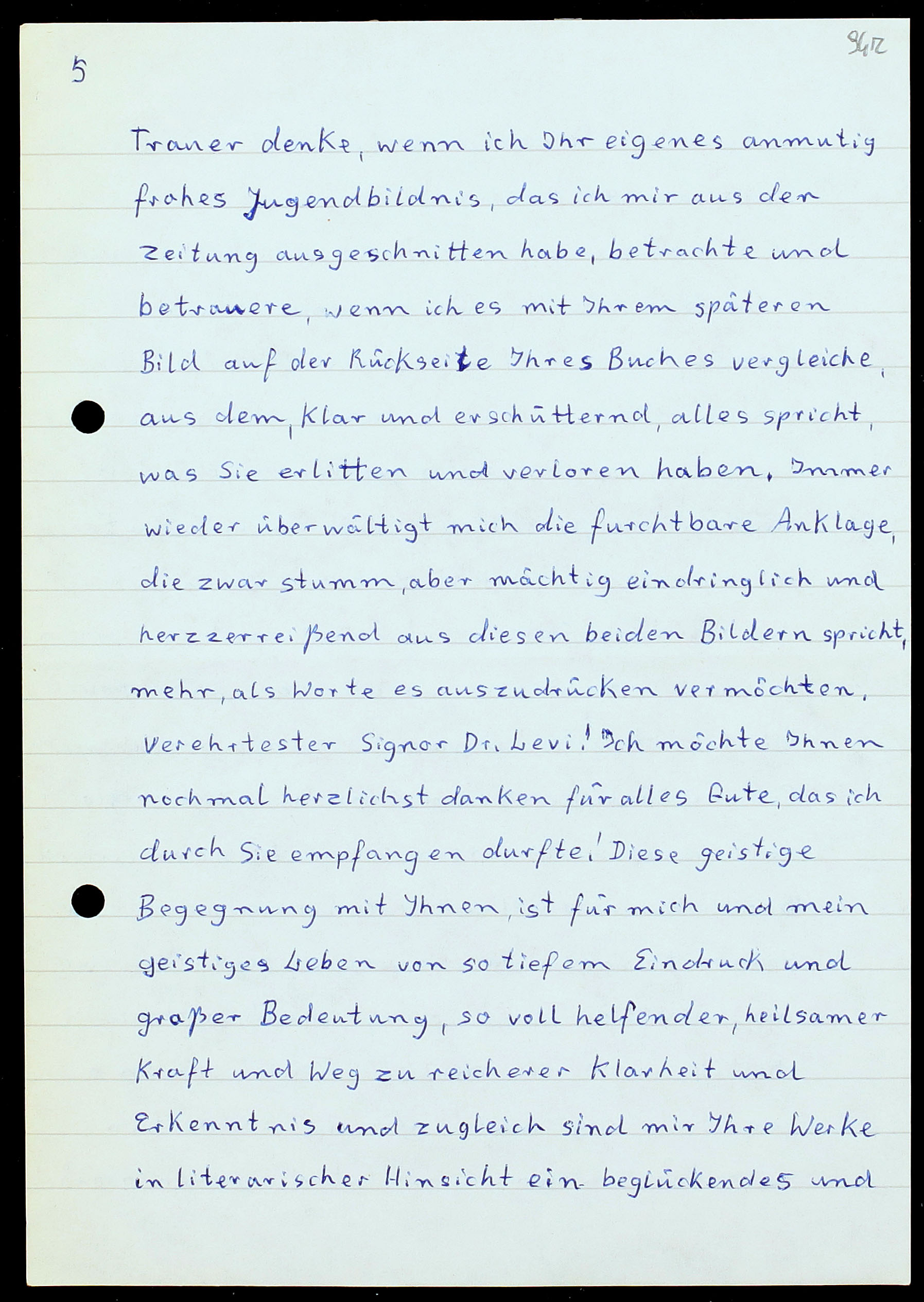
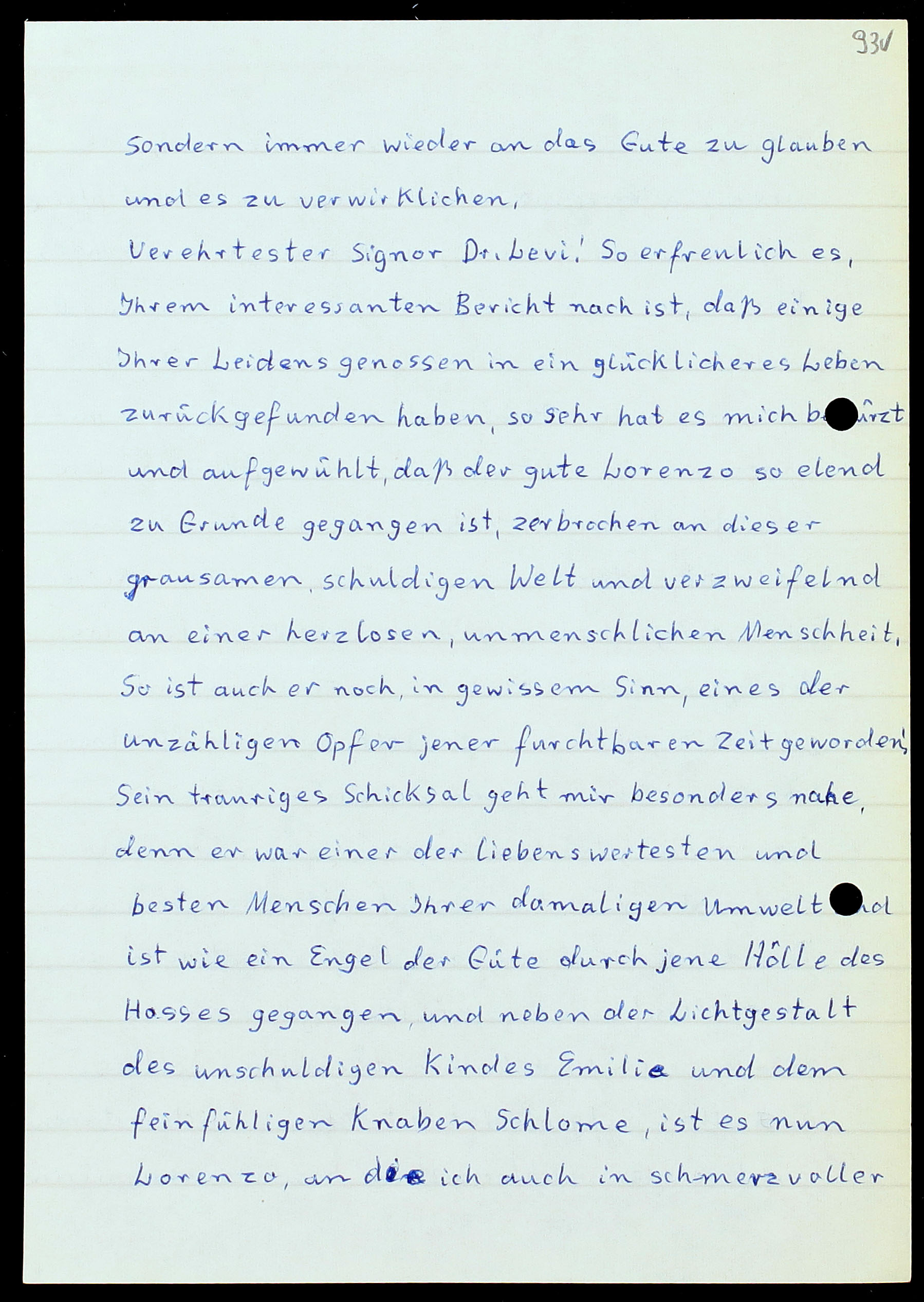
Verehrtester Signor Dr. Levi! So erfreulich es, Ihrem interessanten Bericht nach ist, daß einige Ihrer Leidens genossen in ein glücklicheres Leben zurückgefunden haben, so sehr hat es mich b<..>ürzt und aufgewühlt, daß der gute Lorenzo so elend zu Grunde gegangen ist, zerbrochen an dieser grausamen schuldigen Welt und verzweifelnd an einer herzlosen, unmenschlichen Menschheit. So ist auch er noch, in gewissem Sinn, eines der unzähligen Opfer jener furchtbaren Zeit geworden! Sein trauriges Schicksal geht mir besonders nahe, denn er war einer der liebenswertesten und besten Menschen Ihrer damaligen Umwelt und ist wie ein Engel der Güte durch jene Hölle des Hasses gegangen, und neben der Lichtgestalt des unschuldigen Kindes Emilia und dem feinfühligen Knaben Schlome,[1] ist es nun Lorenzo, an die ich auch in schmerzvoller Trauer denke, wenn ich Ihr eigenes anmutig frohes Jugendbildnis, das ich mir aus der Zeitung ausgeschnitten haben, betrachte und betrauere, wenn ich es mit Ihrem späteren Bild auf der Rückseite Ihres Buches vergleiche, aus dem, Klar und erschütternd, alles spricht, was Sie erlitten und verloren haben. Immer wieder überwältigt mich die furchtbare Anklage, die zwar stumm, aber mächtig eindringlich und herzzerreißend aus diesen beiden Bildern spricht, mehr, als Worte es auszudrücken vermöchten. Verehrtester Signor Dr. Levi! Ich möchte Ihnen nochmal herzlichst danken für alles Gute, das ich durch Sie empfangen durfte! Diese geistige Begegnung mit Ihnen, ist für mich und mein geistiges Leben von so tiefem Eindruck und großer Bedeutung, so voll helfender, heilsamer Kraft und Weg zu reicherer Klarheit und Erkenntnis und zugleich sind mir Ihre Werke in literarischer Hinsicht ein beglückendes und begeisterndes Erlebnis des schönsten und Besten und Ansprechendsten, so daß ich Ihnen für immer zu größtem Dank verpflichtet und verbunden bin. Eine mir ehrenvolle und herzbeglückende Pflicht, denn es ist für mich das Größte und schönste, einem wahren guter und edlen Menschen begegnen zu dürfen, und wie viel, in so tiefen Leid gereifte, Güte und Verstehen, spricht doch aus Ihren Büchern! Mein lieber Primo Levi! Es ist sonst nicht meine Art, zu schmeicheln, und ich selber habe großes Mißtrauen gegen Schmeicheleien, denn ich weiß: “Einem ehrlichen Feind kann man sich sorgloser anvertrauen, als einem schmeichelnden Freund”. Aber sie haben so viel bitterste und ungerechteste Herabsetzung in Ihrem Leben erfahren, durch uns deutsche Teufel, da ist es wohl recht und billig, daß so ein deutscher Teufel Ihnen auch das Gute sagt und Ihnen die Hochachtung und Anerkennung Kund tut, die Ihnen gebührt. Und so darf ich Ihnen wohl sagen daß ich Sie als einen der edelsten, gütigsten, besten und geistig hochstehendsten Menschen schätze, welchen man je im Leben begegnen könnte. Mit brennender Scham und Empörung erfüllt es mich, wenn ich an die Ihnen von uns Deutschen angetane Schmach denke, und daß der blödeste aller Hochmutsdünkel, der Rassenwahn, in meinem Volke, als Parole des Hasses, so furchtbare verheerungen anrichtete, daß die ganze Welt von Entsetzen und Abscheu erfaßt, sich abwenden muß. Ich glaube, Rassenhochmut und Rassenhaß ist immer ein Zeichen von niedrigster, geistiger Primitivität und Gemeinheit und einer grenzenlos bornierten Eitelkeit und Arroganz. Bei und Deutschen hat sich, unbegreiflicher Weise, dieser Rassenkult in eine teuflische Besessenheit und grenzenlose Extreme gesteigert, und ist in grauenvollen Orgien eines hemmungslosen Hasses ausgeartet, dem skrupellos unzählige unschuldige, wertvolle Mensche geopfert wurden, kalt und erbarmungslos, mit unmenschlicher Grausamkeit. Und das in meinem Volk, dem einst das Wort seines großen Dichters so viel gegolten hat: “Edel sei der Mensch, hilfreich und gut!” – Wahr<ß..>ig, es ist nicht zu fassen! Man möochte vor Schmerz und Scham vergehn und wahnsinnig werden, wenn man darüber nachdenkt.
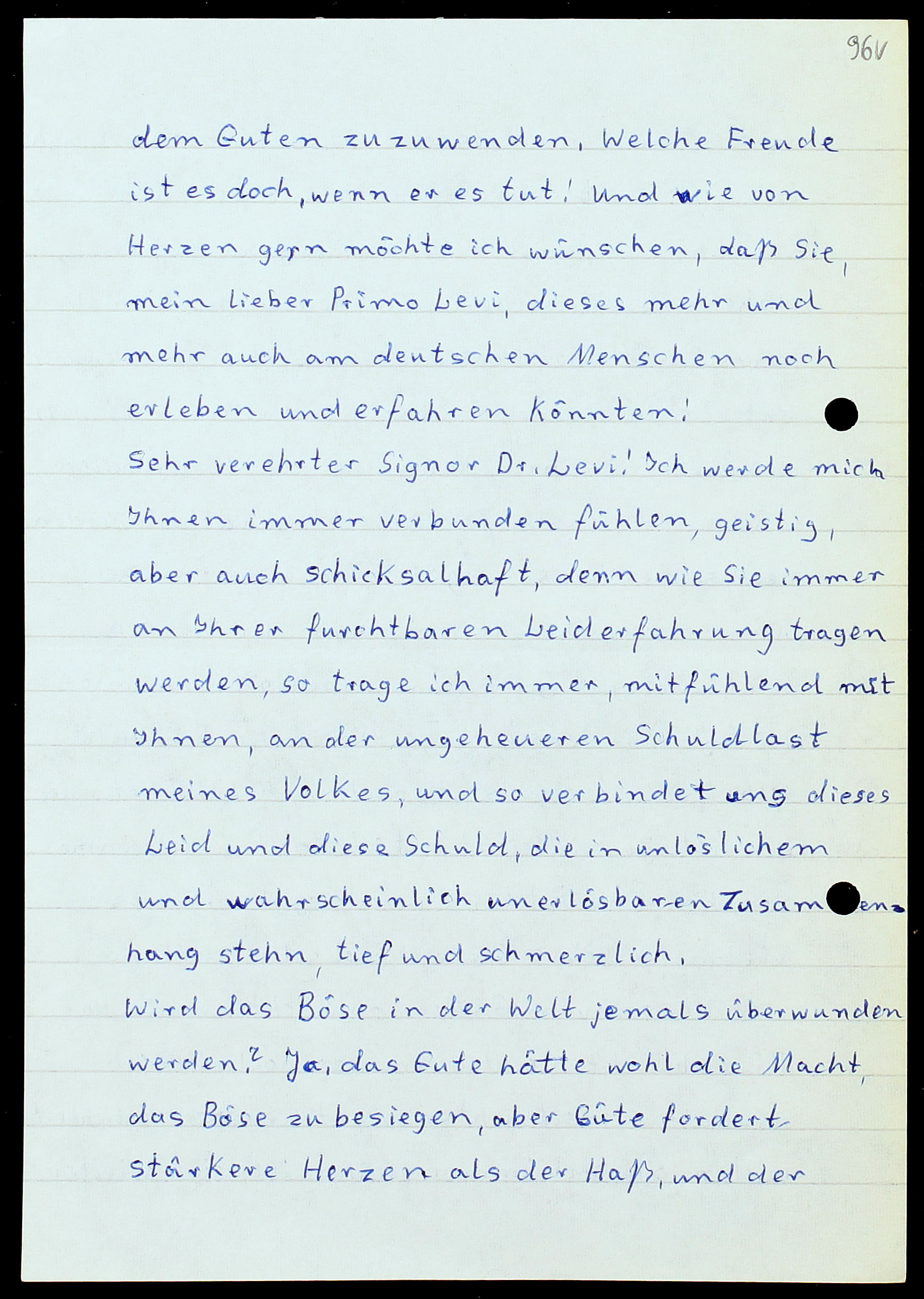
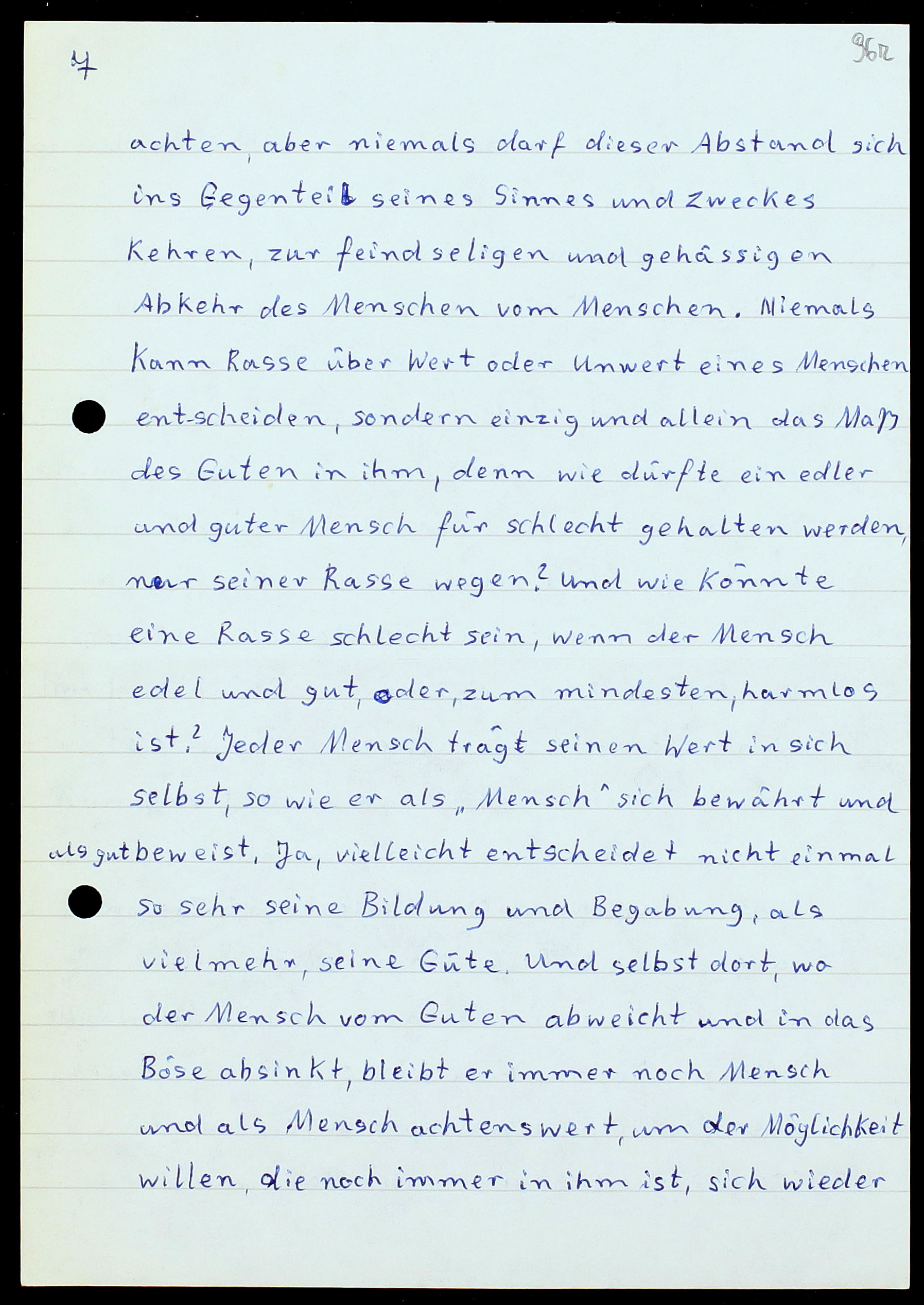
Es mag wohl jeder Mensch eine eigene Welt für sich sein, unergründlich und sich selber oft nicht klar, unheimlich in seinen Möglichkeiten des Guten und des Bösen, eben “ein Mensch!” Es mag die Notwendigkeit eines gewissen Abstandes zuweilen geltend werden, eine achtungsvollen, feinfühligen Rücksichtnahme und erfurchtvollen zurückhaltung vor der Person des Anderen, um seine innere Freiheit und freie Entfaltung seiner Eigenart zu gewährleisten und seine Rechte und Würde zu achten, aber niemals darf dieser Abstand sich ins Gegenteil seines Sinnes und zweckes Kehren, zu feindseligen und gehässigen Abkehr des Menschen von Menschen. Niemals kann Rasse über Wert oder Unwert eines Menschen entscheiden, sondern einzig und allein das Maß des Guten in ihm, denn wie dürfte ein edler und guter Mensch für schlecht gehalten werden, nur seiner Rasse wegen? Und wie könnte eine Rasse schlecht sein, wenn der Mensch edel und gut, oder, zum mindesten, harmlos ist? Jeder Mensch trägt seinen Wert in sich selbst, so wie er als “Mensch” sich bewährt und als gut beweist. Ja, vielleicht entscheidet nicht einmal so sehr seine Bildung und Begabung, als vielmehr, seine Bildung und Begabung, als vielmehr, seine Güte. Und selbst dort, wo der Mensch vom Guten abweicht und in das Böse absinkt, bleibt er immer noch Mensch und als Mensch achtenswert, um der Möglichkeit willen, die noch immer in ihm ist, sich wieder dem Guten zuzuwenden. Welche Freunde ist es doch, wenn er es tut! Und wie von Herzen gern möchte ich wünschen, daß Sie, mein lieber Primo Levi, dieses mehr und mehr auch am deutschen Menschen noch erleben und erfahren könnten!
Sehr verehrter Signor Dr. Levi! Ich werde mich Ihnen immer verbunden fühlen, geistig, aber auch Schicksalhalf, denn wie Sie immer an Ihrer furchtbaren Leiderfahrung tragen werden, so trage ich immer, mitfühlend mit Ihnen, an der ungeheueren Schuldlast meines Volkes, und so verbindet uns dieses Leid und diese Schuld, die in unlöslichem und wahrscheinlich unerlösbaren Zusammenhang stehn, tief und schmerzlich.
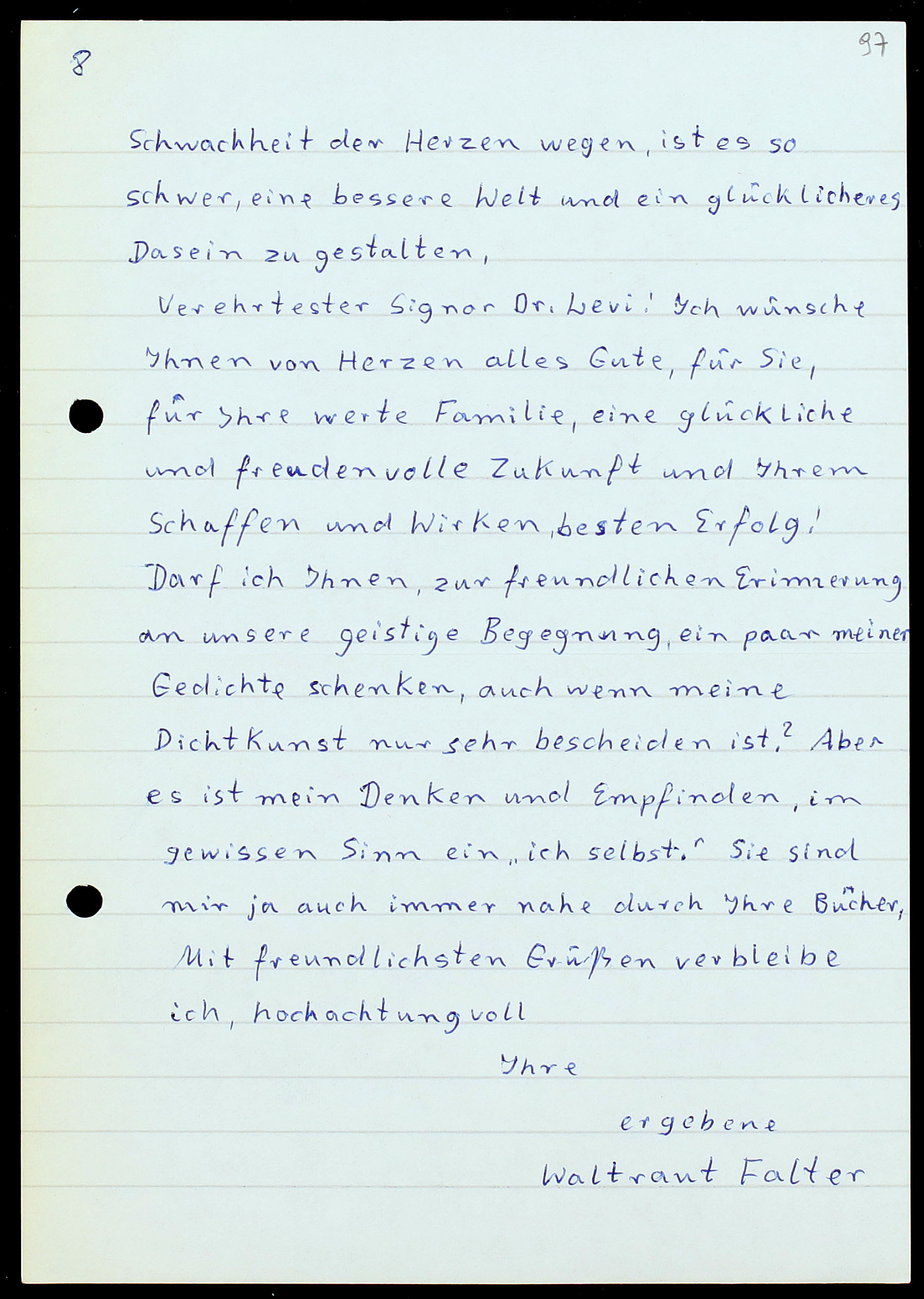
Wird das Böse in der Welt jemals überwunden werden? Ja, das Gute hätte wohl die Macht, das Böse zu besiegen, aber Güte fordert, stärkere Herzen als der Haß, und der Schwachheit der Herzen wegen, ist es so schwer, eine bessere Welt und ein glücklicheres Dasein zu gestalten.
Verhertester Signor Dr. Levi! Ich wünsche Ihnen von Herzen alles Gute, für Sie, für Ihre werte Familie, eine glückliche und freudenvolle Zukunft und Ihrem Schaffen und Wirken, besten Erfolg!
Darf ich Ihnen, zur freundlichen Erinnerung an unsere geistige Begegnung, ein paar meiner Gedichte schenken, auch wenn meine Dichtkunst nur sehr bescheiden ist? Aber es ist mein Denken und Empfinden, im gewissen Sinn ein “ich selbst”. Sie sind mir ja auch immer nahe durch Ihre Bücher.
Mit freundlichsten Grüßen verbleibe ich, hochachtung voll
Ihre
ergebene
Waltraut Falter
20 agosto 1969
Stimatissimo Signor Dott. Primo Levi!
La Sua gentile e cordiale risposta alle mie lettere mi spinge ancora una volta a scriverLe, per esprimerLe il mio più sentito ringraziamento. Purtroppo posso farlo solo in tedesco, perché ignoro altre lingue e mio nipote, che pure mi ha tradotto con grande cura la Sua preziosa lettera, non padroneggia l’inglese abbastanza da osare scrivere la mia lettera per Lei in inglese.
Stimato Signor Dottor Levi, sapere che il Suo compito – quello di richiamare gli uomini, e in particolare noi tedeschi, alla riflessione – e la reazione a questo Suo appello Le abbiano dato in qualche modo conforto e soddisfazione mi rassicura un po’ e mi rallegra per Lei. Ma ciò non basta a placare la violenta tempesta che mi infuria dentro. Lei mi ha aperto gli occhi sull’abisso, una voragine così piena di dolori spaventosi e di colpe tremende, che mi vergogno della mia stessa capacità di essere felice, anche solo per un’ora della mia esistenza.
Il mio pensiero non trova più pace. Questo tema – i crimini orrendi e di una gravità incommensurabile commessi dal mio popolo contro l’umanità – mi aveva già profondamente scossa e tormentata, ma mai in modo così pressante e sconvolgente come ora, dopo questo incontro spirituale, per me così significativo, con Lei, la Sua personalità, il Suo destino e le riflessioni contenute nei Suoi libri. Così questo tema tanto serio è diventato per me un fenomeno esistenziale, un compito al quale voglio e devo rispondere, se voglio essere all’altezza Sua, della mia coscienza e delle esigenze del mio cuore. Mi sento irresistibilmente spinta a fare qualcosa, ad aiutare, a espiare! Ma che cosa posso fare? Che cosa devo fare? Si può, in questo caso, fare davvero qualcosa di efficace e di giusto?
Questa terribile colpa del mio popolo si erge, tormentosa, fra me e Lei e fra me e il mio popolo, ed è questo l’aspetto più orrendo: è “il mio popolo” ad aver causato a Lei e al Suo popolo sofferenze così tremende, e perciò io partecipo di questa colpa e divento colpevole anch’io, poiché devo condannare e respingere con il più profondo disgusto del cuore e della coscienza ciò che il mio popolo ha fatto, e così facendo mi pongo contro il mio stesso popolo, dal quale tuttavia non posso, non devo separarmi, poiché io sono e resto figlia di questo popolo e lo amo come si amano padre e madre. Ma proprio perché mi sento così legata al mio popolo, divento colpevole verso di Lei, caro Primo Levi, e verso i Suoi compagni di sofferenza: non dovrei forse maledire il mio stesso popolo per tutte le sofferenze inflitte a Lei e al Suo popolo? E non Le suona forse amaro, come un insulto, se io – una di quelle tedesche – Le parlo della forza della bontà, che sola può vincere il male, e se invito a essere buoni, dopo tutte le atrocità che Lei ha subito per mano nostra? Non percepisce questo forse come se io, con tale atteggiamento, valutassi troppo leggermente il peso della colpa tedesca e delle Sue sofferenze? E le conseguenze dolorose che ancora porta in sé? Penso al Suo sogno angoscioso di allora – quello di non essere ascoltato e compreso – e temo di darle quella stessa dolorosa impressione, poiché, se volessi farLe davvero giustizia, io e tutti i tedeschi dovremmo forse disperare e impiccarci, dopo ciò che abbiamo fatto a Lei e al Suo popolo. Eppure io cerco una via di speranza, per me e per il mio popolo, per uscire da questa colpa. – Tutto questo e molto altro ancora medito di continuo. Mi tormento senza sosta con questo problema insolubile e non so come fare giustizia a Lei e, insieme, al mio popolo. Mi diventa sempre più chiaro che una colpa tanto immensa non può essere cancellata, poiché da quella colpa è scaturita una sofferenza così incalcolabile e orrenda, e di fronte a questa colpa si erge un esercito sterminato di vittime innocenti, uccise e torturate, che accusano. Ma se lasceremo sempre questa colpa dentro di noi e fra di noi, non ci libereremo mai dal male: esso continuerà a propagarsi in noi e attraverso di noi, crescendo in potere e forza distruttiva, spingendo gli uni all’azione malvagia e gli altri alla vendetta e alla rappresaglia, odio contro odio, dolore da dolore, alimentandosi e accrescendosi a vicenda dalla spaventosa fecondità della malvagità. Un seme terribile e diabolico, dal quale maturano morte e rovina: questa è la colpa più grave del mio popolo, aver seminato questo seme velenoso. Ah! Spesso mi sento che preferirei non vivere più di fronte a tutto questo. Ma so che disperarsi, spezzarsi e soccombere non renderebbe nulla di quanto è accaduto non accaduto, né riparerebbe alcunché. Sarebbe piuttosto una fuga dalla responsabilità e dal peso che, come tedesca, mi deriva da questa immane colpa del mio popolo: una fuga dal compatire e dal soffrire con Lei. Sì, una fuga! Una fuga codarda <…> <…> del mio f<…> <….> per <….>! . Non si risolve né si supera nulla fuggendo, e ciò che non si può cambiare non può essere affrontato in altro modo se non assumendolo e portandolo su di sé. Nell’accettazione c’è pur sempre una speranza di superamento, e io ho davanti agli occhi Lei, mio caro e coraggioso Primo Levi, come esempio unico e incoraggiante. Così voglio cercare di resistere e servire il bene!
Forse questa perseveranza e questa resistenza, questo condividere con Lei il dolore e condividere con il mio popolo il peso schiacciante della colpa, questo accogliere con amore e pazienza ciò che è puramente insopportabile e straziante, è l’unica cosa che posso davvero fare per Lei e, insieme, per il mio popolo nella sua terribile colpa e vergogna. E se la mia compassione potesse darLe un po’ di conforto, ciò mi darebbe il coraggio e la forza di portare con fermezza la mia parte del peso, che il folle delirio di potere crudele e omicida del mio popolo ha imposto a tutti noi. Voglio impegnarmi a non cedere di fronte al potere del male, ma a credere sempre nel bene e a realizzarlo.
Per quanto sia di conforto, secondo il Suo interessante racconto, che alcuni dei Suoi compagni di sofferenza abbiano ritrovato una vita più felice, tanto più mi ha colpito e sconvolto sapere che il buon Lorenzo è finito così miseramente, spezzato da questo mondo crudele e colpevole e disperato di fronte a un’umanità disumana e senza cuore. Anche lui, in un certo senso, è dunque diventato una delle innumerevoli vittime di quel tempo orrendo!
Il suo triste destino mi tocca particolarmente, perché era una delle persone più amabili e migliori del Suo ambiente di allora, ed è passato, come un angelo di bontà, attraverso quell’inferno di odio. Insieme alla figura luminosa della bambina innocente Emilia e del ragazzo sensibile Schlome,[1] penso ora a Lorenzo, nella mia dolorosa tristezza, quando guardo il Suo ritratto giovanile, allegro e gioioso, che ho ritagliato da un giornale, e mi rattristo quando lo confronto con la Sua foto successiva sulla quarta di copertina del Suo libro: da questa foto parla, chiaro e sconvolgente, tutto ciò che Lei ha sofferto e perduto. Mi travolge ogni volta l’atroce accusa che sebbene muta, pure emergepotente, incisiva e straziante da queste due immagini, più di quanto le parole possano esprimere. Stimatissimo Signor Dott. Levi, desidero ancora una volta ringraziarLa di cuore per tutto il bene che ho ricevuto da Lei! Questo incontro spirituale con Lei ha avuto per me e per la mia vita interiore un impatto profondo e un significato enorme, mi ha guidatocon forza ristoratrice in un camminodi maggiore chiarezza e consapevolezza; e al tempo stesso le Sue opere, dal punto di vista letterario, sono per me un’esperienza felicissima e appassionante, tra le più belle, elevate e coinvolgenti che abbia mai vissuto, e per questo sento che sarò per sempre legata a Lei da un immenso debito di riconoscenza. Un debito per me onorevole e che mi riempie il cuore di gioia, poiché niente è più grande e più bello che incontrare una persona davvero buona e nobile d’animo; e quanta bontà e comprensione maturate nella più profonda sofferenza traspaiono dai Suoi libri! Caro Primo Levi! Non è mia abitudine adulare, e io stessa nutro grande diffidenza verso le lusinghe, perché so che “ci si può affidare con più tranquillità a un nemico sincero che a un amico adulatore”. Ma nella Sua vita Lei ha subito così tante amare e ingiustissime umiliazioni per mano di noi diavoli tedeschi, che mi sembra giusto e doveroso che uno di loro Le dica anche il bene e Le manifesti il rispetto e il riconoscimento che Le sono dovuti. E così mi permetto di dirLe che La considero una delle persone più nobili, buone, gentili e intellettualmente elevate che si possano mai incontrare nella vita. Mi riempie di bruciante vergogna e indignazione pensare alle infamie che Le abbiamo inflitto noi tedeschi e al fatto che la più stupida di tutte le forme di arroganza, il delirio razziale, abbia potuto ergersi, nel mio popolo, a parola d’ordine dell’odio e causare devastazioni così spaventose da costringere il mondo intero, preso da orrore e disgusto, a voltargli le spalle. Io credo che superbia e odio razziale siano sempre segno della più bassa primitività e meschinità intellettuale e di una vanità e arroganza senza limiti. Tra noi tedeschi, incomprensibilmente, questo culto razziale è degenerato in un’ossessione diabolica e in aberrazioni senza limiti, sfociando in orge spaventose di odio sfrenato alle quali, con spietata freddezza e crudeltà disumana, sono state sacrificate senza scrupoli innumerevoli persone innocenti e preziose. E questo è accaduto proprio al mio popolo, al quale un tempo era così caro il verso del suo grande poeta: «Sia nobile l’uomo, soccorrevole e buono!»– È davvero inconcepibile! Si vorrebbe morire di dolore e di vergogna e impazzire, quando ci si pensa.
Può darsi che ogni uomo sia un mondo a sé, insondabile e spesso oscuro a sé stesso, inquietante nelle possibilità che ha di compiere il bene e il male, appunto “un uomo”! Può darsi che a volte sia necessaria una certa distanza, un rispettoso, delicato riguardo e una reverente discrezione verso l’altra persona, per garantire la sua libertà interiore e il libero sviluppo della sua individualità, rispettandone la dignità e i diritti. Ma questa distanza non deve mai rovesciarsi nel contrario del suo significato e del suo scopo, ovveronell’allontanamento ostile e malevolo dell’uomo dall’uomo. Mai la razza può decidere del valore o disvalore di un essere umano, questo dipende solo e unicamente dalla misura del bene che è in lui: come potrebbe un uomo nobile e buono essere considerato cattivo solo per la sua appartenenza a una razza? E come potrebbe una razza essere cattiva, se l’uomo è nobile e buono, o almeno innocuo? Ogni uomo porta in sé il proprio valore, così come si rivela “uomo” e si dimostra buono. Sì, forse ciò che conta davvero non è tanto la sua cultura o il suo talento, quanto piuttosto la sua bontà. E perfino dove l’uomo devia dal bene e sprofonda nel male, rimane pur sempre uomo e come tale degno di rispetto, per la possibilità che è ancora in lui di tornare al bene. Che gioia, quando questo accade! E quanto vorrei di cuore che Lei, mio caro Primo Levi, potesse vederlo e sperimentarlo ogni giorno di più anche nell’uomo tedesco!
Stimatissimo Signor Dott. Levi! Mi sentirò sempre legata a Lei, spiritualmente, ma anche nel destino, poiché come Lei porterà sempre con sé il Suo terribile vissuto di sofferenza, così io porto sempre, partecipe con Lei, l’immane peso della colpa del mio popolo, e così questo dolore e questa colpa, indissolubilmente e forse irrimediabilmente legati l’uno all’altra, ci uniscono in modo profondo e doloroso.
Il male nel mondo sarà mai sconfitto? Sì, il bene avrebbe certo il potere di vincere sul male, ma la bontà esige cuori più forti dell’odio, e per la debolezza dei cuori è così difficile costruire un mondo migliore e un’esistenza più felice.
Stimatissimo Signor Dott. Levi, Le auguro di cuore ogni bene, per Lei, per la Sua cara famiglia, un futuro felice e gioioso e il miglior successo alla Sua opera e al Suo lavoro!
Mi permetta, come confortante ricordo del nostro incontro spirituale, di regalarLe alcune mie poesie, anche se la mia arte poetica è molto modesta. Ma sono il mio pensiero e il mio sentire, in un certo senso “me stessa”. Lei mi è sempre vicino con i Suoi libri.
Con i miei più cordiali saluti resto, con grande stima, Sua devota
Waltraut Falter
August 20, 1969
Dear Mr. Primo Levi!
Your kind and friendly reply to my letters has prompted me to write to you again to express my heartfelt thanks. Unfortunately, I can only write in German, as I am unfamiliar with other languages, and although my nephew translated your letter to me very well, he does not have a sufficient command of English to dare to write my letter to you in English.
Esteemed Mr. Levi, The fact that your task of calling on people, and especially us Germans, to reflect, and the response to your call, gave you some comfort and satisfaction reassures me a little and makes me happy for you, but it is not enough to calm the violent storm within me. You have opened my eyes to the depths, to an abyss so full of terrible suffering and appalling guilt that I am ashamed of my ability to ever be happy again in my entire existence.
My thoughts are no longer at rest. This topic, the horrific, immeasurably grave crimes committed by my people against humanity, has deeply moved and preoccupied me before, but never as urgently and disturbingly as now, since this encounter with you, your personality, your fate, and your messages and thoughts about it in your books, which has been so impressive and significant for me. As a result, this serious topic has become a phenomenon in my own existence; a task that I want to and must face if I am to stand before you, my conscience, and the demands of my own heart. I feel an irresistible urge to do something, to help, to atone! But what can I do? What should I do? Is it even possible to do anything effective and right in this case? This terrible guilt of my people stands, tormenting, between me and your people and between me and my people, and that is the most horrible thing, because it is “my people” who caused your and your people’s terrible suffering, and therefore I share in this guilt and become guilty myself, because I must condemn and reject what my people have done with the deepest abhorrence of my heart and conscience, and thus I oppose my own people, from whom I cannot and must not withdraw myself, because I am and remain a child of this people and love them as one loves one’s father and mother. But because I feel so deeply connected to my people, I am guilty towards you, my dear Primo Levi, and your fellow sufferers, for should I not curse my own people for all the suffering they have inflicted on you and your people? And would it not touch you bitterly, like a mockery, if I—one of the Germans—spoke of the power of goodness, which alone can overcome evil, and if I called for goodness after all the cruelty you have experienced at the hands of us Germans? Do you not feel that, with such an attitude, I am underestimating the full weight of German guilt and the suffering you have endured? And that I am not sufficiently grasping, understanding, acknowledging, and lamenting the agonizing aftereffects in you? I think of your nightmare at that time, of not being heard and understood, and I am afraid of causing you this painful impression, because if I want to do you justice, I and all Germans would have to despair and hang ourselves after what we have done to you and your people. And yet I am searching for a hopeful way for myself and my people to emerge from this guilt. I think about all this and much more over and over again. I am constantly tormented by this unsolvable problem and do not know how I can do justice to you and my people at the same time. It is becoming increasingly clear to me. Such an enormous debt cannot be repaid, a debt that has caused such immeasurable, appalling suffering and is confronted by such a vast army of cruelly murdered and tortured innocent victims! But if we allow this guilt to remain within us and between us, we will never be free of evil; it will continue to fester within us and through us, gaining power and destructive force, driving some to evil deeds, others to revenge and retribution, hatred against hatred, suffering from suffering, mutually nourishing and intensifying each other from the violent fertility of malice. A terrible, diabolical seed from which death and destruction ripen, and that is the heaviest guilt of my people, to have sown this poisonous seed. Alas! Often I feel that I would rather not live with all this. But I know that despair, breaking down, and perishing would neither undo what has already happened nor make anything right. It would be more like fleeing from the obligatory burden and responsibility that arises for me, as a German, from the enormous guilt of my people, and like shaking off my compassion and agonizing empathy for you. Yes, an escape! A cowardly escape <…> <…> from my <…> <….> to <….>! You cannot solve or overcome anything you flee from, and what you cannot change must be accepted and borne. In enduring there is at least a hope of overcoming, and I have you, my dear, brave Primo Levi, as a uniquely great and encouraging example before my eyes. SO I shall try to persevere and serve the good! Perhaps this perseverance and endurance, in sympathy with you and in sharing the crushing burden of guilt of my people, this loving and patient acceptance and endurance of the almost unbearable and heartbreaking, is the only thing I can really do for you and at the same time for my people in their terrible guilt and shame. And if my compassion could comfort you a little, it would give me the courage and strength to bravely bear my share of the heavy burden that the diabolical madness of my people’s cruel, murderous, arrogant authority has imposed on us all. I will strive not to resign myself to the power of evil, but to believe in goodness again and again and to make it a reality.
Dearest Mr. Levi! As gratifying as it is, according to your interesting report, that some of your fellow sufferers have found their way back to a happier life, I was deeply saddened and upset that good Lorenzo came to such a miserable end, broken by this cruel, guilty world and despairing of a heartless, inhuman humanity. In a sense, he too has become one of the countless victims of that terrible time! His sad fate touches me particularly deeply, for he was one of the most lovable and best people in your circle at that time, and he went through that hell like an angel of goodness. Alongside the luminous figure of Emilia, the innocent child, and Schlome,[1] the sensitive boy, it is now Lorenzo whom I also think of with painful sadness when I look at your own graceful, joyful portrait from your youth, which I cut out of the newspaper, and mourn when I compare it with your later picture on the back of your book, which clearly and poignantly speaks of everything you suffered and lost. Again and again, I am overwhelmed by the terrible accusation that speaks silently but powerfully and heartbreakingly from these two pictures, more than words could ever express. Dearest Mr. Levi! I would like to thank you once again most sincerely for all the good things I have received through you! This intellectual encounter with you has had such a profound impact and significance on me and my intellectual life, so full of helpful, healing power and a path to richer clarity and insight. At the same time, your works are, from a literary point of view, a joyful and inspiring experience of the most beautiful, best, and most appealing, so that I am forever indebted to you and bound to you with the greatest gratitude. This is an honorable and heartwarming duty for me, for it is the greatest and most beautiful thing for me to be able to meet a truly good and noble person, and how much kindness and understanding, matured in such deep suffering, speaks from your books! My dear Primo Levi! It is not my nature to flatter, and I myself am very distrustful of flattery, for I know that “one can confide more certainly in an honest enemy than in a flattering friend.” But you have experienced so much bitter and unjust degradation in your life at the hands of us German devils, that it is only right and proper that a German devil should also tell you the good things and express the high esteem and recognition you deserve. And so I can tell you that I consider you one of the noblest, kindest, best, and most intellectually superior people one could ever meet in life. I am filled with burning shame and indignation when I think of the disgrace that we Germans have brought upon you, and that the most stupid of all forms of arrogance, racial fanaticism, has caused such terrible devastation in my people as a slogan of hatred that the whole world, seized with horror and disgust, must turn away. I believe that racial arrogance and racial hatred are always signs of the lowest spiritual primitiveness and meanness and of boundless narrow-minded vanity and arrogance. Among us Germans, incomprehensibly, this cult of race has escalated into a diabolical obsession and boundless extremes, degenerating into gruesome orgies of unbridled hatred, to which countless innocent, valuable human beings were unscrupulously sacrificed, coldly and mercilessly, with inhuman cruelty. And this in my people, who once valued so highly the words of their great poet: “Be noble, helpful, and good!” Truly, it is inconceivable! One could die of pain and shame and go mad just thinking about it.
Every human being may well be a world unto themselves, unfathomable and often unclear to themselves, uncanny in their potential for good and evil, simply “a human being!” It may sometimes be necessary to maintain a certain distance, to show respectful, sensitive consideration and reverential restraint towards the other person in order to guarantee their inner freedom and free development of their individuality and to respect their rights and dignity, but this distance must never be turned into the opposite of its meaning and purpose, into hostile and hateful alienation of people from people. Race can never determine the value or worthlessness of a person, but only the measure of good in them, for how could a noble and good person be considered bad simply because of their race? And how could a race be bad if the person is noble and good, or at least harmless? Every person carries their value within themselves, as they prove themselves as a “human being” and demonstrate their goodness. Yes, perhaps it is not so much his education and talent that matter, but rather his kindness. And even when a person deviates from goodness and sinks into evil, he still remains human and worthy of respect as a human being, because of the possibility that still exists within him to turn back to goodness. What a friend he is when he does so! And how I wish with all my heart that you, my dear Primo Levi, could experience and learn this more and more in the German people as well!
Esteemed Mr. Levi, I will always feel connected to you, spiritually, but also in terms of fate, for just as you will always bear the burden of your terrible suffering, so I will always bear, in sympathy with you, the enormous burden of guilt of my people, and so this suffering and this guilt, which are inextricably and probably irredeemably linked, connect us deeply and painfully.
Will evil in the world ever be overcome? Yes, goodness would have the power to defeat evil, but goodness requires hearts stronger than hatred, and because of the weakness of hearts, it is so difficult to create a better world and a happier existence.
Dear Dr. Levi! I wish you all the best, for you, for your dear family, a happy and joyful future, and every success in your work and endeavors!
May I give you a few of my poems as a friendly reminder of our intellectual encounter, even if my poetry is very modest? But it is my thinking and feeling, in a certain sense a version of “me myself.” You are always close to me through your books.
With warmest regards and high esteem,
Yours
sincerely,
Waltraut Falter
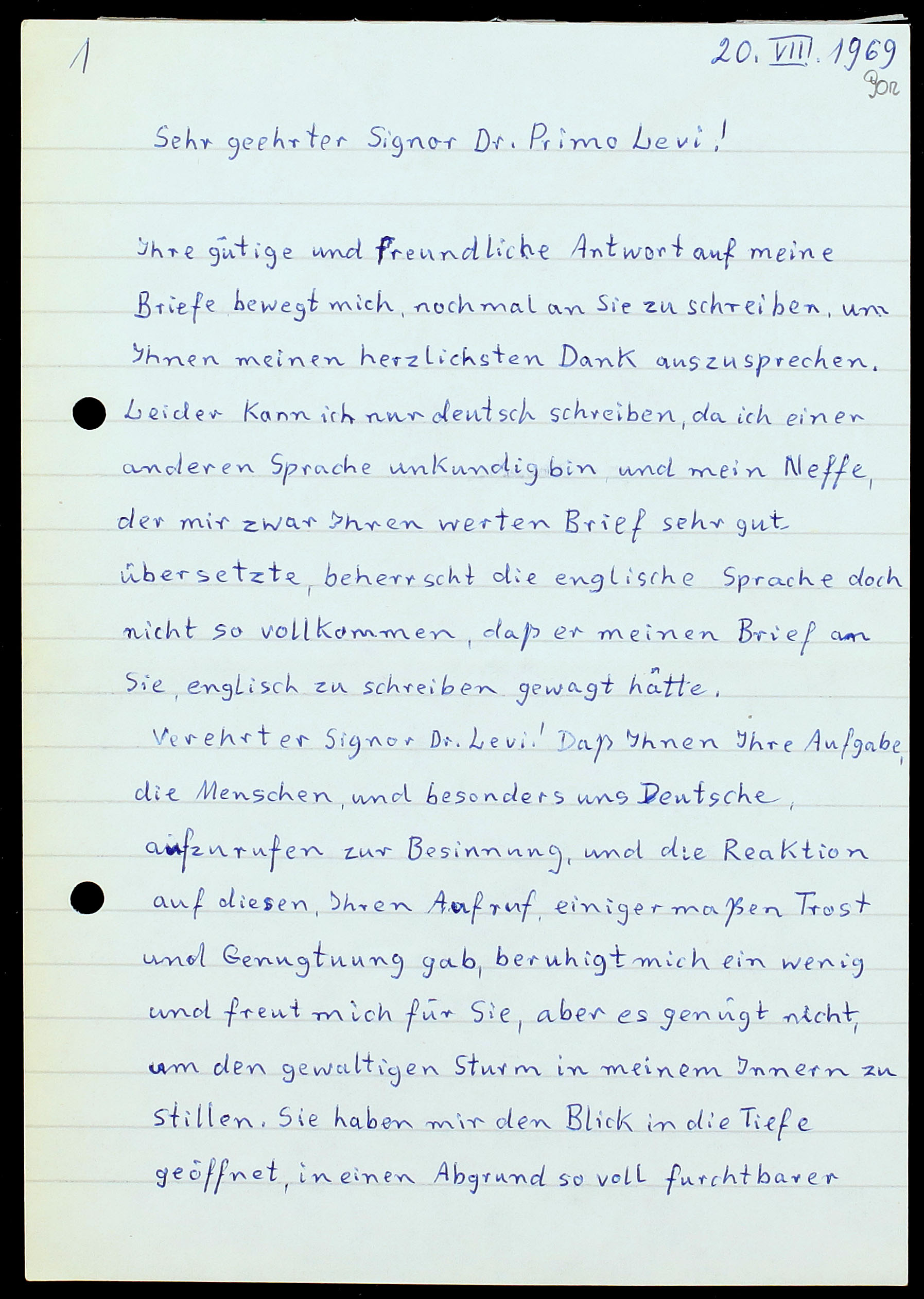
20. VIII. 1969
Sehr geehrter Signor Dr. Primo Levi!
Ihre gütige und freundliche Antwort auf meine Briefe bewegt mich nochmal an Sie zu schreiben, um Ihnen meinen herzlichsten Dank auszusprechen. Leider kann ich nur deutsch schreiben, da ich einer anderen Sprache unkundig bin und mein Neffe, der mir zwar Ihnen werten Brief sehr gut übersetzte, beherrscht die englische Sprache doch nicht so vollkommen, daß er meinen Brief an Sie, englisch zu schreiben gewagt hätte.
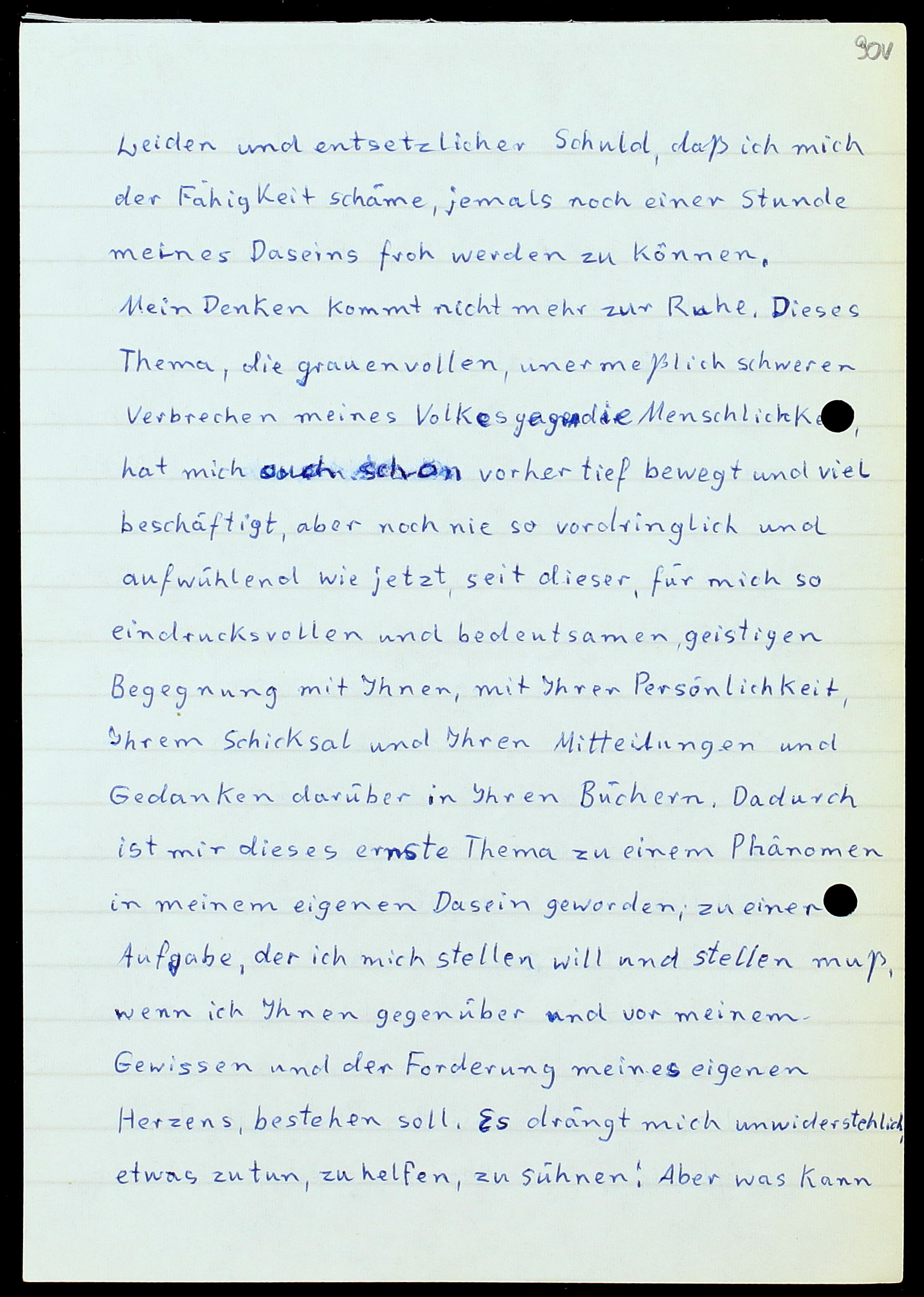
Verehrter Signor Dr. Levi! Daß Ihnen Ihre Aufgabe, die Menschen, und besonders uns Deutsche, aufzurufen zur Besinnung, und die Reaktion auf diesen, Ihren Aufruf, einiger maßen Trost und Genugtuung gab, beruhigt mich ein wenig und freut mich für Sie, aber es genügt nicht, um den gewaltigen Sturm in meinem Innern zu stillen. Sie haben mir den Blick in die Tiefe geöffnet, in einen Abgrund so voll furchtbaren Leiden und entsetzlicher Schuld, daß ich mich der Fähigkeit schäme, jemals noch einer Stunde meines Daseins froh werden zu können.
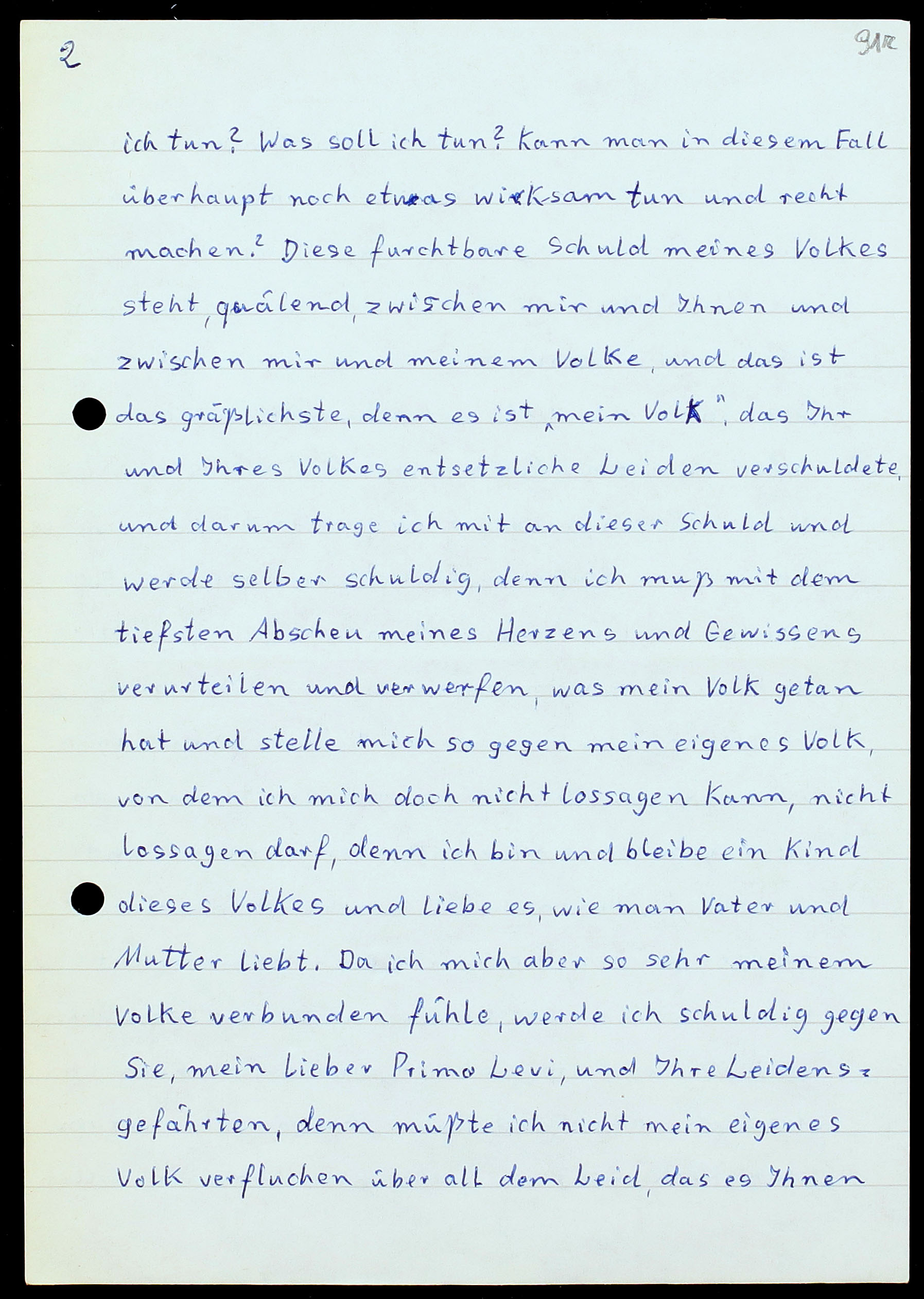
Mein Denken kommt nicht mehr zur Ruhe. Dieses Thema, die grauenvollen, unermeßlich schweren verbrechen meines Volkes gegen die Menschlichkeit, hat mich vorher tief bewegt und viel beschäftigt, aber noch nie so verdringlich und aufwühlend wie jetzt, seit dieser, für mich so eindrucksvollen und bedeutsamen, geistigen Begegnung mit Ihnen, mit Ihren Persönlichkeit, Ihrem Schicksal und Ihren Mitteilungen und Gedanken darüber in Ihren Büchern. Dadurch ist mir dieses ernste Thema zu einem Phänomen in meinem eigenen Dasein geworden; zu einer Aufgabe, der ich mich stellen will und stellen muß, wenn ich Ihnen gegenüber und vor meinem Gewissen und der Forderung meines eigenen Herzens, bestehen soll. Es drängt mich unwiderstehlich, etwas zu tun, zu helfen, zu sühnen! Aber was kann ich tun? Was soll ich tun? Kann man in diesem Fall überhaupt noch etwas wirksam tun und recht machen? diese furchtbare Schuld meines Volkes steht, quälend, zwischen mir und Ihren und zwischen mir und meinem Volke, und das ist das gräßlichste, denn es ist “mein Volk”, das Ihr und Ihres Volkes entsetzliche Leiden verschuldete, und darum trage ich mit an dieser Schuld und werde selber schuldig, denn ich muß mit dem tiefsten Abscheu meines Herzens und Gewissens verurteilen und verwerfen, was mein Volk getan hat und stelle mich so gegen mein eigenes Volk, von dem ich mich doch nicht lossagen kann, nicht lossagen darf, denn ich bin und bleibe ein Kind dieses Volkes und liebe es, wie man Vater Mutter libet. da ich mich aber so sehr meinem Volke verbunden fühle, werde ich schuldig gegen Sie, mein lieber Primo Levi, und Ihre Leidensgefährten, denn müßte ich nicht mein eigenes Volk verfluchen über all dem Leid, das es Ihnen und Ihrem Volke angetan hat? Und berührtes Sie nicht bitter, wie ein Hohn, wenn ich – eine dieser Deutschen – von der Macht der Güte spreche, die allein das Böse überwinden kann, und wenn ich zum Gutsein auffordere, nach all der Grausamkeit, die Sie durch uns Deutsche erfahren haben? Empfinden Sie das nicht so, als würde ich, mit einer solchen Haltung, die ganze Schwere der deutschen Schuld und Ihres erlittenen Leides, zu leicht bemessen? Und die qualvollen Nachwirkungen in Ihnen zu wenig erfassen, verstehen, beachten und mit Ihnen beklagen? Ich denke an Ihren damaligen Angsttraum, das nicht Angehört und verstanden-werdens und habe Angst, Ihnen diesen schmerzlichen Eindruck zu verursachen, denn, wenn ich Ihnen gerecht werden will, müßte ich, und müßten alle Deutschen doch verzweifeln und sich aufhängen, nachdem was wir Ihnen und Ihrem Volk angetan haben? Und doch suche ich nach einem hoffnungsvollen Weg für mich und mein Volk, aus dieser Schuld heraus zukommen. – All das und vieles andere noch, bedenke ich immer und immer wieder. Ich quäle mich mit diesem unlösbaren Problem ununterbrochen und weiß nicht, wie ich Ihnen und meinem Volke gleichzeitig gerecht werden kann. Es kommt mir immer klarer zum Bewußtsein. Es kann eine so unge heuere Schuld nicht getilgt werden, aus der so unermeßliches, entsetzliches Leid hervor gegangen ist, und der ein so gewaltiges Heer grausam hingemordeter und gequälter lebender unschuldiger Opfer, anklagend gegenüber steht! Wenn wir aber diese Schuld immer in uns und zwischen uns stehen lassen, werden wir nie vom Bösen loskommen, wind es sich stets in uns und durch uns fortpflanzen und an Machtgewalt und zerstörenden Wirkung gewinnen, in dem einen treibt es zur bösen Tat, in dem Anderen zu Rache und Vergeltung, Haß gegen Haß, Leid aus dem Leid, gegenseitig sich nährend und steigernd aus der heftigen Fruchtbarkeit der Bosheit. Ein furchtbare, teuflische Saat, aus der Tod und Verderben reift, und das ist die schwerste Schuld meines Volkes, diese Giftsaat gesät zu haben. Ach! Oft ist es mir zu Mut, daß ich am liebsten bei all dem nicht mehr leben möchte. aber ich weiß, ein Verzweifeln, zerbrechen und Untergehn würde weder an dem einmal Geschehen etwas ungeschehen, noch etwas gutmachen können. Es wäre eher wie eine Flucht vor der verpflichtenden Bürde und Verantwortung, die mir, als Deutsche, aus jener ungeheuren Schuld meines Volkes erwächst, und wie ein Abschütteln des Mitleidens und qualvollen Mitfühlens mit Ihnen. Ja, eine Flucht! Eine feige Flucht <…> <…> meines auf<…> <….> zu <….>! Man löst und bewältigt nichts, vor dem man flieht, und was man nicht ändern kann, dem ist nicht anders gerecht zu werden, als daß man es auf sich nimmt und trägt. Im Ertragen liegt immerhin eine Hoffnung des Überwindens, und ich habe Sie, mein lieber, tapferer Primo Levi, als einmalig großes und ermunterndes Beispiel vor Augen. SO will ich versuchen durchzuhalten und dem Guten zu dienen! Vielleicht ist dieses Ausharren und Standhalten, im Mitleiden mit Ihnen und im Mittragen an der erdrückenden Schuldlast meines Volkes, dieses liebende und geduldige Annehmen und Ertragen des schier Unerträglichen und Herzzerreißenden, das Einzige, was ich wirklich für Sie tun kann und gleichzeitig auch für mein Volk in seiner furchtbaren Schuld und Schande. Und wenn mein Mitleiden Sie ein wenig trösten könnte, dann würde mir das wohl den Mut und die Kraft geben, meinen Teil an der schweren Last, tapfer zu tragen, die der teuflische Wahnsinn eines grausamen, mörderischen Machthochmuts meines Volkes, uns allen aufgebürdet hat. Ich will mich bestreben, nicht vor der Machtgewalt des Bösen zu resignieren sondern immer wieder an das Gute zu glauben und es zu verwirklichen.
Verehrtester Signor Dr. Levi! So erfreulich es, Ihrem interessanten Bericht nach ist, daß einige Ihrer Leidens genossen in ein glücklicheres Leben zurückgefunden haben, so sehr hat es mich b<..>ürzt und aufgewühlt, daß der gute Lorenzo so elend zu Grunde gegangen ist, zerbrochen an dieser grausamen schuldigen Welt und verzweifelnd an einer herzlosen, unmenschlichen Menschheit. So ist auch er noch, in gewissem Sinn, eines der unzähligen Opfer jener furchtbaren Zeit geworden! Sein trauriges Schicksal geht mir besonders nahe, denn er war einer der liebenswertesten und besten Menschen Ihrer damaligen Umwelt und ist wie ein Engel der Güte durch jene Hölle des Hasses gegangen, und neben der Lichtgestalt des unschuldigen Kindes Emilia und dem feinfühligen Knaben Schlome,[1] ist es nun Lorenzo, an die ich auch in schmerzvoller Trauer denke, wenn ich Ihr eigenes anmutig frohes Jugendbildnis, das ich mir aus der Zeitung ausgeschnitten haben, betrachte und betrauere, wenn ich es mit Ihrem späteren Bild auf der Rückseite Ihres Buches vergleiche, aus dem, Klar und erschütternd, alles spricht, was Sie erlitten und verloren haben. Immer wieder überwältigt mich die furchtbare Anklage, die zwar stumm, aber mächtig eindringlich und herzzerreißend aus diesen beiden Bildern spricht, mehr, als Worte es auszudrücken vermöchten. Verehrtester Signor Dr. Levi! Ich möchte Ihnen nochmal herzlichst danken für alles Gute, das ich durch Sie empfangen durfte! Diese geistige Begegnung mit Ihnen, ist für mich und mein geistiges Leben von so tiefem Eindruck und großer Bedeutung, so voll helfender, heilsamer Kraft und Weg zu reicherer Klarheit und Erkenntnis und zugleich sind mir Ihre Werke in literarischer Hinsicht ein beglückendes und begeisterndes Erlebnis des schönsten und Besten und Ansprechendsten, so daß ich Ihnen für immer zu größtem Dank verpflichtet und verbunden bin. Eine mir ehrenvolle und herzbeglückende Pflicht, denn es ist für mich das Größte und schönste, einem wahren guter und edlen Menschen begegnen zu dürfen, und wie viel, in so tiefen Leid gereifte, Güte und Verstehen, spricht doch aus Ihren Büchern! Mein lieber Primo Levi! Es ist sonst nicht meine Art, zu schmeicheln, und ich selber habe großes Mißtrauen gegen Schmeicheleien, denn ich weiß: “Einem ehrlichen Feind kann man sich sorgloser anvertrauen, als einem schmeichelnden Freund”. Aber sie haben so viel bitterste und ungerechteste Herabsetzung in Ihrem Leben erfahren, durch uns deutsche Teufel, da ist es wohl recht und billig, daß so ein deutscher Teufel Ihnen auch das Gute sagt und Ihnen die Hochachtung und Anerkennung Kund tut, die Ihnen gebührt. Und so darf ich Ihnen wohl sagen daß ich Sie als einen der edelsten, gütigsten, besten und geistig hochstehendsten Menschen schätze, welchen man je im Leben begegnen könnte. Mit brennender Scham und Empörung erfüllt es mich, wenn ich an die Ihnen von uns Deutschen angetane Schmach denke, und daß der blödeste aller Hochmutsdünkel, der Rassenwahn, in meinem Volke, als Parole des Hasses, so furchtbare verheerungen anrichtete, daß die ganze Welt von Entsetzen und Abscheu erfaßt, sich abwenden muß. Ich glaube, Rassenhochmut und Rassenhaß ist immer ein Zeichen von niedrigster, geistiger Primitivität und Gemeinheit und einer grenzenlos bornierten Eitelkeit und Arroganz. Bei und Deutschen hat sich, unbegreiflicher Weise, dieser Rassenkult in eine teuflische Besessenheit und grenzenlose Extreme gesteigert, und ist in grauenvollen Orgien eines hemmungslosen Hasses ausgeartet, dem skrupellos unzählige unschuldige, wertvolle Mensche geopfert wurden, kalt und erbarmungslos, mit unmenschlicher Grausamkeit. Und das in meinem Volk, dem einst das Wort seines großen Dichters so viel gegolten hat: “Edel sei der Mensch, hilfreich und gut!” – Wahr<ß..>ig, es ist nicht zu fassen! Man möochte vor Schmerz und Scham vergehn und wahnsinnig werden, wenn man darüber nachdenkt.
Es mag wohl jeder Mensch eine eigene Welt für sich sein, unergründlich und sich selber oft nicht klar, unheimlich in seinen Möglichkeiten des Guten und des Bösen, eben “ein Mensch!” Es mag die Notwendigkeit eines gewissen Abstandes zuweilen geltend werden, eine achtungsvollen, feinfühligen Rücksichtnahme und erfurchtvollen zurückhaltung vor der Person des Anderen, um seine innere Freiheit und freie Entfaltung seiner Eigenart zu gewährleisten und seine Rechte und Würde zu achten, aber niemals darf dieser Abstand sich ins Gegenteil seines Sinnes und zweckes Kehren, zu feindseligen und gehässigen Abkehr des Menschen von Menschen. Niemals kann Rasse über Wert oder Unwert eines Menschen entscheiden, sondern einzig und allein das Maß des Guten in ihm, denn wie dürfte ein edler und guter Mensch für schlecht gehalten werden, nur seiner Rasse wegen? Und wie könnte eine Rasse schlecht sein, wenn der Mensch edel und gut, oder, zum mindesten, harmlos ist? Jeder Mensch trägt seinen Wert in sich selbst, so wie er als “Mensch” sich bewährt und als gut beweist. Ja, vielleicht entscheidet nicht einmal so sehr seine Bildung und Begabung, als vielmehr, seine Bildung und Begabung, als vielmehr, seine Güte. Und selbst dort, wo der Mensch vom Guten abweicht und in das Böse absinkt, bleibt er immer noch Mensch und als Mensch achtenswert, um der Möglichkeit willen, die noch immer in ihm ist, sich wieder dem Guten zuzuwenden. Welche Freunde ist es doch, wenn er es tut! Und wie von Herzen gern möchte ich wünschen, daß Sie, mein lieber Primo Levi, dieses mehr und mehr auch am deutschen Menschen noch erleben und erfahren könnten!
Sehr verehrter Signor Dr. Levi! Ich werde mich Ihnen immer verbunden fühlen, geistig, aber auch Schicksalhalf, denn wie Sie immer an Ihrer furchtbaren Leiderfahrung tragen werden, so trage ich immer, mitfühlend mit Ihnen, an der ungeheueren Schuldlast meines Volkes, und so verbindet uns dieses Leid und diese Schuld, die in unlöslichem und wahrscheinlich unerlösbaren Zusammenhang stehn, tief und schmerzlich.
Wird das Böse in der Welt jemals überwunden werden? Ja, das Gute hätte wohl die Macht, das Böse zu besiegen, aber Güte fordert, stärkere Herzen als der Haß, und der Schwachheit der Herzen wegen, ist es so schwer, eine bessere Welt und ein glücklicheres Dasein zu gestalten.
Verhertester Signor Dr. Levi! Ich wünsche Ihnen von Herzen alles Gute, für Sie, für Ihre werte Familie, eine glückliche und freudenvolle Zukunft und Ihrem Schaffen und Wirken, besten Erfolg!
Darf ich Ihnen, zur freundlichen Erinnerung an unsere geistige Begegnung, ein paar meiner Gedichte schenken, auch wenn meine Dichtkunst nur sehr bescheiden ist? Aber es ist mein Denken und Empfinden, im gewissen Sinn ein “ich selbst”. Sie sind mir ja auch immer nahe durch Ihre Bücher.
Mit freundlichsten Grüßen verbleibe ich, hochachtung voll
Ihre
ergebene
Waltraut Falter
20 agosto 1969
Stimatissimo Signor Dott. Primo Levi!
La Sua gentile e cordiale risposta alle mie lettere mi spinge ancora una volta a scriverLe, per esprimerLe il mio più sentito ringraziamento. Purtroppo posso farlo solo in tedesco, perché ignoro altre lingue e mio nipote, che pure mi ha tradotto con grande cura la Sua preziosa lettera, non padroneggia l’inglese abbastanza da osare scrivere la mia lettera per Lei in inglese.
Stimato Signor Dottor Levi, sapere che il Suo compito – quello di richiamare gli uomini, e in particolare noi tedeschi, alla riflessione – e la reazione a questo Suo appello Le abbiano dato in qualche modo conforto e soddisfazione mi rassicura un po’ e mi rallegra per Lei. Ma ciò non basta a placare la violenta tempesta che mi infuria dentro. Lei mi ha aperto gli occhi sull’abisso, una voragine così piena di dolori spaventosi e di colpe tremende, che mi vergogno della mia stessa capacità di essere felice, anche solo per un’ora della mia esistenza.
Il mio pensiero non trova più pace. Questo tema – i crimini orrendi e di una gravità incommensurabile commessi dal mio popolo contro l’umanità – mi aveva già profondamente scossa e tormentata, ma mai in modo così pressante e sconvolgente come ora, dopo questo incontro spirituale, per me così significativo, con Lei, la Sua personalità, il Suo destino e le riflessioni contenute nei Suoi libri. Così questo tema tanto serio è diventato per me un fenomeno esistenziale, un compito al quale voglio e devo rispondere, se voglio essere all’altezza Sua, della mia coscienza e delle esigenze del mio cuore. Mi sento irresistibilmente spinta a fare qualcosa, ad aiutare, a espiare! Ma che cosa posso fare? Che cosa devo fare? Si può, in questo caso, fare davvero qualcosa di efficace e di giusto?
Questa terribile colpa del mio popolo si erge, tormentosa, fra me e Lei e fra me e il mio popolo, ed è questo l’aspetto più orrendo: è “il mio popolo” ad aver causato a Lei e al Suo popolo sofferenze così tremende, e perciò io partecipo di questa colpa e divento colpevole anch’io, poiché devo condannare e respingere con il più profondo disgusto del cuore e della coscienza ciò che il mio popolo ha fatto, e così facendo mi pongo contro il mio stesso popolo, dal quale tuttavia non posso, non devo separarmi, poiché io sono e resto figlia di questo popolo e lo amo come si amano padre e madre. Ma proprio perché mi sento così legata al mio popolo, divento colpevole verso di Lei, caro Primo Levi, e verso i Suoi compagni di sofferenza: non dovrei forse maledire il mio stesso popolo per tutte le sofferenze inflitte a Lei e al Suo popolo? E non Le suona forse amaro, come un insulto, se io – una di quelle tedesche – Le parlo della forza della bontà, che sola può vincere il male, e se invito a essere buoni, dopo tutte le atrocità che Lei ha subito per mano nostra? Non percepisce questo forse come se io, con tale atteggiamento, valutassi troppo leggermente il peso della colpa tedesca e delle Sue sofferenze? E le conseguenze dolorose che ancora porta in sé? Penso al Suo sogno angoscioso di allora – quello di non essere ascoltato e compreso – e temo di darle quella stessa dolorosa impressione, poiché, se volessi farLe davvero giustizia, io e tutti i tedeschi dovremmo forse disperare e impiccarci, dopo ciò che abbiamo fatto a Lei e al Suo popolo. Eppure io cerco una via di speranza, per me e per il mio popolo, per uscire da questa colpa. – Tutto questo e molto altro ancora medito di continuo. Mi tormento senza sosta con questo problema insolubile e non so come fare giustizia a Lei e, insieme, al mio popolo. Mi diventa sempre più chiaro che una colpa tanto immensa non può essere cancellata, poiché da quella colpa è scaturita una sofferenza così incalcolabile e orrenda, e di fronte a questa colpa si erge un esercito sterminato di vittime innocenti, uccise e torturate, che accusano. Ma se lasceremo sempre questa colpa dentro di noi e fra di noi, non ci libereremo mai dal male: esso continuerà a propagarsi in noi e attraverso di noi, crescendo in potere e forza distruttiva, spingendo gli uni all’azione malvagia e gli altri alla vendetta e alla rappresaglia, odio contro odio, dolore da dolore, alimentandosi e accrescendosi a vicenda dalla spaventosa fecondità della malvagità. Un seme terribile e diabolico, dal quale maturano morte e rovina: questa è la colpa più grave del mio popolo, aver seminato questo seme velenoso. Ah! Spesso mi sento che preferirei non vivere più di fronte a tutto questo. Ma so che disperarsi, spezzarsi e soccombere non renderebbe nulla di quanto è accaduto non accaduto, né riparerebbe alcunché. Sarebbe piuttosto una fuga dalla responsabilità e dal peso che, come tedesca, mi deriva da questa immane colpa del mio popolo: una fuga dal compatire e dal soffrire con Lei. Sì, una fuga! Una fuga codarda <…> <…> del mio f<…> <….> per <….>! . Non si risolve né si supera nulla fuggendo, e ciò che non si può cambiare non può essere affrontato in altro modo se non assumendolo e portandolo su di sé. Nell’accettazione c’è pur sempre una speranza di superamento, e io ho davanti agli occhi Lei, mio caro e coraggioso Primo Levi, come esempio unico e incoraggiante. Così voglio cercare di resistere e servire il bene!
Forse questa perseveranza e questa resistenza, questo condividere con Lei il dolore e condividere con il mio popolo il peso schiacciante della colpa, questo accogliere con amore e pazienza ciò che è puramente insopportabile e straziante, è l’unica cosa che posso davvero fare per Lei e, insieme, per il mio popolo nella sua terribile colpa e vergogna. E se la mia compassione potesse darLe un po’ di conforto, ciò mi darebbe il coraggio e la forza di portare con fermezza la mia parte del peso, che il folle delirio di potere crudele e omicida del mio popolo ha imposto a tutti noi. Voglio impegnarmi a non cedere di fronte al potere del male, ma a credere sempre nel bene e a realizzarlo.
Per quanto sia di conforto, secondo il Suo interessante racconto, che alcuni dei Suoi compagni di sofferenza abbiano ritrovato una vita più felice, tanto più mi ha colpito e sconvolto sapere che il buon Lorenzo è finito così miseramente, spezzato da questo mondo crudele e colpevole e disperato di fronte a un’umanità disumana e senza cuore. Anche lui, in un certo senso, è dunque diventato una delle innumerevoli vittime di quel tempo orrendo!
Il suo triste destino mi tocca particolarmente, perché era una delle persone più amabili e migliori del Suo ambiente di allora, ed è passato, come un angelo di bontà, attraverso quell’inferno di odio. Insieme alla figura luminosa della bambina innocente Emilia e del ragazzo sensibile Schlome,[1] penso ora a Lorenzo, nella mia dolorosa tristezza, quando guardo il Suo ritratto giovanile, allegro e gioioso, che ho ritagliato da un giornale, e mi rattristo quando lo confronto con la Sua foto successiva sulla quarta di copertina del Suo libro: da questa foto parla, chiaro e sconvolgente, tutto ciò che Lei ha sofferto e perduto. Mi travolge ogni volta l’atroce accusa che sebbene muta, pure emergepotente, incisiva e straziante da queste due immagini, più di quanto le parole possano esprimere. Stimatissimo Signor Dott. Levi, desidero ancora una volta ringraziarLa di cuore per tutto il bene che ho ricevuto da Lei! Questo incontro spirituale con Lei ha avuto per me e per la mia vita interiore un impatto profondo e un significato enorme, mi ha guidatocon forza ristoratrice in un camminodi maggiore chiarezza e consapevolezza; e al tempo stesso le Sue opere, dal punto di vista letterario, sono per me un’esperienza felicissima e appassionante, tra le più belle, elevate e coinvolgenti che abbia mai vissuto, e per questo sento che sarò per sempre legata a Lei da un immenso debito di riconoscenza. Un debito per me onorevole e che mi riempie il cuore di gioia, poiché niente è più grande e più bello che incontrare una persona davvero buona e nobile d’animo; e quanta bontà e comprensione maturate nella più profonda sofferenza traspaiono dai Suoi libri! Caro Primo Levi! Non è mia abitudine adulare, e io stessa nutro grande diffidenza verso le lusinghe, perché so che “ci si può affidare con più tranquillità a un nemico sincero che a un amico adulatore”. Ma nella Sua vita Lei ha subito così tante amare e ingiustissime umiliazioni per mano di noi diavoli tedeschi, che mi sembra giusto e doveroso che uno di loro Le dica anche il bene e Le manifesti il rispetto e il riconoscimento che Le sono dovuti. E così mi permetto di dirLe che La considero una delle persone più nobili, buone, gentili e intellettualmente elevate che si possano mai incontrare nella vita. Mi riempie di bruciante vergogna e indignazione pensare alle infamie che Le abbiamo inflitto noi tedeschi e al fatto che la più stupida di tutte le forme di arroganza, il delirio razziale, abbia potuto ergersi, nel mio popolo, a parola d’ordine dell’odio e causare devastazioni così spaventose da costringere il mondo intero, preso da orrore e disgusto, a voltargli le spalle. Io credo che superbia e odio razziale siano sempre segno della più bassa primitività e meschinità intellettuale e di una vanità e arroganza senza limiti. Tra noi tedeschi, incomprensibilmente, questo culto razziale è degenerato in un’ossessione diabolica e in aberrazioni senza limiti, sfociando in orge spaventose di odio sfrenato alle quali, con spietata freddezza e crudeltà disumana, sono state sacrificate senza scrupoli innumerevoli persone innocenti e preziose. E questo è accaduto proprio al mio popolo, al quale un tempo era così caro il verso del suo grande poeta: «Sia nobile l’uomo, soccorrevole e buono!»– È davvero inconcepibile! Si vorrebbe morire di dolore e di vergogna e impazzire, quando ci si pensa.
Può darsi che ogni uomo sia un mondo a sé, insondabile e spesso oscuro a sé stesso, inquietante nelle possibilità che ha di compiere il bene e il male, appunto “un uomo”! Può darsi che a volte sia necessaria una certa distanza, un rispettoso, delicato riguardo e una reverente discrezione verso l’altra persona, per garantire la sua libertà interiore e il libero sviluppo della sua individualità, rispettandone la dignità e i diritti. Ma questa distanza non deve mai rovesciarsi nel contrario del suo significato e del suo scopo, ovveronell’allontanamento ostile e malevolo dell’uomo dall’uomo. Mai la razza può decidere del valore o disvalore di un essere umano, questo dipende solo e unicamente dalla misura del bene che è in lui: come potrebbe un uomo nobile e buono essere considerato cattivo solo per la sua appartenenza a una razza? E come potrebbe una razza essere cattiva, se l’uomo è nobile e buono, o almeno innocuo? Ogni uomo porta in sé il proprio valore, così come si rivela “uomo” e si dimostra buono. Sì, forse ciò che conta davvero non è tanto la sua cultura o il suo talento, quanto piuttosto la sua bontà. E perfino dove l’uomo devia dal bene e sprofonda nel male, rimane pur sempre uomo e come tale degno di rispetto, per la possibilità che è ancora in lui di tornare al bene. Che gioia, quando questo accade! E quanto vorrei di cuore che Lei, mio caro Primo Levi, potesse vederlo e sperimentarlo ogni giorno di più anche nell’uomo tedesco!
Stimatissimo Signor Dott. Levi! Mi sentirò sempre legata a Lei, spiritualmente, ma anche nel destino, poiché come Lei porterà sempre con sé il Suo terribile vissuto di sofferenza, così io porto sempre, partecipe con Lei, l’immane peso della colpa del mio popolo, e così questo dolore e questa colpa, indissolubilmente e forse irrimediabilmente legati l’uno all’altra, ci uniscono in modo profondo e doloroso.
Il male nel mondo sarà mai sconfitto? Sì, il bene avrebbe certo il potere di vincere sul male, ma la bontà esige cuori più forti dell’odio, e per la debolezza dei cuori è così difficile costruire un mondo migliore e un’esistenza più felice.
Stimatissimo Signor Dott. Levi, Le auguro di cuore ogni bene, per Lei, per la Sua cara famiglia, un futuro felice e gioioso e il miglior successo alla Sua opera e al Suo lavoro!
Mi permetta, come confortante ricordo del nostro incontro spirituale, di regalarLe alcune mie poesie, anche se la mia arte poetica è molto modesta. Ma sono il mio pensiero e il mio sentire, in un certo senso “me stessa”. Lei mi è sempre vicino con i Suoi libri.
Con i miei più cordiali saluti resto, con grande stima, Sua devota
Waltraut Falter
August 20, 1969
Dear Mr. Primo Levi!
Your kind and friendly reply to my letters has prompted me to write to you again to express my heartfelt thanks. Unfortunately, I can only write in German, as I am unfamiliar with other languages, and although my nephew translated your letter to me very well, he does not have a sufficient command of English to dare to write my letter to you in English.
Esteemed Mr. Levi, The fact that your task of calling on people, and especially us Germans, to reflect, and the response to your call, gave you some comfort and satisfaction reassures me a little and makes me happy for you, but it is not enough to calm the violent storm within me. You have opened my eyes to the depths, to an abyss so full of terrible suffering and appalling guilt that I am ashamed of my ability to ever be happy again in my entire existence.
My thoughts are no longer at rest. This topic, the horrific, immeasurably grave crimes committed by my people against humanity, has deeply moved and preoccupied me before, but never as urgently and disturbingly as now, since this encounter with you, your personality, your fate, and your messages and thoughts about it in your books, which has been so impressive and significant for me. As a result, this serious topic has become a phenomenon in my own existence; a task that I want to and must face if I am to stand before you, my conscience, and the demands of my own heart. I feel an irresistible urge to do something, to help, to atone! But what can I do? What should I do? Is it even possible to do anything effective and right in this case? This terrible guilt of my people stands, tormenting, between me and your people and between me and my people, and that is the most horrible thing, because it is “my people” who caused your and your people’s terrible suffering, and therefore I share in this guilt and become guilty myself, because I must condemn and reject what my people have done with the deepest abhorrence of my heart and conscience, and thus I oppose my own people, from whom I cannot and must not withdraw myself, because I am and remain a child of this people and love them as one loves one’s father and mother. But because I feel so deeply connected to my people, I am guilty towards you, my dear Primo Levi, and your fellow sufferers, for should I not curse my own people for all the suffering they have inflicted on you and your people? And would it not touch you bitterly, like a mockery, if I—one of the Germans—spoke of the power of goodness, which alone can overcome evil, and if I called for goodness after all the cruelty you have experienced at the hands of us Germans? Do you not feel that, with such an attitude, I am underestimating the full weight of German guilt and the suffering you have endured? And that I am not sufficiently grasping, understanding, acknowledging, and lamenting the agonizing aftereffects in you? I think of your nightmare at that time, of not being heard and understood, and I am afraid of causing you this painful impression, because if I want to do you justice, I and all Germans would have to despair and hang ourselves after what we have done to you and your people. And yet I am searching for a hopeful way for myself and my people to emerge from this guilt. I think about all this and much more over and over again. I am constantly tormented by this unsolvable problem and do not know how I can do justice to you and my people at the same time. It is becoming increasingly clear to me. Such an enormous debt cannot be repaid, a debt that has caused such immeasurable, appalling suffering and is confronted by such a vast army of cruelly murdered and tortured innocent victims! But if we allow this guilt to remain within us and between us, we will never be free of evil; it will continue to fester within us and through us, gaining power and destructive force, driving some to evil deeds, others to revenge and retribution, hatred against hatred, suffering from suffering, mutually nourishing and intensifying each other from the violent fertility of malice. A terrible, diabolical seed from which death and destruction ripen, and that is the heaviest guilt of my people, to have sown this poisonous seed. Alas! Often I feel that I would rather not live with all this. But I know that despair, breaking down, and perishing would neither undo what has already happened nor make anything right. It would be more like fleeing from the obligatory burden and responsibility that arises for me, as a German, from the enormous guilt of my people, and like shaking off my compassion and agonizing empathy for you. Yes, an escape! A cowardly escape <…> <…> from my <…> <….> to <….>! You cannot solve or overcome anything you flee from, and what you cannot change must be accepted and borne. In enduring there is at least a hope of overcoming, and I have you, my dear, brave Primo Levi, as a uniquely great and encouraging example before my eyes. SO I shall try to persevere and serve the good! Perhaps this perseverance and endurance, in sympathy with you and in sharing the crushing burden of guilt of my people, this loving and patient acceptance and endurance of the almost unbearable and heartbreaking, is the only thing I can really do for you and at the same time for my people in their terrible guilt and shame. And if my compassion could comfort you a little, it would give me the courage and strength to bravely bear my share of the heavy burden that the diabolical madness of my people’s cruel, murderous, arrogant authority has imposed on us all. I will strive not to resign myself to the power of evil, but to believe in goodness again and again and to make it a reality.
Dearest Mr. Levi! As gratifying as it is, according to your interesting report, that some of your fellow sufferers have found their way back to a happier life, I was deeply saddened and upset that good Lorenzo came to such a miserable end, broken by this cruel, guilty world and despairing of a heartless, inhuman humanity. In a sense, he too has become one of the countless victims of that terrible time! His sad fate touches me particularly deeply, for he was one of the most lovable and best people in your circle at that time, and he went through that hell like an angel of goodness. Alongside the luminous figure of Emilia, the innocent child, and Schlome,[1] the sensitive boy, it is now Lorenzo whom I also think of with painful sadness when I look at your own graceful, joyful portrait from your youth, which I cut out of the newspaper, and mourn when I compare it with your later picture on the back of your book, which clearly and poignantly speaks of everything you suffered and lost. Again and again, I am overwhelmed by the terrible accusation that speaks silently but powerfully and heartbreakingly from these two pictures, more than words could ever express. Dearest Mr. Levi! I would like to thank you once again most sincerely for all the good things I have received through you! This intellectual encounter with you has had such a profound impact and significance on me and my intellectual life, so full of helpful, healing power and a path to richer clarity and insight. At the same time, your works are, from a literary point of view, a joyful and inspiring experience of the most beautiful, best, and most appealing, so that I am forever indebted to you and bound to you with the greatest gratitude. This is an honorable and heartwarming duty for me, for it is the greatest and most beautiful thing for me to be able to meet a truly good and noble person, and how much kindness and understanding, matured in such deep suffering, speaks from your books! My dear Primo Levi! It is not my nature to flatter, and I myself am very distrustful of flattery, for I know that “one can confide more certainly in an honest enemy than in a flattering friend.” But you have experienced so much bitter and unjust degradation in your life at the hands of us German devils, that it is only right and proper that a German devil should also tell you the good things and express the high esteem and recognition you deserve. And so I can tell you that I consider you one of the noblest, kindest, best, and most intellectually superior people one could ever meet in life. I am filled with burning shame and indignation when I think of the disgrace that we Germans have brought upon you, and that the most stupid of all forms of arrogance, racial fanaticism, has caused such terrible devastation in my people as a slogan of hatred that the whole world, seized with horror and disgust, must turn away. I believe that racial arrogance and racial hatred are always signs of the lowest spiritual primitiveness and meanness and of boundless narrow-minded vanity and arrogance. Among us Germans, incomprehensibly, this cult of race has escalated into a diabolical obsession and boundless extremes, degenerating into gruesome orgies of unbridled hatred, to which countless innocent, valuable human beings were unscrupulously sacrificed, coldly and mercilessly, with inhuman cruelty. And this in my people, who once valued so highly the words of their great poet: “Be noble, helpful, and good!” Truly, it is inconceivable! One could die of pain and shame and go mad just thinking about it.
Every human being may well be a world unto themselves, unfathomable and often unclear to themselves, uncanny in their potential for good and evil, simply “a human being!” It may sometimes be necessary to maintain a certain distance, to show respectful, sensitive consideration and reverential restraint towards the other person in order to guarantee their inner freedom and free development of their individuality and to respect their rights and dignity, but this distance must never be turned into the opposite of its meaning and purpose, into hostile and hateful alienation of people from people. Race can never determine the value or worthlessness of a person, but only the measure of good in them, for how could a noble and good person be considered bad simply because of their race? And how could a race be bad if the person is noble and good, or at least harmless? Every person carries their value within themselves, as they prove themselves as a “human being” and demonstrate their goodness. Yes, perhaps it is not so much his education and talent that matter, but rather his kindness. And even when a person deviates from goodness and sinks into evil, he still remains human and worthy of respect as a human being, because of the possibility that still exists within him to turn back to goodness. What a friend he is when he does so! And how I wish with all my heart that you, my dear Primo Levi, could experience and learn this more and more in the German people as well!
Esteemed Mr. Levi, I will always feel connected to you, spiritually, but also in terms of fate, for just as you will always bear the burden of your terrible suffering, so I will always bear, in sympathy with you, the enormous burden of guilt of my people, and so this suffering and this guilt, which are inextricably and probably irredeemably linked, connect us deeply and painfully.
Will evil in the world ever be overcome? Yes, goodness would have the power to defeat evil, but goodness requires hearts stronger than hatred, and because of the weakness of hearts, it is so difficult to create a better world and a happier existence.
Dear Dr. Levi! I wish you all the best, for you, for your dear family, a happy and joyful future, and every success in your work and endeavors!
May I give you a few of my poems as a friendly reminder of our intellectual encounter, even if my poetry is very modest? But it is my thinking and feeling, in a certain sense a version of “me myself.” You are always close to me through your books.
With warmest regards and high esteem,
Yours
sincerely,
Waltraut Falter
Info
Notes
Tag
Sender: Waltraut Falter
Addressee: Primo Levi
Date of Drafting: 1969-08-20
Place of Writing: Deggendorf
Description:handwritten letter in blue ballpoint pen on A5 lined notebook paper (mm205x145). On the inner margin of the back of each sheet, in the upper lefthand corner, is a handwritten progressive number (from 1 to 5).
Archive: Archivio privato di Primo Levi, Turin
Series: Complesso di Fondi primo Levi, Fondo Primo Levi, Corrispondenza, Corrispondenti particolari, fasc. 20, sottofasc. 001, doc. 029, f.90r/v, 91r/v, 92r/v, 93r/v, 94r/v, 95r/v, 96r/v, 97
Folio: 7 front and back, 1 front only
DOI: https://doi.org/10.15160/xr0x-rq44
1
Emilia and Schlome are two children-characters in If This Is a Man. Levi met them before entering Auschwitz and immediately upon entering it, respectively. Emilia, whose full name was Emilia Levi, was the daughter of Aldo; she was deported on the same train convoy as Primo and was killed at Auschwitz with her entire family. Levi dedicates one of the most lyrical passages of the book to her, inserted in the 1958 edition: “This is the reason that three-year-old Emilia died: the historical necessity of killing the children of Jews was self-evident to the Germans. Emilia, the daughter of the engineer Aldo Levi of Milan, was a curious, ambitious, cheerful, intelligent child; during the journey in the packed car, her parents had succeeded in bathing her in a zinc tub with tepid water that the degenerate German engineer had allowed them to draw from the engine dragging us all to death,” CW I, p. 16 (see: Matteo Giancotti, “L’infanzia è morta ad Auschwitz: ricomposizione del dittico Emilia-Hurbinek,” in Esemplari umani: i personaggi nell’opera di Primo Levi, edited by Giovanna Cordibella and Martina Mengoni, Bern-Berlin-New York-Oxford: Peter Lang, 2024, pp. 31-41). Schlome was one of the first prisoners Levi encountered inside the camp, a smith who was little more than sixteen years old. He tells Levi that he has been there for three years and gives the new arrival some crucial advice. “Then he says, ‘Ich Schlome. Du?’ I tell him my name, and he asks me, ‘Where your mother?’ ‘In Italy.’ Schlome is amazed: a Jew in Italy? ‘Yes,’ I explain as best I can, ‘hidden, no one knows, run away, does not speak, no one sees her.’ He has understood; now he gets up, approaches, and timidly embraces me. The adventure is over, and I am filled with a serene sadness that is almost joy. I never saw Schlome again, but I have not forgotten his serious and gentle child’s face, welcoming me on the threshold of the house of the dead” (CW I, p. 27).