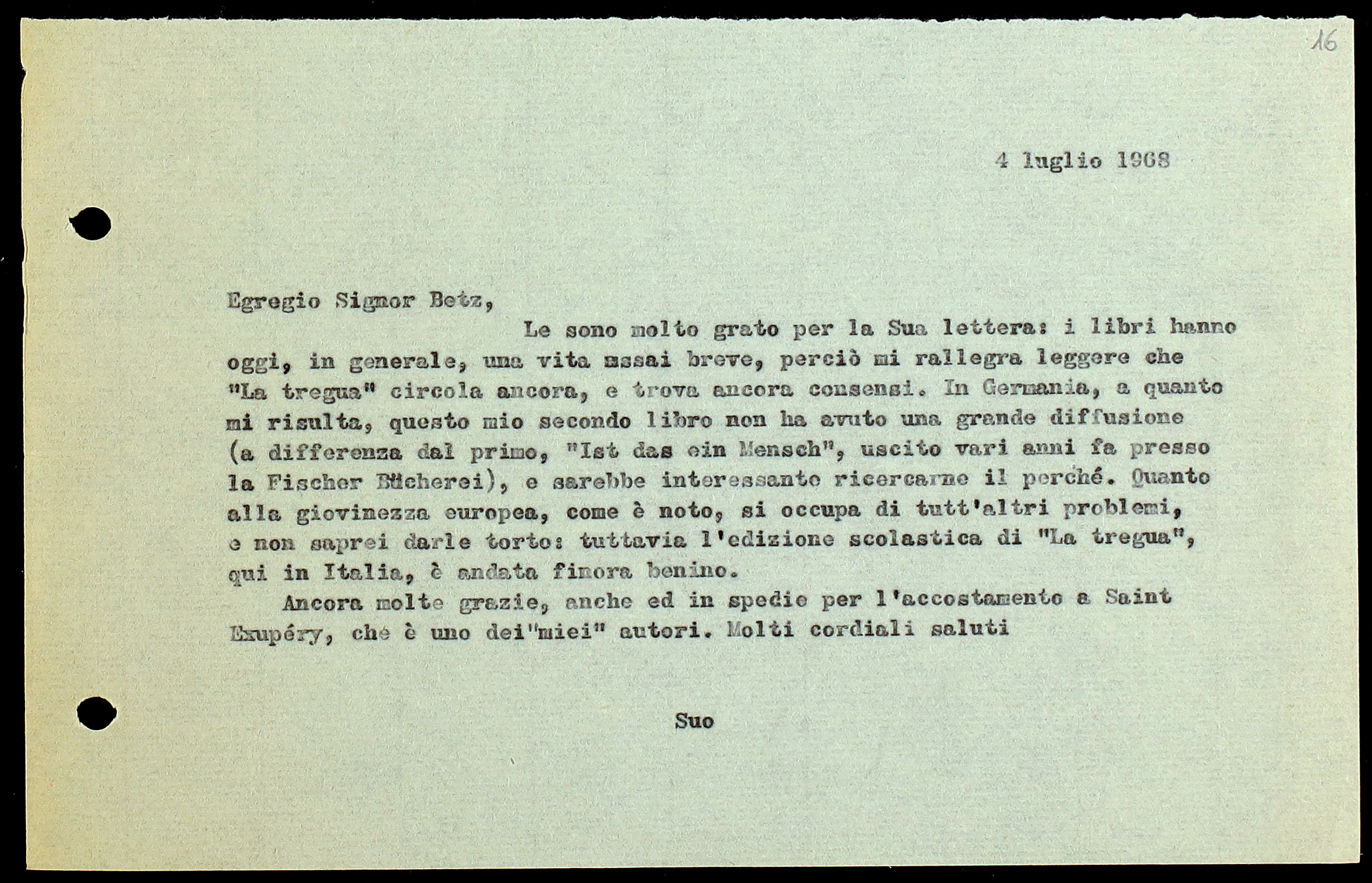
Levi thanks Betz and says he is happy that The Truce still finds consensus among readers.
4 luglio 1968
Egregio Signor Betz,
Le sono molto grato per la Sua lettera: i libri hanno oggi, in generale, una vita assai breve, perciò mi rallegra leggere che La tregua circola ancora, e trova ancora consensi. In Germania, a quanto mi risulta, questo mio secondo libro non ha avuto una grande diffusione (a differenza del primo, Ist das ein Mensch, uscito vari anni fa presso la Fischer Bücherei), e sarebbe interessante ricercarne il perché.[1] Quanto alla giovinezza europea, come è noto, si occupa di tutt’altri problemi, e non saprei darle torto:[2] tuttavia l’edizione scolastica di La tregua, qui in Italia, è andata finora benino.[3]
Ancora molte grazie, anche ed in specie per l’accostamento a Saint Exupéry, che è uno dei “miei” autori.[4]
Molti cordiali saluti.
Suo
4 luglio 1968
Egregio Signor Betz,
Le sono molto grato per la Sua lettera: i libri hanno oggi, in generale, una vita assai breve, perciò mi rallegra leggere che La tregua circola ancora, e trova ancora consensi. In Germania, a quanto mi risulta, questo mio secondo libro non ha avuto una grande diffusione (a differenza del primo, Ist das ein Mensch, uscito vari anni fa presso la Fischer Bücherei), e sarebbe interessante ricercarne il perché.[1] Quanto alla giovinezza europea, come è noto, si occupa di tutt’altri problemi, e non saprei darle torto:[2] tuttavia l’edizione scolastica di La tregua, qui in Italia, è andata finora benino.[3]
Ancora molte grazie, anche ed in specie per l’accostamento a Saint Exupéry, che è uno dei “miei” autori.[4]
Molti cordiali saluti.
Suo
July 4, 1968
Dear Mr. Betz,
I am very grateful to you for your letter: nowadays, books have a very brief life, in general, and therefore I am happy to read that The Truce still circulates, and that it still finds consensus. As far as I know, in Germany this second bookof mine has not been widely distributed (as opposed to the first, Ist das ein Mensch, which was released several years ago by Fischer Bücherei), and it would be interesting to investigate the reason.[1] As for Europe’s young people, they are notoriously busy with entirely different problems, and I cannot blame them;[2]however, here in Italy, the scholastic edition of The Truce has gone fairly well so far.[3]
Once again, many thanks, also and in particular for comparing me to Saint Exupéry, who is one of “my” authors.[4]
Many kind regards. Your
4 luglio 1968
Egregio Signor Betz,
Le sono molto grato per la Sua lettera: i libri hanno oggi, in generale, una vita assai breve, perciò mi rallegra leggere che La tregua circola ancora, e trova ancora consensi. In Germania, a quanto mi risulta, questo mio secondo libro non ha avuto una grande diffusione (a differenza del primo, Ist das ein Mensch, uscito vari anni fa presso la Fischer Bücherei), e sarebbe interessante ricercarne il perché.[1] Quanto alla giovinezza europea, come è noto, si occupa di tutt’altri problemi, e non saprei darle torto:[2] tuttavia l’edizione scolastica di La tregua, qui in Italia, è andata finora benino.[3]
Ancora molte grazie, anche ed in specie per l’accostamento a Saint Exupéry, che è uno dei “miei” autori.[4]
Molti cordiali saluti.
Suo
4 luglio 1968
Egregio Signor Betz,
Le sono molto grato per la Sua lettera: i libri hanno oggi, in generale, una vita assai breve, perciò mi rallegra leggere che La tregua circola ancora, e trova ancora consensi. In Germania, a quanto mi risulta, questo mio secondo libro non ha avuto una grande diffusione (a differenza del primo, Ist das ein Mensch, uscito vari anni fa presso la Fischer Bücherei), e sarebbe interessante ricercarne il perché.[1] Quanto alla giovinezza europea, come è noto, si occupa di tutt’altri problemi, e non saprei darle torto:[2] tuttavia l’edizione scolastica di La tregua, qui in Italia, è andata finora benino.[3]
Ancora molte grazie, anche ed in specie per l’accostamento a Saint Exupéry, che è uno dei “miei” autori.[4]
Molti cordiali saluti.
Suo
July 4, 1968
Dear Mr. Betz,
I am very grateful to you for your letter: nowadays, books have a very brief life, in general, and therefore I am happy to read that The Truce still circulates, and that it still finds consensus. As far as I know, in Germany this second bookof mine has not been widely distributed (as opposed to the first, Ist das ein Mensch, which was released several years ago by Fischer Bücherei), and it would be interesting to investigate the reason.[1] As for Europe’s young people, they are notoriously busy with entirely different problems, and I cannot blame them;[2]however, here in Italy, the scholastic edition of The Truce has gone fairly well so far.[3]
Once again, many thanks, also and in particular for comparing me to Saint Exupéry, who is one of “my” authors.[4]
Many kind regards. Your
Info
Notes
Tag
Sender: Primo Levi
Addressee: Engelbert M. Betz
Date of Drafting: 1968-07-04
Place of Writing: Turin
Description:carbon copy on onionskin paper of typewritten letter.
Archive: Archivio privato di Primo Levi, Turin
Series: Complesso di fondi Primo Levi, Fondo Primo Levi, Corrispondenza, Corrispondenti particolari, Fasc. 20, sottofasc. 1, doc. 8, f. 16
Folio: 1, front only
DOI: https://doi.org/10.15160/fty2-c252
1Levi had this impression ever since 1964, the year the German translation of The Truce was published. This is evinced in his letter to Heinz Riedt dated December 26, 1964: “whereas I immediately received numerous letters from German readers for Ist das, I have yet to receive a single one for Atempause, almost four months after its publication. But maybe it isn’t all the fault of the translation: the topic is less interesting to the German public, it has less shock effect,” cf. P. Levi, Il carteggio con Heinz Riedt, edited by M. Mengoni, Turin: Einaudi, 2024, p. 174.
2This is what Primo Levi said in an interview with Mladen Machiedo in 1968: “I have a daughter who is twenty years old and a son who is eleven. They do not read my books. My daughter doesn’t find them interesting. Of course, there is a big difference between my generation – and not only mine, but yours as well, the thirty-year-olds – and the generation that today is about twenty years old. They have not experienced war. To them, war is something terrible but it is abstract, a possibility they do not seriously believe in. At home, my daughter is mild-mannered but she is very active in the students’ movement. In general, students are very active but their ideas are confused” (OC III, p. 32).
3The Italian school edition of The Truce was published by Einaudi in their series for middle schools in 1965.
4For insights regarding Primo Levi’s relationship with the works of Saint-Exupéry, cf. the biography of Engelbert Betz.