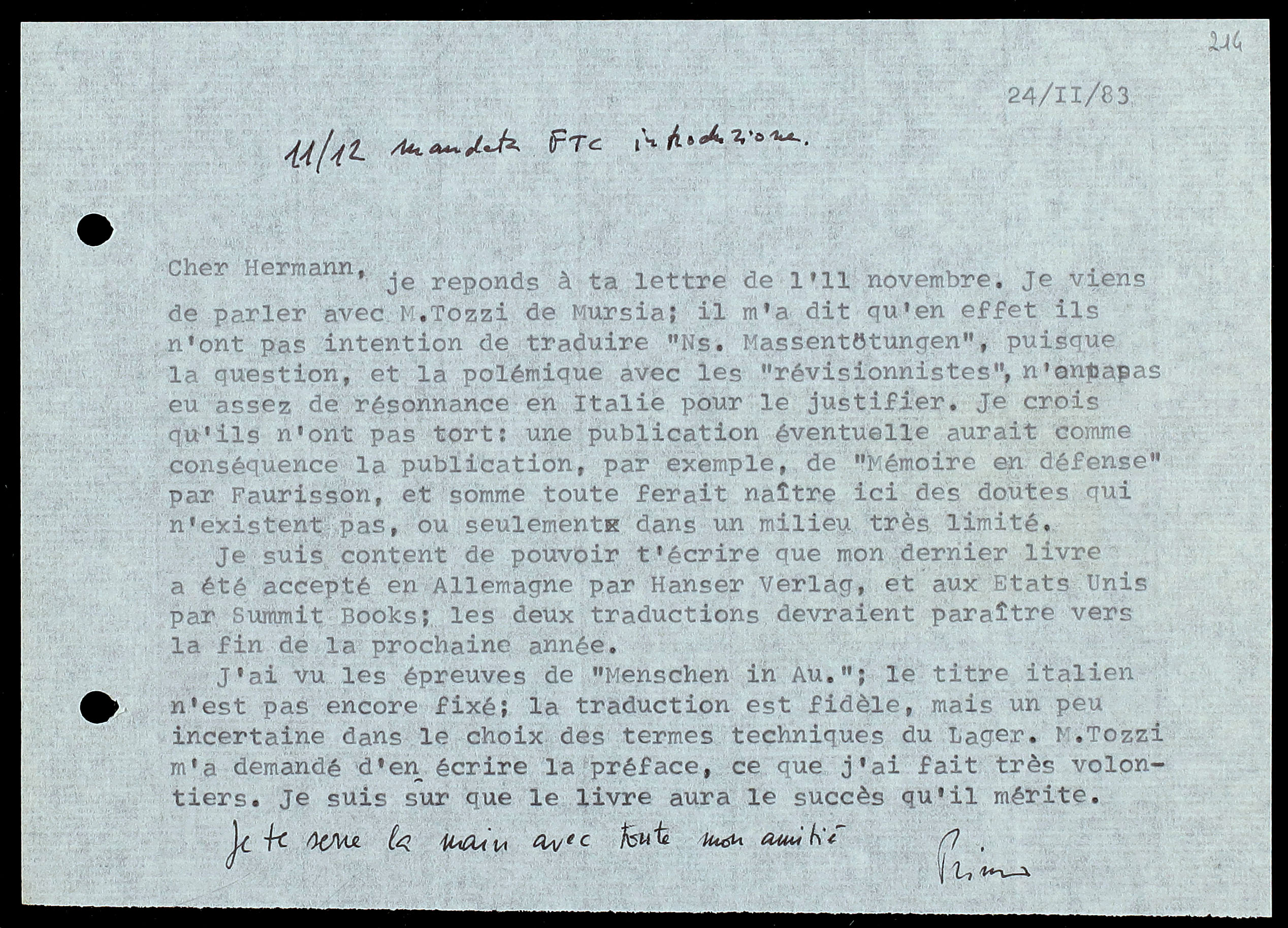
Mursia non sembra interessata a tradurre il libro sulle camere a gas, anche per non dare una cassa di risonanza, se pur per contrasto, ai negazionisti. Levi annuncia a Langbein le traduzioni tedesca e inglese di Se non ora, quando?
24/11/83[1]
Cher Hermann,
je reponds à ta lettre de l’11 novembre. Je viens de parler avec M. Tozzi de Mursia; il m’a dit qu’en effet ils n’ont pas intention de traduire Nationalsozialistische Massentötungen, puisque la question, et la polémique avec les «révisionnistes», n’ont pas eu assez de résonnance en Italie pour le justifier. Je crois qu’ils n’ont pas tort: une publication éventuelle aurait comme conséquence la publication, par exemple, de Mémoire en défense par Faurisson,[2] et somme toute ferait naître ici des doutes qui n’existent pas, ou seulement dans un milieu très limité.
Je suis content de pouvoir t’écrire que mon dernier livre a été accepté en Allemagne par Hanser Verlag, et aux Etats Unis par Summit Books; les deux traductions devraient paraître vers la fin de la prochaine année.[3]
J’ai vu les épreuves de Menschen in Auschwitz; le titre italien n’est pas encore fixé; la traduction est fidèle, mais un peu incertaine dans le choix des termes techniques du Lager. M. Tozzi m’a demandé d’en écrire la préface, ce que j’ai fait très volontiers. Je suis sur que le livre aura le succès qu’il mérite.[4]
24/11/83[1]
Caro Hermann,
rispondo alla tua dell’11 novembre. Ho appena parlato con il signor Tozzi di Mursia; mi ha detto che in verità non hanno intenzione di tradurre «Gli omicidi di massa del nazionalsocialismo con il gas tossico», perché l’argomento, e la polemica con i «revisionisti», in Italia non hanno avuto risonanza tale da giustificarlo. Credo che non abbiano torto: un’eventuale pubblicazione potrebbe motivare, per esempio, l’uscita di Memoria in difesa di Faurisson,[2] e in sostanza favorire la nascita di dubbi che qui non sussistono, salvo in un ambiente molto ristretto.
Sono contento di poterti scrivere che il mio ultimo libro è stato accettato in Germania da Hanser Verlag, e negli Stati Uniti da Summit Books; entrambe le traduzioni dovrebbero uscire verso la fine dell’anno prossimo.[3]
Ho visto le bozze di Uomini ad Auschwitz; il titolo italiano non è ancora deciso; la traduzione è fedele, anche se un po’ incerta nella scelta dei termini tecnici di Lager. Il signor Tozzi mi ha chiesto di scrivere la prefazione, cosa che ho fatto con molto piacere. Sono certo che il libro avrà il successo che merita.[4]
11/24/83[1]
Dear Hermann,
I am replying to your letter of November 11th. I have just spoken with Mr. Tozzi of Mursia; he told me that indeed they do not intend to translate “National Socialist Mass Murder,” because the issue, and the polemic with the “revisionists,” have not had enough resonance in Italy to justify it. I think they are not wrong: possible publication would have as a consequence the publication, for example, of “Essay in Defense”by Faurisson,[2] and all things considered would create doubts here that do not exist, or only in a very restricted milieu.
I am pleased to be able to tell you that my latest book has been accepted in Germany by Hanser Verlag, and in the United States by Summit Books; both translations should appear toward the end of next year.[3]
I have seen the proofs of People in Auschwitz; the Italian title has not yet been determined; the translation is faithful, but a bit unsure in the choice of the technical terms of the concentration camp. Mr. Tozzi asked me to write the preface, which I was very glad to do. I am sure the book will have the success it deserves.[4]
24/11/83[1]
Cher Hermann,
je reponds à ta lettre de l’11 novembre. Je viens de parler avec M. Tozzi de Mursia; il m’a dit qu’en effet ils n’ont pas intention de traduire Nationalsozialistische Massentötungen, puisque la question, et la polémique avec les «révisionnistes», n’ont pas eu assez de résonnance en Italie pour le justifier. Je crois qu’ils n’ont pas tort: une publication éventuelle aurait comme conséquence la publication, par exemple, de Mémoire en défense par Faurisson,[2] et somme toute ferait naître ici des doutes qui n’existent pas, ou seulement dans un milieu très limité.
Je suis content de pouvoir t’écrire que mon dernier livre a été accepté en Allemagne par Hanser Verlag, et aux Etats Unis par Summit Books; les deux traductions devraient paraître vers la fin de la prochaine année.[3]
J’ai vu les épreuves de Menschen in Auschwitz; le titre italien n’est pas encore fixé; la traduction est fidèle, mais un peu incertaine dans le choix des termes techniques du Lager. M. Tozzi m’a demandé d’en écrire la préface, ce que j’ai fait très volontiers. Je suis sur que le livre aura le succès qu’il mérite.[4]
24/11/83[1]
Caro Hermann,
rispondo alla tua dell’11 novembre. Ho appena parlato con il signor Tozzi di Mursia; mi ha detto che in verità non hanno intenzione di tradurre «Gli omicidi di massa del nazionalsocialismo con il gas tossico», perché l’argomento, e la polemica con i «revisionisti», in Italia non hanno avuto risonanza tale da giustificarlo. Credo che non abbiano torto: un’eventuale pubblicazione potrebbe motivare, per esempio, l’uscita di Memoria in difesa di Faurisson,[2] e in sostanza favorire la nascita di dubbi che qui non sussistono, salvo in un ambiente molto ristretto.
Sono contento di poterti scrivere che il mio ultimo libro è stato accettato in Germania da Hanser Verlag, e negli Stati Uniti da Summit Books; entrambe le traduzioni dovrebbero uscire verso la fine dell’anno prossimo.[3]
Ho visto le bozze di Uomini ad Auschwitz; il titolo italiano non è ancora deciso; la traduzione è fedele, anche se un po’ incerta nella scelta dei termini tecnici di Lager. Il signor Tozzi mi ha chiesto di scrivere la prefazione, cosa che ho fatto con molto piacere. Sono certo che il libro avrà il successo che merita.[4]
11/24/83[1]
Dear Hermann,
I am replying to your letter of November 11th. I have just spoken with Mr. Tozzi of Mursia; he told me that indeed they do not intend to translate “National Socialist Mass Murder,” because the issue, and the polemic with the “revisionists,” have not had enough resonance in Italy to justify it. I think they are not wrong: possible publication would have as a consequence the publication, for example, of “Essay in Defense”by Faurisson,[2] and all things considered would create doubts here that do not exist, or only in a very restricted milieu.
I am pleased to be able to tell you that my latest book has been accepted in Germany by Hanser Verlag, and in the United States by Summit Books; both translations should appear toward the end of next year.[3]
I have seen the proofs of People in Auschwitz; the Italian title has not yet been determined; the translation is faithful, but a bit unsure in the choice of the technical terms of the concentration camp. Mr. Tozzi asked me to write the preface, which I was very glad to do. I am sure the book will have the success it deserves.[4]
Info
Note
Tag
Mittente: Primo Levi
Destinatario: Hermann Langbein
Data di stesura: 1983-11-24
Luogo di stesura: Torino
Descrizione del documento: copia carbone di lettera ds. con inserti ms. a penna stilografica nera su carta velina (mm. 220x150).
Archivio: Archivio privato di Primo Levi, Torino
Segnatura: Fasc. 14, sottofasc. 8, docc. da 8 a 12, f. 214
Fogli: 1 solo recto
DOI: https://doi.org/10.15160/29DP-JP45
1
Nella parte superiore del foglio, al centro e poco sopra il testo della lettera, è presente un inserto ms. di Levi a inchiostro liquido nero: «11/12 mandata FTC introduzione». L’introduzione è quella che Levi aveva scritto all’edizione italiana di Menschen in Auschwitz, e a cui si fa riferimento anche nella lettera; «FTC» sta probabilmente per fotocopia.
2
Robert Faurisson aveva pubblicato Mémoire en défense. Contre ceux qui m’accusent de falsifier l’histoire. La question des chambres à gaz nel 1980 per l’editore La Vieille Taupe. Noam Chomsky (1928), pur contrario alle tesi di Faurisson, ne aveva la prefazione, come gesto in difesa della libertà d’espressione. Prima di Langbein, al libro di Faurisson aveva risposto duramente Pierre Vidal Naquet (1930-2006), con Un Eichmann de papier («Esprit» 1980) e poi con De Faurisson et de Chomsky («Esprit» 1981), cfr. il relativo Approfondimento.
3Se non ora, quando? uscì in inglese (If not now, when?) nel 1985 per Summit Books, tradotto da William Weaver; la versione tedesca (Wann, wenn nicht jetzt?) fu pubblicata per Hanser l’anno successivo, nel 1986, tradotta da Barbara Kleiner.
4
Sul margine inferiore del foglio è presente un inserto ms. di Levi a inchiostro liquido nero: «Je te serre la main avec toute mon amitié | Primo»; «Ti stringo la mano con amicizia | Primo».