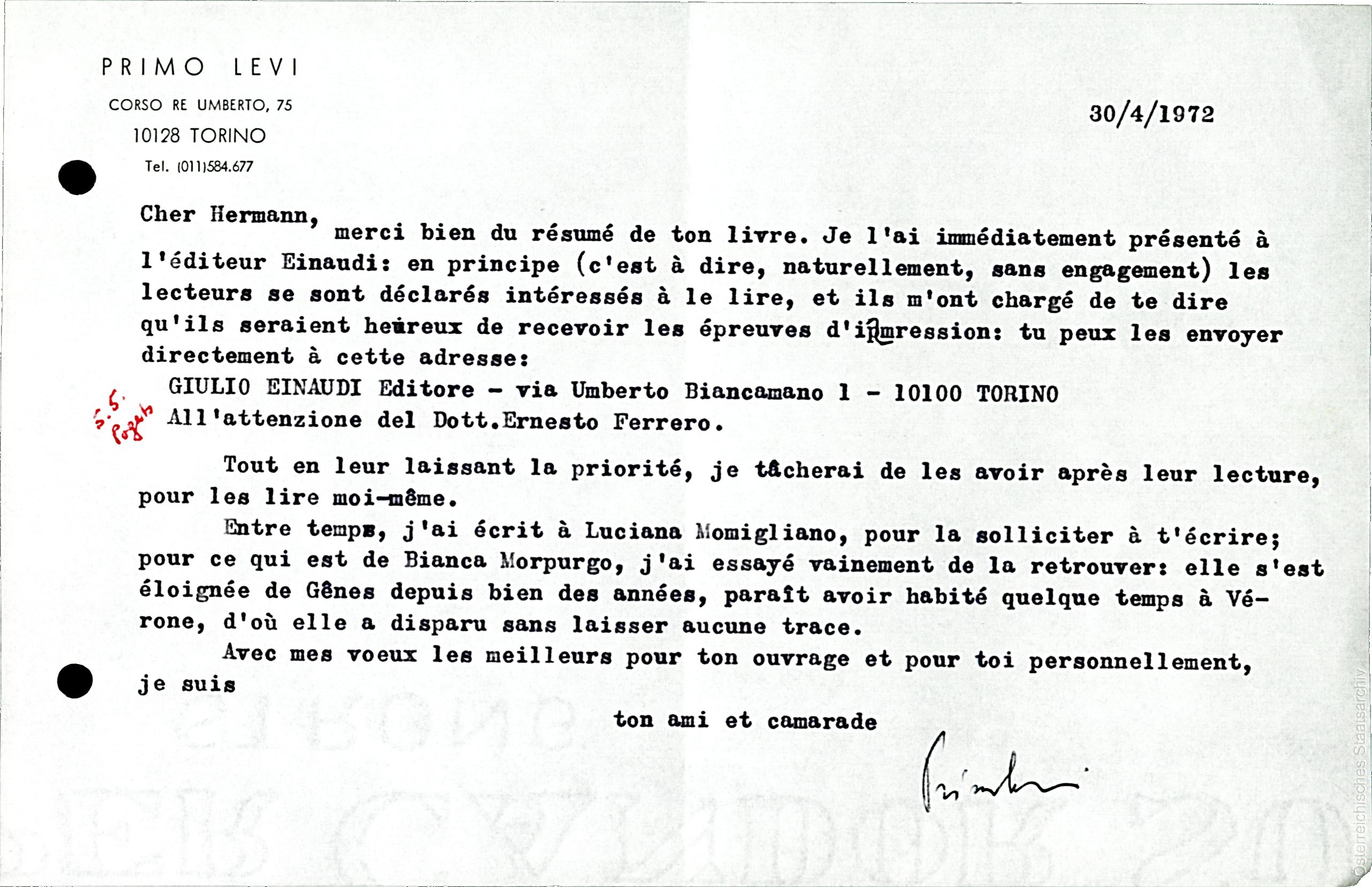
Levi ha presentato a Einaudi Menschen in Auschwitz (Uomini ad Auschwitz) di Langbein, per capire se potrebbero essere interessati a pubblicarlo in italiano; ha scritto a Luciana Nissim Momigliano in merito al processo contro Johann Schindler.
merci bien du résumé de ton livre. Je l’ai immédiatement présenté à l’éditeur Einaudi: en principe (c’est à dire, naturellement, sans engagement) les lecteurs se sont déclarés intéressés à le lire, et ils m’ont chargé de te dire qu’ils seraient heureux de recevoir les épreuves d’impression: tu peux les envoyer directement à cette adresse:
Tout en leur laissant la priorité, je tâcherai de les avoir après leur lecture, pour les lire moi-même.
Entre temps, j’ai écrit à Luciana Momigliano,[3] pour la solliciter à t’écrire ; pour ce qui est de Bianca Morpurgo, j’ai essayé vainement de la retrouver: elle s’est éloignée de Gênes depuis bien des années, paraît avoir habité quelque temps à Vérone, d’où elle a disparu sans laisser aucune trace.
Avec mes voeux les meilleurs pour ton ouvrage et pour toi personnellement, je suis
ton ami et camarade
Primo Levi
30/4/1972
Caro Hermann,
grazie molte per il riassunto del tuo libro. L’ho presentato immediatamente all’editore Einaudi: in linea di massima (ovvero, naturalmente, senza impegno) i lettori si sono detti interessati a guardarlo e mi hanno incaricato di dirti che sarebbero lieti di ricevere le bozze di stampa: puoi mandarle direttamente a questo indirizzo:
Pur lasciando a loro la precedenza, cercherò di farmele dare subito dopo per poterle leggere io stesso.
Frattanto ho scritto a Luciana Momigliano,[3] per sollecitarla a contattarti; quanto a Bianca Morpurgo, ho tentato invano di trovarla: è andata via da Genova molti anni fa, pare che abbia abitato per qualche tempo a Verona, da dove è sparita senza lasciare tracce.
Con i migliori auguri per il tuo libro e per te personalmente, il tuo amico e compagno
Primo Levi
4/30/1972
Dear Hermann,
Thank you for the summary of your book. I immediately showed it to the publisher Einaudi: in theory (meaning, naturally, without commitment) the readers said they were interested in reading it, and they told me to tell you that they would be happy to receive the proofs: you can send them directly to this address:
Although I am giving them the first opportunity, I will try to obtain the proofs after they have finished so that I can read them myself.
In the meantime, I have written to Luciana Momigliano,[3] to ask her to write to you; as for Bianca Morpurgo, I have tried in vain to find her: she left Genoa many years ago, and seems to have lived in Verona for a while, but she disappeared from there without a trace.
With my best wishes for your book and for you personally, I remain
your friend and comrade
Primo Levi
30/4/1972
Cher Hermann,
merci bien du résumé de ton livre. Je l’ai immédiatement présenté à l’éditeur Einaudi: en principe (c’est à dire, naturellement, sans engagement) les lecteurs se sont déclarés intéressés à le lire, et ils m’ont chargé de te dire qu’ils seraient heureux de recevoir les épreuves d’impression: tu peux les envoyer directement à cette adresse:
Tout en leur laissant la priorité, je tâcherai de les avoir après leur lecture, pour les lire moi-même.
Entre temps, j’ai écrit à Luciana Momigliano,[3] pour la solliciter à t’écrire ; pour ce qui est de Bianca Morpurgo, j’ai essayé vainement de la retrouver: elle s’est éloignée de Gênes depuis bien des années, paraît avoir habité quelque temps à Vérone, d’où elle a disparu sans laisser aucune trace.
Avec mes voeux les meilleurs pour ton ouvrage et pour toi personnellement, je suis
ton ami et camarade
Primo Levi
30/4/1972
Caro Hermann,
grazie molte per il riassunto del tuo libro. L’ho presentato immediatamente all’editore Einaudi: in linea di massima (ovvero, naturalmente, senza impegno) i lettori si sono detti interessati a guardarlo e mi hanno incaricato di dirti che sarebbero lieti di ricevere le bozze di stampa: puoi mandarle direttamente a questo indirizzo:
Pur lasciando a loro la precedenza, cercherò di farmele dare subito dopo per poterle leggere io stesso.
Frattanto ho scritto a Luciana Momigliano,[3] per sollecitarla a contattarti; quanto a Bianca Morpurgo, ho tentato invano di trovarla: è andata via da Genova molti anni fa, pare che abbia abitato per qualche tempo a Verona, da dove è sparita senza lasciare tracce.
Con i migliori auguri per il tuo libro e per te personalmente, il tuo amico e compagno
Primo Levi
4/30/1972
Dear Hermann,
Thank you for the summary of your book. I immediately showed it to the publisher Einaudi: in theory (meaning, naturally, without commitment) the readers said they were interested in reading it, and they told me to tell you that they would be happy to receive the proofs: you can send them directly to this address:
Although I am giving them the first opportunity, I will try to obtain the proofs after they have finished so that I can read them myself.
In the meantime, I have written to Luciana Momigliano,[3] to ask her to write to you; as for Bianca Morpurgo, I have tried in vain to find her: she left Genoa many years ago, and seems to have lived in Verona for a while, but she disappeared from there without a trace.
With my best wishes for your book and for you personally, I remain
your friend and comrade
Primo Levi
Info
Note
Tag
Mittente: Primo Levi
Destinatario: Hermann Langbein
Data di stesura: 1972-04-30
Luogo di stesura: Torino
Descrizione del documento: lettera ds. con firma e inserti ms. a biro nera e a biro rossa su carta intestata, mm225x140.
Intestazione: PRIMO LEVI | CORSO RE UMBERTO 75 | 10128 TORINO | Tel. (011) 584.677
DOI: https://doi.org/10.15160/DZP4-XD51
1
Di fianco all’indirizzo di Einaudi si legge un inserto ms. in obliquo a biro rossa di Langbein con una data, «5.5.», seguita da una parola di difficile comprensione, che potrebbe leggersi «Pogets» o «Pagets» o Pageb» o Pogeb».
2
All’epoca responsabile dell’Ufficio Stampa della casa editrice.
3
La lettera di Levi a Luciana Nissim, datata 26 aprile 1972, è pubblicata in Alessandra Chiappano, Luciana Nissim Momigliano. Una vita, Firenze, La Giuntina 2010, p. 235. A proposito di Johann Schindler, Levi scrive: «Non so come la pensi tu, per conto mio credo che uno così, se possibile, stia meglio dentro che fuori e meglio tardi che mai».