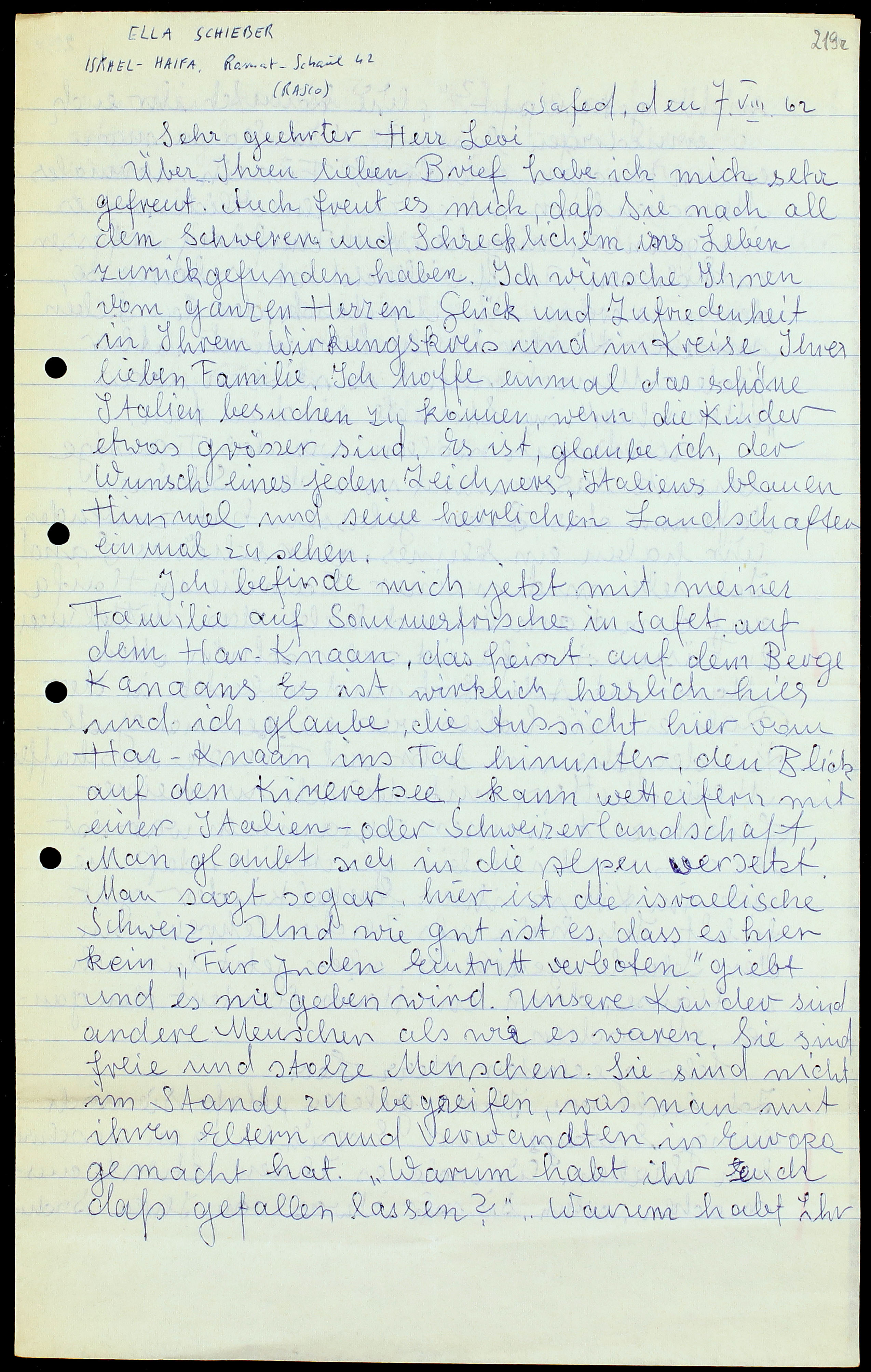
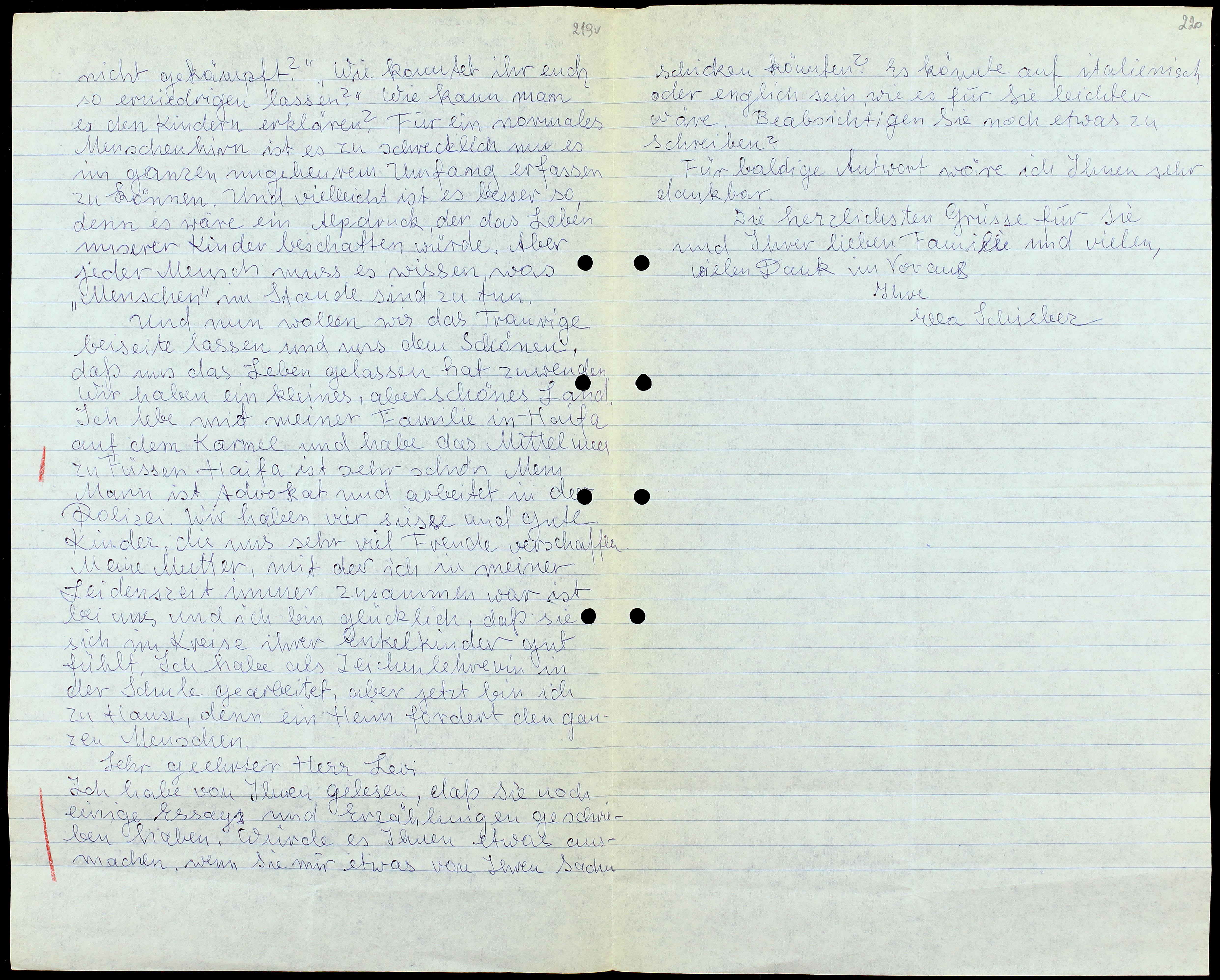
Schieber scrive alcune notizie sul suo presente e riferisce anche di una certa discrepanza tra genitori e figli, in Israele, relativamente al tema della Shoah.
Safed, den 7.VIII.62
Sehr geehrter Herr Levi
Über Ihren lieben Brief habe ich mich sehr gefreut. Auch freut es mich, daß Sie nach all dem Schweren und Schrecklichen ins Leben zurückgefunden haben. Ich wünsche Ihnen vom ganzen Herzen Glück und Zufriedenheit in Ihrem Wirkungskreis und im Kreise Ihrer lieben Familie. Ich hoffe einmal das schöne Italien besuchen zu können, wenn die Kinder etwas grösser sind. Es ist, glaube ich, der Wunsch eines jeden Zeichners, Italiens beamen Himmel und seine herzlichen Landschaften einmal zu sehen.
Ich befinde mich jetzt mit meiner Familie auf Sommerfrische in Safet auf dem Har-Knaan, das heisst, auf dem Berge Kanaans. Es ist wirklich herrlich hier und ich glaube, die Aussicht hier vom Har-Knaan ins Tal hinunter, dem Blick auf den Kineretsee, kann wetteifern mit einer Italien- oder Schweizerlandschaft, man glaubt sich in die Alpen versetzt. Man sagt sogar, hier ist die israelische Schweiz. Und wie gut ist es dass es hier kein „Für Juden Eintritt verboten” giebt und es nie geben wird.[1] Unsere Kinder sind andere Menschen als wir es waren. Sie sind freie und stolze Menschen. Sie sind nicht im Stande zu begreifen, was man mit ihren Eltern und Verwandten in Europa gemacht hat. „Warum habt ihr euch daß gefallen lassen?” „Warum habt Ihr nicht gekämpft?” „Wie kämmte ihr euch so erniedrigen lassen?” Wie kann man es den Kindern erklären? Für ein normales Menschenhirn ist es zu schrecklich nun es im ganzen ungeheurem Umfang erfassen zu können. Und vielleicht ist es besser so, denn es wäre ein Alpdruck, der das Leben unserer Kinder beschaffen würde. Aber jeder Mensch muss es wissen, was „Menschen” im Stande sind zu tun.
Und nun wollen wir das Traurige beiseite lassen und uns dem Schönen, daß uns das Leben gelassen hat zuwenden. Wir haben ein kleines, aber schönes Land. Ich lebe mit meiner Familie in Haifa auf dem Karmel und habe das Mittelmeer zu Füssen. Haifa ist sehr schön.[2]Mein Mann ist Advokat und arbeitet in den Polizei. Wir haben vier süsse und gute Kinder, die uns sehr viel Freude verschaffen. Meine Mutter, mit der ich in meiner Leidenszeit immer zusammen war, ist bei uns und ich bin glücklich, daß sie sich im Kreise ihrer Enkelkinder gut fühlt. Ich habe als Zeichenlehrerin in der Schule gearbeitet, aber jetzt bin ich zu Hause, denn ein Herrin fordert den ganzen Menschen.
Sehr geehrter Herr Levi
Ich habe von Ihnen gelesen, daß sie noch einige Essay und Erzählungen geschrieben haben.[3] Wurde es Ihnen etwas ausmachen, wenn Sie etwas vor Ihren Sachen schicken könnten?[4] Es könnte auf italienisch oder englisch sein, wie es für Sie leichter wäre. Beabsichtigen Sie noch etwas zu schreiben?
Für baldige Antwort wäre ich Ihnen sehr dankbar.
Die herzlichsten Grüsse für Sie und Ihrer lieben Familie und vielen vielen Dank in Voraus Ihre
Ella Schieber
Safed, 7 agosto 62
Stimatissimo Signor Levi
mi ha fatto molto piacere ricevere la Sua cara lettera. Mi rallegra anche il fatto che, dopo tante esperienze dure e terribili, sia riuscito a tornare alla vita. Le auguro con tutto il cuore felicità e soddisfazione nella sua attività e in seno alla sua amata famiglia. Quando i figli saranno un po’ più grandi, spero di poter visitare un giorno la bella Italia. Credo che sia il desiderio di ogni disegnatore poter vedere almeno una volta il cielo e i caldi paesaggi italiani.
In questo momento mi trovo con la mia famiglia in villeggiatura a Safet, sull’Har-Knaan, cioè sul monte di Canaan. Qui è davvero una meraviglia e credo che la vista dall’Har-Knaan sulla valle, con lo sguardo che spazia sul lago Kineret, possa competere con un paesaggio italiano o svizzero, sembra quasi di essere sulle Alpi. Si dice addirittura che questa sia la Svizzera israeliana. E quando è bello che qui il non ci sia e mai ci sarà il «divieto di ingresso agli ebrei».[1] I nostri figli sono diversi da come eravamo noi. Sono persone libere e fiere. Non riescono a comprendere ciò che è stato fatto ai loro genitori e parenti in Europa. «Perché avete permesso che vi facessero tutto questo?». «Perché non avete combattuto?». «Come avete potuto permettere che vi umiliassero così?». Come spiegarlo ai figli? L’enormità di quanto è accaduto è terribile da comprendere per una normale mente umana. E forse è meglio così, perché sarebbe un incubo che graverebbe sulla vita dei nostri figli. Eppure, tutti devonosapere di cosa è capace l’«uomo».
E ora lasciamo da parte la tristezza e guardiamo alle cose belle che la vita ci ha lasciato. Il nostro è un paese piccolo ma incantevole. Vivo con la mia famiglia ad Haifa, sul monte Carmelo, e ho il Mediterraneo ai miei piedi. Haifa è molto bella.[2]Mio marito è avvocato e lavora nella polizia. Abbiamo quattro figli dolcissimi e buoni, che ci danno tanta gioia. Mia madre, con cui ho condiviso tutte le sofferenze del passato, vive con noi, e sono felice che stia bene circondata dai suoi nipotini. Ho lavorato come insegnante di disegno a scuola, ma ora sono a casa, perché essere una madre di famiglia richiede tutta la mia presenza.
Stimatissimo Signor Levi,
ho letto che ha scritto anche alcuni saggi e racconti.[3] Le dispiacerebbe inviarmene qualcuno?[4] Andrebbe bene anche in italiano o in inglese, come le è più comodo. Ha intenzione di scrivere ancora?
Le sarei molto grata se potesse rispondermi presto.
I più cordiali saluti a Lei e alla Sua cara famiglia e molte molte grazie fin d’ora Sua
Ella Schieber
Safed, August 7, 1962
Dear Mr. Levi
I was very pleased to receive your kind letter. I am also delighted that you have found your way back to life after all the hardships and horrors you have endured. With all my heart, I wish you happiness and contentment in your work and with your dear family. I hope to visit beautiful Italy one day, when the children are a little older. I believe it is the wish of every artist to see Italy’s beautiful sky and warm landscapes.
I am currently in Safet on Har-Knaan, meaning Mount Canaan, where I am spending the summer with my family. It is truly wonderful here, and I believe the view from Har-Knaan down into the valley, overlooking Lake Kineret, rivals any Italian or Swiss landscape; it is easy to feel transported to the Alps. Some even said that this is the Israeli Switzerland. And how wonderful it is that here there has never been, and never will be, a “no Jews allowed.”[1] Our children are different from the way we were. They are free and proud. They are unable to comprehend what was done to their parents and relatives in Europe. “Why did you put up with that?” “Why didn’t you fight?” “How could you allow yourselves to be humiliated like that?” How can we explain it to our children? It is too terrible for a normal human mind to comprehend the full extent of it. And maybe it is better that way, because it would be a nightmare that would shape our children’s lives. But every human being must know what their fellow “human beings” are capable of doing.
But now let us set sad matters aside and turn to the beauty that life has left us. We have a small but beautiful country. I live with my family in Haifa on Mount Carmel, with the Mediterranean Sea at our feet. Haifa is very beautiful.[2]My husband is a lawyer and works for the police. We have four sweet and good children who bring us a lot of joy. My mother, whom I was always with throughout my time of suffering, is with us, and I am happy she feels good surrounded by her grandchildren. I used to work as a school art teacher, but now I stay home, because being the lady of the house is demanding.
Dear Mr. Levi,
I read that you’ve written several more essays and stories.[3] Would you mind sending some of them to us?[4] They could be in Italian or English, whichever is easier for you. Do you intend to write anything else?
I would be deepy grateful for your prompt reply.
Warmest regards to you and your dear family, and many, many thanks in advance Yours,
Ella Schieber
Safed, den 7.VIII.62
Sehr geehrter Herr Levi
Über Ihren lieben Brief habe ich mich sehr gefreut. Auch freut es mich, daß Sie nach all dem Schweren und Schrecklichen ins Leben zurückgefunden haben. Ich wünsche Ihnen vom ganzen Herzen Glück und Zufriedenheit in Ihrem Wirkungskreis und im Kreise Ihrer lieben Familie. Ich hoffe einmal das schöne Italien besuchen zu können, wenn die Kinder etwas grösser sind. Es ist, glaube ich, der Wunsch eines jeden Zeichners, Italiens beamen Himmel und seine herzlichen Landschaften einmal zu sehen.
Ich befinde mich jetzt mit meiner Familie auf Sommerfrische in Safet auf dem Har-Knaan, das heisst, auf dem Berge Kanaans. Es ist wirklich herrlich hier und ich glaube, die Aussicht hier vom Har-Knaan ins Tal hinunter, dem Blick auf den Kineretsee, kann wetteifern mit einer Italien- oder Schweizerlandschaft, man glaubt sich in die Alpen versetzt. Man sagt sogar, hier ist die israelische Schweiz. Und wie gut ist es dass es hier kein „Für Juden Eintritt verboten” giebt und es nie geben wird.[1] Unsere Kinder sind andere Menschen als wir es waren. Sie sind freie und stolze Menschen. Sie sind nicht im Stande zu begreifen, was man mit ihren Eltern und Verwandten in Europa gemacht hat. „Warum habt ihr euch daß gefallen lassen?” „Warum habt Ihr nicht gekämpft?” „Wie kämmte ihr euch so erniedrigen lassen?” Wie kann man es den Kindern erklären? Für ein normales Menschenhirn ist es zu schrecklich nun es im ganzen ungeheurem Umfang erfassen zu können. Und vielleicht ist es besser so, denn es wäre ein Alpdruck, der das Leben unserer Kinder beschaffen würde. Aber jeder Mensch muss es wissen, was „Menschen” im Stande sind zu tun.
Und nun wollen wir das Traurige beiseite lassen und uns dem Schönen, daß uns das Leben gelassen hat zuwenden. Wir haben ein kleines, aber schönes Land. Ich lebe mit meiner Familie in Haifa auf dem Karmel und habe das Mittelmeer zu Füssen. Haifa ist sehr schön.[2]Mein Mann ist Advokat und arbeitet in den Polizei. Wir haben vier süsse und gute Kinder, die uns sehr viel Freude verschaffen. Meine Mutter, mit der ich in meiner Leidenszeit immer zusammen war, ist bei uns und ich bin glücklich, daß sie sich im Kreise ihrer Enkelkinder gut fühlt. Ich habe als Zeichenlehrerin in der Schule gearbeitet, aber jetzt bin ich zu Hause, denn ein Herrin fordert den ganzen Menschen.
Sehr geehrter Herr Levi
Ich habe von Ihnen gelesen, daß sie noch einige Essay und Erzählungen geschrieben haben.[3] Wurde es Ihnen etwas ausmachen, wenn Sie etwas vor Ihren Sachen schicken könnten?[4] Es könnte auf italienisch oder englisch sein, wie es für Sie leichter wäre. Beabsichtigen Sie noch etwas zu schreiben?
Für baldige Antwort wäre ich Ihnen sehr dankbar.
Die herzlichsten Grüsse für Sie und Ihrer lieben Familie und vielen vielen Dank in Voraus Ihre
Ella Schieber
Safed, 7 agosto 62
Stimatissimo Signor Levi
mi ha fatto molto piacere ricevere la Sua cara lettera. Mi rallegra anche il fatto che, dopo tante esperienze dure e terribili, sia riuscito a tornare alla vita. Le auguro con tutto il cuore felicità e soddisfazione nella sua attività e in seno alla sua amata famiglia. Quando i figli saranno un po’ più grandi, spero di poter visitare un giorno la bella Italia. Credo che sia il desiderio di ogni disegnatore poter vedere almeno una volta il cielo e i caldi paesaggi italiani.
In questo momento mi trovo con la mia famiglia in villeggiatura a Safet, sull’Har-Knaan, cioè sul monte di Canaan. Qui è davvero una meraviglia e credo che la vista dall’Har-Knaan sulla valle, con lo sguardo che spazia sul lago Kineret, possa competere con un paesaggio italiano o svizzero, sembra quasi di essere sulle Alpi. Si dice addirittura che questa sia la Svizzera israeliana. E quando è bello che qui il non ci sia e mai ci sarà il «divieto di ingresso agli ebrei».[1] I nostri figli sono diversi da come eravamo noi. Sono persone libere e fiere. Non riescono a comprendere ciò che è stato fatto ai loro genitori e parenti in Europa. «Perché avete permesso che vi facessero tutto questo?». «Perché non avete combattuto?». «Come avete potuto permettere che vi umiliassero così?». Come spiegarlo ai figli? L’enormità di quanto è accaduto è terribile da comprendere per una normale mente umana. E forse è meglio così, perché sarebbe un incubo che graverebbe sulla vita dei nostri figli. Eppure, tutti devonosapere di cosa è capace l’«uomo».
E ora lasciamo da parte la tristezza e guardiamo alle cose belle che la vita ci ha lasciato. Il nostro è un paese piccolo ma incantevole. Vivo con la mia famiglia ad Haifa, sul monte Carmelo, e ho il Mediterraneo ai miei piedi. Haifa è molto bella.[2]Mio marito è avvocato e lavora nella polizia. Abbiamo quattro figli dolcissimi e buoni, che ci danno tanta gioia. Mia madre, con cui ho condiviso tutte le sofferenze del passato, vive con noi, e sono felice che stia bene circondata dai suoi nipotini. Ho lavorato come insegnante di disegno a scuola, ma ora sono a casa, perché essere una madre di famiglia richiede tutta la mia presenza.
Stimatissimo Signor Levi,
ho letto che ha scritto anche alcuni saggi e racconti.[3] Le dispiacerebbe inviarmene qualcuno?[4] Andrebbe bene anche in italiano o in inglese, come le è più comodo. Ha intenzione di scrivere ancora?
Le sarei molto grata se potesse rispondermi presto.
I più cordiali saluti a Lei e alla Sua cara famiglia e molte molte grazie fin d’ora Sua
Ella Schieber
Safed, August 7, 1962
Dear Mr. Levi
I was very pleased to receive your kind letter. I am also delighted that you have found your way back to life after all the hardships and horrors you have endured. With all my heart, I wish you happiness and contentment in your work and with your dear family. I hope to visit beautiful Italy one day, when the children are a little older. I believe it is the wish of every artist to see Italy’s beautiful sky and warm landscapes.
I am currently in Safet on Har-Knaan, meaning Mount Canaan, where I am spending the summer with my family. It is truly wonderful here, and I believe the view from Har-Knaan down into the valley, overlooking Lake Kineret, rivals any Italian or Swiss landscape; it is easy to feel transported to the Alps. Some even said that this is the Israeli Switzerland. And how wonderful it is that here there has never been, and never will be, a “no Jews allowed.”[1] Our children are different from the way we were. They are free and proud. They are unable to comprehend what was done to their parents and relatives in Europe. “Why did you put up with that?” “Why didn’t you fight?” “How could you allow yourselves to be humiliated like that?” How can we explain it to our children? It is too terrible for a normal human mind to comprehend the full extent of it. And maybe it is better that way, because it would be a nightmare that would shape our children’s lives. But every human being must know what their fellow “human beings” are capable of doing.
But now let us set sad matters aside and turn to the beauty that life has left us. We have a small but beautiful country. I live with my family in Haifa on Mount Carmel, with the Mediterranean Sea at our feet. Haifa is very beautiful.[2]My husband is a lawyer and works for the police. We have four sweet and good children who bring us a lot of joy. My mother, whom I was always with throughout my time of suffering, is with us, and I am happy she feels good surrounded by her grandchildren. I used to work as a school art teacher, but now I stay home, because being the lady of the house is demanding.
Dear Mr. Levi,
I read that you’ve written several more essays and stories.[3] Would you mind sending some of them to us?[4] They could be in Italian or English, whichever is easier for you. Do you intend to write anything else?
I would be deepy grateful for your prompt reply.
Warmest regards to you and your dear family, and many, many thanks in advance Yours,
Ella Schieber
Info
Note
Tag
Mittente: Ella Liebermann-Schieber
Destinatario: Primo Levi
Data di stesura: 1962-08-07
Luogo di stesura: Safad (Zefat)
Descrizione del documento:lettera ms. a biro blu su foglio protocollo a righe. Sul margine superiore sx. del f. 219r Levi annota l’indirizzo della corrispondente: «ELLA SCHIEBER | ISRAEL-HAIFA, Ramat-Schaul 42| (RASCO)». Sono presenti contrassegni di Levi ms. a matita rossa.
Archivio: Archivio privato di Primo Levi, Torino
Segnatura: Complesso di Fondi Primo Levi, Fondo Primo Levi, Corrispondenza, Corrispondenti particolari, Fasc. 20, sottofasc. 1, doc. 080, f. 219r/v e 220
Fogli: 1 recto e verso, 1 solo recto
DOI: https://doi.org/10.15160/0n49-d431
1Safet (o Tzefiya Safad, Zefat, Sefad), uno dei centri principali della Galilea, fu meta di migrazioni dopo l'espulsione degli ebrei dalla Spagna nel 1492, ed è in effetti dal XV-XVI che vi si attesta la presenza di una prima importante comunità ebraica: forse è a questo che potrebbe alludere il commento di Schieber, anche se nel corso dei secoli successivi la città subì poi varie incursioni di Beduini e Drusi, nonché una serie di terremoti disastrosi, e la comunità ebraica non ne uscì indenne. Insieme a Gerusalemme, Hebron e Tiberiade, è da secoli riconosciuta come una delle città sacre dell'ebraismo in Palestina. Cfr. David Grossman, Rural Arab Demography and Early Jewish Settlements in Palestine. Distribution and Population Density during the late Ottoman and Early MandatePeriods (“Demografia rurale araba e primi insediamenti ebraici in Palestina. Distribuzione e densità di popolazione durante l’ultima fase ottomana e l’inizio del Mandato”), New Brunswick, Transaction Publishers, 2011, pp. 129-131.
2
Levi contrassegna «Haifa ist sehr schön» a matita rossa sul margine interno del foglio.
3
Si vedano note 1 e 2 della successiva risposta di Levi, Lettera 165.
4
Levi contrassegna «Ich habe von Ihnen gelesen…Sachschichen könnten» a matita rossa sul margine interno del foglio.