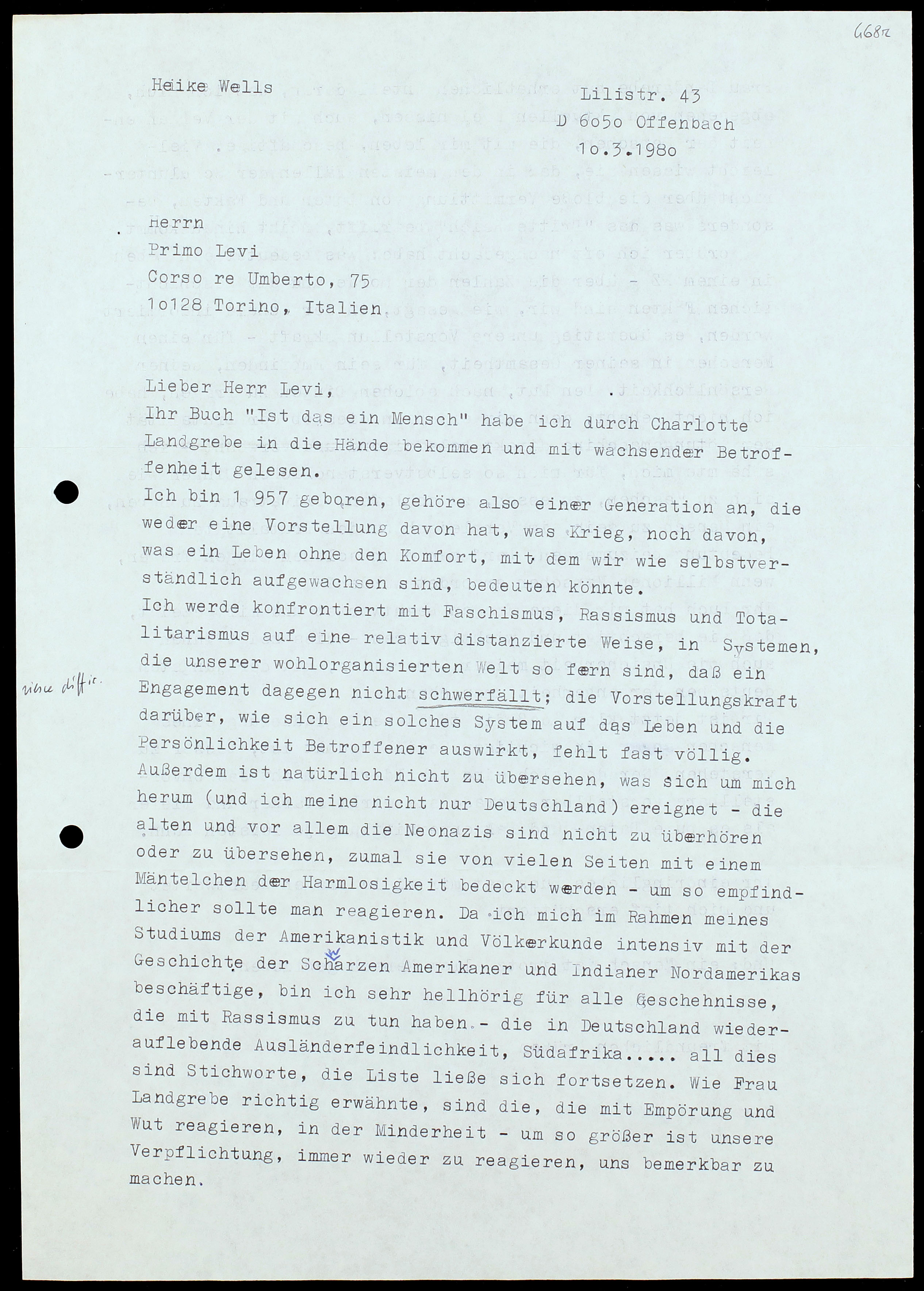
Heike Wells, nata nella seconda metà degli anni cinquanta, scrive a Levi di aver letto Ist das ein Mensch?e riflette sul rapporto della sua generazione con il passato nazista della Germania e con il razzismo.
Heike Wells Lilistr. 43 D 6050 Offenbach
10.03.1980
Herrn Primo Levi Corso re Umberto, 75 10128 Torino, Italien
Lieber Herr Levi,
Ihr Buch Ist das ein Mensch habe ich durch Charlotte Landgrebe in die Hände bekommen und mit wachsender Betroffenheit gelesen.
Ich bin 1957 geboren, gehöre also einer Generation an, die weder eine Vorstellung davon hat, was Krieg, noch davon, was ein Leben ohne den Komfort, mit dem wir wie selbstverständlich aufgewachsen sind, bedeuten könnte.
Ich werde konfrontiert mit Faschismus, Rassismus und Totalitarismus auf eine relativ distanzierte Weise, in Systemen, die unserer wohlorganisierten Welt so fern sind, daß ein Engagement dagegen nicht schwerfällt;[1] die Vorstellungskraft darüber, wie sich ein solches System auf das Leben und die Persönlichkeit Betroffener auswirkt, fehlt fast völlig.
Außerdem ist natürlich nicht zu übersehen, was sich um mich herum (und ich meine nicht nur Deutschland) ereignet – die alten und vor allem die Neonazis sind nicht zu überhören oder zu übersehen, zumal sie von vielen Seiten mit einem Mäntelchen der Harmlosigkeit bedeckt werden – um so empfindlicher sollte man reagieren. Da ich mich im Rahmen meines Studiums der Amerikanistik und Völkerkunde intensiv mit der Geschichte der Schwarzen[2] Amerikaner und Indianer Nordamerikas beschäftige, bin ich sehr hellhörig für alle Geschehnisse, die mit Rassismus zu tun haben. – die in Deutschland wiederauflebende Ausländerfeindlichkeit, Südafrika… all dies sind Stichworte, die Liste ließe sich fortsetzen. Wie Frau Landgrebe richtig erwähnte, sind die, die mit Empörung und Wut reagieren, in der Minderheit – um so größer ist unsere Verpflichtung, immer wieder zu reagieren, uns bemerkbar zu machen.
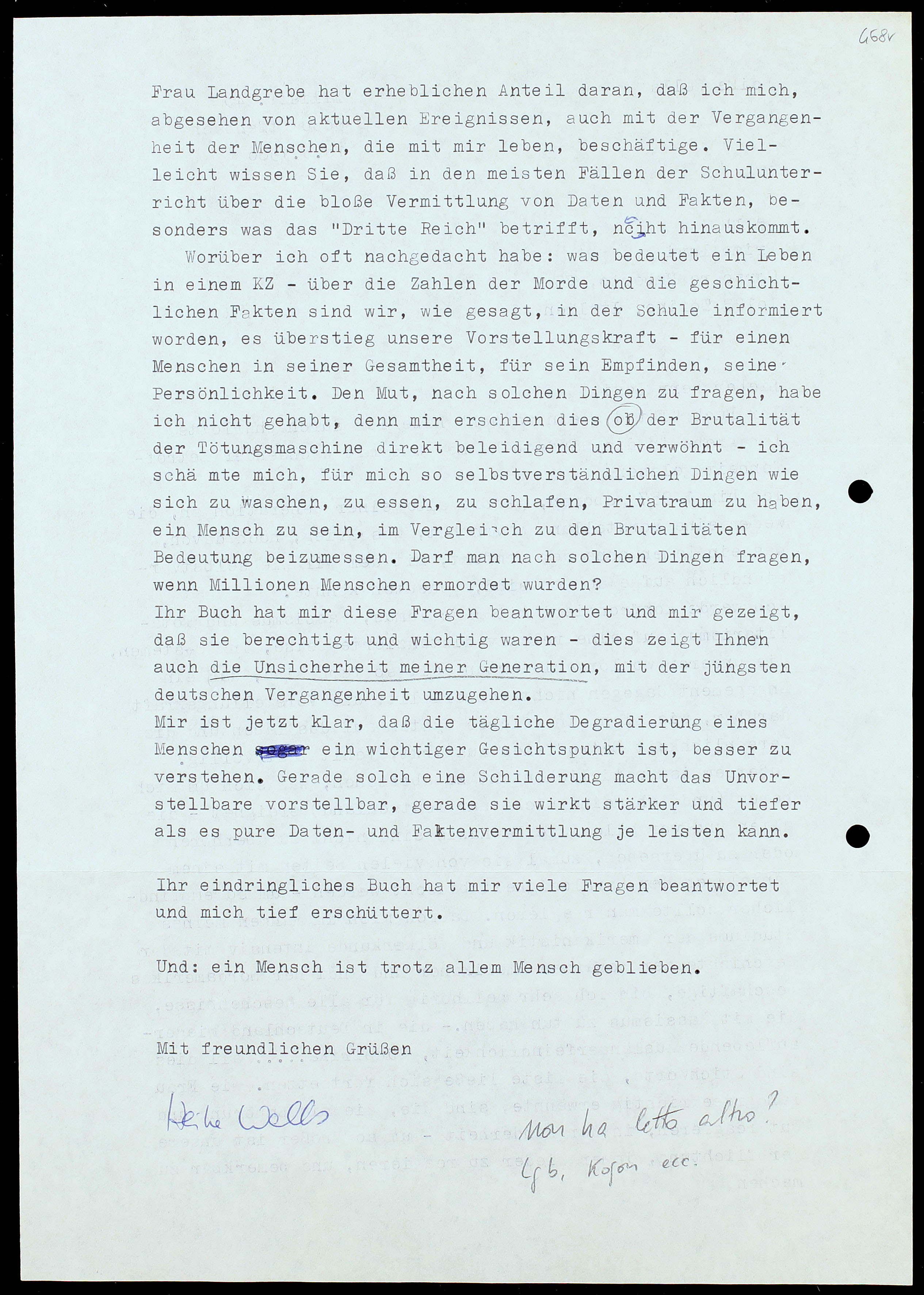
Frau Landgrebe hat erheblichen Anteil daran, daß ich mich, abgesehen von aktuellen Ereignissen, auch mit der Vergangenheit der Menschen, die mit mir leben, beschäftige.Vielleicht wissen Sie, daß in den meisten Fällen der Schulunterricht über die bloße Vermittlung von Daten und Fakten, besonders was das „Dritte Reich” betrifft, nicht[3]hinauskommt.
Worüber ich oft nachgedacht habe: was bedeutet ein Leben in einem KZ – über die Zahlen der Morde und die geschichtlichen Fakten sind wir, wie gesagt, in der Schule informiert worden, es überstieg unsere Vorstellungskraft – für einen Menschen in seiner Gesamtheit, für sein Empfinden, seine Persönlichkeit. Den Mut, nach solchen Dingen zu fragen, habe ich nicht gehabt, denn mir erschien dies ob[4]der Brutalität der Tötungsmaschine direkt beleidigend und verwöhnt – ich schämte mich, für mich so selbstverständlichen Dingen wie sich zu waschen, zu essen, zu schlafen, Privatraum zu haben, ein Mensch zu sein, im Vergleich zu den Brutalitäten Bedeutung beizumessen. Darf man nach solchen Dingen fragen, wenn Millionen Menschen ermordet wurden?
Ihr Buch hat mir diese Fragen beantwortet und mir gezeigt, daß sie berechtigt und wichtig waren – dies zeigt Ihnen auch die Unsicherheit meiner Generation,[5] mit der jüngsten deutschen Vergangenheit umzugehen.
Mir ist jetzt klar, daß die tägliche Degradierung eines Menschen[6] ein wichtiger Gesichtspunkt ist, besser zu verstehen. Gerade solch eine Schilderung macht das Unvorstellbare vorstellbar, gerade sie wirkt stärker und tiefer als es pure Daten – und Faktenvermittlung je leisten kann.
Ihr eindringliches Buch hat mir viele Fragen beantwortet und mich tief erschüttert.
Und: ein Mensch ist trotz allem Mensch geblieben.
Mit freundlichen Grüßen
Heike Wells
Lilistr. 43 D 6050 Offenbach
10.03.1980
Herrn Primo Levi Corso re Umberto, 75 10128 Torino, Italien
Gentile Signor Levi,
ho avuto il Suo libro Se questo è un uomo grazie a Charlotte Landgrebe, e l’ho letto con crescente turbamento.
Sono nata nel 1957, appartengo quindi a una generazione che non ha la minima idea di cosa sia una guerra, né di cosa voglia dire vivere senza le comodità con cui siamo cresciuti come se fossero scontate.
Conosco fascismo, razzismo e totalitarismo da una relativa distanza: sono sistemi talmente lontani dal nostro mondo ben organizzato, che impegnarsi a combatterli non è difficile;[1] la capacità di immaginare che impatto possono avere simili sistemi sulla vita e sulla personalità di chi li subisce manca quasi del tutto.
È impossibile tuttavia ignorare ciò che accade intorno a me (e non intendo solo in Germania), impossibile non vedere e non sentire i nazisti di allora e soprattutto i neonazisti di oggi, a maggior ragione perché da più parti vengono ammantati di un’apparente innocuità – il che dovrebbe spingerci a tenere gli occhi ancora più aperti e a reagire in modo più incisivo. Nel mio percorso di studi – mi occupo di americanistica ed etnologia – ho approfondito in particolare la storia degli afroamericani[2] e dei nativi del Nord America. Per questo motivo sono molto attenta a tutti i fenomeni legati al razzismo: la nuova ondata di xenofobia in Germania, il Sudafrica… tanto per dare un’idea, ma la lista potrebbe allungarsi. Come ha giustamente detto la signora Landgrebe, a reagire con indignazione e rabbia è solo una minoranza – il che aumenta il peso della nostra responsabilità: dobbiamo reagire sempre, farci sentire.
Devo in gran parte alla signora Landgrebe se ho iniziato a occuparmi non solo degli eventi attuali, ma anche del passato delle persone che vivono intorno a me. Forse saprà che spesso l’insegnamento scolastico – in particolare per quanto riguarda il “Terzo Reich” – si limita a esporre date e fatti, senza[3] andare oltre.
Mi sono spesso chiesta cosa significhi vivere in un campo di concentramento – a scuola, come ho già detto, abbiamo appreso il numero dei morti e i fatti storici, tutto al di là della nostra immaginazione – e cosa questo comporti per un essere umano nella sua interezza, per il suo sentire, per la sua personalità. Non ho mai trovato il coraggio di fare simili domande perché, di fronte alla brutalità della macchina dello sterminio, mi sembravano[4] quasi offensive, da persona vissuta nella bambagia. Mi vergognavo di attribuire importanza a cose per me ovvie come potersi lavare, mangiare, dormire, avere uno spazio privato, essere semplicemente un essere umano. Ma è lecito porsi domande di questo genere di fronte a milioni di persone uccise?
Il Suo libro ha risposto a quelle mie domande, mostrandomi che erano giuste e importanti – ed è questa, credo, la prova dell’incertezza della mia generazione[5] nel confrontarsi con il passato più recente della Germania.
Oggi mi è chiaro che la degradazione quotidiana dell’essere umano[6] è una chiave fondamentale per comprendere davvero. È proprio questa narrazione a rendere in qualche modo immaginabile l’inimmaginabile, con un’intensità e una forza che una semplice esposizione di dati e di fatti non può avere.
Il Suo libro, tanto intenso quanto toccante, mi ha dato molte risposte e mi ha scossa nel profondo.
E: un uomo è rimasto, nonostante tutto, uomo.
Con i miei più cordiali saluti
Heike Wells Lilistr. 43 D 6050 Offenbach
March 10, 1980
Mr. Primo Levi Corso re Umberto, 75 10128 Turin, Italy
Dear Mr. Levi,
I came across your book If This Is a Man through Charlotte Landgrebeand read it with growing dismay.
I was born in 1957, so I belong to a generation that has no idea what war is like, nor what it might mean to live without the comforts we have grown up with as a matter of course.
I have only had to deal with fascism, racism, and totalitarianism in a relatively distant way, in social systems that are so far removed from our well-organized world that it is not difficult[1] to take a stand against them; I can hardly imagine how such a system impacts the lives and personalities of those who live within it.
Furthermore, it is impossible to ignore what is happening around me (and I do not mean only in Germany)—the older people and especially the neo-Nazis cannot be ignored or overlooked, especially since they are hidden by a cloak of harmlessness from many sides—which makes it all the more important that one react sensitively. As part of my courses in American Studies and Ethnology, I am deeply engaged with the history of Black Americans[2] and Native Americans, so I am quick to pick up on anything related to racism—the resurgence of xenophobia in Germany, South Africa… these are just a few examples, and the list could go on. As Miss Landgrebe rightly observed, those who react with outrage and anger are in the minority—which makes it all the more important for us to respond promptly, again and again, and make ourselves heard.
Miss Landgrebehas played a significant role in my decision, above and beyond current events, to engage with the past of the people around me. As you may already be aware, most school education merely imparts data and facts without[3] going much further, especially when it comes to the “Third Reich.”
Because of that, I have often thought about what living in a concentration camp might mean. In school, as I have mentioned, we were taught facts and numbers—the quantity of murders and basic historical events, all of which was beyond imagination—but we could not fathom what it all meant for a person as a whole, for their feelings, their personality. I did not have the courage to ask such questions, because it seemed to me, given[4] the brutality of the killing machine, to be too direct, too offensive—I was ashamed to ascribe importance to things that were so natural to me, such as washing, eating, sleeping, having private space, being human, compared to such brutality. Can one even ask about such things when millions of people have been murdered?
Your book answered these questions for me, and showed me that they were justified and important—which also shows you how insecure my generation is[5] when it comes to Germany’s recent past.
It is now clear to me that[6] the daily degradation of any human being is an important aspect to understand better. It is precisely such descriptions that make the unimaginable imaginable; they have a stronger and deeper effect than pure data and facts ever could.
Your striking book answered many of my questions and shook me to the core.
And: in spite of it all, a man is still a man.
With kind regards
Heike Wells Lilistr. 43 D 6050 Offenbach
10.03.1980
Herrn Primo Levi Corso re Umberto, 75 10128 Torino, Italien
Lieber Herr Levi,
Ihr Buch Ist das ein Mensch habe ich durch Charlotte Landgrebe in die Hände bekommen und mit wachsender Betroffenheit gelesen.
Ich bin 1957 geboren, gehöre also einer Generation an, die weder eine Vorstellung davon hat, was Krieg, noch davon, was ein Leben ohne den Komfort, mit dem wir wie selbstverständlich aufgewachsen sind, bedeuten könnte.
Ich werde konfrontiert mit Faschismus, Rassismus und Totalitarismus auf eine relativ distanzierte Weise, in Systemen, die unserer wohlorganisierten Welt so fern sind, daß ein Engagement dagegen nicht schwerfällt;[1] die Vorstellungskraft darüber, wie sich ein solches System auf das Leben und die Persönlichkeit Betroffener auswirkt, fehlt fast völlig.
Außerdem ist natürlich nicht zu übersehen, was sich um mich herum (und ich meine nicht nur Deutschland) ereignet – die alten und vor allem die Neonazis sind nicht zu überhören oder zu übersehen, zumal sie von vielen Seiten mit einem Mäntelchen der Harmlosigkeit bedeckt werden – um so empfindlicher sollte man reagieren. Da ich mich im Rahmen meines Studiums der Amerikanistik und Völkerkunde intensiv mit der Geschichte der Schwarzen[2] Amerikaner und Indianer Nordamerikas beschäftige, bin ich sehr hellhörig für alle Geschehnisse, die mit Rassismus zu tun haben. – die in Deutschland wiederauflebende Ausländerfeindlichkeit, Südafrika… all dies sind Stichworte, die Liste ließe sich fortsetzen. Wie Frau Landgrebe richtig erwähnte, sind die, die mit Empörung und Wut reagieren, in der Minderheit – um so größer ist unsere Verpflichtung, immer wieder zu reagieren, uns bemerkbar zu machen.
Frau Landgrebe hat erheblichen Anteil daran, daß ich mich, abgesehen von aktuellen Ereignissen, auch mit der Vergangenheit der Menschen, die mit mir leben, beschäftige.Vielleicht wissen Sie, daß in den meisten Fällen der Schulunterricht über die bloße Vermittlung von Daten und Fakten, besonders was das „Dritte Reich” betrifft, nicht[3]hinauskommt.
Worüber ich oft nachgedacht habe: was bedeutet ein Leben in einem KZ – über die Zahlen der Morde und die geschichtlichen Fakten sind wir, wie gesagt, in der Schule informiert worden, es überstieg unsere Vorstellungskraft – für einen Menschen in seiner Gesamtheit, für sein Empfinden, seine Persönlichkeit. Den Mut, nach solchen Dingen zu fragen, habe ich nicht gehabt, denn mir erschien dies ob[4]der Brutalität der Tötungsmaschine direkt beleidigend und verwöhnt – ich schämte mich, für mich so selbstverständlichen Dingen wie sich zu waschen, zu essen, zu schlafen, Privatraum zu haben, ein Mensch zu sein, im Vergleich zu den Brutalitäten Bedeutung beizumessen. Darf man nach solchen Dingen fragen, wenn Millionen Menschen ermordet wurden?
Ihr Buch hat mir diese Fragen beantwortet und mir gezeigt, daß sie berechtigt und wichtig waren – dies zeigt Ihnen auch die Unsicherheit meiner Generation,[5] mit der jüngsten deutschen Vergangenheit umzugehen.
Mir ist jetzt klar, daß die tägliche Degradierung eines Menschen[6] ein wichtiger Gesichtspunkt ist, besser zu verstehen. Gerade solch eine Schilderung macht das Unvorstellbare vorstellbar, gerade sie wirkt stärker und tiefer als es pure Daten – und Faktenvermittlung je leisten kann.
Ihr eindringliches Buch hat mir viele Fragen beantwortet und mich tief erschüttert.
Und: ein Mensch ist trotz allem Mensch geblieben.
Mit freundlichen Grüßen
Heike Wells
Lilistr. 43 D 6050 Offenbach
10.03.1980
Herrn Primo Levi Corso re Umberto, 75 10128 Torino, Italien
Gentile Signor Levi,
ho avuto il Suo libro Se questo è un uomo grazie a Charlotte Landgrebe, e l’ho letto con crescente turbamento.
Sono nata nel 1957, appartengo quindi a una generazione che non ha la minima idea di cosa sia una guerra, né di cosa voglia dire vivere senza le comodità con cui siamo cresciuti come se fossero scontate.
Conosco fascismo, razzismo e totalitarismo da una relativa distanza: sono sistemi talmente lontani dal nostro mondo ben organizzato, che impegnarsi a combatterli non è difficile;[1] la capacità di immaginare che impatto possono avere simili sistemi sulla vita e sulla personalità di chi li subisce manca quasi del tutto.
È impossibile tuttavia ignorare ciò che accade intorno a me (e non intendo solo in Germania), impossibile non vedere e non sentire i nazisti di allora e soprattutto i neonazisti di oggi, a maggior ragione perché da più parti vengono ammantati di un’apparente innocuità – il che dovrebbe spingerci a tenere gli occhi ancora più aperti e a reagire in modo più incisivo. Nel mio percorso di studi – mi occupo di americanistica ed etnologia – ho approfondito in particolare la storia degli afroamericani[2] e dei nativi del Nord America. Per questo motivo sono molto attenta a tutti i fenomeni legati al razzismo: la nuova ondata di xenofobia in Germania, il Sudafrica… tanto per dare un’idea, ma la lista potrebbe allungarsi. Come ha giustamente detto la signora Landgrebe, a reagire con indignazione e rabbia è solo una minoranza – il che aumenta il peso della nostra responsabilità: dobbiamo reagire sempre, farci sentire.
Devo in gran parte alla signora Landgrebe se ho iniziato a occuparmi non solo degli eventi attuali, ma anche del passato delle persone che vivono intorno a me. Forse saprà che spesso l’insegnamento scolastico – in particolare per quanto riguarda il “Terzo Reich” – si limita a esporre date e fatti, senza[3] andare oltre.
Mi sono spesso chiesta cosa significhi vivere in un campo di concentramento – a scuola, come ho già detto, abbiamo appreso il numero dei morti e i fatti storici, tutto al di là della nostra immaginazione – e cosa questo comporti per un essere umano nella sua interezza, per il suo sentire, per la sua personalità. Non ho mai trovato il coraggio di fare simili domande perché, di fronte alla brutalità della macchina dello sterminio, mi sembravano[4] quasi offensive, da persona vissuta nella bambagia. Mi vergognavo di attribuire importanza a cose per me ovvie come potersi lavare, mangiare, dormire, avere uno spazio privato, essere semplicemente un essere umano. Ma è lecito porsi domande di questo genere di fronte a milioni di persone uccise?
Il Suo libro ha risposto a quelle mie domande, mostrandomi che erano giuste e importanti – ed è questa, credo, la prova dell’incertezza della mia generazione[5] nel confrontarsi con il passato più recente della Germania.
Oggi mi è chiaro che la degradazione quotidiana dell’essere umano[6] è una chiave fondamentale per comprendere davvero. È proprio questa narrazione a rendere in qualche modo immaginabile l’inimmaginabile, con un’intensità e una forza che una semplice esposizione di dati e di fatti non può avere.
Il Suo libro, tanto intenso quanto toccante, mi ha dato molte risposte e mi ha scossa nel profondo.
E: un uomo è rimasto, nonostante tutto, uomo.
Con i miei più cordiali saluti
Heike Wells Lilistr. 43 D 6050 Offenbach
March 10, 1980
Mr. Primo Levi Corso re Umberto, 75 10128 Turin, Italy
Dear Mr. Levi,
I came across your book If This Is a Man through Charlotte Landgrebeand read it with growing dismay.
I was born in 1957, so I belong to a generation that has no idea what war is like, nor what it might mean to live without the comforts we have grown up with as a matter of course.
I have only had to deal with fascism, racism, and totalitarianism in a relatively distant way, in social systems that are so far removed from our well-organized world that it is not difficult[1] to take a stand against them; I can hardly imagine how such a system impacts the lives and personalities of those who live within it.
Furthermore, it is impossible to ignore what is happening around me (and I do not mean only in Germany)—the older people and especially the neo-Nazis cannot be ignored or overlooked, especially since they are hidden by a cloak of harmlessness from many sides—which makes it all the more important that one react sensitively. As part of my courses in American Studies and Ethnology, I am deeply engaged with the history of Black Americans[2] and Native Americans, so I am quick to pick up on anything related to racism—the resurgence of xenophobia in Germany, South Africa… these are just a few examples, and the list could go on. As Miss Landgrebe rightly observed, those who react with outrage and anger are in the minority—which makes it all the more important for us to respond promptly, again and again, and make ourselves heard.
Miss Landgrebehas played a significant role in my decision, above and beyond current events, to engage with the past of the people around me. As you may already be aware, most school education merely imparts data and facts without[3] going much further, especially when it comes to the “Third Reich.”
Because of that, I have often thought about what living in a concentration camp might mean. In school, as I have mentioned, we were taught facts and numbers—the quantity of murders and basic historical events, all of which was beyond imagination—but we could not fathom what it all meant for a person as a whole, for their feelings, their personality. I did not have the courage to ask such questions, because it seemed to me, given[4] the brutality of the killing machine, to be too direct, too offensive—I was ashamed to ascribe importance to things that were so natural to me, such as washing, eating, sleeping, having private space, being human, compared to such brutality. Can one even ask about such things when millions of people have been murdered?
Your book answered these questions for me, and showed me that they were justified and important—which also shows you how insecure my generation is[5] when it comes to Germany’s recent past.
It is now clear to me that[6] the daily degradation of any human being is an important aspect to understand better. It is precisely such descriptions that make the unimaginable imaginable; they have a stronger and deeper effect than pure data and facts ever could.
Your striking book answered many of my questions and shook me to the core.
And: in spite of it all, a man is still a man.
With kind regards
Info
Note
Tag
Mittente: Heike Wells
Destinatario: Primo Levi
Data di stesura: 1980-03-10
Luogo di stesura: Offenbach am Main
Descrizione del documento:lettera ds. con firma ms. a biro blu. Il foglio presenta inserti di Wells a biro blu e sottolineature e annotazioni di Levi a matita grigia e biro nera. Nel verso del foglio, Levi annota a matita sul margine inferiore dx.: «non ha letto altro? | Langbein, Kogon ecc.»
Archivio: Archivio privato di Primo Levi, Torino
Segnatura: Complesso di Fondi Primo Levi, Fondo Primo Levi, Corrispondenza, Corrispondenza generale, Fasc. 12, sottofasc. 21, doc. 005, f. 468r/v.
Fogli: 1 recto e verso
DOI: https://doi.org/10.15160/q407-sd83
1Levi sottolinea «schwerfällt» a matita grigia e annota a biro nera la traduzione nel margine interno del foglio: «riesce diffic.».
2Ds. «Scharzen», emendato da Wells con un’aggiunta a biro blu.
3Ds. «nciht», emendato da Wells con un segno di inversione a biro blu.
4 «ob» è cerchiato da Levi a matita grigia.
5«die Unsicherheit meiner Generation» è sottolineato da Levi a matita grigia.