
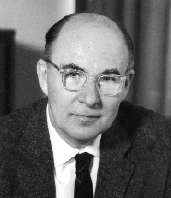
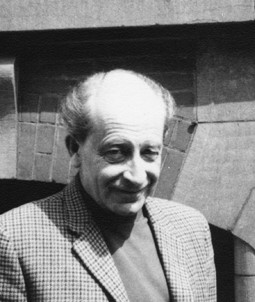
Herbert Plügge
Biography
by Simone Ghelli, translation by Gail McDowell
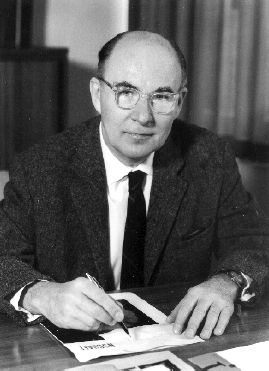
Source: Deutsche Medizinische Wochenschrift (2022)
The Life and Career of Dr. Med. Plügge (1906–1972)
Herbert Wilhelm Adolf Plügge was born on September 14, 1906 in Leipzig. He began his medical studies at the University of Leipzig, where he studied under Martin Gildemeister (1876-1943), an important exponent of German sensorial physiology, and Viktor von Weizsäcke (1886-1957), the founder of medical anthropology. In 1932, he received his PhD (Promotion) and in 1939, he became a professor of Internal Medicine and Neurology in Gießen.
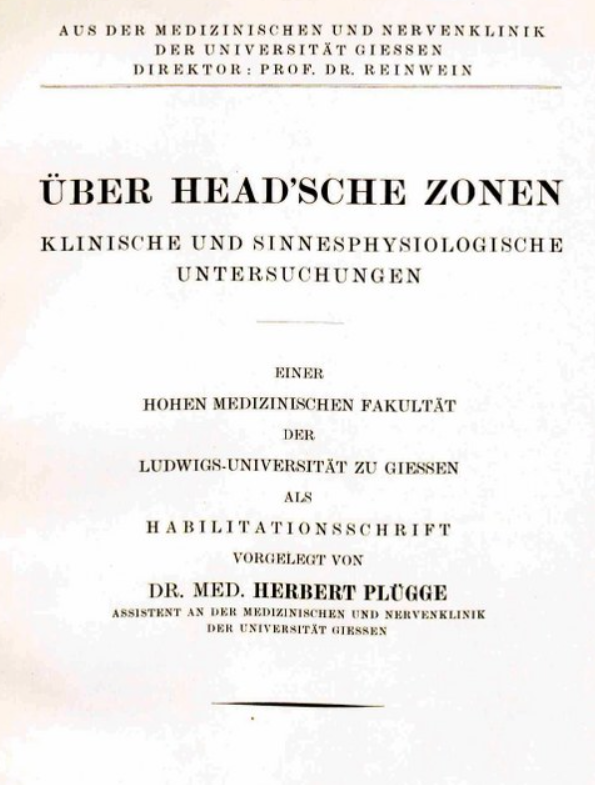
Title page of Plügge’s habilitation thesis (1938).
Source: Deutsche Friedensgesellschaft.
During World War II (1939–1942), Plügge worked in military hospitals (Lazarette). In 1941, he fought on the Eastern front near the Pripyat Marshes (on the border between Belarus and Ukraine), one of the most brutal theatres of action during the German invasion of the Soviet Union.
In 1943, he taught in Kiel and then moved to Darmstadt, where he became the director of the Medical Clinic of the Municipal Hospital Institutions.
During the years of the Nazi regime, Plügge, in part due to his managerial role, was obliged to join the NSDAP. The denazification (Entnazifizierung) files regarding him classify him as a Mitläufer (follower), that is, the fourth, in decreasing order of severity, of the five categories (Gruppen der Verantwortlichen) with which the “Law for the Liberation from National Socialism and Militarism” dated March 5, 1946 (Gesetz zur Befreiung von Nationalsozialismus und Militarismus) classified the degrees of responsibility – and their relative “measures of atonement” (Sühnemaßnahmen). According to Article 12, a Mitläufer is someone who did not participate in National Socialism more than nominally, or only supported it to a minor extent, and who did not prove to be a militarist [Mitläufer ist: wer nicht mehr als nominell am Nationalsozialismus teilgenommen oder ihn nur unwesentlich unterstützt und sich auch nicht als Militarist erwiesen hat].
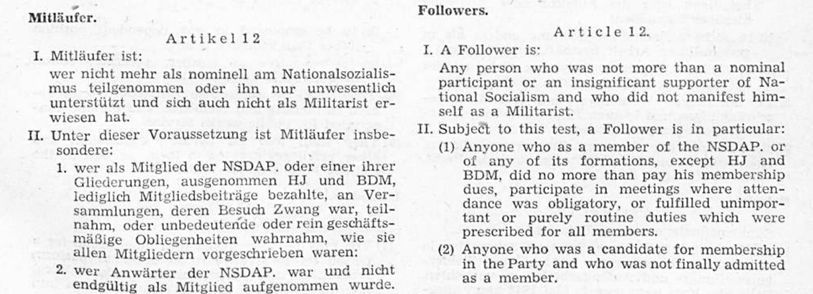
Source: Verkündungsplattform Bayern.
From 1952 until 1969, the year he retired, Plügge taught at the University of Heidelberg and was also in charge of the city’s general hospital. His lessons were generally very popular with the students. As Karlheinz Engelhardt, a doctor and professor in Kiel (the city where Plügge lived and taught during the summer of 1943), wrote:
His lessons in the lecture hall on Hospitalstraße, which were always crowded to the last seat, enthralled the students [...]. As a teacher, Plügge was not an orator in the sense of monologues. His style was dialogue, conversations with patients and students. Instead of curves, images, and diagrams, center stage was taken by the patient, his illness, and a differential diagnosis [...]. His teaching called to mind Socrates and his maieutic, the art of the midwife [...]. Through dialogue and questions, Plügge sparked thoughts and emotions in the students that were useful on a diagnostic and therapeutic level. Everyone was stimulated to think for themself, to fill the gaps through study. To be praised by him for an intuition was a motive to be proud. In an engaging manner, he taught differential diagnosis, which can be compared to the detective stories by the doctor Arthur Conan Doyle (1859–1930), who created Sherlock Holmes: the detective collects the key information to find the guilty person, whereas the internist, through a similar process, discovers the illness by synthesizing many small details, ailments, symptoms, and results into a coherent framework.
Plügge, who suffered from heart disease, died on August 16, 1972 at 66 years of age.
A Phenomenological Doctor
Strangely, we doctors are not interested in a theory of states of mind, which should naturally correspond to a theory of bodily experience, of how a person lives and senses their own body. This is due to the nature of contemporary medicine: we do not pay attention to the subjective state of our patients because, behind every state of mind, we immediately search for an objective diagnosis and concentrate solely on that. In other words: we consider the objective diagnosis to be “essential,” what truly counts, and we feel limited to that. Objective diagnosis is the presumed “truth.” We tend to believe that feelings can be misleading and that only diagnoses are dependable. Objective diagnoses represent our scientific foundation, whereas no determining importance is given to the subjective component; in fact, it could even be considered superfluous, in theory.
H. Plügge, Das Befinden. Zur Phänomenologie des Leib-Erlebens besonders bei inneren Krankheiten (1957)
Besides his activities as an internist and professor, Herbert Plügge also dedicated much time to clinical and theoretical research, making a name for himself as an important scientific figure well beyond the confines of medicine. His works reflect a wide-ranging intellectual curiosity that combine knowledge from various disciplinary fields such as literature, philosophy, anthropology, and psychology. In his studies, analyses of clinical cases are, in fact, enhanced by the perspectives offered by the existentialism of Sartre and Heidegger, the phenomenology of Husserl and Merleau-Ponty, or the philosophical anthropology of Plessner.
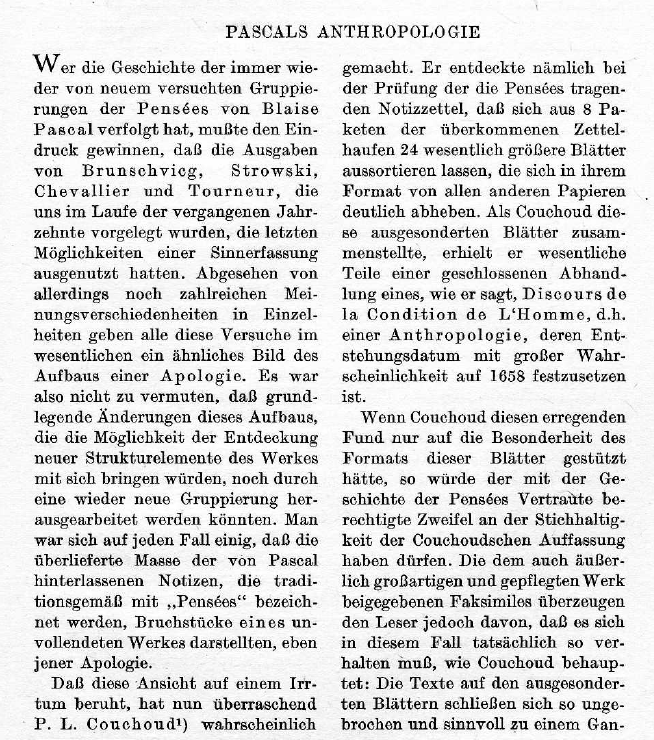
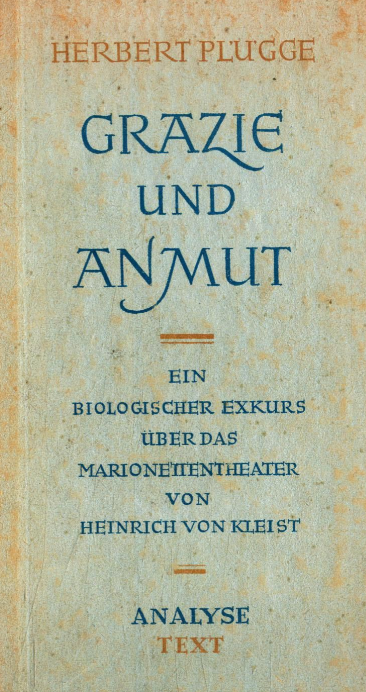
As proof of the versatility of Plügge’s interests, consider the 1947 monograph Grazie und Anmut. Ein biologischer Exkurs über das Marionettentheater von Heinrich v. Kleist [Grace and elegance. A biological excursus on the puppet theatre of Heinrich von Kleist] and the 1949 book Pascals Begriff des Ennui und seine Bedeutung für eine medizinische Anthropologie [Pascal’s concept of ennui and its significance for a medical anthropology].
His youthful fascination with Wiezsäcke’s medical anthropology steered his research toward defining a diagnostic approach that was more qualitative than quantitative. In other words, in Plügge, medical practice dovetails with a phenomenological analysis of the ailment as a bodily and mental experience that defines the patient’s being-in-the-world. Thus, anamnesis becomes fundamental and Plügge dedicated some of his most illuminating and pioneering research to this practice, leading to the successive development of what is known as medical humanities. As Plügge argues in the conclusion of the 1965 essay Über die Anamnese:
In this shared dialogue, everything the patient says about the nature of his relationship with the world explains the structure of his unique being. And everything he says about his condition, and the way he speaks of it, explains his relationship with the world; it explains what was and is possible or impossible, essential or superfluous, real or illusory, desired or non-essential in his relationships with people and things. It explains both the contingency and the freedom of his existence.
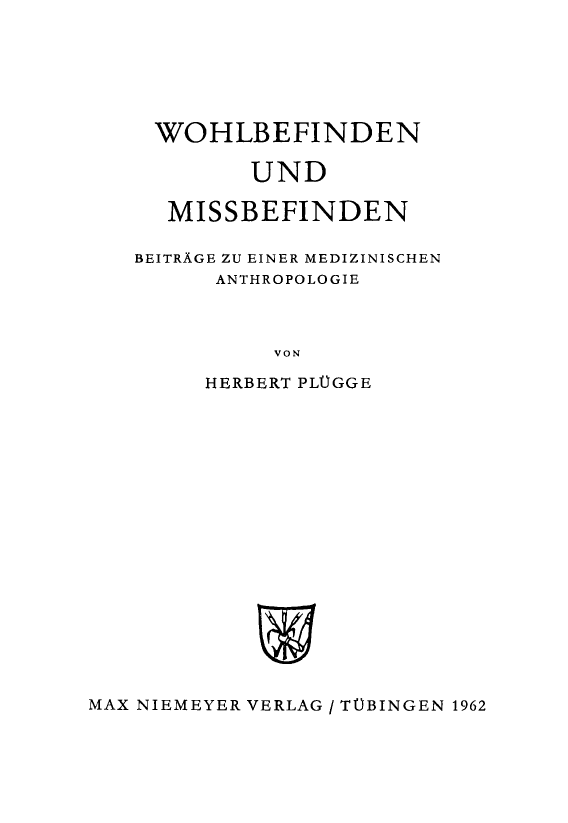
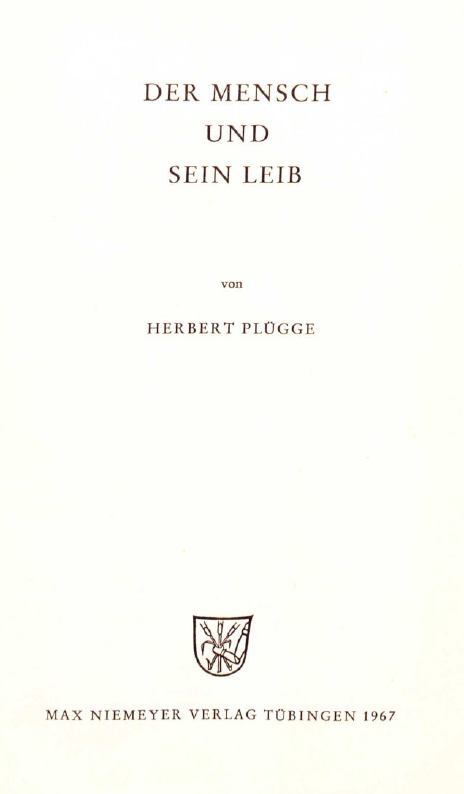
Herbert Plügge published his most important studies in the two volumes Wohlbefinden und Missbefinden. Beiträge zu einer medizinischen Anthropologie [Wellbeing and malaise. Contributions to medical anthropology] from 1962 and Der Mensch und sein Leib [Man and his body] from 1967.
In 1970, he published his final monograph: Vom Spielraum des Leibes. Klinisch-Phänomenologische Erwägungen über Körperschema und Phantomglied [The body’s margin of action; clinical-phenomenological considerations on body schema and phantom limbs].
Jean Améry, a Friend and Reader of Plügge
I immediately dove into reading – in fact, rereading – your essays (I was already familiar with some of them), and once again I thought, as I already had in the past, about how nobly they are written and how personally they touch me. I literally told my wife: for just one of these contributions, I would willingly give away all of Adorno’s Negative Dialectics which, as God is my witness, lies unused on my desk.
Così Jean Améry in una lettera a Herbert Plügge dell’11 febbraio 1967.
Jean Améry wrote this to HerbertPlügge in a letter dated February 11, 1967.
Améry and Plügge became correspondents and friends during the 1960s. The deep intellectual affinity that developed between the two of them significantly influenced their respective research.
The medical-phenomenological nature of Plügge’s clinical studies immediately sparked the interest of Améry, who became an enthusiastic reader of Wohlbefinden und Missbefinden (1962) and Der Mensch und sein Leib (1967). Améry admired Plügge’s ability to build a bridge between the medical and the humanistic sciences, using the instruments of phenomenological investigation to restore philosophical dignity to the condition of the patient, as a significant existential mode, endowed with its own distinctive mode of openness to Being.
I am sure I will read your book [Wohlbefinden und Missbefinden] many more times; in particular the passages in which you discuss aging, which I might ask your permission to quote in the future. I send you once again my most sincere congratulations for this book, which is already important in its own right, and I am convinced that it will bring you much recognition
Jean Améry to Herbert Plügge, February 11, 1967.
In 1968, Améry published Über das Altern. Revolte und Resignation, translated in Italy by Bollati Boringhieri in 1988 with the title Rivolta e rassegnazione. Sull'invecchiare [Revolution and resignation. On aging]. In the preface to the first edition, Améry acknowledged his intellectual debt to Plügge’s studies:
Even if I dispense with every allegedly scientific instrument and base my point of view entirely on myself and the uncertain ground of my questioning, it is still only too obvious that I have been subject to numerous influences. Readers can recognize them as easily as they can my quotations, occasionally structured into the text and as such not expressly indicated.
But there are three authors from whom I have learned much and whom I have to introduce explicitly since they are possibly not sufficiently well known: the Sorbonne professor Vladimir Jankelevitch, the German physician and phenomenologist Herbert Plügge, the French publicist Andre Gorz.
Über das Altern is one of the most important “philosophical recognitions” that Plügge received in his lifetime. The name of the «the German physician and phenomenologist». the author of «.incomparably thoughtful book» [Wohlbefinden und Missbefinden], is not out of place alongside those of famous existentialists such as Jankelevitc and Gorz.
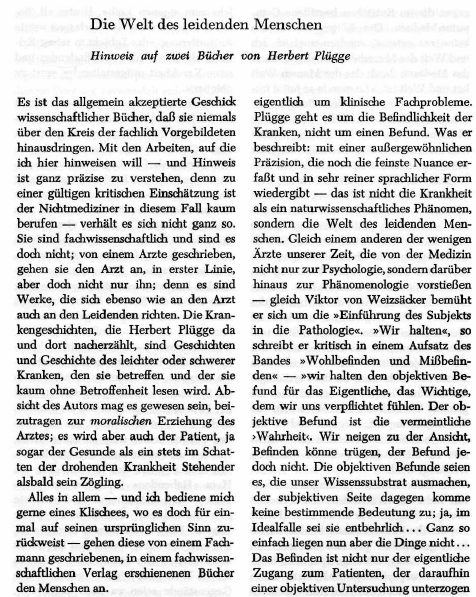
In March 1969, in the journal Merkur, Améry reviewed Plügge’s two books in an article entitled “Die Welt des leidenden Menschen” [The world of the suffering human being]. In his opinion, «As a whole, these books, written by a specialist and published by a scientific publishing house, regard Mankind».
References and bibliography
The information regarding the education and academic career of Herbert Plügge was taken from: K. Engelhardt, “Herbert Plügge – vergessenes ärztliches Vorbild. Eine Erinnerung in seinem 30. Todesjahr,” in Deutsche medizinische Wochenschrift, 6/2002, pp. 284-285; P. Christian, “In memoria. Nachruf auf Herbert Plügge,” in Nervenartz, 9/1973, pp. 502-503; the entry “Plügge, Herbert” from the online archive of the Deutsche Friedensgesellschaft - Vereinigte KriegsdienstgegnerInnen/Gruppe Darmstadt (https://dfg-vk-darmstadt.de/Lexikon_Auflage_2/PlueggeHerbert.htm?utm_source=chatgpt.com). Our thanks to Anne Phieler from the University of Heidelberg for having provided files on Herbert Plügge.
On the categories of denazification, see T. Speccher, La Germania sì che ha fatto i conti con il nazismo, Laterza, Rome–Bari, 2022, chap. I.5.
Quoted works by Herbert Plügge:
- Grazie und Anmut. Ein biologischer Exkurs über das Marionettentheater von Heinrich v. Kleist, Claassen & Goverts, Hamburg 1947.
- Wohlbefinden und Missbefinden. Beiträge zu einer medizinischen Anthropologie, Max Niemeyer Verlag, Tübingen 1962.
- Pascals Begriff des Ennui und seine Bedeutung für eine medizinische Anthropologie, pp. 1-16.
- "Das Befinden. Zur Phänomenologie des Leib-Erlebens besonders bei inneren Krankheiten", pp. 73-90.
- Der Mensch und sein Leib, Max Niemeyer Verlag, Tübingen 1967.
- Über die Anamnese, pp. 114-123.
Quoted works by Jean Améry:
- Die Welt des leidenden Menschen, in «Merkur», 251/1969, pp. 297-299. Il saggio è stato successivamente raccolto in J. Améry, Der integrale Humanismus. Zwischen Philosophie und Literatur: Aufsätze und Kritiken eines Lesers, 1966-1978, a cura di Helmut Heissenbüttel, Klett-Cotta, Stuttgart 1985, pp. 159-165
- On Aging. Revolt and Resignation, trans. J. D. Barlow, Indiana University Press, Bloomington and Indianapolis 1994.
The correspondence between Améry and Plügge is conserved at the Deutsches Literaturarchiv Marbach.