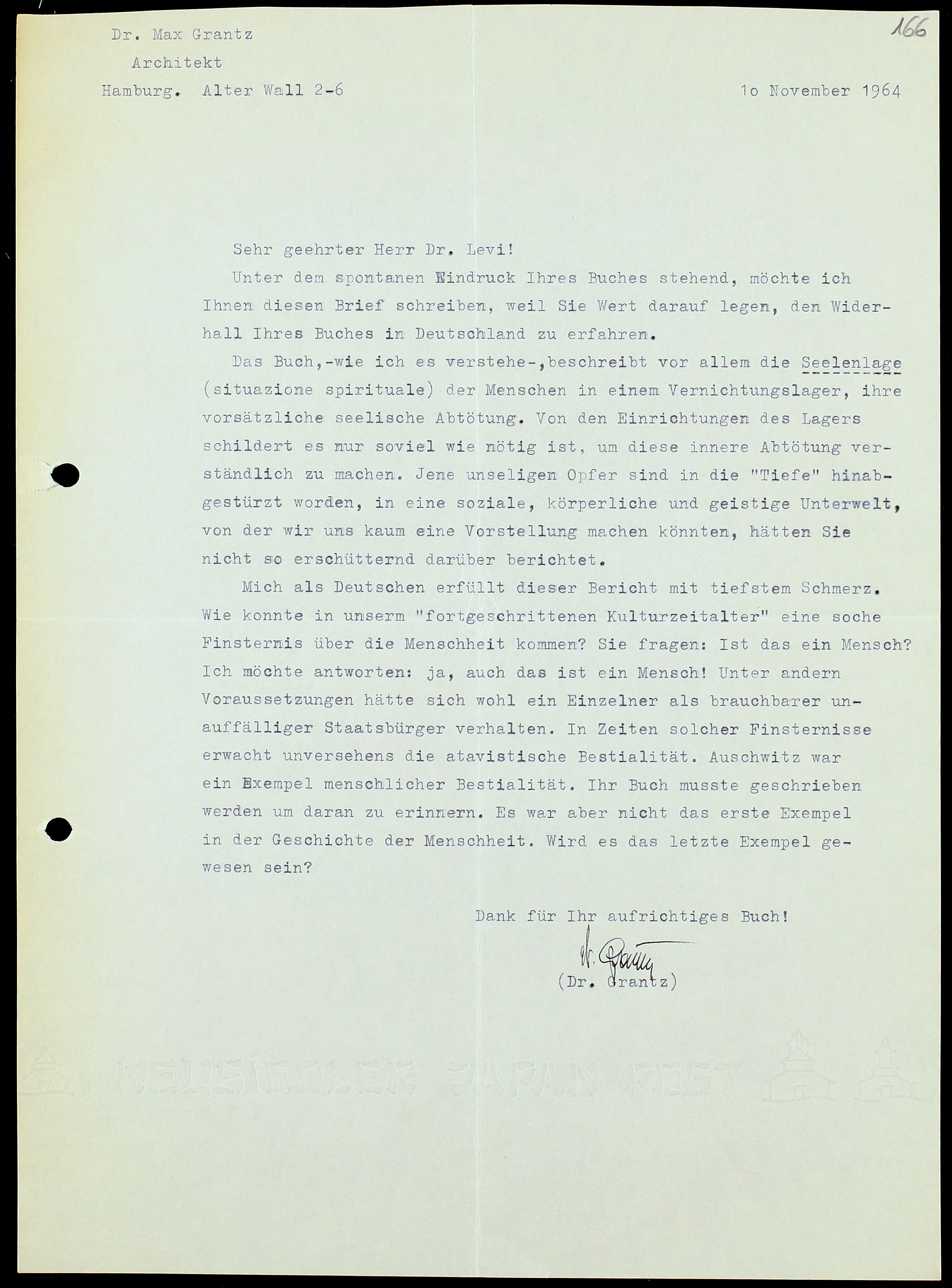
Max Grantz, an architect from Hamburg, writes his letter because he was moved by Levi’s comment about the importance of having resonance with the Germans, and thanks him for bearing witness.
Dr. Max Grantz
Architekt
Hamburg. Alter Wall 2-6
10 November 1964
Sehr geehrter Herr Dr. Levi!
Unter dem spontanen Eindruck Ihres Buches stehend, möchte ich Ihnen diesen Brief schreiben, weil Sie Wert darauf legen, den Widerhall Ihres Buches in Deutschland zu erfahren.
Das Buch,– wie ich es verstehe –, beschreibt vor allem die Seelenlage (situazione spirituale) der Menschen in einem Vernichtungslager, ihre vorsätzliche seelische Abtötung. Von den Einrichtungen des Lagers schildert es nur soviel wie nötig ist, um diese innere Abtötung verständlich zu machen. Jene unseligen Opfer sind in die „Tiefe“[1] hinabgestürzt worden, in eine soziale, körperliche und geistige Unterwelt, von der wir uns kaum eine Vorstellung machen könnten, hätten Sie nicht so erschütternd darüber berichtet.
Mich als Deutschen erfüllt dieser Bericht mit tiefstem Schmerz. Wie konnte in unserm „fortgeschrittenen Kulturzeitalter“ eine solche Finsternis über die Menschheit kommen? Sie fragen: Ist das ein Mensch? Ich möchte antworten: ja, auch das ist ein Mensch! Unter andern Voraussetzungen hätte sich wohl ein Einzelner als brauchbarer unauffälliger Staatsbürger verhalten. In Zeiten solcher Finsternisse erwacht unversehens die atavistische Bestialität. Auschwitz war ein Exempel menschlicher Bestialität. Ihr Buch musste geschrieben werden um daran zu erinnern. Es war aber nicht das erste Exempel in der Geschichte der Menschheit. Wird es das letzte Exempel gewesen sein?
Dank für Ihr aufrichtiges Buch!
M. Grantz
(Dr. Grantz)
Dr. Max Grantz
Architekt
Hamburg. Alter Wall 2-6
10 novembre 1964
Stimatissimo dottor Levi,
Le scrivo questa lettera sull’onda dell’impressione immediata che mi ha lasciato la lettura del Suo libro, visto che tiene a conoscere l’eco suscitata in Germania dalla Sua opera.
Il libro – per come lo comprendo io – descrive in primo luogo la situazione spirituale in cui versano le persone rinchiuse in un campo di sterminio: un annientamento spirituale deliberato. Delle strutture del campo Lei racconta solo quanto è necessario per rendere comprensibile questo annientamento umano. Quelle sventurate vittime sono state scagliate sul «fondo»,[1] in un inferno sociale, fisico e spirituale, di cui difficilmente potremmo avere un’idea se Lei non ne avesse dato una testimonianza tanto sconvolgente.
Una testimonianza che, in quanto tedesco, mi riempie del più profondo dolore. Com’è possibile che nella nostra “epoca di civiltà avanzata” sull’umanità si abbattano tenebre tanto pesanti? Se questo è un uomo, chiede Lei. Vorrei risponderLe: sì, anche questo è un uomo! In altre circostanze, forse, quell’individuo si sarebbe comportato come un bravo cittadino comune. Ma in epoche così buie la bestialità più atavica si risveglia di colpo. Auschwitz è stato un esempio di quella bestialità umana: il Suo libro doveva essere scritto per ricordarlo. Ma non è stato questo il primo esempio nella storia dell’umanità. Sarà forse l’ultimo?
Grazie per il Suo libro sincero!
(Dr. Grantz)
Dr. Max Grantz
Architect
Hamburg. Alter Wall 2-6
November 10, 1964
Dear Mr. Levi!
On the impetus of the impression your book has made on me, I am writing this letter because you expressed a desire to hear how your book resonates in Germany.
The book—as I understand it—primarily describes the spiritual state (situazione spirituale) of the people in an extermination camp, their deliberate spiritual mortification. It describes the camp facilities only to the extent necessary to make this inner numbing understandable. Those unfortunate victims were plunged into the “bottom,”[1] into a social, physical, and spiritual underworld we could hardly imagine had you not offered us such a devastating account of it.
As a German, this account fills me with deep pain. How could such darkness come over humanity in our “culturally advanced age”? You ask if this is a man. I would like to answer: yes, this too is a man! Under different circumstances, any such individual might well have behaved like a helpful, inconspicuous citizen. In times of such darkness, an atavistic brutality is unexpectedly awakened. Auschwitz was an example of human brutality. Your bookhad to be written to remind us of this. Yet it was not the first example in human history. Will it be the last?
Thank you for your candid book!
(Dr. Grantz)
Dr. Max Grantz
Architekt
Hamburg. Alter Wall 2-6
10 November 1964
Sehr geehrter Herr Dr. Levi!
Unter dem spontanen Eindruck Ihres Buches stehend, möchte ich Ihnen diesen Brief schreiben, weil Sie Wert darauf legen, den Widerhall Ihres Buches in Deutschland zu erfahren.
Das Buch,– wie ich es verstehe –, beschreibt vor allem die Seelenlage (situazione spirituale) der Menschen in einem Vernichtungslager, ihre vorsätzliche seelische Abtötung. Von den Einrichtungen des Lagers schildert es nur soviel wie nötig ist, um diese innere Abtötung verständlich zu machen. Jene unseligen Opfer sind in die „Tiefe“[1] hinabgestürzt worden, in eine soziale, körperliche und geistige Unterwelt, von der wir uns kaum eine Vorstellung machen könnten, hätten Sie nicht so erschütternd darüber berichtet.
Mich als Deutschen erfüllt dieser Bericht mit tiefstem Schmerz. Wie konnte in unserm „fortgeschrittenen Kulturzeitalter“ eine solche Finsternis über die Menschheit kommen? Sie fragen: Ist das ein Mensch? Ich möchte antworten: ja, auch das ist ein Mensch! Unter andern Voraussetzungen hätte sich wohl ein Einzelner als brauchbarer unauffälliger Staatsbürger verhalten. In Zeiten solcher Finsternisse erwacht unversehens die atavistische Bestialität. Auschwitz war ein Exempel menschlicher Bestialität. Ihr Buch musste geschrieben werden um daran zu erinnern. Es war aber nicht das erste Exempel in der Geschichte der Menschheit. Wird es das letzte Exempel gewesen sein?
Dank für Ihr aufrichtiges Buch!
M. Grantz
(Dr. Grantz)
Dr. Max Grantz
Architekt
Hamburg. Alter Wall 2-6
10 novembre 1964
Stimatissimo dottor Levi,
Le scrivo questa lettera sull’onda dell’impressione immediata che mi ha lasciato la lettura del Suo libro, visto che tiene a conoscere l’eco suscitata in Germania dalla Sua opera.
Il libro – per come lo comprendo io – descrive in primo luogo la situazione spirituale in cui versano le persone rinchiuse in un campo di sterminio: un annientamento spirituale deliberato. Delle strutture del campo Lei racconta solo quanto è necessario per rendere comprensibile questo annientamento umano. Quelle sventurate vittime sono state scagliate sul «fondo»,[1] in un inferno sociale, fisico e spirituale, di cui difficilmente potremmo avere un’idea se Lei non ne avesse dato una testimonianza tanto sconvolgente.
Una testimonianza che, in quanto tedesco, mi riempie del più profondo dolore. Com’è possibile che nella nostra “epoca di civiltà avanzata” sull’umanità si abbattano tenebre tanto pesanti? Se questo è un uomo, chiede Lei. Vorrei risponderLe: sì, anche questo è un uomo! In altre circostanze, forse, quell’individuo si sarebbe comportato come un bravo cittadino comune. Ma in epoche così buie la bestialità più atavica si risveglia di colpo. Auschwitz è stato un esempio di quella bestialità umana: il Suo libro doveva essere scritto per ricordarlo. Ma non è stato questo il primo esempio nella storia dell’umanità. Sarà forse l’ultimo?
Grazie per il Suo libro sincero!
(Dr. Grantz)
Dr. Max Grantz
Architect
Hamburg. Alter Wall 2-6
November 10, 1964
Dear Mr. Levi!
On the impetus of the impression your book has made on me, I am writing this letter because you expressed a desire to hear how your book resonates in Germany.
The book—as I understand it—primarily describes the spiritual state (situazione spirituale) of the people in an extermination camp, their deliberate spiritual mortification. It describes the camp facilities only to the extent necessary to make this inner numbing understandable. Those unfortunate victims were plunged into the “bottom,”[1] into a social, physical, and spiritual underworld we could hardly imagine had you not offered us such a devastating account of it.
As a German, this account fills me with deep pain. How could such darkness come over humanity in our “culturally advanced age”? You ask if this is a man. I would like to answer: yes, this too is a man! Under different circumstances, any such individual might well have behaved like a helpful, inconspicuous citizen. In times of such darkness, an atavistic brutality is unexpectedly awakened. Auschwitz was an example of human brutality. Your bookhad to be written to remind us of this. Yet it was not the first example in human history. Will it be the last?
Thank you for your candid book!
(Dr. Grantz)
Info
Notes
Tag
Sender: Max Grantz
Addressee: Primo Levi
Date of Drafting: 1964-11-10
Place of Writing: Hamburg
Description:typewritten letter on white paper with handwritten signature in black ballpoint pen.
Archive: Archivio privato di Primo Levi, Turin
Series: Complesso di fondi Primo Levi, Fondo Primo Levi, Corrispondenza, Corrispondenti particolari, Fasc. 20, sottofasc. 1, doc. 056, f.166.
Folio: 1, front only
DOI: https://doi.org/10.15160/636f-d994
1The reference is to the title of the second chapter of If This Is a Man, “On the Bottom,” in German “In der Tiefe.”